Field Guide
What Is a Vintage Levi’s Jacket Worth in 2026?
We paid $12,000 in cash for one. Most are worth far less, a few are worth more. Here is how the market actually prices them.
We buy from every state · free video appraisal · paid before you ship
By Sam Wingenbach and Jake Cover, the buyers behind our video appraisals and house calls · Updated September 30, 2026
Read the transcript
What's up guys? On my way. About to go see a sweet Type 1. Nice old, I think it's an early 50s one. A mother who's in her 90s and her daughter reached out to us. And got some cash here. So we're going to go check it out. See how it goes. Alrighty guys, just got it. The thing is tiny. They were beyond thrilled with my price I offered. I think I overpaid for sure. This thing would probably barely fit my 7 year old. But you know what? It's cool, man. It's still a Type 1. But I definitely think I overpaid. Pretty sweet. Check out, it still has the leather patch. Crazy. Most of the time after washing, or people just used to cut those things off back in the day. But got the Type 1. Yeah. Came out of the gate real strong, and the pleats are all busted on it and stuff. But you know what? We still love it. Still 40s Levi's. But I definitely think I overpaid. But they threw in a tie. Look at this old 50s horse tie. Isn't that cool? Gosh, I'll wear this thing to a wedding. Anyways, very cool. Add to the collection. Success, I guess we'd call that. Maybe. Because I paid a lot. All right, well, here she is. Just wanted to show you. Super cool. Looks like a shotgun shell went off accidentally while it was in the pocket. But that happens sometimes.
The short answer, from our July 2026 market read: a vintage Levi’s denim jacket is worth anywhere from about $50 to several thousand dollars, set mostly by which of three types it is. Type 1 (one chest pocket, cinch back, 1905 to 1952) typically brings $2,000 to $8,000 worn and far more exceptional. Type 2 (two pockets, side waist tabs, 1953 to 1962) typically brings $800 to $1,500. Type 3 truckers with a big E tab run $150 to $2,000 and beyond, and small e Type 3s usually $50 to $300. Condition, size, and originality move every number. California Vintage Buyers buys old Levi’s jackets from every state: call or text (949) 449-1255, with photos of the front and the red tab, for a free same-day read.
Vintage Levi’s jackets are among the most misunderstood objects in American closets. To most people, an old denim jacket is an old denim jacket. To collectors, the right one is a serious asset: we recently paid $12,000, on the spot, for a 1940s Type 1. The seller was a former dealer who knew exactly what he had, and he chose to sell it to us. This guide explains how the market really prices these jackets, so you know what you are holding before anyone makes you an offer.
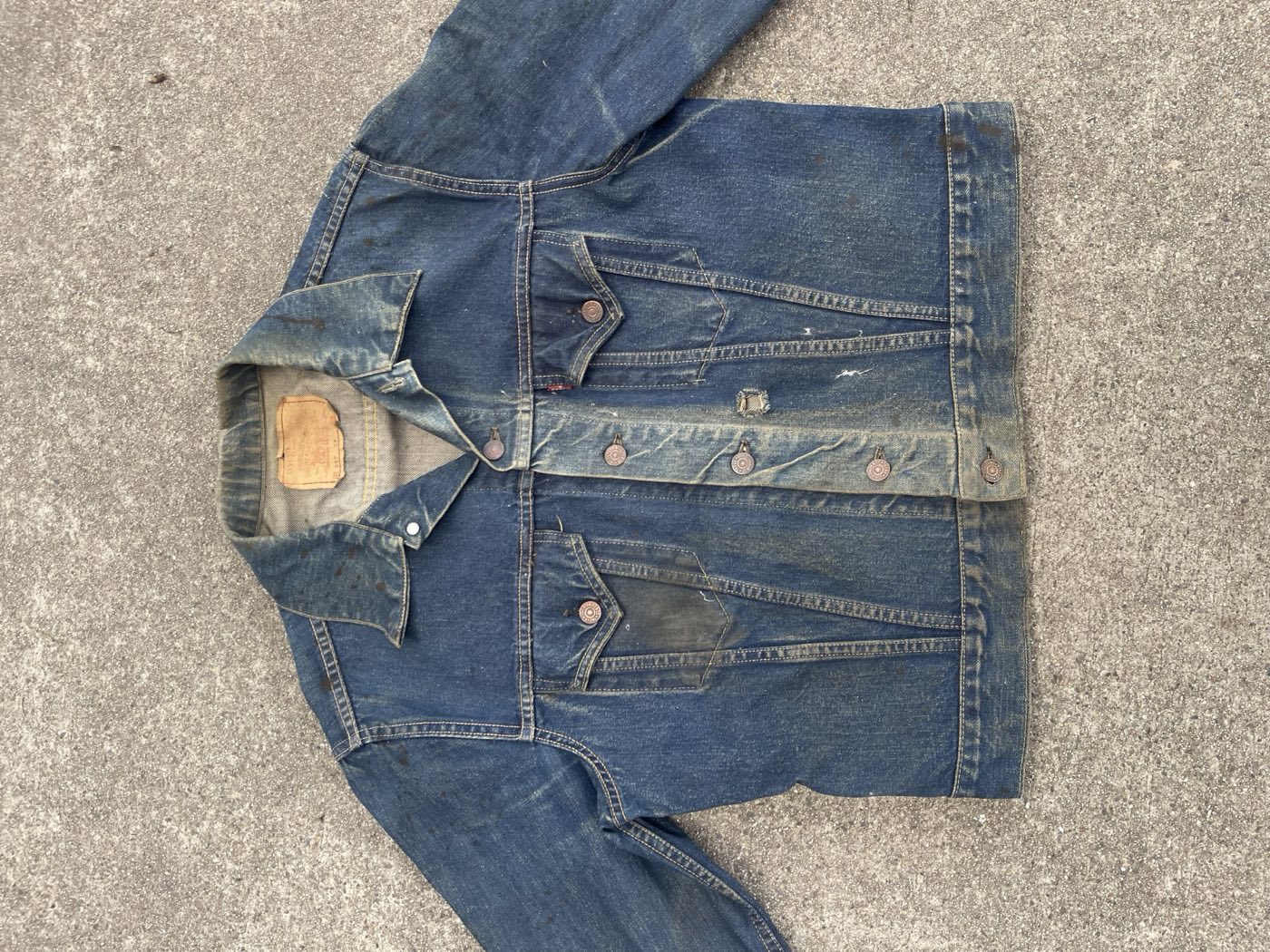
Vintage Levi’s jacket value guide: the three checks, in order
Every number on this page follows from three checks that take under a minute. First, count the chest pockets and look at the back: one pocket with a cinch is a Type 1, two pockets with side waist tabs a Type 2, two pointed-flap pockets with no side tabs a Type 3. Second, read the red tab on the left chest pocket: LEVI’S in capitals means before 1971, a lowercase e means 1971 or later. Third, open the jacket: no care label means an original from before 1971, while a sewn-in care label on a jacket that otherwise looks early usually means a Levi’s Vintage Clothing reproduction, which the reproduction guide covers. Type sets the bracket, the tab and the label confirm the era, and condition and size place the jacket inside the bracket.
What are the three types of Levi’s jacket, and what is each one worth?
Levi’s denim jackets fall into three families, named by collectors after their design eras. Identifying which one you have is the single biggest step in valuing it, and it takes about ten seconds: count the chest pockets, then look at the back. One pocket with a cinch strap is a Type 1, two pockets with side tabs at the waist is a Type 2, and two pointed-flap pockets with no side tabs is a Type 3 trucker. The jacket types guide walks each one with photographs of jackets we bought, including how to tell an original from a Levi’s Vintage Clothing reproduction of the same lot number.
| Type | Years | How to spot it | Typical range, read July 2026 |
|---|---|---|---|
| Type 1 (506XX) | 1905 to 1952 | One chest pocket, back cinch buckle, front pleats | $2,000 to $8,000 worn; exceptional pieces far above |
| Type 2 (507XX) | 1953 to 1962 | Two chest pockets, no cinch, side waist tabs | $800 to $1,500; top observed listing $4,800 |
| Type 3 (557XX), big E | 1962 to 1971 | Pointed flaps, V-stitch, capital E on the tab | $150 to $2,000 and beyond |
| Type 3, small e | 1971 onward | Same silhouette, lowercase e on the tab | $50 to $300 |
What is a Type 1 Levi’s jacket worth?
One chest pocket, a cinch buckle on the back, and pleats running down the front. The earliest examples have a single-sided red tab or no tab at all. Honest examples in worn condition typically bring $2,000 to $8,000 (our July 2026 read); exceptional early pieces, big-E tabs, strong condition, or wartime details can run $10,000 to $30,000 and beyond. Even damaged Type 1s are worth real money. In plain words, the jacket a family finds looks like this: one pocket on the chest, pleats running down the front, and a small buckle strap across the lower back. On the biggest sizes there is one more tell, a line of stitching down the middle of the back that forms a T. The narrow selvedge denim of the day was not wide enough to cut a large back in one piece, so Levi’s sewed it from two. Collectors call these T-backs, or split backs; the T marks a big size, not an older year, and big sizes carry a real premium. For scale at the ceiling of this market: a WWII-era S506XXE Type 1, a big-size split back in museum-grade deadstock, holds the Guinness record for the most valuable pair of Levi’s garments at £260,590, roughly $346,000. That is an outlier and nobody should price a family jacket against it, but it explains why collectors chase the one-pocket jackets the way they do.
What is a Type 2 Levi’s jacket worth?
Two chest pockets, no cinch, side tabs at the waist. The jacket of the fifties, worn by everyone from ranch hands to rock and roll. Typical range, read July 2026: $800 to $1,500, with the strongest example we have observed listed at $4,800. The Type 2 is where most surprised families land: a jacket grandpa wore to work that turns out to be worth a used car.
What is a Type 3 trucker jacket worth?
The pointed-flap, V-stitch trucker silhouette everyone pictures. Value divides sharply at 1971, when the red tab changed from a capital E (big E) to a lowercase e. As of our July 2026 read, big E Type 3s span a wide band, $150 to $2,000 and beyond, depending on condition, size, and the particular year. Post-1971 jackets are usually $50 to $300, though certain details still surprise.
Is a 1980s or 1990s trucker jacket worth anything?
This is the jacket most families actually find, so it deserves a straight answer rather than a shrug. A post-1971 small e trucker is usually a $50 to $300 garment (July 2026 read), and the honest middle of that band is nearer the bottom than the top. It is not a collector object; it is a good jacket that somebody wants to wear.
Inside that range, a handful of things decide where a small e lands. A Made in USA label rather than an overseas one. A size at either extreme, because the very large and the very small are the sizes resellers cannot keep in stock. A blanket-lined or corduroy-collar version rather than the plain shell. Deep, even fading that took a decade of real wear to earn, which is the one thing a factory cannot fake convincingly. And original condition, meaning no cropped hem, no removed collar, no added patches. A small e with three of those is a genuinely wanted jacket. A washed-out plain one from a late-1990s mall rack is not, and we will tell you so.
The check that decides everything else: capital E or lowercase e on the red tab. Capital E means the jacket was made before 1971 and belongs in the collector conversation. Lowercase e means 1971 or later, which is where nearly every jacket in a closet sits, and the honest ceiling drops accordingly. The date codes guide reads the numbers printed on a post-1971 care tag if you want the actual year.
What makes one vintage Levi’s jacket worth more than another?
- Big E red tab: a capital E means pre-1971 production, and the market pays for it.
- Single-sided tab: printing on one side only suggests the earliest tab era.
- Buttons and rivets: early laurel-wreath buttons and hidden construction details date a jacket precisely.
- Size: large sizes (44 and up) are scarce in early jackets and command real premiums. Collectors are bigger than ranch hands were.
- Original condition: unwashed, unrepaired, unaltered. Honest wear is fine; amateur repairs are not.
- Provenance: the story, photos of the original owner wearing it, even a name written inside. Collectors pay for history they can document.
What should I not do to an old denim jacket before selling it?
- Washing it. Collectors prize original, unwashed condition. One wash can cost hundreds of dollars.
- Repairing it. A skilled period repair is one thing; iron-on patches and machine darning are another. Leave damage alone.
- Cutting or altering. Shortened sleeves and removed cinches are permanent value loss.
- Selling by brand alone. A 1980s jacket and a 1950s jacket are both Levi’s. They differ in value by a hundred times.
- Trading an old jacket in at Levi’s SecondHand before it has been read. Checked against Levi’s published trade-in values in September 2026, a Trucker Jacket made more than twenty years ago earns up to $30, paid as a gift card for Levi’s merchandise rather than cash, whatever the jacket turns out to be. The counter does not read the pleats, the side tabs, or the tab. The same $30 ceiling covers a 1950s Type 2 that typically sells into the collector market for $800 to $1,500 (July 2026 read), and the trade cannot be undone. Terms change, so check them, but check the jacket first.
The honest rule: do nothing to the jacket. Do not wash it, do not repair it, do not press it. Put it in a clean bag exactly as it is and get knowledgeable eyes on it.
Why do two Levi’s jackets that look alike sell for such different money?
Two jackets of the same type can differ by thousands of dollars based on details invisible to most owners: tab printing, button stamps, stitch counts, denim weight, and the particular year’s construction quirks. The collector market, especially in Japan, prices these distinctions precisely. This is why quick offers from generalist buyers run low: they price the risk of what they cannot identify. That is the gap California Vintage Buyers exists to close: we handle vintage Levi’s every week, buy them from every state, and pay for what the jacket actually is.
How do I find out what my Levi’s jacket is worth?
Photograph the front, the back, the tab, the buttons, and any labels, in daylight. Then call or text California Vintage Buyers at (949) 449-1255 for a free read, usually the same day. We handle vintage denim every week and buy Levi’s jackets from every state: we look at the jacket together on a free video appraisal, agree the price on the call, and send payment through PayPal before you ship, with shipping on us. In Southern California we come to you instead and pay cash on the spot. We explain what we see as we see it, and the honest answer sometimes is that your jacket is a fifty dollar jacket. When it is a five thousand dollar jacket, you will know exactly why.
Do I need a buyer in my own state?
No. Many of the families who call us about an old Levi’s jacket live outside California, and a jacket sells well from a distance: it photographs clearly, it reads on a video call, and it ships in one box. The order is what keeps it safe. California Vintage Buyers agrees the price with you on the call and pays through PayPal before you pack anything, and the shipping label is on us, so you never mail a jacket on a promise. A local vintage shop is a reasonable place for a 1990s trucker. Before a one-pocket, pleated, or capital E jacket goes to anyone, call or text (949) 449-1255 and get the free read first.
Common questions
- How can I tell which type of Levi’s jacket I have?
- Count the chest pockets and look at the back. One chest pocket with a cinch buckle is a Type 1 (1905 to 1952), two pockets with side tabs at the waist is a Type 2 (1953 to 1962), and two pockets with no side tabs is a Type 3, the modern trucker. The type sets the value range before anything else.
- Is a damaged vintage Levi’s jacket still worth anything?
- Yes, especially for Type 1 and early Type 2 jackets. Rarity does most of the work on pre-1955 denim, so holes, stains, and honest repairs are priced in rather than disqualifying. A torn Type 1 is still a serious piece.
- Should I wash or repair an old denim jacket before selling?
- No. Washing flattens the fades collectors pay for, and home repairs read as damage on top of damage. Leave the jacket exactly as it is and let a buyer see the original condition.
- Is a 1980s or 1990s Levi’s trucker jacket worth anything?
- Usually $50 to $300 as of our July 2026 read, and honestly nearer the bottom of that band than the top. A lowercase e on the red tab means 1971 or later, which puts the jacket outside the collector market. What lifts one inside its range is a Made in USA label, a very large or very small size, a blanket-lined or corduroy-collar version, deep even fading earned by real wear, and no cropped hem or removed collar.
- What does Levi’s pay for an old denim jacket at trade-in?
- Checked against Levi’s published trade-in values in September 2026, a Trucker Jacket made more than twenty years ago earns up to $30, paid as a Levi’s gift card rather than cash. The counter does not read the pleats, the side tabs, or the tab, so the same $30 ceiling covers a 1950s Type 2 that typically sells into the collector market for $800 to $1,500 (July 2026 read). Have the jacket read before you trade it, because the trade cannot be undone.
- What is the most valuable Levi’s jacket?
- A 1940s Type 1 in strong condition. We paid $12,000 in cash, the same day, for one from a former dealer who knew exactly what he had. Most jackets are worth far less, but the right early Type 1 is a genuine asset.
- My old jean jacket has one pocket on the chest, pleats down the front, and a buckle on the back. What is it?
- If the buttons or the red tab say Levi’s, it is a Type 1, lot 506XX, made from 1905 to 1952 and the most valuable Levi’s jacket there is. Honest worn examples typically bring $2,000 to $8,000 as of our July 2026 read, and exceptional ones far more. Levi’s Vintage Clothing reproductions copy the look but carry a care tag sewn inside, which an original does not, so check the inside before anything else. Do not wash or repair it. Call or text photos of the front, the back, the red tab and the buttons to California Vintage Buyers at (949) 449-1255 for a free read the same day; we buy Type 1s from every state and pay before you ship.
- Why does my big old Levi’s jacket have a T-shaped seam on the back?
- Because it is a big size. On large Type 1 jackets the narrow selvedge denim of the day was not wide enough to cut the back in one piece, so Levi’s sewed it from two, leaving a line of stitching down the middle that forms a T. Collectors call these T-backs, or split backs. The seam marks a large size, not an older year, and large sizes carry a real premium: the record Levi’s jacket, a WWII-era Type 1 that set a Guinness record at roughly $346,000 in 2026, is a split back. Call or text photos to California Vintage Buyers at (949) 449-1255 for a free read from any state.
- Who should I call to sell an old Levi’s jacket if I do not live in California?
- California Vintage Buyers, at (949) 449-1255, by call or text. We buy old Levi’s jackets from every state: a free video appraisal, the price agreed on the call, and payment through PayPal before you ship, with shipping on us. You do not need a vintage shop in your own town, and for a Type 1 or Type 2 it pays to get our free read before any shop quotes you. In Southern California we come to you and pay cash.
Have something like this?
One phone call, from any state. A free video appraisal, the price agreed on the call, and payment through PayPal before you ship, with shipping on us. In Southern California we come to you and pay cash the same day.
Keep reading
- Levi's Denim Jacket Types: How to Tell a Type 1, Type 2, and Type 3 Apart→
- Where to Sell Vintage Levi’s From Anywhere in the US (2026)→
- How to Photograph Vintage Levi’s for an Accurate Offer→
- Sell vintage Levi’s to people who know what they’re holding.→
- Levi’s Date Codes: How to Read the Care Tag, Button Stamps, and Lot Numbers→
- Sell vintage clothing in Orange County.→
- That box of concert tees might be the best thing in the closet.→