Field Guide
How to Tell If Your Levi’s Are Vintage
Five checks, five minutes, no expertise required. Any one of these is reason to stop and get a real evaluation.
We buy from every state · free video appraisal · paid before you ship
By Sam Wingenbach and Jake Cover, the buyers behind our video appraisals and house calls · Updated September 6, 2026
Read the transcript
Hi guys, Sam from California Vintage Buyers here, and today we're going to talk a little bit about Levi's. Very simple information. How do you know if your Levi's are vintage or not? Well, they made them in the USA up till about 2003. So one tell to look for, if they're USA or not, would be, see on the tag right there, Made in USA, right above the waist size. That's what you want to look for. That's there from the 90s and 80s. Now, sometimes you're going to find a pair that looks like that. You can't read anything, but just by looking at that paper patch, you can tell them puppies are not from Costco in 2016. Those are pretty old, you know what I'm saying? And then you have stuff like this, where it looks like it might be vintage, but it doesn't say Made in USA. That's because it's not. It's made in Guatemala. You can tell right there. Why do I point all this out? Well, because there's a slight value variation in USA denim versus non-USA denim. We still buy it all, but I just want to give a little bit of a tutorial of the first place to look to know if your pants are made in USA. If they're USA Levi's, it would be this back tag. After that, inside here, left pocket, you'll find another tag in there for the 90s ones. Look in there as well if this patch is missing out here. So, that's it. USA Levi's.
Most valuable Levi’s are found before anyone goes looking for them: a dad’s old work jeans in the garage, a box marked old clothes in an Orange County closet clear-out, a storage unit or an estate closet nobody had opened in years. If that is roughly how you got here, jeans in one hand and a phone in the other, you are in the right place. The find happens because somebody knew one or two quick checks. Here are the five that matter, in the order to try them. None requires expertise; all of them have stopped a valuable garment inches from the donation bag.
| Check | What you are looking for | What it means |
|---|---|---|
| Red tab | LEVI'S in capital letters, the big E | Pre-1971, collector value almost regardless of condition |
| Selvedge line | Clean finished outseam edge with colored thread | Narrow shuttle loom denim, phased out in the early 1980s |
| Back cinch | Strap and metal buckle across the back waistband | Before 1942, when wartime rules removed it |
| Single stitch | One line of stitching at the pocket edges | Earlier construction than the later double stitch |
| Care tag | No care label anywhere inside | Before 1971, when care labeling became federal law |
Prefer to be walked through it? Our free sixty second identification assistant asks five questions about the tab, the cinch, the arcuate, the care tag, and the cuff, and hands you the probable era with an honest range.
Check 1: what does the big E on the red tab mean?
Look at the small red tab on the back pocket of jeans or the chest pocket of a jacket. If LEVI’S is stitched in capital letters (the big E), the garment predates 1971 and has collector value almost regardless of condition. A lowercase e means 1971 or later, which is not a dead end, but the big E is the single fastest valuable-or-not signal in vintage denim.
Tab missing entirely? On very early garments there was no tab at all. Absence plus other old details can mean very old rather than worthless. For one-sided versus two-sided tabs, orange tab capitals, and the modern capital E cases, see the big E guide.
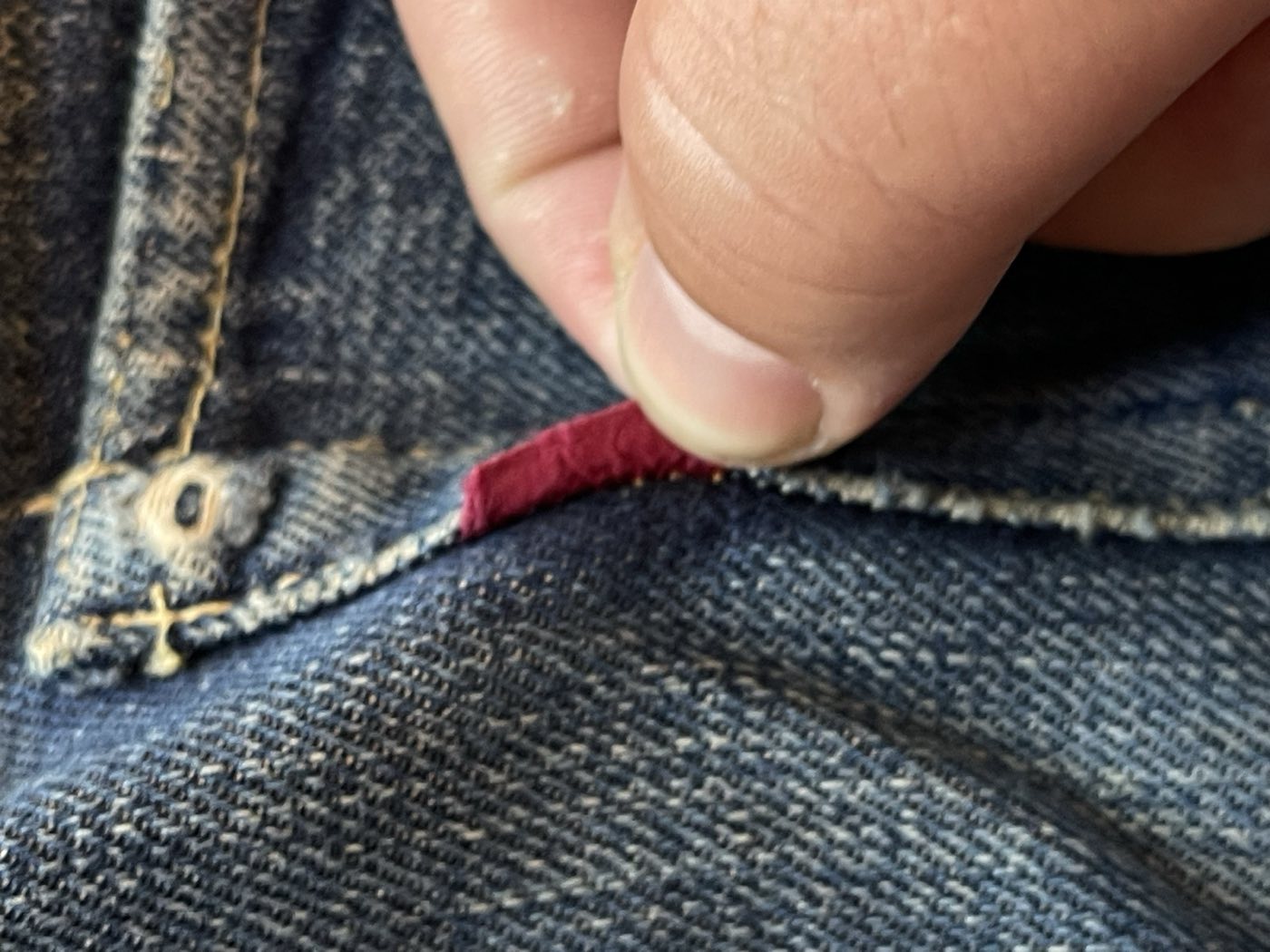
Check 2: how do I know if my jeans are selvedge?
Cuff the jeans and look at the outseam’s inside edge. A clean, finished edge with a colored thread line (usually red) is selvedge denim, woven on narrow shuttle looms that Levi’s phased out in the early 1980s. Selvedge alone signals pre-1983 production for 501s, and collectors care. A fuzzy overlocked edge means modern wide-loom denim.
Check 3: is there a buckle on the back, or hidden rivets in the pockets?
- Buckle-back: a cinch strap on the back waistband means pre-1942. Serious money, condition almost irrelevant. The buckle-back guide covers store brands and reproductions.
- Hidden rivets: feel inside the back pockets. Bumps under the fabric (rivets concealed by cloth) date jeans to 1937-1966.
- Single needle work: examine the stitching rows. Construction details shift by decade, and the differences are documented to the year.
Check 4: what does the patch say, and is it leather?
The waistband patch tells its own story. Leather patches predate 1955 or so; the jacquard cardboard-feel patch came later. A leather patch on jeans, even a dried or partial one, points to the valuable decades. Lot numbers printed on the patch (501XX, for instance) help date precisely: the XX suffix is an early marker.
Check 5: is there a care tag, or none at all?
Care tags became standard in the early 1970s. No care tag inside the waistband or side seam suggests pre-1971 manufacture. A care tag does not end the conversation (1970s and 1980s Levi’s have their own market now), but its absence, combined with any check above, is a strong old signal. If there IS a care tag, it is not a dead end either: the small digits printed at the bottom of it carry a production month, a year digit, and a factory number, which is a second dating method in its own right.
Which vintage Levi's are valuable? What each signal is worth
Identification is only half the question. This is roughly where each signal lands in the market, in the ranges we actually see and pay. Treat them as brackets rather than quotes: size, condition, and how complete the pair is move a garment several hundred dollars inside its own row.
| What you found | Era it points to | Typical range |
|---|---|---|
| Small e tab, care tag, Made in USA | 1980s to 1990s | $40 to $150 |
| Small e tab with redline selvedge | 1971 to mid 1980s | $200 to $1,000 |
| Big E tab | Before 1971 | $500 to $10,000 and up |
| Hidden rivets under the back pockets | 1937 to 1966 | Sits in the big E bracket, at the higher end |
| Back cinch and buckle | Before 1942 | Top of the market, read in person rather than priced from a chart |
For scale at the very top of this market: a mine-found 1880s pair brought $87,400 at auction, and we paid $12,000 in cash for a 1940s Type 1 jacket. Those are the outliers that make the checks worth doing, not what an ordinary old pair brings.
The three misreadings that cost sellers money
- Redline selvedge is not the same as big E. Redline ran into the mid-1980s, well past the 1971 tab change, so a redline pair is not automatically pre-1971. Plenty of small e redline pairs are genuinely good, and their market is roughly $200 to $1,000, but they get listed as big E constantly and the correction is not a friendly one.
- A buckle-back does not mean the 1800s. It means before about 1942, when the War Production Board removed the cinch, the crotch rivet, and the suspender buttons. That is still the top of the market, so the claim costs nothing to make and everything in credibility to defend.
- A 555 stamp on the back of the top button does not by itself make a pair old. It marks the Valencia Street plant in San Francisco, which ran until Levi’s closed its last US factories, and which also produced modern Levi’s Vintage Clothing reproductions. Read it alongside the tab and the care tag, never alone.
The three mistakes that cannot be undone
Misreadings cost credibility. These three cost the garment itself, and no later conversation gets it back.
- Washing or repairing the pair before it has been read. Collectors pay for original condition, and one trip through the machine or one iron-on patch is permanent. Do nothing to the garment until knowledgeable eyes have seen it.
- Trading a big E pair in at Levi’s SecondHand. As of September 2026 the program’s published terms pay up to $30 for jeans or a Trucker Jacket made more than twenty years ago, as a gift card rather than cash, whatever the pair actually is, and the trade cannot be undone. Fine for the ordinary, a disaster for the old.
- Selling a good pair inside a bulk bundle. A big E pair sold by the pound in a box of ordinary denim earns bundle money, and once the box is gone, so is the pair. Pull anything that passes a check above out of the pile and have it read on its own.
A worked example: four photos, one honest answer
Early in August 2026, a man texted us four photos of a rough pair of jeans and one honest question: are these worth anything at all? He thought they might be late 1940s. He was close. The photos in this section are the ones he sent, shared here with his permission, and they are worth studying because they show the checks above working on a real, dirty, damaged pair instead of a museum example.
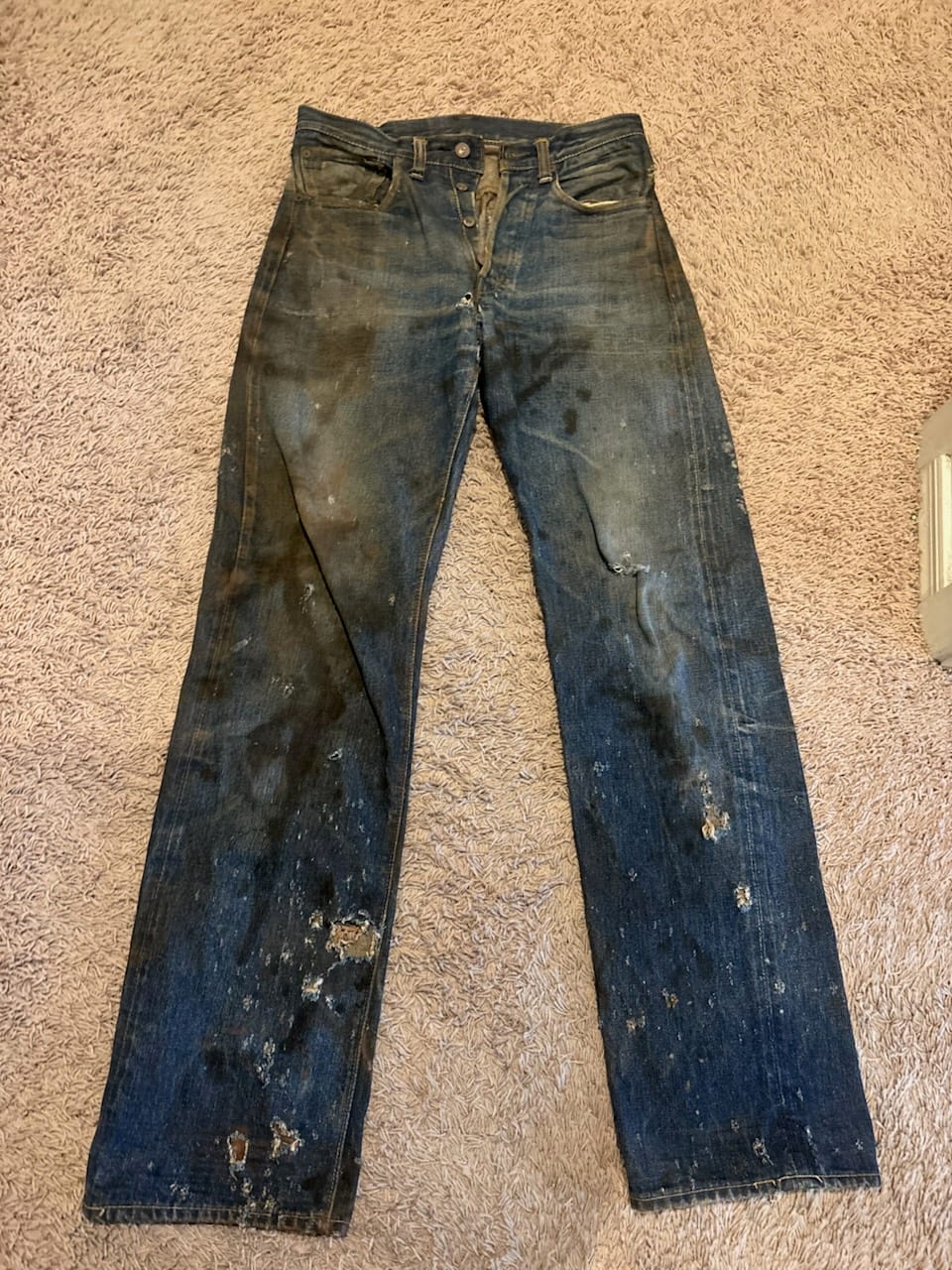
Condition this rough scares most owners into assuming zero. Era comes first, though, and the era markers here are strong: a button fly, the remains of a leather patch dried nearly black at the waistband, and the check that settles things fastest, the red tab.
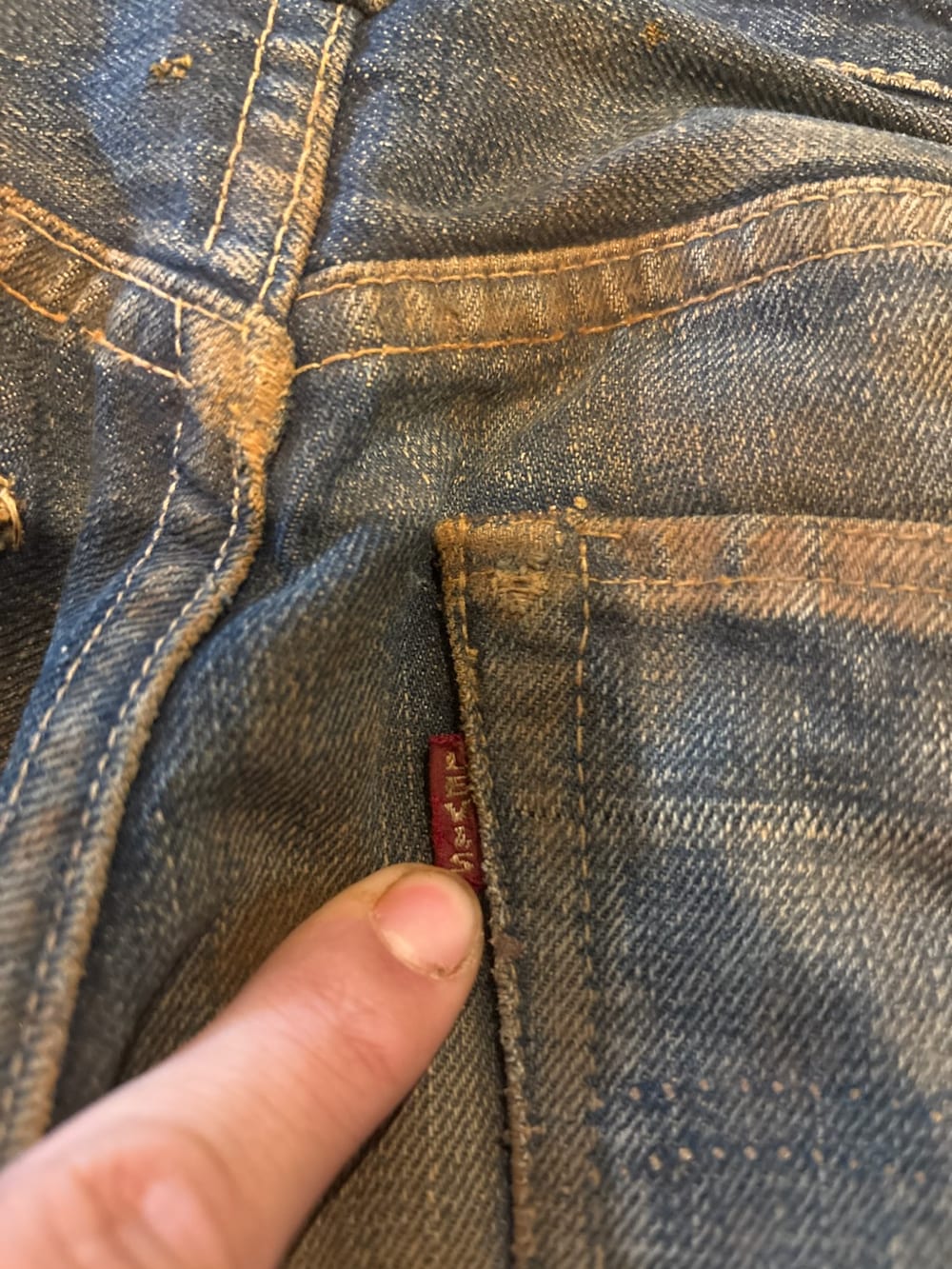
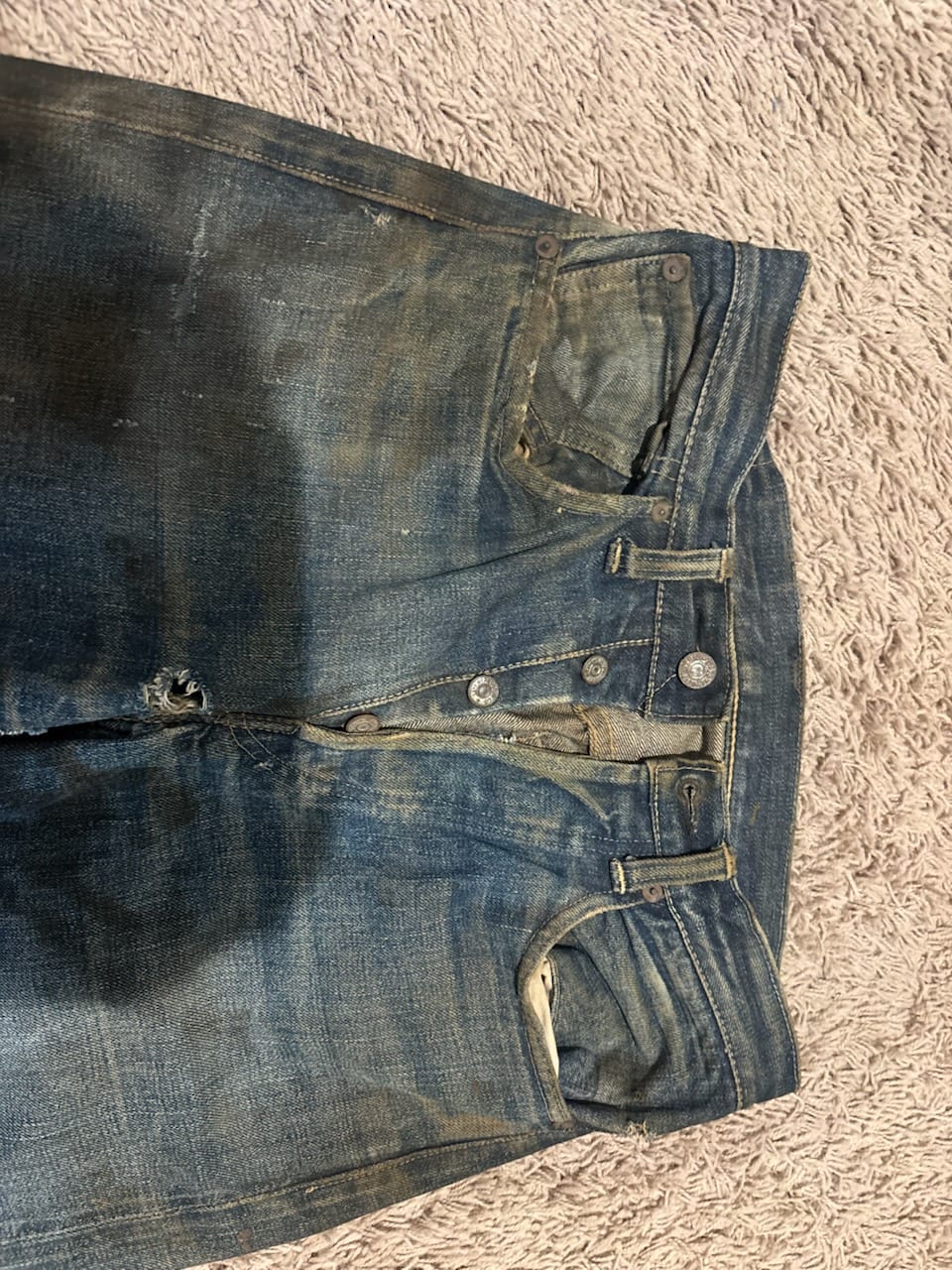
Our read from these four photos: late 1940s to early 1950s, small, and in genuinely poor condition. We told him exactly that and made a cash offer with every hole priced in. Real money, in other words, but not life-changing money. Size is the market's honest ceiling here: collectors are mostly grown men, and a 29 inch waist thins the bidding no matter the decade.
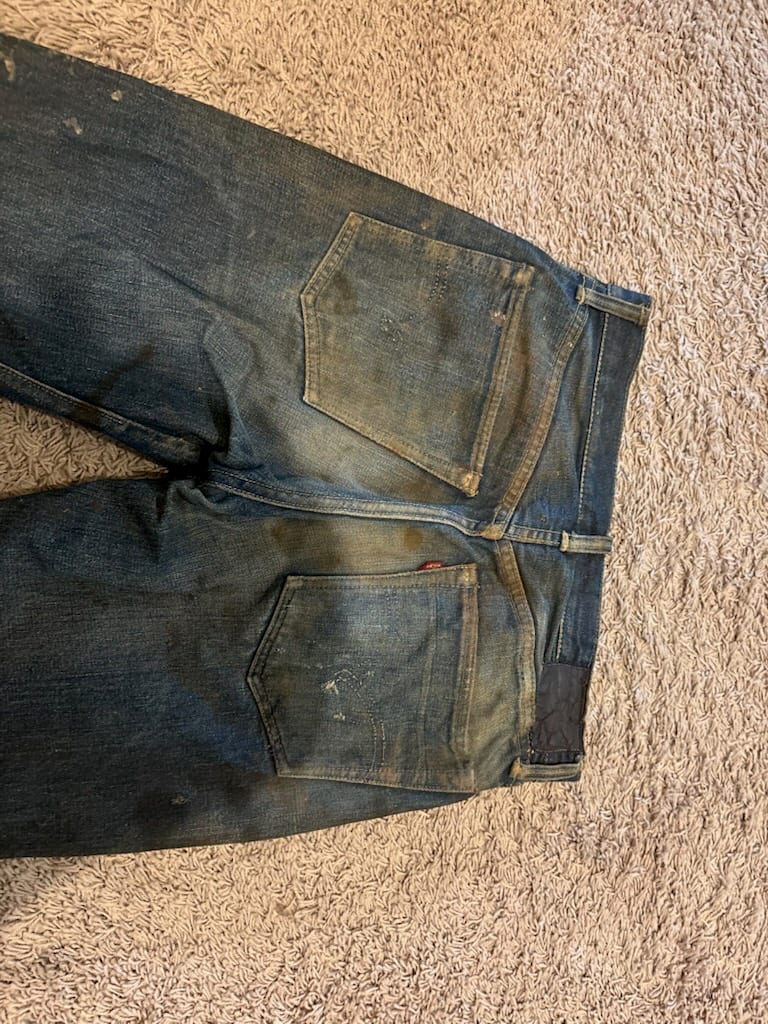
He thought it over and answered in one line: “I think I am going to keep them because it’s such a cool find.” We told him to enjoy them, and we meant it. An owner who keeps a piece because he finally knows what he has is a good outcome for this guide. He also mentioned knowing where more 1940s denim is waiting, inside an old mine he means to get back into. We told him to let us know when it is out of the ground. If you are holding your own cool find, text us photos and we will read them the same way, whether or not you ever sell.
What the checks mean together
One positive check earns a closer look. Two or more, and you should treat the garment as potentially valuable: store it flat and dry, wash nothing, repair nothing, and get it evaluated before it travels anywhere in a donation bag. The difference between a thrift-pile pair of jeans and a four-figure pair is exactly these details, and they take five minutes to check.
When you find something
Photograph the tab, the patch, the cuffed outseam, and the garment front and back in daylight. We read photos like these every week and can usually tell you within hours whether a piece deserves an in-person look. Most of our denim buying happens across Orange County, and house calls are free across the rest of Southern California too. The evaluation happens in front of you, and payment is cash, the same visit. If you are anywhere else in the country, we buy remotely just as often: we look at the pair together on a video call, agree the price on the call, and send payment through PayPal before you ship, with shipping on us.
Common questions
- What is the quickest way to tell if Levi’s are vintage?
- Look at the red tab. A capital-E reading of LEVI’S dates the garment before 1971, which is the single fastest signal that you are holding something older and potentially valuable.
- What are hidden rivets and selvedge on Levi’s?
- Hidden rivets sit under the back pockets and were used through 1966. Selvedge is a clean woven edge with a colored thread line inside the outseam, a mark of shuttle-loom denim. Both point to an older, more collectible pair.
- Do vintage Levi’s have to be in good shape to be worth money?
- No. Age matters more than condition on early denim, and honest wear is often a feature rather than a flaw. Do not repair or wash before getting an evaluation.
- How do I find out what my old Levi’s are worth?
- Photograph the red tab, the back patch, the inside buttons, and any selvedge edge, then text the photos to (949) 449-1255 for a same-day read. Those details place the era and the value.
- What is each vintage Levi’s signal actually worth?
- Roughly: a small e pair with a care tag and a Made in USA label brings $40 to $150, a small e pair with redline selvedge $200 to $1,000, and a big E pair from before 1971 $500 to $10,000 and up. Hidden rivets sit at the higher end of the big E bracket, and a back cinch buckle, meaning before 1942, is the top of the market and should be read in person rather than priced from a chart.
Have something like this?
One phone call, from any state. A free video appraisal, the price agreed on the call, and payment through PayPal before you ship, with shipping on us. In Southern California we come to you and pay cash the same day.
Keep reading
- Where to Sell Vintage Levi’s From Anywhere in the US (2026)→
- How to Photograph Vintage Levi’s for an Accurate Offer→
- Sell vintage Levi’s to people who know what they’re holding.→
- What Is a Vintage Levi’s Jacket Worth in 2026?→
- Levi’s Date Codes: How to Read the Care Tag, Button Stamps, and Lot Numbers→
- Sell vintage clothing in Los Angeles, to dealers, not resellers.→