Field Guide
How to Date a Vintage Band T-Shirt: Tags, Stitching, and the Copyright Line
No single detail dates a band shirt. The hem, the tag, the small print under the graphic, and the country it was sewn in each tell part of the story, and a real shirt tells the same story four times.
Think you have one? Text a photo to (949) 449-1255
By Sam Wingenbach and Jake Cover, the buyers who make our house calls · Updated September 29, 2026
The short answer: to date a vintage band t-shirt, check four things and make them agree. A single-stitch hem on the sleeves and bottom points before the mid-1990s. The tag narrows the years: a Giant by Tultex tag, for example, was used from about 1993 to 1996. The copyright line under the graphic gives the earliest year the art existed, not the year the shirt was printed. And a tag reading Made in USA, or fabric made in the USA and sewn in Jamaica or Mexico, fits the 1980s and 1990s. When all four agree, you have a period shirt. When one disagrees, it is usually a reprint. California Vintage Buyers reads tee photos free at (949) 449-1255.
Band shirts are the one corner of vintage clothing where the same graphic can be worth two dollars or two thousand, because the famous designs have been reprinted for decades, sometimes by the bands themselves. Nobody can date a tee from the front alone. The date lives on the inside: the hem, the tag, and a line of print so small most owners have never read it. Here is how collectors work through it, in the order they do.
What year is my band t-shirt? The five checks in order
| Check | What to look for | What it tells you | The catch |
|---|---|---|---|
| 1. The hem | Turn a sleeve and the bottom hem inside out and count the rows of stitching | One row, single stitch, was standard through the 1970s, 80s and early 90s; makers moved to double stitch in the mid-1990s | Some shirts from the late 1990s and some modern retro lines are single stitch too, so it narrows, it does not prove |
| 2. The tag | The brand at the collar: Screen Stars, Brockum, Winterland, Giant, Hanes, Anvil, Tultex | Each maker changed its tag every few years, so the tag style places the shirt within a window | Some tag names were revived by later owners; Tultex closed in 1999 and the name came back under a new company |
| 3. The copyright line | Tiny print under or beside the graphic: a © year, the band, and often the merch company | The earliest year the artwork existed, and who held the license | A licensed reprint carries the original year, so a 1987 line on a 2015 shirt is normal |
| 4. Where it was sewn | Made in USA, or fabric made in the USA and sewn in Jamaica, Mexico, or Honduras | Made in USA fits the vintage decades; split fabric-and-sewing tags are typical of the 1990s | Country alone is weak evidence; use it to confirm, never to date |
| 5. Tour dates and the print | Cities and dates on the back, the feel of the ink, cracking in the print | A tour back ties the shirt to one run; a thick, cracked, aged print fits the era | Reprints copy tour backs too, so the back is only as good as the hem and tag under it |
What does single stitch mean on a t-shirt?
Single stitch means the sleeve and bottom hems are closed with one row of stitching instead of two parallel rows. It was the standard construction for t-shirts through the 1970s, 1980s and early 1990s; manufacturers moved to double-stitched hems in the mid-1990s, and double stitch was mostly standard by 2000. That makes the hem the fastest first check there is. It is not proof on its own, because a handful of later blanks and some retro lines use single stitch, but almost every valuable band shirt has it, and a double-stitched hem on a shirt claiming to be from 1985 is the first sign of a reprint.
How do you read the tag in an old band shirt?
Most band shirts were printed by a merchandise company on a blank bought from a mill, and the tag tells you one or the other. Collectors have mapped the tag changes year by year from thousands of dated shirts. The windows below are that collector consensus, read in September 2026, not factory records, so treat them as strong clues rather than certificates.
- Screen Stars. A Fruit of the Loom label made for screen printers from about 1980, and the favorite blank of the decade. The later Screen Stars Best tag turns up from about 1986 or 1987 and carries into the 1990s.
- Brockum. One of the biggest official concert merchandise companies of the late 1980s and early 1990s. Its silver tags begin in 1988, a black Worldwide tag runs from about 1991 to 1994, and the company changed hands around 1997.
- Winterland. Founded in San Francisco in 1974 by Bill Graham and Dell Furano. Its first own tag appeared in 1982; from 1988 to about 1991 most of its shirts were printed on Hanes blanks instead; a Productions Worldwide tag ran from 1992 to 1997.
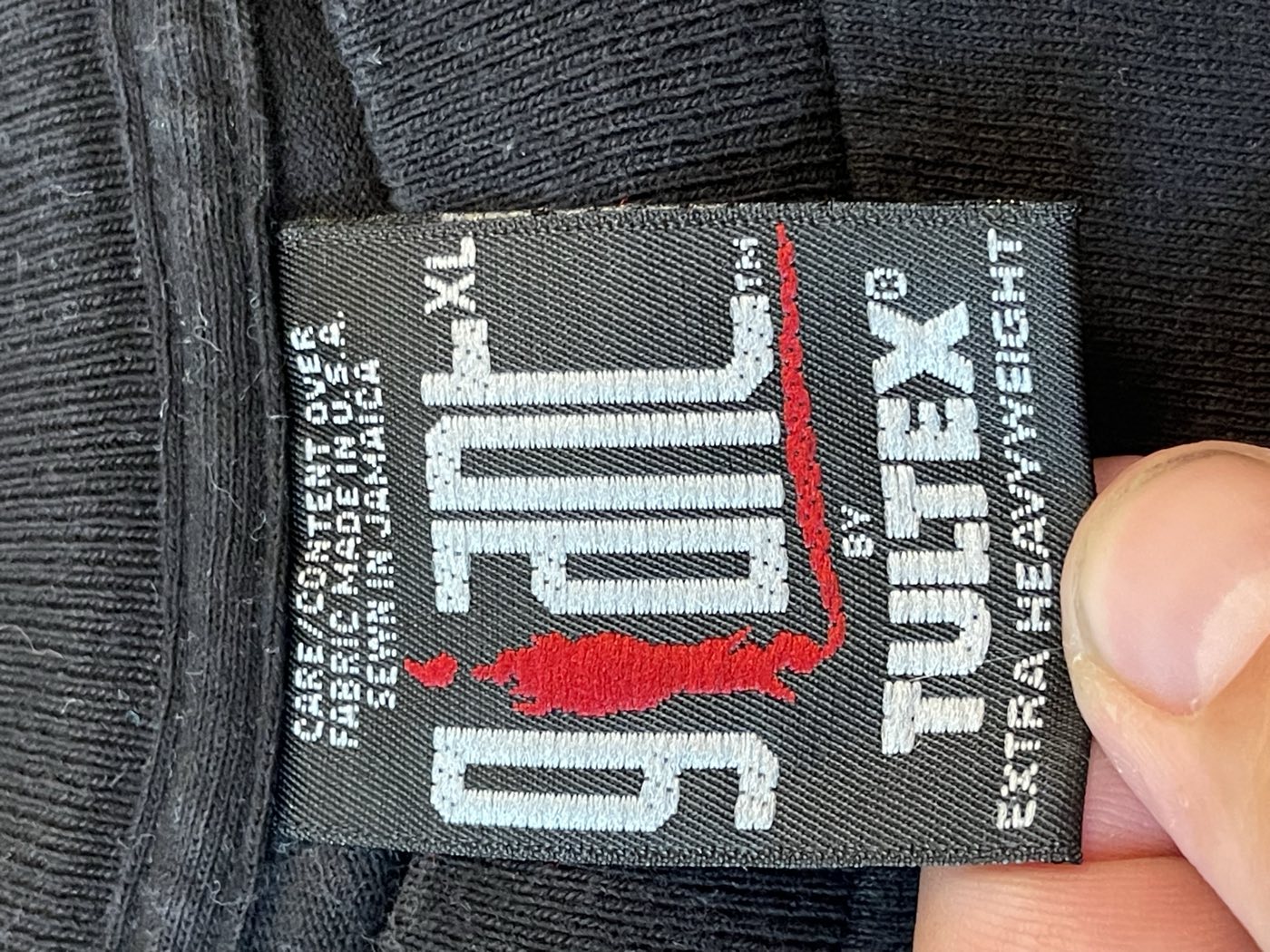
- Giant. A music merchandise company founded in 1990 that did something unusual: it named its blank maker on its own tag, Giant by Anvil, Tee Jays, or Tultex. The Giant by Tultex tag first appears in 1993 and runs to about 1996.
- Tultex. A Virginia mill that filed for bankruptcy in December 1999 and closed. A Tultex tag fits the 1990s, but the name was later revived by another company, so read it alongside the hem and the print.
- Hanes, Anvil, Fruit of the Loom. The everyday blanks. Their tags changed often enough to date, but a plain Hanes tag says less on its own than a merch company tag does.
What does the copyright year printed on a t-shirt mean?
The small line under the graphic, something like © 1987 plus a band or company name, records when the artwork was copyrighted and who licensed it. That makes it the earliest possible date for the shirt, never the actual date. A band that reprints its 1987 tour design in 2015 prints the 1987 line with it, perfectly legally, and those reprints are exactly the shirts that fool sellers. Read the line for what it is good for: the licensee. A line naming Brockum, Winterland, or Giant should sit on a shirt whose tag and hem fit that company’s years. When the line says 1991 and the tag is a modern tear-away label, you are holding a later shirt.
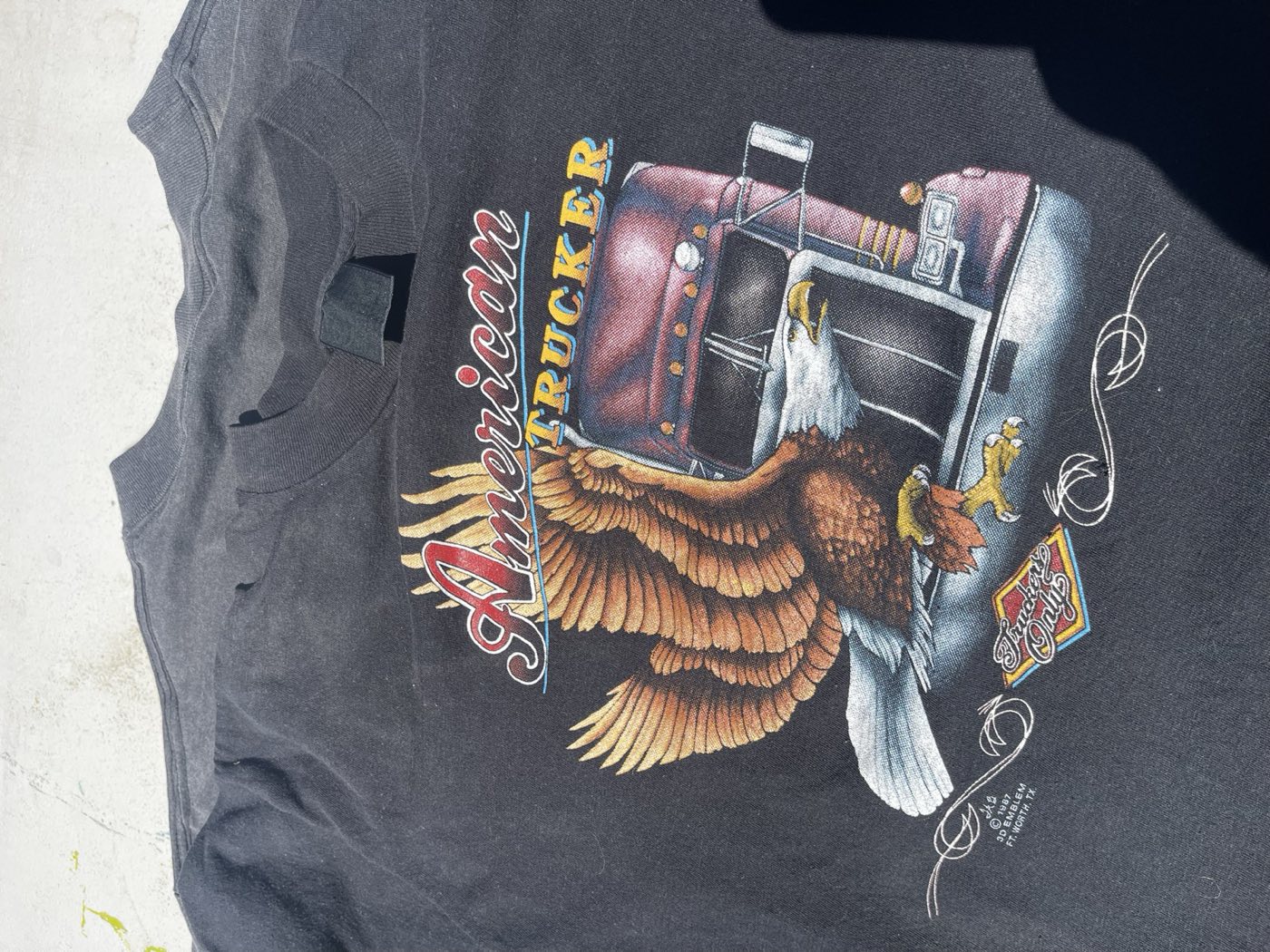
Some print shops signed their work in the same place. 3D Emblem, a Fort Worth, Texas shop known for detailed Harley-Davidson art printed on black shirts through the 1980s, put its name, city, and year beside the graphic, and it held its Harley license only into the mid-1990s. A 3D Emblem line on a single-stitch shirt with an era tag is about as consistent a story as a t-shirt tells.
Is it a band tee, a tour tee, or a reprint?
A band tee carries the act’s licensed graphic. A tour tee was printed for one specific run, usually with the cities and dates on the back, and original tour shirts are the heart of the market. A reprint is any later printing of either, whether licensed by the band, sold at a mall, or made last year to look old. Tour backs, famous graphics, and even the copyright line are all copied faithfully on reprints. The hem and the tag are much harder to fake convincingly, which is why every experienced buyer turns the shirt inside out before looking at the front for long.
- Double-stitched hems on a shirt dated to the 1980s by its graphic.
- A printed or heat-pressed label instead of a sewn tag, or a tear-away tag, both far more common on modern blanks.
- A crisp, bright, flexible print with no cracking on a shirt that should be decades old.
- A modern fitted cut, or sizing that runs to 3XL and beyond on a design from the 1980s.
- Care symbols instead of written care words; symbol care labels became standard on US garments much later.
- A tag from a company whose years do not match the copyright line.
What about the care label and the RN number?
Care instructions have been required on US clothing since the early 1970s, so a tee with a care label is from that decade or later, which settles very little for band shirts but helps with the rare 1960s example. The RN number printed on many tags is a registration number the Federal Trade Commission issues to the company responsible for the garment. You can look it up in the FTC’s public RN database to learn who made or imported the blank. It identifies the company, not the year, so use it to confirm a tag rather than to date one.
Does the era change what a band shirt is worth?
Almost entirely. As of August 2026, most vintage t-shirts bring $10 to $40, while original tour-issue band tees commonly bring $200 to $500 on marketplaces, with the scarcest acts above that; those are directional marketplace figures, not auction results. The ceiling is far higher and far rarer. A never-worn 3D Emblem Harley-Davidson Road Rebel shirt with a 1988 Black Hills Classic back print sold privately for $13,500 through a tee consignment house, paid in December 2024, after its finder bought it for $3. That is a trophy result, not a price for a family closet, but it shows why the dating matters: the same design reprinted later is a ten-dollar shirt. For prices by genre, see the vintage t-shirt value guide.
The mistakes that destroy value
- Cutting out the tag because it itches. The tag is the dating evidence; a shirt without one loses much of its story and much of its price.
- Washing hot or machine drying. Heat shrinks old cotton and cracks or peels the print.
- Ironing the graphic. A hot iron can melt or lift a vintage print permanently.
- Cutting the sleeves or cropping the hem. Alteration is permanent, and it removes the single-stitch hem that dates the shirt.
- Storing it folded on the print for years, which cracks the graphic exactly where the eye lands.
- Pricing it from the front. A reprint and an original can look identical in a listing photo; sell or buy on the hem and the tag.
Before you do anything else: leave the tag in, do not wash it, and photograph three things in daylight, the front, the tag, and an inside sleeve hem. Those three photos date most band shirts.
How do I get a band shirt dated and sold?
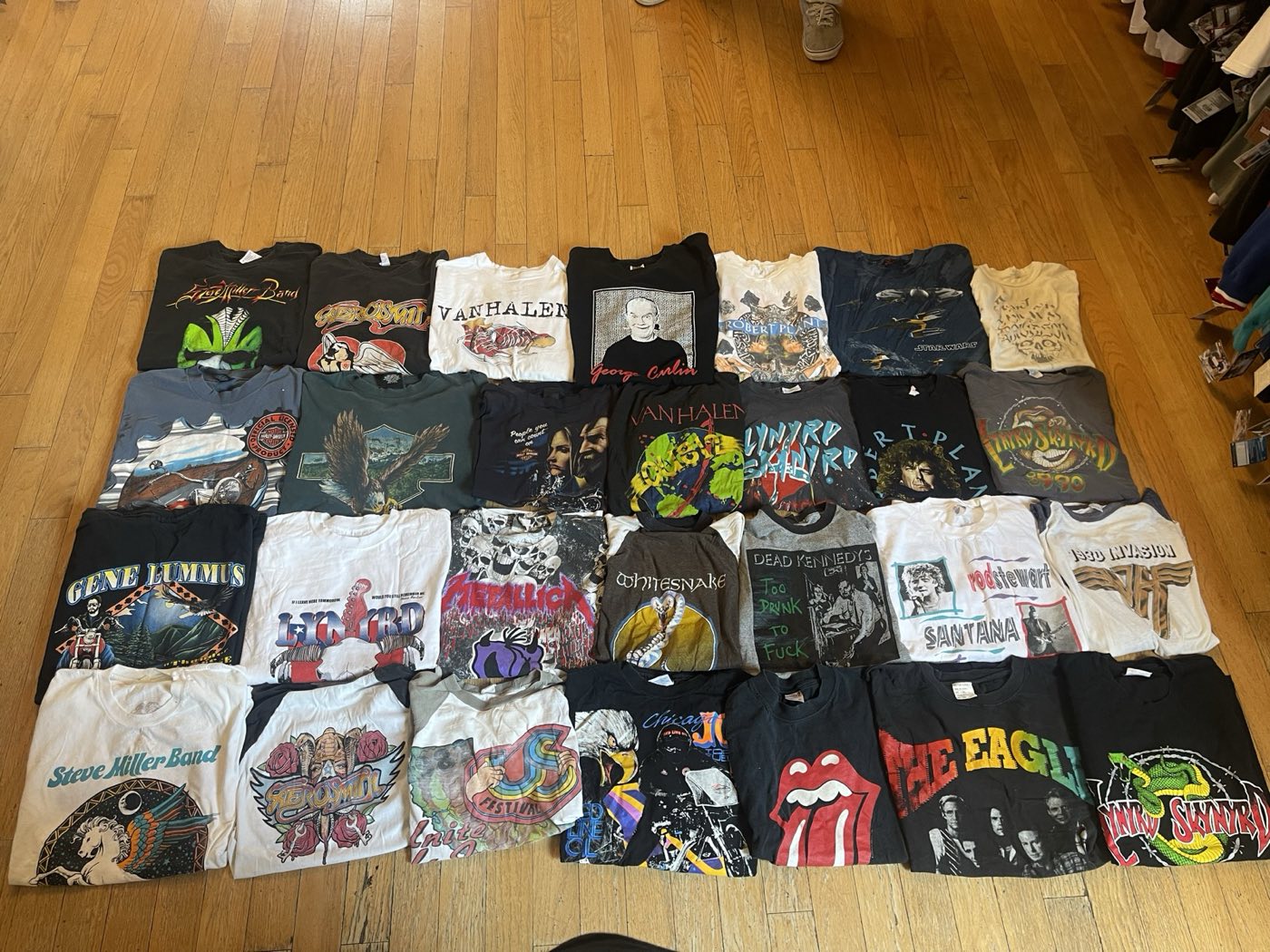
Start with the three photos above and send them to someone who dates shirts every week. We read band tees across Southern California: we come to you, sort the box in front of you, and pay cash the same visit, telling you which shirts are period and which are later printings, and why. If you are anywhere else in the country, we buy remotely: we look at the shirts together on a video call, agree the price on the call, and pay through PayPal before you ship, with shipping on us. Most boxes are mostly ordinary shirts, and we say so. The one that reads 1980s four times over is the one worth knowing about. For the other labels worth checking before a donation run, see old clothes worth money.
Common questions
- How can I tell what year my band shirt is from?
- Stack four checks. A single-stitch hem points before the mid-1990s. The tag narrows the window, since each merch company and blank maker changed its tag every few years. The copyright line under the graphic gives the earliest year the art existed. And a Made in USA tag, or fabric made in the USA and sewn in Jamaica or Mexico, fits the 1980s and 1990s. When all four agree, the shirt is period; when one disagrees, it is usually a reprint.
- What does a Giant by Tultex tag mean on a band tee?
- Giant was a music merchandise company founded in 1990 that named its blank maker on its own tag. The Giant by Tultex version first appears in 1993 and runs to about 1996, according to collector tag archives, so it places a shirt in the mid-1990s when the hem and print agree. Tultex itself, a Virginia mill, went bankrupt in December 1999.
- Does a copyright date on a t-shirt prove how old it is?
- No. The copyright line records when the artwork was copyrighted and who licensed it, so it is the earliest the shirt could be, not when it was printed. Licensed reprints carry the original year decades later. Confirm the era with the hem and the tag, and check that the company named in the line fits the tag’s years.
- What is the RN number on a t-shirt tag?
- It is a Registered Identification Number that the Federal Trade Commission issues to the company responsible for a garment. You can search it in the FTC’s public RN database to learn who made or sold the blank. It identifies the company, not the year, so it confirms a tag rather than dating a shirt.
Have something like this?
One phone call and we come to you, anywhere in Southern California. Free visit, honest evaluation, cash the same day.