Sell to Us · Turquoise
How to tell Lone Mountain from Lander Blue, and either from a tourist piece.
Free visit · cash offers · no obligation
California Vintage Buyers reads turquoise and Native American jewelry free across Southern California: natural or stabilized stone, the mine where it can be told, hallmark, maker and era, from a photo, the same day, with nothing owed. The rugs, baskets, pottery and Southwestern paintings in the same house get a cash offer on a free house call. Call (949) 449-1255.
Turquoise is a specialty for us, and it is one of the few categories where knowledge changes the number more than condition does. A heavy old cuff with natural, high-grade stone can be worth many times what a generic counter offers for it by weight. Hallmarks, stampwork, stone provenance, and age all matter, and all of them can be read.
We identify turquoise and Native American jewelry across Southern California, and we read it the way collectors do: the stone first, then the maker, the era, and the hand that made it. The read is free and you owe nothing either way. What we buy outright is everything that usually sits in the same house: the rugs, the baskets, the pottery, and the Southwestern paintings, in person and for cash.
Silver and stone, and how to read them
Old pawn and early pieces
Pre-1950s Navajo, Zuni, and Hopi work: ingot silver, hand-pulled wire, early stamps.
Text us a photo Send us a photoCuffs and bracelets
Row bracelets, heavy ingot cuffs, cluster work, and signed contemporary masters.
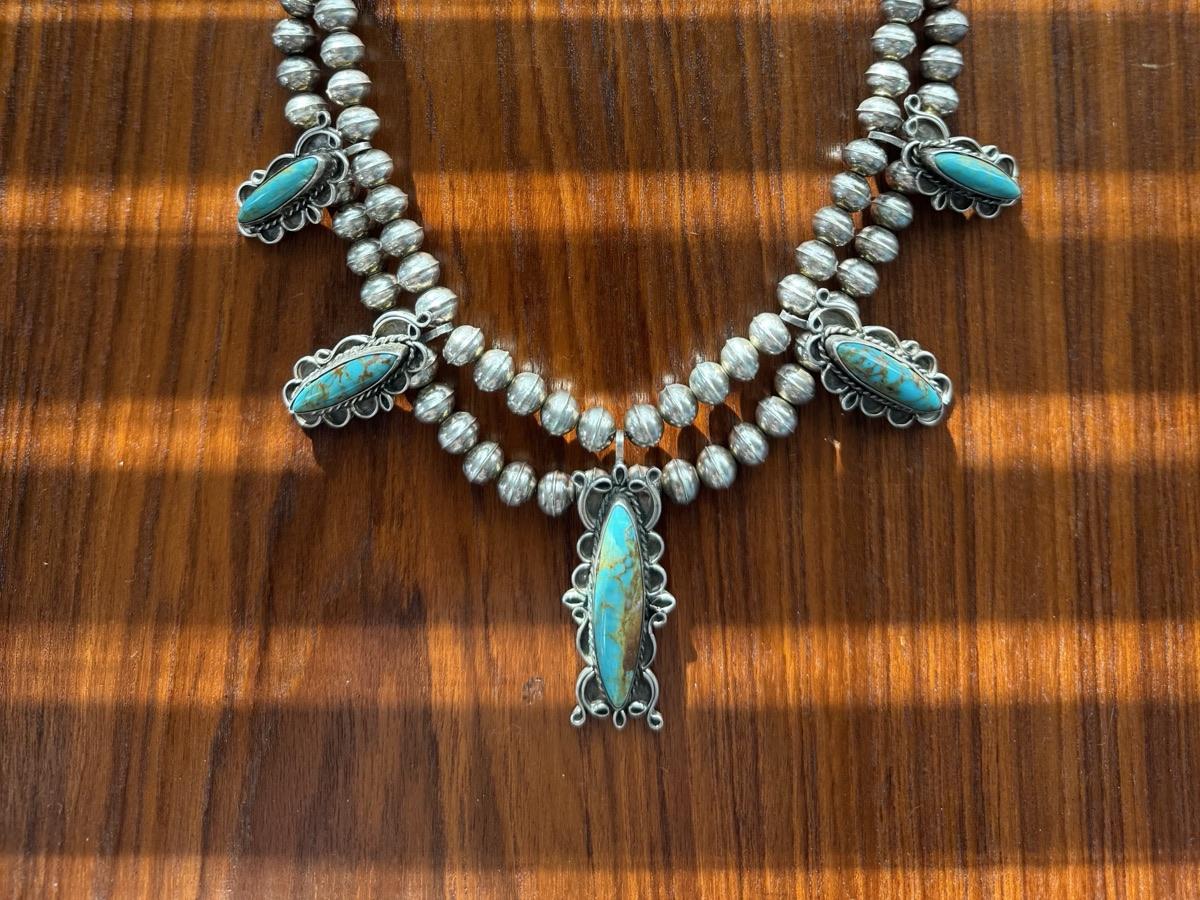
Text us a photo Send us a photoSquash blossoms and necklaces
Naja necklaces, coral and heishi strands, and complete original sets.
Text us a photo Send us a photoConcho belts and buckles
First-phase style belts, stamped conchos, and ranger sets.
Text us a photo Send us a photoNatural stone
Lone Mountain, Lander Blue, Bisbee, Morenci, Number 8: named mines bring named prices.
Text us a photo Send us a photoDo not sell it as scrap silver
The saddest thing we see in this category is a family selling a collection to a counter that weighs it. Old turquoise jewelry is worth more than its melt value, sometimes astonishingly more, and once a piece is melted the history is gone for good. Before any scale gets involved, send us a photo. We will tell you what you actually have, free, and you can take that knowledge to whichever buyer you choose.
Why It Matters
The difference between ordinary and valuable is in the details: a stitch, a hallmark, a date code. Knowing them is our entire job.
From the Shop
Sell Native American Turquoise Jewelry in Orange County. We Come to You and Pay Cash
Read the transcript
Hey guys, Sam here at California Vintage Buyers in beautiful Orange County, California. Today we're going to talk a little bit about turquoise jewelry. When did it start? Well, late 1800s, they started mining silver and turquoise out of the ground in the beautiful deserts of Arizona, New Mexico, and Native American tribes such as the Navajo, the Hopi, the Zuni, they started making handcrafted beautiful jewelry out of it. And it has since become pretty collectible. And so we love the stuff personally and we are purveyors of it. And as you can see, they spent a lot of time making a lot of this stuff. We have some really old stuff, Fred Harvey era kinds of things, all the way up to just new 80s, 90s fun hearts kind of stuff. So we're into it all. If you've inherited any of this kind of stuff or you have some that you don't really wear much anymore, we would love to buy it and we pay fair prices for it. Please give us a call, 949-449-1255. We can come to you. We go all over Southern California. But yeah, great examples of the kind of things we buy. When in doubt, text us photos to that number or give us a call, 949-449-1255.
How it works
Call or text photos.
A real conversation about what you have, no pressure to sell.
We come to you.
We look at everything, at your pace. We know what we're seeing.
Cash offer, same visit.
A fair price on the spot, or a full estate sale run for you.
Common questions
The jewelry is unsigned. Is it still valuable?
Often, yes. Most early Native American silverwork is unsigned. Construction, stampwork, and stone tell us the age and quality; a hallmark is a bonus, not a requirement.
What is my turquoise and silver jewelry worth?
That is exactly what the free read answers: what the stone is, roughly when and how the piece was made, and which market it belongs in. You keep that knowledge whatever you decide to do next, and if you decide to sell the piece we know the buyers who take this work seriously and will point you to the right one. The rugs, baskets, pottery, and Southwestern art that usually come with these collections we do buy, in person and for cash.
Need an appraisal, or just an honest read?
We are not certified appraisers, and the look is free. Text photos or ask for a quick video call and we will tell you plainly what we see, usually the same day. If you need certified paperwork for insurance or probate, that is a licensed appraiser’s job, and we will say so honestly rather than pretend otherwise.
How can I tell natural turquoise from stabilized?
Natural stone shows depth and variation in the matrix, and wear that follows the shape of the piece. Stabilized material looks uniform, with color sitting flat and matrix repeating too evenly. It matters because high grade natural runs roughly ten times stabilized per carat, and natural is a small share of what is on the market, with most turquoise sold today treated in some way.
What is block turquoise?
Block is not turquoise at all. It is dyed plastic or resin pressed to look like the stone, and it is common in tourist jewelry. The tells are flat color with no depth, matrix that repeats like a pattern, and a piece that feels light for its size.
What is a named mine, and why does it matter?
Lone Mountain, Lander Blue, Bisbee, Morenci, Number 8: stones from famous mines carry the mine's name the way a painting carries a signature, and collectors pay for a confident attribution. The attribution is the hard part. Matrix, color, and provenance all feed it, and honest dealers say consistent with far more often than they say is. If a trader ever told your family which mine a stone came from, keep whatever paperwork or story came with that claim; it is part of the value.
Should I clean turquoise jewelry before selling?
No, and this one causes permanent damage rather than just lost value. Turquoise is porous, so ultrasonic cleaners and chemical dips can crack or discolor a stone for good, and the dark patina in old silver is part of what collectors pay for. Leave it exactly as it is.
Do you buy the rest of the collection?
Yes, and it is usually a single visit. Turquoise jewelry tends to share a house with Navajo weavings, baskets, pottery, and Western and California paintings, and those we buy outright, for cash. One walkthrough covers the jewelry read and the purchase together, anywhere in Southern California.
Can you look at pieces remotely?
Yes, anywhere in California. Text clear photos of the fronts, the backs, and any stamps or hallmarks to (949) 449-1255, and we will tell you what we see, usually the same day. For a large collection, ask for a quick video call and we will go through it piece by piece. The identification is free either way.
Know what it’s worth before you sell.
Our field guides explain how the market actually prices these things. No fishing, no hype: real ranges and the details that move them.
One call. We’ll take it
from there.
(949) 449-12555.0 on Google · Free visit, no obligation · Cash the same visit
Mon-Sat 6 am-8 pm · Sun 8 am-5 pm
A real person answers seven days a week, weekends included. Photos sent today are usually answered the same day.
Or send your photos online Photos on your phone? Text them to (949) 449-1255
Also from California Vintage Buyers
- How to tell what your Native American jewelry actually is.→
- A squash blossom necklace is worth far more than the silver in it.→
- A good concho belt is silver worth reading, not silver worth melting.→
- Old pawn is the good stuff, and the melt counter cannot see why.→
- Sell the rug for what the weaver put into it.→
- Sell California art to buyers who know the Laguna school by hand.→
- Sell western wear to buyers who live and breathe it.→