Sell to Us · Native American Jewelry
How to tell what your Native American jewelry actually is.
Free visit · cash offers · no obligation
California Vintage Buyers identifies Native American jewelry free across Southern California: tribe, technique, era and whether a hallmark belongs to a maker collectors chase, from a photo, the same day, with nothing owed. The Navajo rugs, baskets, pottery and Southwestern art in the same house get a cash offer on a free house call. Call (949) 449-1255.
Native American silverwork is one of the few things a family can own for a lifetime and still have no idea what it is. A heavy old cuff, a squash blossom that came home from a trip to New Mexico decades ago, a box of pieces inherited with the rest of an estate. The costly mistake is treating all of it as one undifferentiated pile, because the difference between a tourist piece and master silverwork can be many times over in value.
On Native American jewelry across Southern California the read comes first, free and with nothing owed either way: the tribe, the technique, the era, and whether a hallmark belongs to a maker collectors chase. Send photos and you will have a straight answer the same day, and a number if you want one.
We are California Vintage Buyers, based in Laguna Hills. Collections like these very often arrive alongside Navajo rugs, baskets, pottery, and Southwestern art, and those we do buy, in person and for cash.
The traditions, and how to recognise them
Navajo silverwork
The first Southwestern silver, from Atsidi Sani in the mid-1800s onward: heavy ingot cuffs, stamped conchos, hand-pulled wire, and the squash blossom necklaces that became the signature of the whole region.
Text us a photo Send us a photoZuni lapidary
The stonesetters. Petit point and needlepoint clusters, channel inlay, and carved fetishes, where the value lives in the precision of dozens or hundreds of hand-cut stones.
Text us a photo Send us a photoHopi overlay
The technique Fred Kabotie and Paul Saufkie developed in the 1940s, cut and soldered over an oxidized base. Guild pieces and signed masters like Charles Loloma reach the fine-art market.
Text us a photo Send us a photoKewa (Santo Domingo) beadwork
Hand-rolled heishi shell and stone strands, and the Depression-era thunderbird necklaces built from battery casings and old records when nothing else was to hand.
Text us a photo Send us a photoOld pawn and signed masters
Pieces worn and pawned at the trading posts, plus hallmarked work by makers whose names multiply value: Kenneth Begay, Lee Yazzie, Charles Loloma, Julian Lovato.
Text us a photo Send us a photoPlease do not sell it to a scale
The costliest mistake in this category is handing a collection to a counter that weighs it and pays melt. A single high-grade cuff or an early squash blossom can be worth many times its metal weight, and once a piece is melted the history is gone permanently. Before any scale gets involved, send photos to (949) 449-1255, including any hallmarks stamped on the back, and we will tell you the same day whether you have tourist work or master work, free and with no obligation. Attribution is the whole point here, which under the Indian Arts and Crafts Act of 1990 is exactly as it should be. Knowing what a piece is protects you whoever you eventually sell it to. And if the collection came with rugs, baskets, pottery, or Southwestern paintings, those we do buy, in person across Southern California.
Why It Matters
The difference between ordinary and valuable is in the details: a stitch, a hallmark, a date code. Knowing them is our entire job.
From the Shop
Sell Native American Turquoise Jewelry in Orange County. We Come to You and Pay Cash
Read the transcript
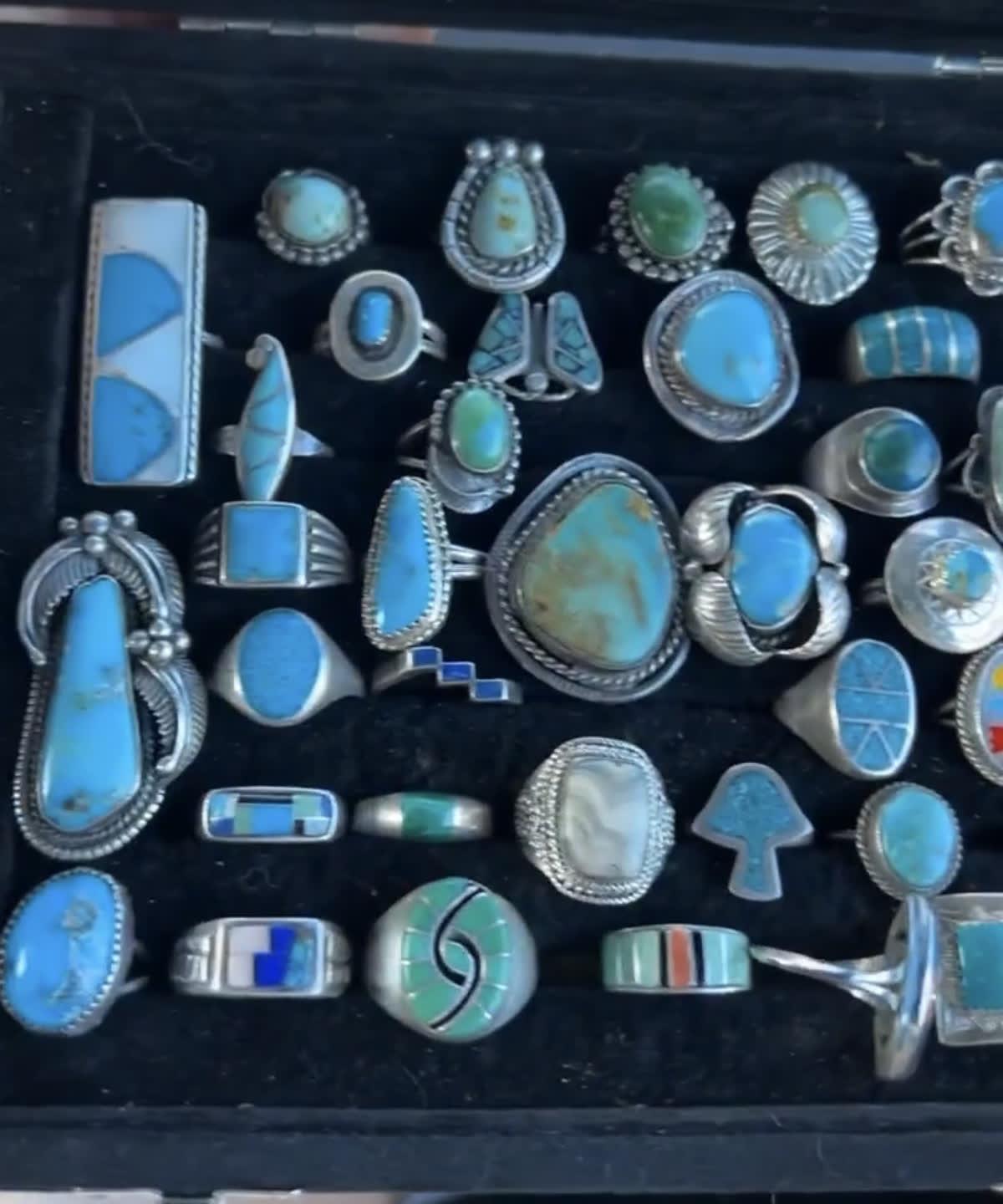
Hey guys, Sam here at California Vintage Buyers in beautiful Orange County, California. Today we're going to talk a little bit about turquoise jewelry. When did it start? Well, late 1800s, they started mining silver and turquoise out of the ground in the beautiful deserts of Arizona, New Mexico, and Native American tribes such as the Navajo, the Hopi, the Zuni, they started making handcrafted beautiful jewelry out of it. And it has since become pretty collectible. And so we love the stuff personally and we are purveyors of it. And as you can see, they spent a lot of time making a lot of this stuff. We have some really old stuff, Fred Harvey era kinds of things, all the way up to just new 80s, 90s fun hearts kind of stuff. So we're into it all. If you've inherited any of this kind of stuff or you have some that you don't really wear much anymore, we would love to buy it and we pay fair prices for it. Please give us a call, 949-449-1255. We can come to you. We go all over Southern California. But yeah, great examples of the kind of things we buy. When in doubt, text us photos to that number or give us a call, 949-449-1255.
How it works
Call or text photos.
A real conversation about what you have, no pressure to sell.
We come to you.
We look at everything, at your pace. We know what we're seeing.
Cash offer, same visit.
A fair price on the spot, or a full estate sale run for you.
Common questions
How do you tell which tribe made a piece?
Technique first. Navajo work leans on stampwork and heavy silver, Zuni on precise stone cutting like petit point and inlay, Hopi on the overlay cut-out style, Kewa on heishi and shell. Construction, wear, and stampwork usually place the era and the hand before we ever look for a hallmark.
My piece is not signed. Is it still worth something?
Very often, yes. Most early Native American silverwork is unsigned, because makers did not routinely hallmark until the middle of the twentieth century. Age, construction, stampwork, and stone tell us what it is. A signature is a bonus that can multiply value, not a requirement for it.
What can you tell me about my Native American jewelry?
We identify and value these pieces. The identification is free and there is nothing owed either way. We do buy Navajo rugs and weavings, baskets, pottery, and Southwestern art, which is often what the rest of the collection turns out to be.
What is the point of a free identification?
Knowing what you have is what stops a piece being sold for melt. Sellers who can name the tribe, the era, and the maker get treated differently by every buyer they speak to afterward, and a hallmark we spot can be the difference between a scrap quote and a four-figure piece. We would rather be the reason a squash blossom survived than the reason it did not.
A buyer offered to weigh the whole collection and pay by the gram. What is the risk?
Melt pays for metal weight and nothing else, and a single high grade cuff or an early squash blossom can be worth many times what it weighs. Melting is permanent, so once a piece goes into the crucible the maker, the era, and the history are gone with it. Get the collection identified before any scale is involved. Send photos to (949) 449-1255 and we will tell you what you have, free and with nothing owed either way.
Where are the hallmarks, and what if a stamp is too faint to read?
Look on the reverse of a cuff near the terminals, the back of a naja or pendant, and the end of a clasp or bar. A mark can be initials, a small pictograph such as an animal or a symbol, a shop name, or nothing at all on early work. Photograph it in raking light from the side rather than straight on, which makes a shallow stamp readable. Do not polish the piece: polishing rounds off a faint stamp and strips the dark recesses that let stampwork and repousse read at all.
Is it legal to sell Native American jewelry?
Yes. Owning and reselling genuine pieces is entirely lawful. The federal rule worth knowing is the Indian Arts and Crafts Act of 1990, which makes it illegal to sell goods as Native American made when they are not. The law binds honest description, and honest description starts with knowing what you have, which is one more reason the identification is worth getting before anything is listed or sold.
Is it wrong to sell a parent's collection?
No, and the families we sit with usually land somewhere gentler than all-or-nothing. A collection like this was assembled with care, and passing it to people who will wear it and look after it is one honest way of continuing that care; so is each keeping a single piece and letting the rest go on. What helps most is knowing what everything actually is first. An identification is not a sale and commits you to nothing, and it lets a family divide things fairly, keep the pieces that matter, and decide about the rest without wondering later what they gave away.
Know what it’s worth before you sell.
Our field guides explain how the market actually prices these things. No fishing, no hype: real ranges and the details that move them.
One call. We’ll take it
from there.
(949) 449-12555.0 on Google · Free visit, no obligation · Cash the same visit
Mon-Sat 6 am-8 pm · Sun 8 am-5 pm
A real person answers seven days a week, weekends included. Photos sent today are usually answered the same day.
Or send your photos online Photos on your phone? Text them to (949) 449-1255
Also from California Vintage Buyers
- How to tell Lone Mountain from Lander Blue, and either from a tourist piece.→
- A free turquoise jewelry appraisal, from someone who handles it every week.→
- A squash blossom necklace is worth far more than the silver in it.→
- A good concho belt is silver worth reading, not silver worth melting.→
- Old pawn is the good stuff, and the melt counter cannot see why.→
- Sell the rug for what the weaver put into it.→
- Sell California art to buyers who know the Laguna school by hand.→