Sell to Us · Inherited Jewelry
Inherited jewelry, read before anything leaves the house.
Free visit · cash offers · no obligation
A jewelry box usually arrives at the worst possible time. Somebody has died, the house has to be dealt with by a date that somebody else set, and a lifetime of small objects is sitting on a table in front of people who never asked to become experts in any of it. Almost nobody in that position has decided to sell anything yet, and that is the right place to start from. The honest first step is not a sale, it is finding out what is actually there, because nearly every expensive mistake in this category happens before an offer is ever made.
We read inherited collections for a living and the read is free, with nothing owed either way. In Orange County and across Southern California we come to the house, work through the box at your table at your pace with whoever in the family wants to sit in, and tell you what each piece is and roughly what it should bring. Anywhere else in California a ten minute video call does the same work from photos. You finish knowing what you are holding, whether or not you sell a single thing.
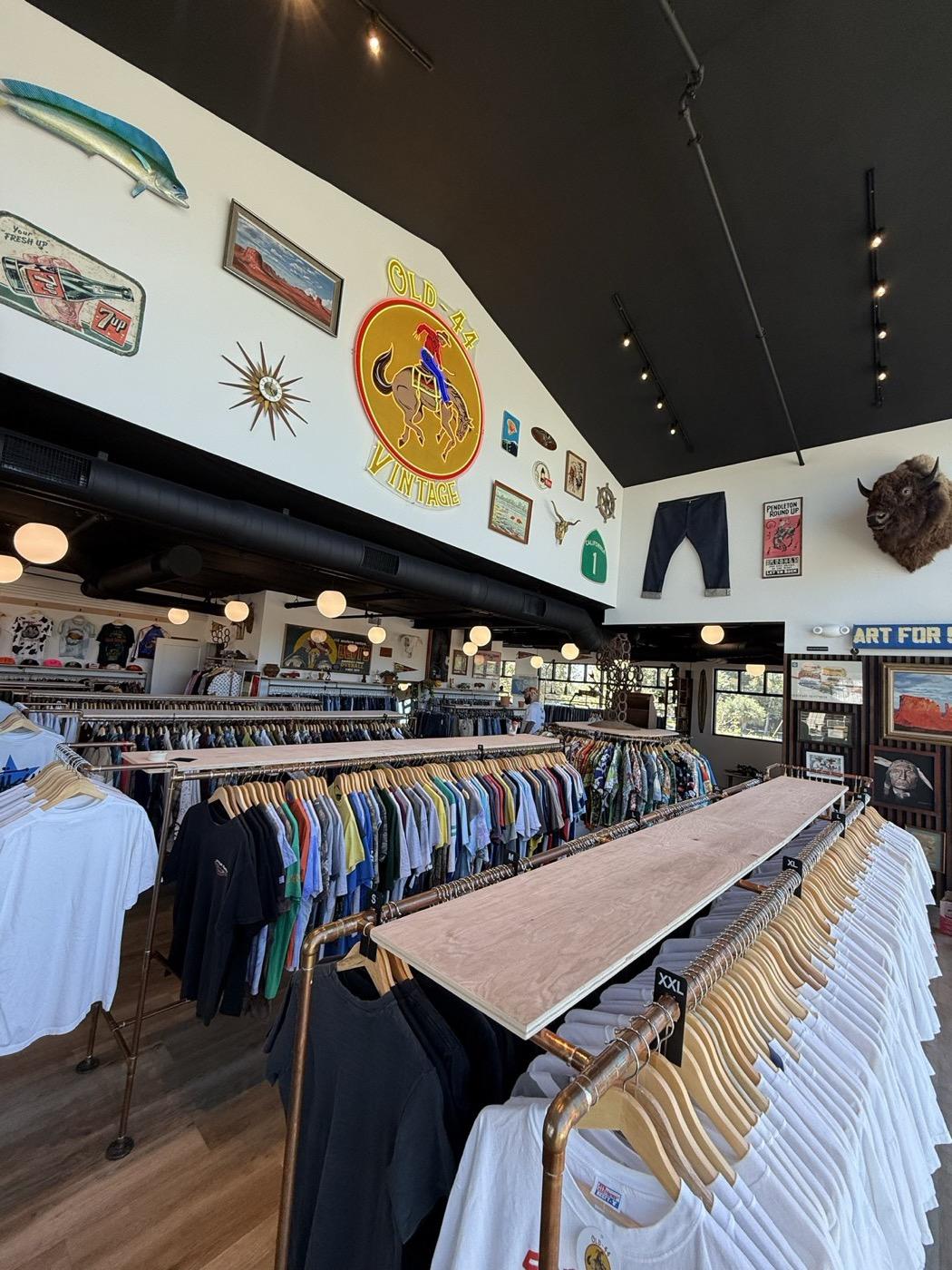
We are the team behind Old 44 Vintage, and what we do every day is read old objects and buy them. Costume and signed jewelry, watches, and the rest of the household that a jewelry box tends to arrive with, the vintage clothing, the cards, the coins, the art and the rugs, are what we come for, and we pay cash the same visit. The rule we would want anyone to follow, even if they never call us, is simple: let somebody who knows the marks read the whole collection before any of it is sorted, cleaned, or split up.
What an inherited box usually holds
Signed costume jewelry
Haskell, Trifari, Eisenberg, Coro, and real Bakelite hide in ordinary unsorted trays, and one signed piece regularly outprices everything else in the box combined. Every clasp and the back of every brooch gets checked before anything is called junk.
Native American and turquoise work
Squash blossoms, concho belts, old pawn, and the cuff that came home from a road trip through Gallup decades ago. Attribution is the whole point in this category, so the tribe, the technique, the stone and the era get read carefully and free, hallmarks included.
Watches, running or stopped
Wristwatches and pocket watches, with boxes and papers or with nothing at all. Mechanical watches from the good decades are a real collector market, and the plain steel one a father wore to the office every day is often the one that matters most.
The fine pieces
Gold, silver, platinum and diamond jewelry gets a free expert identification at the same visit: the marks read out loud, the eras named, the difference between an old European cut and a modern brilliant explained while the ring is in your hand. If you decide to sell those pieces afterward, we know the reputable buyers and will point you to the right one.
Everything the box arrived with
An inherited jewelry box almost never turns up alone. The vintage denim and workwear in the closet, the Pokemon and sports cards in the garage, the coins, the rugs, the California and Western art, the militaria: that is the rest of the estate, and we buy it in the same visit and pay before we leave.
Before anything leaves the house
The five minutes before a box gets emptied decide more money than any negotiation ever will. Keep the packaging and the paper: original boxes and pouches, receipts, repair tickets, old pawn tags, hand-written notes about who a piece came from, and the yellowed insurance schedule in the filing cabinet. On a signed piece that paperwork is worth real money, and on everything else it is the fastest route to knowing what something is. Do not polish anything, do not have a stone reset or a clasp mended, and do not pre-sort the box into a good pile and a junk pile, because the misfiled piece is almost always the one that pays. Keep the single earrings, the broken chain, and the beads at the bottom. We make house calls anywhere in Orange County, usually within a day or two of your call, and across Los Angeles, San Diego, the Inland Empire and Ventura County most weeks. Our warehouse at 23011 Moulton Pkwy Suite G-11 in Laguna Hills sees sellers by appointment. Anywhere else in California, text photos to (949) 449-1255 or ask for a video call and you will have a straight answer the same day.
A Recent Find
A 1940s Levi’s Type 1 jacket, sold to us by a former dealer who knew exactly what he had. We paid $12,000 in cash, the same day.
How it works
Call or text photos.
A real conversation about what you have, no pressure to sell.
We come to you.
We look at everything, at your pace. We know what we're seeing.
Cash offer, same visit.
A fair price on the spot, or a full estate sale run for you.
Common questions
My mother died and left me a jewelry box. What should I do with it first?
Nothing irreversible, and there is less time pressure than it feels like. Put everything in one place, including the broken pieces, the odd earrings, and the boxes and papers that came with it, and leave it exactly as you found it. Do not clean, sort, or repair anything, and do not take the good half to one place and donate the rest. Then have the whole collection read by somebody who handles this every week. An identification is not a sale and commits you to nothing, and knowing what is there makes every decision that follows easier, including the decision to keep it.
How do I know if any of my mother’s jewelry is valuable?
Start with the marks, because most of them are readable with a phone camera and a bright light. They hide inside a ring shank, on the back of a brooch near the pin, inside a necklace clasp, and on the reverse of an earring clip. Numbers such as 925, 585, 750 and 950 name the material, initials or a small symbol name the maker, and a copyright symbol dates a costume piece to the mid-1950s or later. What a mark cannot tell you is the part that usually carries the money: the cut of an old stone, whether a signature belongs to a collected maker, and whether a plain looking piece is genuine period work. Photograph the marks in raking light from the side rather than straight on, and text them to (949) 449-1255.
What should we not throw away?
The paper and the packaging first. Original boxes and pouches, receipts, repair and appraisal papers, old pawn tickets, and the note somebody wrote about who a piece came from all add real money on signed jewelry and help identify everything else. Then the things that look like rubbish: odd earrings, broken chains, loose stones in a folded envelope, cufflinks, medals, watch parts, and the tangle of beads at the bottom of the box. Families empty the bottom of the box into a bin constantly, and the bottom of the box is exactly where the misfiled piece lives.
Is it better to sell a collection together or piece by piece?
Together in almost every case, with one exception. A whole collection read and sold in one sitting means the strong pieces carry the ordinary ones, nothing sits unsold in a spare room for a year, and nobody gets to take the two good things and leave you holding the rest. The exception is a genuinely exceptional item, a signed piece from a major house or an important stone, which deserves to be valued on its own and occasionally belongs at a specialist auction instead. When that is the case we say so at the table, and hearing it costs you nothing.
What actually happens when a buyer comes to the house?
You choose the table and who sits at it, and family is welcome to watch the whole thing. Everything comes out of the box in front of you with a loupe, one piece at a time: marks read aloud, condition described honestly, costume separated from fine, and the reasoning given as we go instead of saved for the end. Nothing leaves your hand unless you agree to it. At the end you get one clear number on what we are able to take, with the thinking behind it, and if you accept, cash before we leave and a written record of what went. If you decline, that is an ordinary afternoon: no fee, no pressure, no follow-up campaign.
How do I make sure I am not taken advantage of?
Watch four specific things rather than trusting a general feeling. One blended number for a mixed box is the most common way value quietly disappears, because the price then gets set by the pile instead of by the pieces in it. A confident figure quoted over the phone is a way to get in the door, since nobody can value estate jewelry without holding it. A buyer who never explains a single piece is telling you something. And anything posted to a mail-in buyer leaves you with no leverage and no witness. The test is easy to run: ask why on any three pieces. Somebody who knows the market answers immediately, and somebody who does not will change the subject.
What happens with the fine pieces at the visit?
They get the same careful read as everything else, free, from people with no stake in the answer. We tell you what the marks mean, whether a diamond is an old European cut or a modern brilliant, what era a mounting belongs to, and where a piece sits in the market as it actually is rather than as a decades-old appraisal describes it. Gold, silver and platinum jewelry is identified and explained during that same visit, and if you decide to sell those pieces afterward, we know the reputable buyers in Southern California and will point you to the right one. Knowing exactly what you are holding is what stops a good piece going for its weight, which is permanent and cannot be undone.
Should I pay for an appraisal before selling?
Usually not first, and often not at all. A formal appraisal from a licensed appraiser earns its fee in three situations: one piece that may be genuinely important, insurance on something you are keeping, and a family division where a neutral number keeps the peace. For a mixed box it buys you what a free identification would have told you, and the figure it produces is retail replacement cost, which is what it would take to have the piece made new again. That is why a ring appraised at $4,000 to $8,000 in the 1990s commonly sells for $800 to $2,500 today. Old appraisal papers identify a piece well and price it badly, so read them as documentation rather than as a price tag.
Can we sell inherited jewelry while the estate is still in probate?
Only the person the court appointed, the executor or the administrator, can sign off on a sale, and the letters issued by the court are the document that proves it. If nobody has been appointed yet, nothing should change hands, although California also provides a simplified affidavit route for small estates whose dollar threshold is adjusted periodically, so check the current figure rather than a number you read somewhere. Having the jewelry identified is not a sale and can happen at any point, and doing it early usually helps, because a family dividing an estate needs honest values before it needs an offer. Orange County Superior Court publishes plain-language probate self-help resources at occourts.org.
Do you charge for the visit, and how far do you travel?
There is no charge for any of it and no obligation at any stage. House calls run across Orange County, usually within a day or two, and out through Los Angeles, San Diego, the Inland Empire and Ventura County most weeks. Our Laguna Hills warehouse on Moulton Parkway sees sellers by appointment when it is one piece or a small box and you would rather come to us. Anywhere else in California the same read happens over a video call, usually the same day you text the first photos to (949) 449-1255.
Know what it’s worth before you sell.
Our field guides explain how the market actually prices these things. No fishing, no hype: real ranges and the details that move them.
One call. We’ll take it
from there.
(949) 449-12555.0 on Google · Free visit, no obligation · Cash the same visit
Mon-Sat 6 am-8 pm · Sun 8 am-5 pm
A real person answers seven days a week, weekends included. Photos sent today are usually answered the same day.
Prefer photos? Text them straight to the same number · or send them here
Also from California Vintage Buyers
- Orange County jewelry boxes are full of names nobody checked.→
- Somewhere in the costume box, a Trifari is waiting.→
- How to tell what your Native American jewelry actually is.→
- How to tell Lone Mountain from Lander Blue, and either from a tourist piece.→
- Antique buyers who come to you.→
- Estate buyers for Orange County. Call us first, while everything is still in the house.→
- Sell a vintage watch without wondering what it was really worth.→