Field Guide
Levi’s Ghost Signs of the West: Where the Painted Walls Are, and What They Say About the Closets Nearby
Levi Strauss and Co. painted its name on store walls across the West around 1900. A dozen are still legible. Every one marks a town that bought riveted denim by the crate, and most of those closets have never been looked at.
We buy from every state · free video appraisal · paid before you ship
By Sam Wingenbach and Jake Cover, the buyers behind our video appraisals and house calls · Updated September 10, 2026
Read the transcript
Hi guys, Sam here with California Vintage Buyers, and I want to help clear the air and give you a little bit of information on how do you know if your old Levi's you're looking at are worth the time to try to sell them or bound for Salvation Army and just get them out of here. There's not really value there. This is not an exhaustive list of things to look for, but it's just some key distinguishing factors, right? So I have a few pairs of pants in front of me and different eras. So we're going to go over with the newer ones, right? Here we have a pair of the year 2000 pants. How do I know that these are from the year 2000? Well, because if you see that dark 501XX right there, that style of lettering is from the 90s to the early 2000s. It's different than this stuff. Do you see the difference of that one right there? You can see the difference. We'll get to these in a minute. But if you see that block lettering on your pants, you're looking at 90s up to say 2004 or something like that. Another tell. Let's just say you don't have this patch here. You wore the belt a lot. He wore the belt. She wore the belt a lot. The patch is gone. How old are my pants? With these ones, you can also pop this guy out right here. And you have, see that number right there? 1000. It's actually not the number 1000. It's 10, 00, October the year 2000. So whatever number you're looking at right there on the tag, if it has this tag on the inside leg, look at that number and you're going to see probably 0497 or what have you. It's going to be month and year. Good to know. So if that's gone, check if it has one of those. If it doesn't have one of these, then you're looking at somewhere in the 80s, right? Or potentially older. So I have a pair of 80s here. Anything made in USA is going to say on this tag, made in USA, right? So see that right there? Made in USA. Made in USA. What does these not have? These don't have made in USA. See how that part's missing? Made in Guatemala in the 2000s. They outsourced all the manufacturing. Bummer. So still good pants. We'll still buy these if the wash is cool. But the collector factor is not there. So again, if you got a pile of 100 of these guys, we'll still buy them. Give us a call. Are you kidding me? But when it comes to like Levi's, it's the details that matter. So moving forward. Oh, another thing is the distinguishing factor. See how it's red, the 501. And this one's black. You see in red, you're seeing 80s. Right? So you're looking at made in USA. Got the little red 501. That was an 80s thing. Right? So that's a couple things. Then you go over to these guys. Now, this is also 80s, but these are early 80s. What's the distinguishing factor on these guys? Flip up the pant leg. Do you see that? That's called selvedge denim. They call them redlines. These are called redlines. Right? Anything 501, 1982, 83-ish, right around there, and previous is going to have this kind of thing. This makes the value go up a little bit higher. Right? Why do they call these redlines you're asking? Great question. Well, when they were brand new, like these puppies from the 70s, which are a fantastic sample, they had a red line. Then, selvedge denim. So what does selvedge denim mean? It means the pant leg was made out of one sheet of denim, and they slapped them together. That's the end of a sheet of denim. They put them together, and they sewed the pant leg. And so this is made out of one sheet, a little more collectible. These are redlines. These are redlines. If you see that, you're looking at redlines. Even if you don't see any red, you got a pair of redlines. Right? We'll buy all these guys. Now, if you see one of these things that has a capital E right there, it's even better. Right? If you're looking at dealing with a barn, a ranch, Uncle Bob's house, and you're clearing it out, and you found him in the attic or in the bottom of his closet or something, we're great buyers for all this stuff. And we've paid up to thousands before for certain types of Levi's. There's a collectible value. It all depends on what the details are. You know? It's like if you call the car dealership, and you're like, hey, what do y'all pay for cars? They're going to say, okay, well, yes, we buy cars. What's the make? Model? Mileage? How's the condition? All the things. Give us a call. Number is 949-449-1255. We'd love to help you discern what you got, make your sweet offer, and buy all that stuff and more.
The short version: Levi Strauss and Co. advertised on the sides of buildings across the West from the 1890s into the 1910s, before movie slides, billboards and radio took over. The painted walls that survive, in Jacksonville, Oregon; Fort Bidwell, California; Dayton and Eureka, Nevada; Eureka, Utah; Livingston and Big Timber, Montana; Steamboat Springs, Colorado; and on the company’s own 1906 headquarters in San Francisco, are a map of where the jeans were sold. That is also a map of where the old ones still are.
One of us stood in front of the Jacksonville wall this year. The lettering is worn to a whisper but it still reads: a store name and General Merchandise across the top, Levi Strauss and Co’s across the middle, Copper Riveted around the two-horse mark, Overalls to the right, Strong and Durable at the bottom. It is on a brick wall in the town’s National Historic Landmark district, and Levi Strauss and Co.’s own historian has featured it twice, dating it to the turn of the twentieth century, the years when, in her words, the company began to paint the sides of buildings with its name and slogans all over the West.
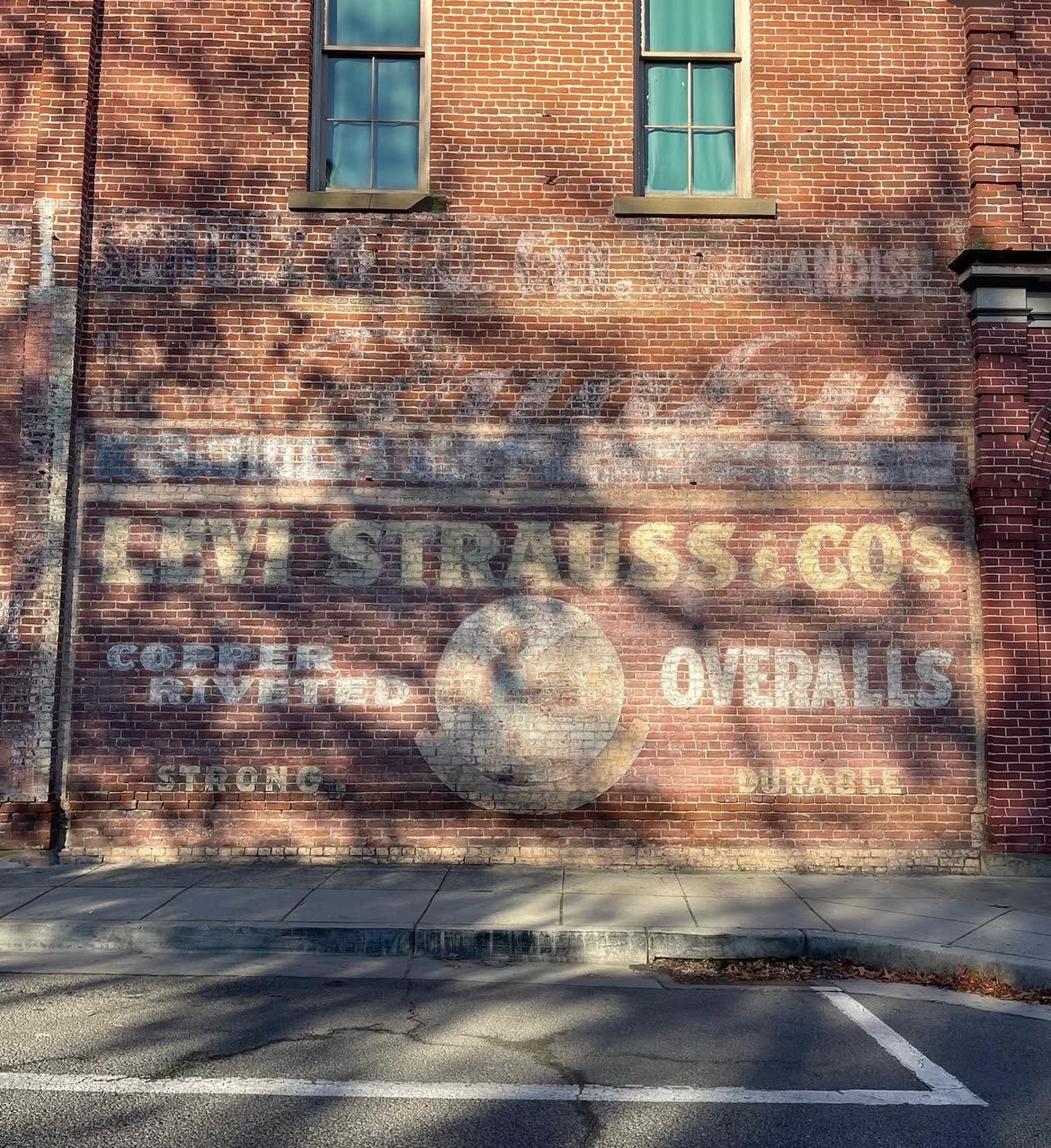
Why Levi’s painted walls
The two-horse mark that anchors most of these signs dates to 1886, when the company put an image of two horses failing to pull a pair of waist overalls apart on its leather patch and in its advertising. Its patent on riveted pockets was about to expire, competitors were coming, and the picture communicated strength to customers who could not read English. The product line was called the Two Horse Brand until the Levi’s name was adopted in 1928, which is why the walls say Copper Riveted Overalls and not Levi’s jeans.
Painted walls were the medium of the moment. Itinerant sign painters, wall dogs in the trade, moved from town to town painting merchants’ names and the brands they stocked, using lead-heavy paint that is the reason the signs survive. Levi Strauss and Co. moved on to silent-movie slides in the 1910s, billboards and store displays in the 1930s to 50s, and radio in the 1960s. The walls stayed.
The surviving Levi’s ghost signs
| Town | Where it is | What it says, and the source |
|---|---|---|
| Jacksonville, Oregon | A brick wall in the National Historic Landmark district; Travel Oregon places it on 3rd Street | Store name and General Merchandise, Levi Strauss and Co’s Copper Riveted Overalls, Strong, Durable; featured by Levi Strauss and Co.’s historian in 2016 and 2019 |
| Fort Bidwell, California (Modoc County) | South wall of the Henry Kober and Co. mercantile, a retail customer from 1909 | Two-horse image and the guarantee, A New Pair Free if They Rip, Levi’s Waist Overalls; the company calls it possibly its oldest surviving advertisement |
| Dayton, Nevada | The original general merchandise building that sold the overalls | Copper riveted overalls; Levi Strauss and Co. blog, 2016 |
| Eureka, Nevada | Listed in a state ghost-sign index (single source) | Clothing category; not independently confirmed |
| Eureka, Utah | The Elks Lodge, formerly the Golden Rule store and an early J.C. Penney | 1920s black and yellow waist overalls sign; Levi Strauss and Co. blog, 2019 |
| Livingston, Montana | An interior wall of a downtown cafe | Includes the rip guarantee; Levi Strauss and Co. blog, 2019 |
| Big Timber, Montana | Two overlapping signs, one reading San Francisco Made, Copper Riveted, visible only with image enhancement (single source) | Big Sky Journal, Images of the West |
| Steamboat Springs, Colorado | F.M. Light and Sons, a western store since 1905 | Real Cowboy Wear Levi’s; Levi Strauss and Co. blog, 2019 |
| San Francisco, California | East wall of the company’s own 1906 headquarters at Pine and Battery | A faded LEVIS; Levi Strauss and Co. blog, 2016 |
| Arizona (town not named) | Revealed during a cantina renovation | Copper Riveted Overalls; Levi Strauss and Co. blog, 2016 |
| Hoboken, New Jersey | A haberdashery founded in 1923 | The one Eastern survivor on the list; Levi Strauss and Co. blog, 2019 |
No Levi’s wall sign is documented in Idaho, and Jacksonville is the only one documented in Oregon. If you know of another, we would like the photograph.
Jacksonville: the wall and the valley behind it
Jacksonville was the commercial center of Southern Oregon from the gold strike at Rich Gulch in December 1851 until the railroad bypassed it in the 1880s; the county seat moved to Medford in 1927 and the town was left largely as it was, which is why the whole district became a National Historic Landmark in 1966. Historic Jacksonville explains that in the late 1800s the town’s brick buildings doubled as billboards. The Levi’s wall is one of several ghost signs there. Which merchant’s name runs across the top of it is not settled by any published source we can find, and we will not guess in print; the photograph shows a name ending in and Co. above General Merchandise, and the town’s general-merchandise houses of the period included farmers’ and miners’ suppliers, which is exactly who stocked riveted overalls.
What the wall says about the region is the useful part. Riveted denim came to the Rogue Valley with the miners, stayed for the orchards after 1885, the mills of Medford, Grants Pass and Roseburg, and the cattle of the Klamath Basin, and it was worn by families who are still there: the Oregon Century Farm and Ranch Program has registered more than 1,200 farms and ranches held by one family for a hundred years or longer, including a Klamath County ranch founded in 1873 and still in the founders’ great-great-grandson’s hands. Summers are dry enough that a jacket left in a loft does not rot. No valuable denim find in Oregon has been reported the way the Nevada mine pairs have; the same conditions exist, and nobody has looked.
Fort Bidwell and Dayton: the other two-horse walls
Fort Bidwell, in the far northeast corner of California, may hold the oldest surviving Levi’s advertisement anywhere. It is on the south wall of the Henry Kober and Co. mercantile, a Levi Strauss and Co. retail customer from 1909, and it carries the guarantee the company printed for decades: A New Pair Free if They Rip. Dayton, Nevada, on the road out of the Comstock, keeps its sign on the original general-merchandise building that sold the overalls. Both are ranch and mining towns of the kind where the 1880s pair that sold for $87,400 in 2022 was found, in a Nevada mine, by someone who went looking.
Why the walls matter to anyone clearing a closet
A painted Levi’s wall means a merchant in that town was selling copper riveted overalls by the crate a hundred and twenty years ago, to miners, ranch hands, mill workers and orchard crews, most of whom never moved away. Their jeans and jackets did not become collectible until the 1980s, long after they had gone into a trunk, a loft or the back of a closet. The picker circuits that swept the coasts rarely reached these towns. So a wall sign is not just a photograph. It is a reason to check the barn.
The checklist is short. A strap and buckle across the back of jeans means pre-war. A capital E on the red tab means before 1971. One chest pocket on a denim jacket means a Type 1, the jacket we paid $12,000 for. Old Lee, Wrangler and overall labels count too. Do not wash any of it, and text photos to (949) 449-1255 for a free read. We travel anywhere in the United States for the right pieces, and for a few items we pay through PayPal before you ship, with shipping on us.
Common questions
- Where is the Levi’s ghost sign in Jacksonville, Oregon?
- On a brick wall in Jacksonville’s National Historic Landmark district; Travel Oregon places it on 3rd Street. It reads a merchant’s name and General Merchandise above Levi Strauss and Co’s Copper Riveted Overalls, Strong, Durable, around the two-horse mark. Levi Strauss and Co.’s historian dates it to the turn of the twentieth century. The merchant’s name is not settled by any published source.
- How old are the painted Levi’s signs on buildings in the West?
- Most date from the 1890s to the 1910s, the years Levi Strauss and Co. painted its name and slogans on store walls across the West before moving to movie slides, billboards and radio. The two-horse mark they carry dates to 1886, and the wording is Copper Riveted Overalls because the product was called the Two Horse Brand until the Levi’s name was adopted in 1928.
- What is the oldest surviving Levi’s advertisement?
- Levi Strauss and Co. says it may be the wall sign on the Henry Kober and Co. mercantile in Fort Bidwell, California, a retail customer from 1909, which carries the two-horse image and the guarantee A New Pair Free if They Rip.
- Does a Levi’s ghost sign mean there is valuable old denim in that town?
- It means a merchant there sold copper riveted overalls by the crate a century ago to people who mostly stayed, and that the picker circuits rarely reached the town. It does not prove any particular find. The 1880s pair that sold for $87,400 in 2022 came out of a Nevada mine because someone looked; the towns on this list are where looking makes sense.
- Has old Levi’s denim been found in Oregon?
- No Oregon find has been documented the way the Nevada and Arizona mine finds have. The conditions are the same: 1850s gold districts around Jacksonville, the Applegate and Yreka, dry summers, and more than 1,200 farms and ranches held by one family for a century or more. If you have found something in an Oregon barn, attic or trunk, text photos to (949) 449-1255 and it will be the first documented one.
Have something like this?
One phone call, from any state. A free video appraisal, the price agreed on the call, and payment through PayPal before you ship, with shipping on us. In Southern California we come to you and pay cash the same day.