Sell to Us · Vintage Levi’s · Alaska
Alaska kept its Levi’s. We pay what they’re actually worth.
Free video appraisal · paid before you ship · no obligation
From Fairbanks to Sitka, and off the road system wherever the mail reaches, California Vintage Buyers buys old Levi’s remotely. Text photos to (949) 449-1255 and a real buyer answers the same day; we agree the price on video, pay through PayPal before anything is packed, and cover the shipping.
Alaska’s whole modern story is a workwear story. Stampeders came north in riveted denim from 1897, Fairbanks grew out of Felix Pedro’s 1902 gold strike, dredges worked the creeks into the 1950s, and the pipeline boom of the 1970s put roughly seventy thousand people to work in exactly the denim eras collectors now pay serious money for. Very little of it ever met a knowledgeable buyer, because the picker circuits that swept the Lower 48 never made it up the Alcan. The proof that the market is real reaches all the way to Anchorage: a single pair of 1960s big E 501s brought $2,040 at an Anchorage auction house, and an 1880s pair recovered from a Western mine sold for $87,400 in 2022.
We are California Vintage Buyers, based in Laguna Hills, and one of us knows your state from the inside: Sam grew up in Alaska and graduated high school in Sitka, and he still hunts and fishes every chance he gets. We buy from Alaska the only sensible way, remotely: a short video call to look at what you have together, a price agreed while you hold the piece, payment to your PayPal before you pack a box, and shipping on us.
What Alaska closets tend to hold
Big E 501s and earlier
Capital E red tabs made before 1971, hidden rivets, leather patches. The everyday jeans of mining and homestead families are the collector pieces now, and pairs can bring $500 to well into four figures.
Text us a photo Send us a photoType 1, 2, and 3 jackets
Pleated fronts, single pockets, buckle-backs. We paid $12,000 for a 1940s Type 1, and jackets survive Alaska closets better than almost anything.
Text us a photo Send us a photoBuckle-back and wartime denim
The back cinch disappeared around 1942 under wartime metal rationing, so a buckle on the back means pre-war and worth a call in any condition.
Text us a photo Send us a photoPipeline-era denim and workwear
The 1974 to 1977 construction years sat squarely in the redline selvedge era. Jeans, jackets, and arctic gear from workers who stayed are exactly what we buy.
Text us a photo Send us a photoLee, Wrangler, and the rest
101-J and Storm Rider jackets, Blue Bell era Wrangler, heavy old workwear of every label. If the tag looks old, it is worth a photo.
Text us a photo Send us a photoFrom Fairbanks to Sitka, the process is the same
Text photos of the piece, the tags, and the buttons to (949) 449-1255 and a real buyer answers the same day. If it looks promising we set up a ten minute video call, FaceTime or whatever you already use, agree on a price while the piece is in your hands, and send payment through PayPal before anything is packed. Shipping is on us, and USPS has reached every corner of the state we have ever needed it to. Do not wash it, do not repair it, do not cut anything off: original condition is what collectors pay for, and some of the most valuable denim ever sold looks like it should have been thrown away twice.
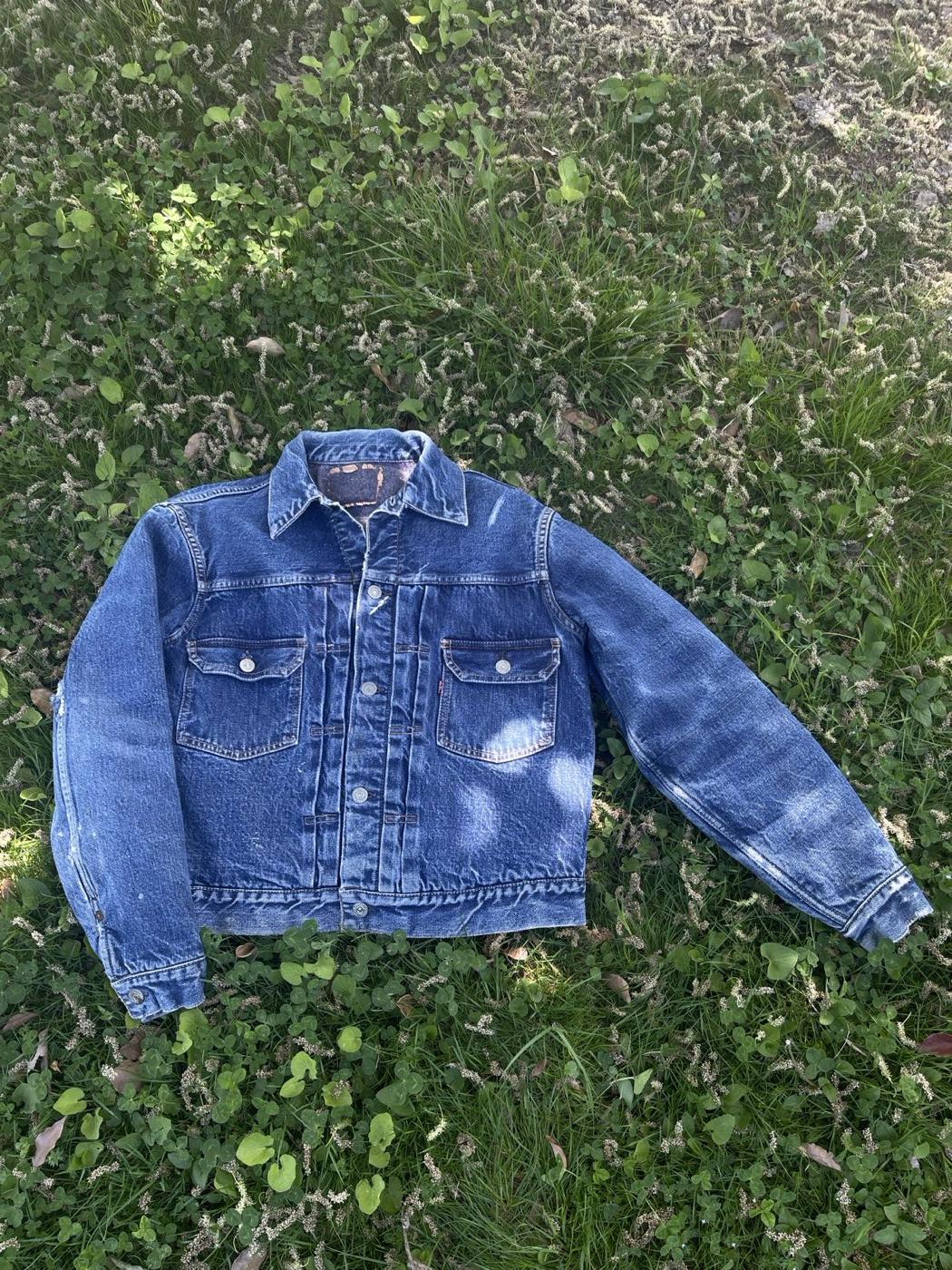
A Recent Find
A 1940s Levi’s Type 1 jacket, sold to us by a former dealer who knew exactly what he had. We paid $12,000 in cash, the same day.
From the Shop
Are My Old Levi's Worth Anything? Read the Patch, Care Tag, Selvedge and Big E
Read the transcript
Hi guys, Sam here with California Vintage Buyers, and I want to help clear the air and give you a little bit of information on how do you know if your old Levi's you're looking at are worth the time to try to sell them or bound for Salvation Army and just get them out of here. There's not really value there. This is not an exhaustive list of things to look for, but it's just some key distinguishing factors, right? So I have a few pairs of pants in front of me and different eras. So we're going to go over with the newer ones, right? Here we have a pair of the year 2000 pants. How do I know that these are from the year 2000? Well, because if you see that dark 501XX right there, that style of lettering is from the 90s to the early 2000s. It's different than this stuff. Do you see the difference of that one right there? You can see the difference. We'll get to these in a minute. But if you see that block lettering on your pants, you're looking at 90s up to say 2004 or something like that. Another tell. Let's just say you don't have this patch here. You wore the belt a lot. He wore the belt. She wore the belt a lot. The patch is gone. How old are my pants? With these ones, you can also pop this guy out right here. And you have, see that number right there? 1000. It's actually not the number 1000. It's 10, 00, October the year 2000. So whatever number you're looking at right there on the tag, if it has this tag on the inside leg, look at that number and you're going to see probably 0497 or what have you. It's going to be month and year. Good to know. So if that's gone, check if it has one of those. If it doesn't have one of these, then you're looking at somewhere in the 80s, right? Or potentially older. So I have a pair of 80s here. Anything made in USA is going to say on this tag, made in USA, right? So see that right there? Made in USA. Made in USA. What does these not have? These don't have made in USA. See how that part's missing? Made in Guatemala in the 2000s. They outsourced all the manufacturing. Bummer. So still good pants. We'll still buy these if the wash is cool. But the collector factor is not there. So again, if you got a pile of 100 of these guys, we'll still buy them. Give us a call. Are you kidding me? But when it comes to like Levi's, it's the details that matter. So moving forward. Oh, another thing is the distinguishing factor. See how it's red, the 501. And this one's black. You see in red, you're seeing 80s. Right? So you're looking at made in USA. Got the little red 501. That was an 80s thing. Right? So that's a couple things. Then you go over to these guys. Now, this is also 80s, but these are early 80s. What's the distinguishing factor on these guys? Flip up the pant leg. Do you see that? That's called selvedge denim. They call them redlines. These are called redlines. Right? Anything 501, 1982, 83-ish, right around there, and previous is going to have this kind of thing. This makes the value go up a little bit higher. Right? Why do they call these redlines you're asking? Great question. Well, when they were brand new, like these puppies from the 70s, which are a fantastic sample, they had a red line. Then, selvedge denim. So what does selvedge denim mean? It means the pant leg was made out of one sheet of denim, and they slapped them together. That's the end of a sheet of denim. They put them together, and they sewed the pant leg. And so this is made out of one sheet, a little more collectible. These are redlines. These are redlines. If you see that, you're looking at redlines. Even if you don't see any red, you got a pair of redlines. Right? We'll buy all these guys. Now, if you see one of these things that has a capital E right there, it's even better. Right? If you're looking at dealing with a barn, a ranch, Uncle Bob's house, and you're clearing it out, and you found him in the attic or in the bottom of his closet or something, we're great buyers for all this stuff. And we've paid up to thousands before for certain types of Levi's. There's a collectible value. It all depends on what the details are. You know? It's like if you call the car dealership, and you're like, hey, what do y'all pay for cars? They're going to say, okay, well, yes, we buy cars. What's the make? Model? Mileage? How's the condition? All the things. Give us a call. Number is 949-449-1255. We'd love to help you discern what you got, make your sweet offer, and buy all that stuff and more.
How it works
Text us photos.
Send shots of the piece, the tags, and the buttons to (949) 449-1255. A real buyer answers the same day.
Video call, price agreed.
Ten minutes on FaceTime or whatever you already use. We agree the number while the piece is in your hands.
Paid before you ship.
The PayPal payment lands before you pack a box. Then we handle the shipping label, and shipping is on us.
Common questions
How do I sell my old Levi’s from Alaska?
Three steps. Text photos to (949) 449-1255, front, back, red tab, and the patch. We look together on a quick video call and agree on a price. The money lands in your PayPal, then you ship it with the shipping on us. You never send anything before you are paid.
Does anyone actually buy used Levi’s?
Yes, and the older the better. Pre-1971 big E pieces are the heart of the collector market, pieces into the late 1980s still have real buyers, and even worn examples sell when the era is right. Recent mall-era jeans are not our market, and we will tell you so honestly rather than waste your time.
Which Levi’s are most valuable?
Big E red tabs, 501XX pairs, buckle-back cinches, and Type 1 and 2 jackets lead the market. Redline selvedge ran into the mid 1980s, so even 1970s and early 80s pairs deserve a look. The details are exactly what the video call is for: hold the jeans up to the camera and we will read them with you.
My jeans are worn out. Are they still worth selling?
Often yes. Fading, repairs, and honest wear are part of what collectors want, and a hard-worn pair from the right era beats a clean pair from the wrong one. The 1880s pairs that sell for five and six figures came out of mine shafts. Let us look before anything goes in the burn barrel or the donation bag.
What exactly am I photographing when I text pictures of the jeans?
Six shots cover most of it: the front, the back, the small tab on the back pocket, the leather or paper patch above it, the inside care tag if there is one, and the reverse of the top button. The tab tells us whether the E is capital or lowercase, the button back carries a small factory number, and the care tag carries a lot number, and together those date a pair within a few years. Send them to (949) 449-1255 and a real buyer answers the same day.
I worked the pipeline in the seventies. Is that denim old enough to be worth anything?
Yes, seventies Levi’s sit squarely in the eras collectors chase. Check the red tab for a lowercase e, look for a single line of stitching along the back pocket edges, and see whether the care tag is printed on cloth rather than woven, since those details separate the seventies from later decades. Whatever you do, do not wash them, do not have them repaired, and do not cut off tags or belt loops, because a washed pair loses the fades and creases that are most of what a collector is paying for.
I live off the road system. Can I still sell to you?
If the mail reaches you, yes. The photos and the video call happen wherever you have a signal, the payment lands in your PayPal before any box exists, and the trip to the post office can wait for your next run to town. Shipping is on us, and USPS has reached every corner of the state we have ever needed it to. Distance is the reason this process exists, not an exception to it.
Know what it’s worth before you sell.
Our field guides explain how the market actually prices these things. No fishing, no hype: real ranges and the details that move them.
One call. We’ll take it
from there.
(949) 449-12555.0 on Google · Free video appraisal · Paid before you ship, shipping on us
Mon-Sat 6 am-8 pm · Sun 8 am-5 pm
A real person answers seven days a week, weekends included. Photos sent today are usually answered the same day.
Or send your photos online Photos on your phone? Text them to (949) 449-1255
Also from California Vintage Buyers
- Sell vintage Levi’s to people who know what they’re holding.→
- Where do you actually sell old clothing in Fairbanks?→
- Four of every ten Alaskan closets are within an hour of Anchorage.→
- Grandpa’s uniform deserves a real answer, not a donation bin.→
- Sell vintage Carhartt to people who know what a union label means.→
- Southern Oregon wore its Levi’s hard. We pay what they’re actually worth.→