Field Guide
Where to Sell Vintage Levi’s in Southern California: Your Options, Compared
Consignment, eBay, trade-in programs, ship-in buyers, or a local cash buyer. Each one makes sense for somebody. Here is how to tell which one makes sense for you.
We buy from every state · free video appraisal · paid before you ship
By Sam Wingenbach and Jake Cover, the buyers behind our video appraisals and house calls · Updated October 7, 2026
Read the transcript
Hi guys, Sam here with California Vintage Buyers, and I want to help clear the air and give you a little bit of information on how do you know if your old Levi's you're looking at are worth the time to try to sell them or bound for Salvation Army and just get them out of here. There's not really value there. This is not an exhaustive list of things to look for, but it's just some key distinguishing factors, right? So I have a few pairs of pants in front of me and different eras. So we're going to go over with the newer ones, right? Here we have a pair of the year 2000 pants. How do I know that these are from the year 2000? Well, because if you see that dark 501XX right there, that style of lettering is from the 90s to the early 2000s. It's different than this stuff. Do you see the difference of that one right there? You can see the difference. We'll get to these in a minute. But if you see that block lettering on your pants, you're looking at 90s up to say 2004 or something like that. Another tell. Let's just say you don't have this patch here. You wore the belt a lot. He wore the belt. She wore the belt a lot. The patch is gone. How old are my pants? With these ones, you can also pop this guy out right here. And you have, see that number right there? 1000. It's actually not the number 1000. It's 10, 00, October the year 2000. So whatever number you're looking at right there on the tag, if it has this tag on the inside leg, look at that number and you're going to see probably 0497 or what have you. It's going to be month and year. Good to know. So if that's gone, check if it has one of those. If it doesn't have one of these, then you're looking at somewhere in the 80s, right? Or potentially older. So I have a pair of 80s here. Anything made in USA is going to say on this tag, made in USA, right? So see that right there? Made in USA. Made in USA. What does these not have? These don't have made in USA. See how that part's missing? Made in Guatemala in the 2000s. They outsourced all the manufacturing. Bummer. So still good pants. We'll still buy these if the wash is cool. But the collector factor is not there. So again, if you got a pile of 100 of these guys, we'll still buy them. Give us a call. Are you kidding me? But when it comes to like Levi's, it's the details that matter. So moving forward. Oh, another thing is the distinguishing factor. See how it's red, the 501. And this one's black. You see in red, you're seeing 80s. Right? So you're looking at made in USA. Got the little red 501. That was an 80s thing. Right? So that's a couple things. Then you go over to these guys. Now, this is also 80s, but these are early 80s. What's the distinguishing factor on these guys? Flip up the pant leg. Do you see that? That's called selvedge denim. They call them redlines. These are called redlines. Right? Anything 501, 1982, 83-ish, right around there, and previous is going to have this kind of thing. This makes the value go up a little bit higher. Right? Why do they call these redlines you're asking? Great question. Well, when they were brand new, like these puppies from the 70s, which are a fantastic sample, they had a red line. Then, selvedge denim. So what does selvedge denim mean? It means the pant leg was made out of one sheet of denim, and they slapped them together. That's the end of a sheet of denim. They put them together, and they sewed the pant leg. And so this is made out of one sheet, a little more collectible. These are redlines. These are redlines. If you see that, you're looking at redlines. Even if you don't see any red, you got a pair of redlines. Right? We'll buy all these guys. Now, if you see one of these things that has a capital E right there, it's even better. Right? If you're looking at dealing with a barn, a ranch, Uncle Bob's house, and you're clearing it out, and you found him in the attic or in the bottom of his closet or something, we're great buyers for all this stuff. And we've paid up to thousands before for certain types of Levi's. There's a collectible value. It all depends on what the details are. You know? It's like if you call the car dealership, and you're like, hey, what do y'all pay for cars? They're going to say, okay, well, yes, we buy cars. What's the make? Model? Mileage? How's the condition? All the things. Give us a call. Number is 949-449-1255. We'd love to help you discern what you got, make your sweet offer, and buy all that stuff and more.
The short answer: in Southern California you have five ways to sell vintage Levi’s: a resale or consignment shop, Levi’s own SecondHand trade-in, eBay, a national ship-in buyer, or a local cash buyer who comes to you. California Vintage Buyers, based in Laguna Hills, makes house calls across Orange County, Los Angeles, and San Diego and pays cash the same day. Outside Southern California, California Vintage Buyers buys old Levi’s from every state by video call: text photos to (949) 449-1255, agree the price on the call, and get paid through PayPal before you ship (every route from any state, compared). The right choice depends on what your denim is worth, and the comparison below shows how to tell.
If you have vintage Levi’s to sell, you have more options than most people realize, and they pay very differently depending on what you have and how much work you want to do. We buy vintage denim for a living, so we obviously have a horse in this race. We have tried to be straight about the cases where another route serves you better, because it sometimes does.
| Option | Payout speed | Typical net for valuable vintage | Effort and risk |
|---|---|---|---|
| Resale or consignment shop | Same day, or months on consignment | Retail-margin price; rare pieces often underpaid | Low effort; the counter may not recognize what you have |
| Levi’s SecondHand trade-in | Same day | Small gift card, capped regardless of rarity | No effort, but rarity is never paid for; wrong for anything old |
| eBay and marketplaces | Days to months | Highest ceiling if you know collector language | High effort; fees, returns, and pricing mistakes |
| National ship-in buyer | About a week | Fair from good operators | You mail valuables to a stranger and wait on the in-hand verdict |
| Local cash buyer, house call | Same visit | Collector-market offer, explained in person | None; you watch the evaluation happen |
What does the same pair bring by each route?
The table above compares the routes. This one puts real numbers on them for the pairs families actually find. The trade-in column is Levi’s own published value, read in August 2026. The eBay column is what pairs actually sold for between June and early September 2026, not what sellers were asking. The fee column is eBay’s own clothing rate, read in September 2026: 13.6 percent of the sale up to $7,500, plus $0.40 an order.
| The pair | Levi’s SecondHand, read August 2026 | Sold on eBay, June to September 2026 | eBay’s cut at 13.6 percent, read September 2026 |
|---|---|---|---|
| Worn 1980s or 1990s Made in USA 501 | $30 gift card | $40 to $150 | About $5 to $20 |
| Deadstock 1980s or 1990s 501 with the flasher tags still on | $30 gift card | $299 to $899 | About $41 to $122 |
| Redline selvedge 501, most pairs | $30 gift card | $200 to $1,000 | About $27 to $136 |
| 1960s big E 501, wearable | $30 gift card | $540 to $1,600 | About $73 to $218 |
| Levi’s Vintage Clothing reproduction, used | $30 gift card | $99 to $311 | About $13 to $42 |
Read it two ways. For a worn 1990s pair, the trade-in is a fair, frictionless deal, and listing it yourself nets only a little more after fees, shipping, and your evening. For anything with a redline, a capital E from before 1971, or its original tags, the same $30 credit is a small fraction of what the pair sells for, and a trade-in cannot be undone. Many of the eBay rows closed on Best Offer, where the accepted price can land below the listed one, so treat the eBay column as a ceiling for your own pair, not a promise.
Option one: consignment and resale shops
Southern California has excellent vintage shops that buy over the counter or take pieces on consignment. For ordinary vintage, 1990s 501s, worn trucker jackets, non-collector pieces, this is a fine route: you get an answer the same day and the shop handles everything. The limits show up when the piece is genuinely valuable. A shop buying for its own racks pays a retail-margin price, and consignment means waiting months for a sale that may not come. If your jeans have a capital E on the red tab, hidden rivets, or a leather patch, a shop counter is usually the wrong place to find out what they are worth.
Option two: Levi’s own SecondHand trade-in
Levi’s runs a trade-in program that accepts old jeans and trucker jackets at participating stores in exchange for gift cards, typically capped at modest amounts regardless of what you bring in. It is a tidy way to pass along ordinary used denim and keep it out of a landfill. It is not a market price for anything collectible, and the store associate is not trained to recognize a 1955 501XX. Use it for the ordinary, never for the old.
Option three: eBay and online marketplaces
For a seller with time, good photographs, and patience, eBay reaches the deepest pool of denim collectors in the world, including the Japanese market where much of the best American denim ultimately goes. The catch is that top prices require knowing exactly what you have and describing it in collector language: lot numbers, tab details, measurements taken the way buyers expect. Price a rare pair wrong and it sells in an hour for a tenth of its value. There are also fees, returns, and the real risk of a buyer disputing an expensive item. If you already know the collector market, eBay is a strong option. If you are guessing, it is the most expensive place to guess.
Option four: national ship-in buyers
Several reputable national companies buy vintage Levi’s by mail: you text them photos, they quote, you ship, they pay. For sellers in states with no local vintage market, this model works well, and the good operators are knowledgeable and fair. The trade-off is concrete. Grading from photos forces conservative offers, because the buyer is pricing the risk of everything a photo cannot show, and the final money conversation happens after the pair is already in a box and gone. An in-person read, or a live video call, prices the actual denim instead of a photograph of it. That is why California Vintage Buyers runs remote buying the other way around, for sellers in every state: text photos to (949) 449-1255, we look at the pair together on a video call, agree the price on that call, and send payment through PayPal before you ship, with shipping on us.
Option five: a local cash buyer who comes to you
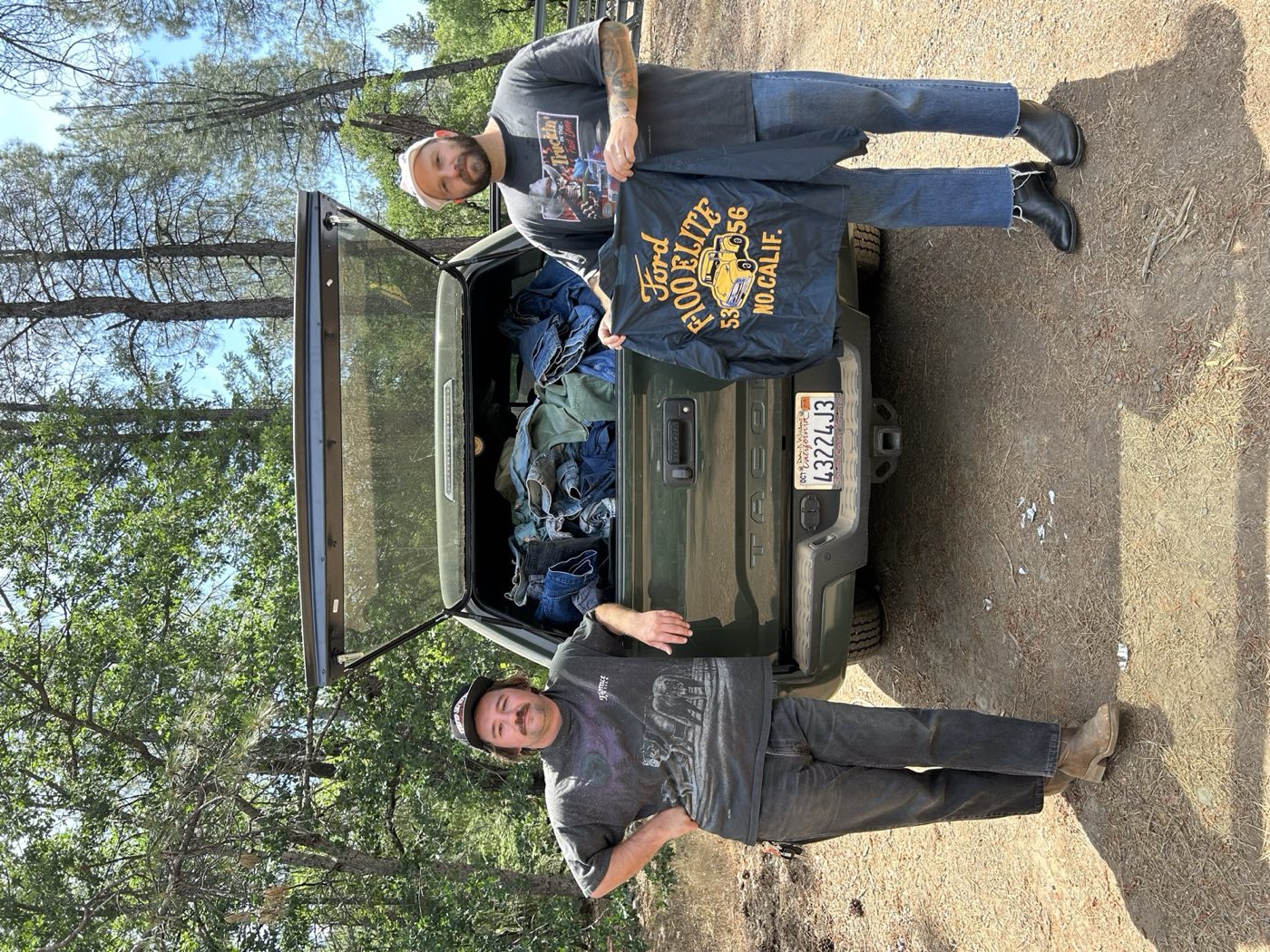
This is what we do, and in Southern California it is an option most of the country does not have. We drive to you anywhere from Santa Barbara to San Diego, most often through Orange County and up into the Los Angeles basin, evaluate the denim in front of you, explain what we are seeing, tab by tab and rivet by rivet, and pay cash before we leave. Nothing gets shipped, nothing waits on consignment, and you watch the entire evaluation happen. We paid $12,000 in cash, same day, for a 1940s Type 1 jacket, to a seller who knew exactly what he had and chose this route anyway.
Two checks before you pick a route
- Rule out a reproduction first. Levi’s own Vintage Clothing line remakes big E, redline, and hidden-rivet pairs with real care, and used ones sold for $99 to $311 on eBay between June and September 2026, a fraction of an original. Some resale listings drop the word LVC entirely, and a style number like 66501 on the tag is Levi’s 1966 reproduction, not a 1966 pair. Price the pair you actually have before you choose where to sell it.
- Do not trade in or list before anyone has read the pair. Once a pair is traded for store credit it is gone, and once a rare pair is listed at an ordinary price it can sell within the hour. A free read from photos costs nothing and keeps every route open.
The honest summary
- Ordinary modern denim: Levi’s SecondHand or any resale shop. Quick, fair for what it is.
- Decent vintage, and you enjoy selling: eBay, if you can describe it in collector terms and wait for the right buyer.
- Potentially valuable vintage, outside California: a buyer who agrees the price with you on a live video call and pays before you ship. California Vintage Buyers buys that way from every state; text photos to (949) 449-1255.
- Potentially valuable vintage, in Southern California: get it evaluated in person before it goes in a box or on a website. The evaluation costs nothing and you keep every option open.
Not sure which category your denim falls into? Text photos of the red tab, the waistband patch, and the back of the jeans to California Vintage Buyers at (949) 449-1255, from any state. We will tell you honestly what you have, usually the same day.
Common questions
- Where is the best place to sell vintage Levi’s?
- It depends on the pair. High-value early denim is best sold to a knowledgeable buyer who can verify it and agree the price with you live, in person or on a video call, while common later pairs may do fine on a marketplace if you have time to list and ship. Trade-in programs pay the least. California Vintage Buyers buys old Levi’s from every state: call or text (949) 449-1255.
- Who buys old Levi’s if I do not live in Southern California?
- California Vintage Buyers buys old Levi’s jeans and jackets from every state. Text photos of the red tab, the patch, and the care tag to (949) 449-1255, we look at the pair together on a free video call and agree the price on that call, and payment arrives through PayPal before you ship, with shipping on us. Other mail-in denim buyers exist too, and the question worth asking any of them is whether they pay before the box leaves your hands or after it arrives.
- How much does the Levi’s SecondHand trade-in pay?
- Checked against Levi’s published values in September 2026: up to $30 for jeans or a Trucker Jacket made more than twenty years ago, up to $15 for early 2000s pieces, and up to $5 for items from the past ten years. Pairs with large rips, holes, stains or missing buttons earn nothing at the counter. It is paid as a gift card for Levi’s merchandise rather than cash, and items they cannot resell earn nothing. Convenient, but credit at that level is a small fraction of what a valuable vintage pair brings from a collector buyer in cash.
- Is it safe to mail vintage jeans to a buyer?
- For a common pair the risk is small, but four-figure denim is exactly what owners are least comfortable shipping. In Southern California a house call removes the risk entirely and pays cash the same visit. Outside the region the safe version of shipping exists too: we agree a price on a video call and pay through PayPal before the box is packed, so you are never shipping on faith.
- Is Levi’s own trade-in program worth using for vintage?
- Compare it honestly before you decide. As of September 2026 Levi’s SecondHand pays up to $30 for jeans or a Trucker Jacket made more than twenty years ago, as a gift card rather than cash. For an ordinary old pair that is a fair and frictionless deal. For a big E pair from before 1971, a buckle-back, or an early jacket, it is a small fraction of collector-market value and the trade cannot be undone, so have the denim read first. Terms change, so re-check them.
- Is eBay better than selling to a buyer in person?
- It depends on what you are holding. eBay keeps 13.6 percent of a clothing sale up to $7,500 plus $0.40 an order (its own fee page, read September 2026), grading vintage denim accurately is difficult, mistakes are expensive in both directions, and high-value listings attract fraud and chargebacks. A documented in-person cash offer removes fees, returns, and shipping risk. For an ordinary 1990s pair the marketplace may well net more; for early denim the risk sits the other way.
- Should I sell a whole lot or piece by piece?
- Whole lots are usually the better trade for the seller, because the good pieces carry the ordinary ones and nothing sits unsold in a spare room for a year. The exception is a single standout garment, an early Type 1 or a buckle-back, which deserves to be valued on its own rather than absorbed into a lot price.
Have something like this?
One phone call, from any state. A free video appraisal, the price agreed on the call, and payment through PayPal before you ship, with shipping on us. In Southern California we come to you and pay cash the same day.
Keep reading
- Where to Sell Vintage Levi’s From Anywhere in the US (2026)→
- How to Photograph Vintage Levi’s for an Accurate Offer→
- Sell vintage Levi’s to people who know what they’re holding.→
- Sell vintage Levi’s in Orange County to buyers based right in Laguna Hills.→
- Sell vintage Levi’s in Los Angeles without the middleman markup.→