Field Guide
How to Photograph Vintage Levi’s for an Accurate Offer
A buyer who cannot hold the pair reads it through your phone. Ten well-lit photos carry nearly every signal that dates a pair of Levi’s, and each one takes a few seconds.
Think you have one? Text a photo to (949) 449-1255
By Sam Wingenbach and Jake Cover, the buyers who make our house calls · Updated September 25, 2026
The short answer: to get an accurate offer on vintage Levi’s from photos, send the whole front, the whole back, the red tab from both sides, the back patch, every tag inside the waistband including the small care tag, the back of the top button, the back pockets and rivets, the cuff turned up to show the side seam, and the waist and inseam measured flat beside a tape measure. Those ten shots carry nearly every dating signal a buyer reads, and you can text them to (949) 449-1255 or send them through our photo form.
Two pairs of Levi’s that look identical across a room can be decades and hundreds of dollars apart, and the difference lives in details the size of a fingernail: a letter on the tab, a digit on a button, a thread in the cuff. A buyer working remotely can only price what your photos show. Clear photos of the right details get you a real number. Blurry photos of the whole pair get you a cautious one.
What photos do I need to sell vintage Levi’s jeans?
| The shot | How to take it | What it tells the buyer |
|---|---|---|
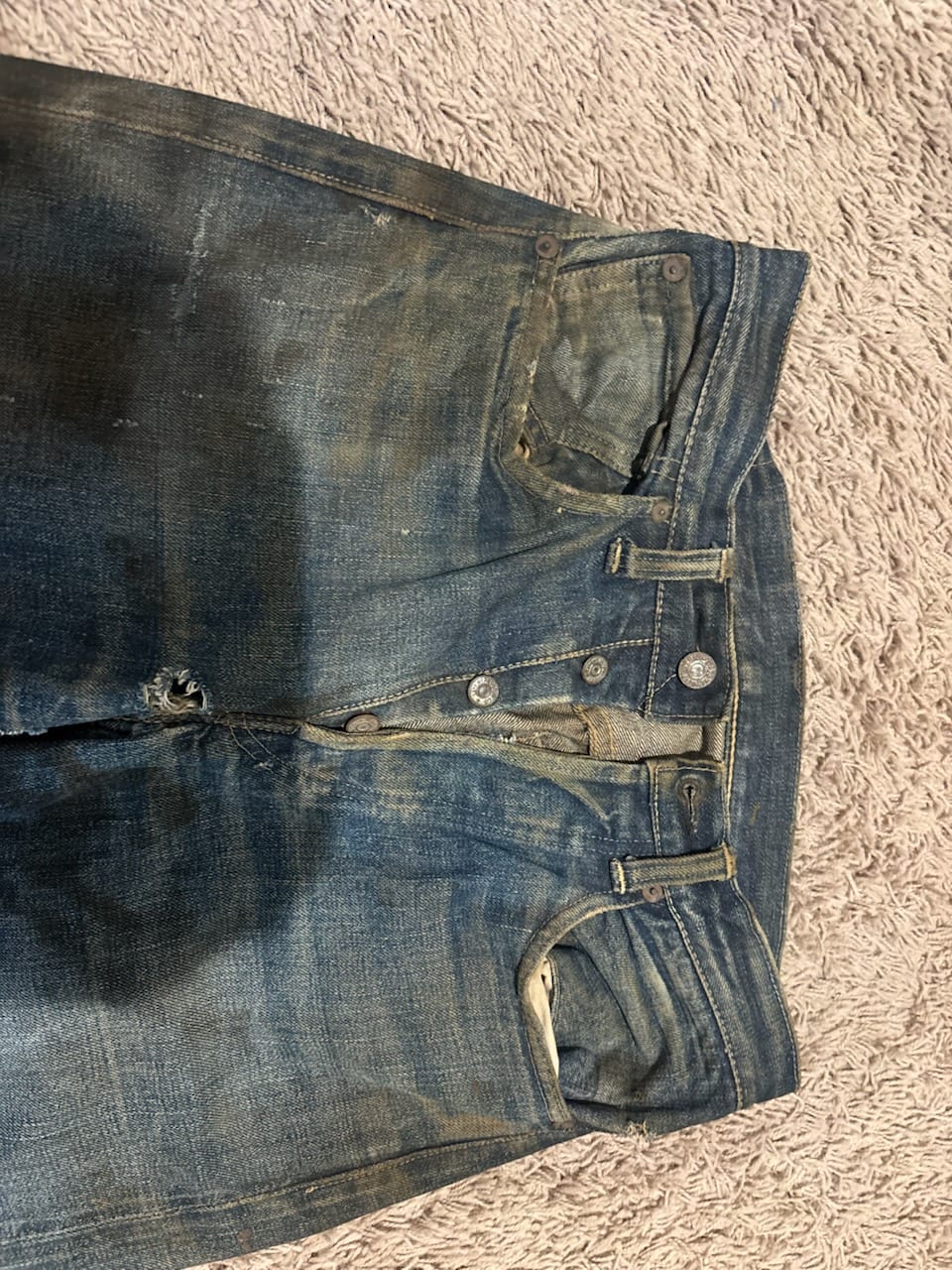
| 1. Whole front | Laid flat, buttoned, the full pair in frame | Overall condition, fade, repairs, and whether the fly is buttons or a zipper |
| 2. Whole back | Laid flat, the full pair in frame | The back pockets and their stitching, the patch, and whether there is a buckled cinch strap, which on jeans means before about 1942 |
| 3. Red tab, both sides | Close up, then fold the tab back with a finger | A tab reading LEVI’S in capitals means before 1971. Lettering on one side only is a 1936 to early 1950s marker. No tab at all points before 1936, and an orange tab means 1969 or later |
| 4. Back patch | Straight on, filling the frame, every character readable | The lot number and the size. XX after the number, as in 501XX, places a pair before about the mid-1960s |
| 5. Every tag inside the waistband | Open the waistband and flatten each tag, including the tiny one at the bottom of the care tag | No care tag means before 1971. On 1970s and 1980s pairs the short code gives the month and one digit of the year; from 1993 it is a four-digit month and year. A Levi’s Vintage Clothing tag or a modern barcoded label marks a reproduction |
| 6. Back of the top button | Open the fly and photograph the stamp inside the waist button | A factory code. Original pre-1971 buttons carry no number or one or two digits; later pairs and reproductions carry three. The number should match the factory number on the care tag |
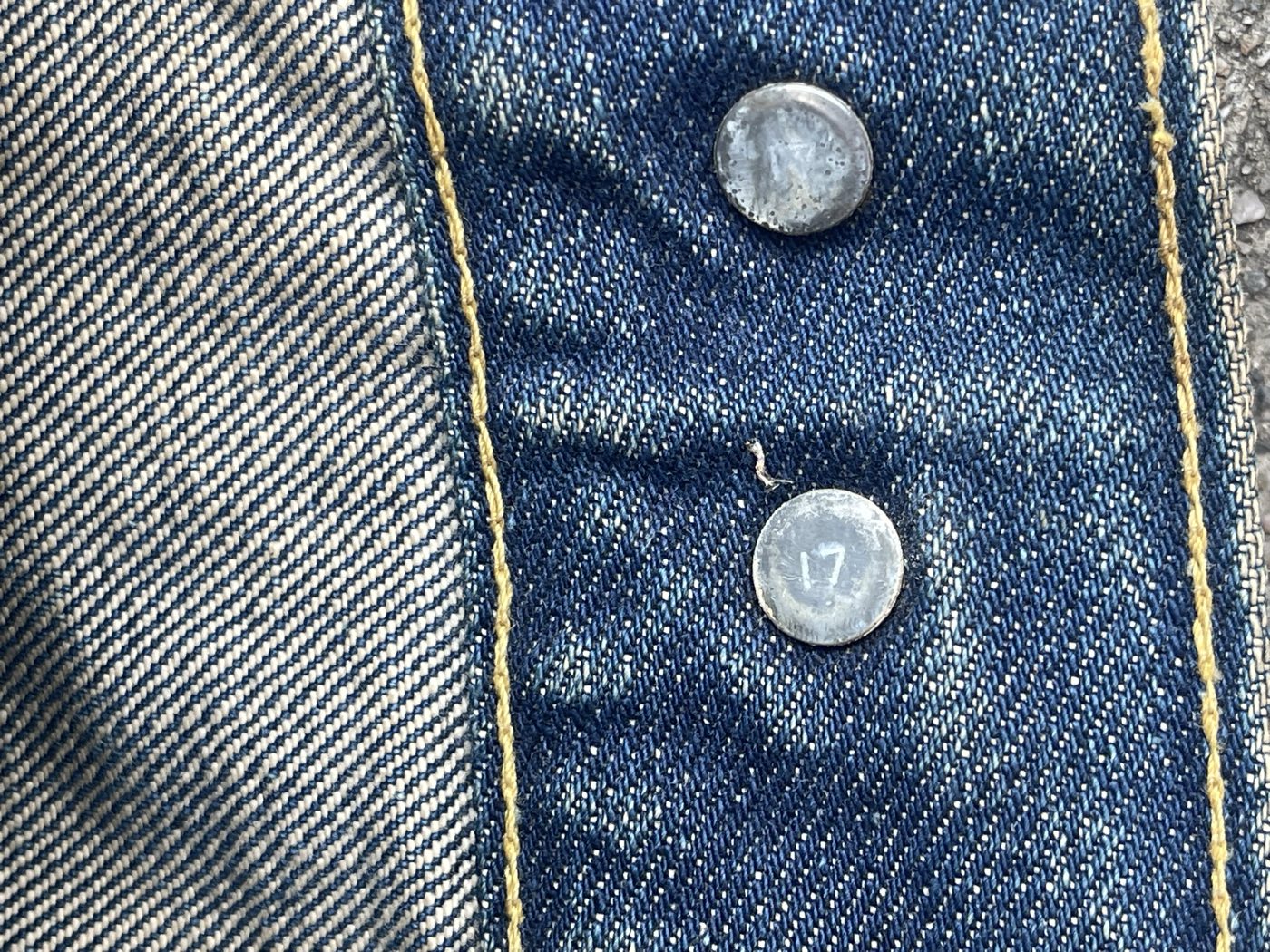
| 7. Back pockets and rivets | Each back pocket, outside and inside | Rivets showing on the outside of the back pockets mean before 1937. Rivets hidden under the denim were used from 1937 to 1966 |
| 8. Cuff turned up | Turn up one leg so the inside of the outer side seam shows at the hem | A clean finished edge with a red line is redline selvedge, which on 501s ran into the mid-1980s. It is a different signal from the capital E, and often confused with it |
| 9. Waist measured flat | Buttoned, laid flat, a tape or ruler straight across the top of the waistband, the number readable | Size is the first question every buyer asks, and smaller adult waists carry a premium in the vintage market |
| 10. Inseam measured | Tape from the crotch seam down the inside of the leg to the hem | Length, and whether the leg has been cut or hemmed |
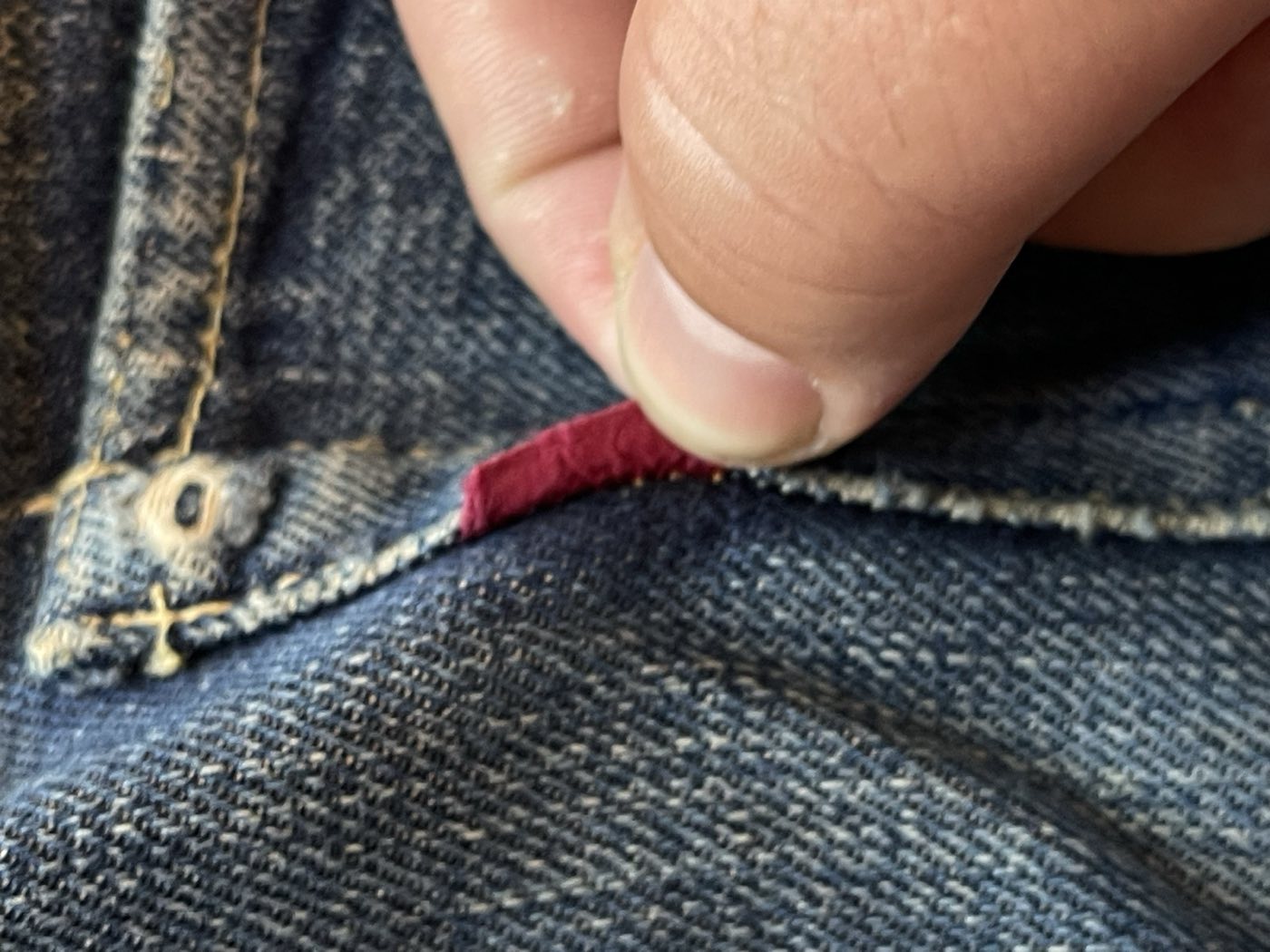
Then add a close photo of anything wrong: holes, stains, repairs, a torn or missing patch, a broken button. Damage does not end a conversation, and on old denim it is expected. Showing it up front means the number agreed on the call is the number that holds.
Why does each detail matter so much?
Because no single signal dates a pair of Levi’s on its own, and a buyer stacks them. A capital E tab with no care tag and hidden rivets is a consistent story from before 1971. A capital E tab with a barcoded care label is not, because Levi’s has put the capital E back on some modern premium products since 2018, and its Vintage Clothing line reproduces big E, redline, and hidden-rivet pairs faithfully. The tags and the button are where a reproduction usually gives itself away, which is why shots five and six matter as much as the tab.
Made in USA on the tag is worth photographing too. Levi’s closed its last United States plant in 2003, so it places a pair before then, and a 555 button stamp marks the Valencia Street plant in San Francisco, which ran until 2002. That plant also sewed early reproductions, so a 555 stamp is a detail to read alongside the tags, not proof of age. For the full signal-by-signal table, see our guide to dating Levi’s, or run the pair through the free Levi’s identifier while you have it out.
What extra photos does a Levi’s jacket need?
- The whole front, buttoned and flat. The pocket count and the pleats identify the type: one chest pocket is the early Type 1 pattern, and two pockets with pleats running down the front is the Type 2 pattern.
- The whole back. A buckled cinch strap across the back is a Type 1 feature; when the Type 2 replaced it in 1953, buttoned waist tabs replaced the cinch.
- The red tab, both sides. On jackets it sits on the left chest pocket, and the same capital E rule applies.
- The pocket flaps, close up, open and closed.
- The back of the front buttons, for the stamped factory codes.
- Every tag inside, at the collar and along the side seams. A modern care and fiber label, or a tag reading Levi’s Vintage Clothing, marks a later jacket or a reproduction.
- The patch, if there is one, straight on so the lot number reads, plus a flat measurement across the chest from armpit to armpit.
Jackets carry some of the largest numbers in vintage denim. As of August 2026 a Type 2 507XX typically brings $800 to $1,500 and a worn Type 1 $2,000 to $8,000, which is why the pocket and the tags deserve the same care as a 501’s tab. Our jacket value guide walks each type.
How should I light and set up the photos?
- Use daylight. Lay the pair near a window or take it outside in open shade. Daylight shows the true color of the indigo and the red in a selvedge line.
- Turn the flash off. Flash throws glare across a tab, a patch, and a button, which is exactly where the lettering you need lives.
- Lay it flat on a bed or a clean floor with a plain cover underneath, and hold the phone straight above the pair rather than at an angle.
- Fill the frame for details. For the tab, the tags, and the button, move close until the detail takes up most of the picture, then tap to focus before you shoot.
- Keep the numbers readable. On measurement shots, the tape and the number at the edge of the waistband should both be sharp.
- Photograph it as you found it. Do not iron, repair, or tidy the pair first; the buyer needs to see its true condition.
How many photos should I send, and how do I send them?
Ten photos per pair is the working set, plus the damage close-ups, and a jacket runs a few more. Text them to (949) 449-1255 a handful at a time, or upload them through our photo form. If you have a stack of pairs, keep each pair’s photos together and in order, starting with the whole front, so no tab ends up matched to the wrong jeans. For a big box, start with a photo of the whole pile and the tab and tags of each pair; we can ask for the rest of the shots on the pairs that need them.
Photos start the conversation; the video call finishes it. From any state, we set up a free video appraisal, look at the pair together, and agree the price on the call. If you accept, we pay you through PayPal before you ship, and shipping is on us. There is no obligation at any step. In Southern California we come to you and pay cash instead. For how this compares with every other way to sell, read where to sell vintage Levi’s from anywhere in the US, and for the remote process in full, sell from anywhere.
Common questions
- What photos do I need to sell vintage jeans?
- Ten shots cover almost every pair: the whole front and the whole back laid flat, the red tab from both sides, the back patch straight on, every tag inside the waistband including the small care tag, the back of the top button, the back pockets and rivets, the cuff turned up to show the side seam, and the waist and inseam measured flat beside a tape measure. Add close-ups of any damage. Text them to California Vintage Buyers at (949) 449-1255 for a free read from any state.
- Why does a buyer want a photo of the back of the button?
- The number stamped inside the top waist button is a factory code. On original Levi’s from before 1971 it is blank or one or two digits, while later pairs and reproductions carry three digits, and on 1970s and 1980s pairs it should match the factory number on the care tag. A 555 stamp marks the Valencia Street plant in San Francisco, which also made early reproductions, so it is read alongside the tags rather than as proof of age.
- How do I show selvedge in a photo?
- Turn up one leg so the inside of the outer side seam shows at the hem, and photograph it in daylight without flash. Selvedge shows as a clean, finished edge along the seam, and on Levi’s it usually carries a thin red line, which is why it is called redline. On 501s it ran into the mid-1980s, so it marks an older pair but is not the same as a big E tab.
- Can I get an offer on vintage Levi’s from photos alone?
- Photos get you a read and tell you whether a pair is worth pursuing. With California Vintage Buyers the price itself is agreed on a free video appraisal, where we can ask you to turn the cuff or tilt the tab into the light. If you accept, we pay through PayPal before you ship, with shipping on us, and there is no obligation. Text photos to (949) 449-1255 to start.
Have something like this?
One phone call and we come to you, anywhere in Southern California. Free visit, honest evaluation, cash the same day.