Field Guide
What Is WWII Navy Denim Worth? Deck Jackets, Dungarees and Chambray
The shawl collar jacket in the sea bag is the one collectors ask about. Here is how to read the buttons, the stencil and the label, and what the market honestly pays.
We buy from every state · free video appraisal · paid before you ship
By Sam Wingenbach and Jake Cover, the buyers behind our video appraisals and house calls · Updated October 2, 2026
The short answer: an original WWII US Navy shawl collar denim jacket is a real collector piece. As of September 2026 dealers ask roughly $225 to $550 for honest worn examples, wartime dungaree trousers about $200 to $1,000, and chambray shirts $40 to $200. Those are asking prices, not sales; no public auction record exists for this category. Free identification by photo: (949) 449-1255.
Most of this denim turns up the same way: a sea bag or footlocker in a garage, a father’s or grandfather’s name stenciled on the cloth, and a family unsure whether it is a keepsake or money. It can be both. The Navy issued denim to millions of sailors in the 1940s, and the plain shawl collar jacket they wore on deck is now one of the most reproduced workwear designs in the world, which tells you how much the original is wanted. This guide covers what each piece is, how to date it, what the stencil means, how to tell issue denim from Levi’s and Lee, and what it is honestly worth.
What is the WWII Navy shawl collar denim jacket?
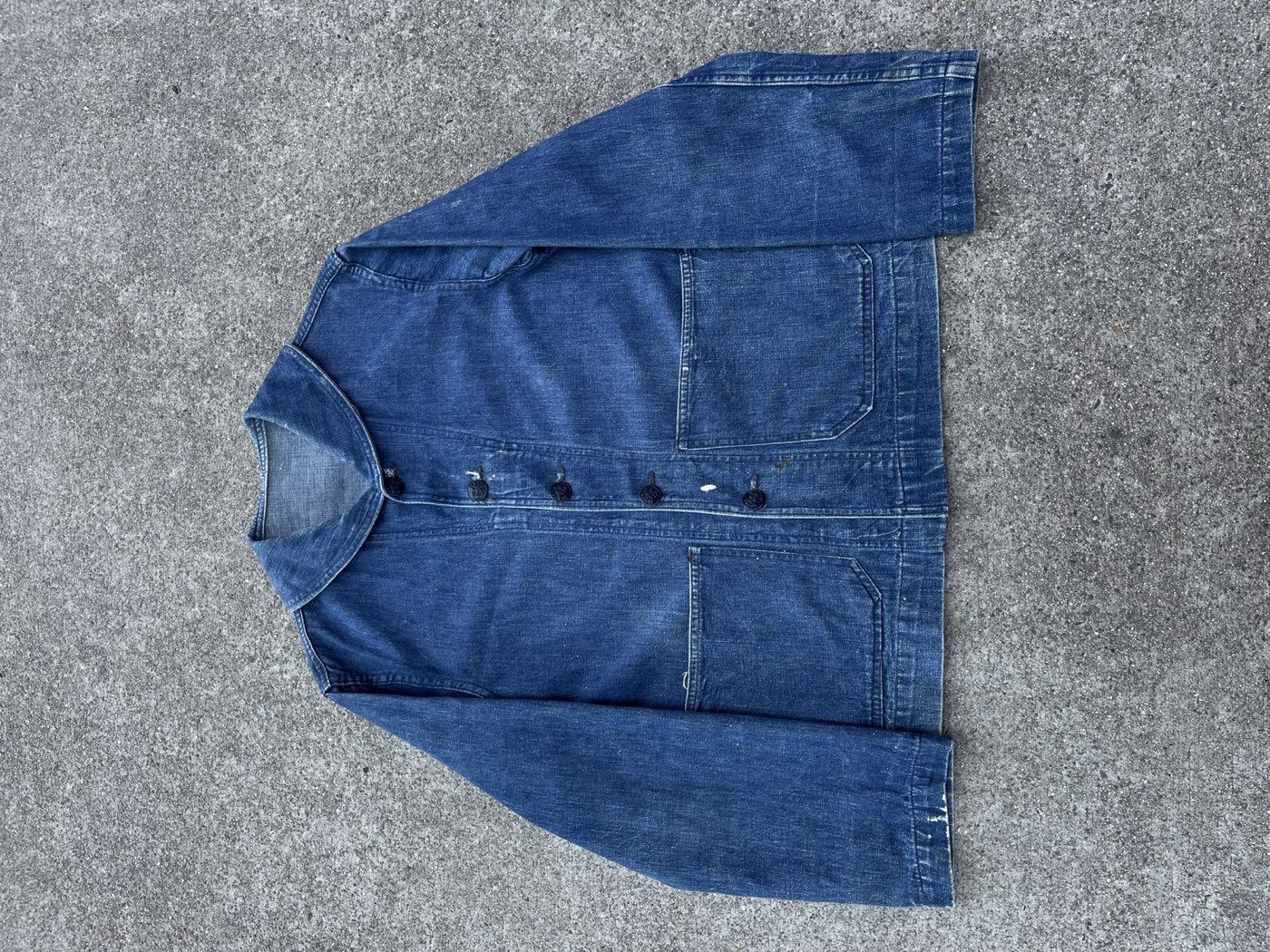
Collectors call it the USN denim jacket, the dungaree jumper, or the shawl collar deck jacket. The Navy called it a jumper. Its history is older than most people expect: regulations of 1901 authorized denim jumpers and trousers as a working uniform for dirty jobs, and the 1913 regulations allowed the dungaree outfit for officers and enlisted men alike, mostly in engine rooms, gun turrets, machinery spaces and submarines. The first jumpers pulled over the head; a button-front version appeared around 1918, and that pattern went to war in the 1940s.
The 1941 working uniform, as the regulations of that year described it, was dungaree trousers, a chambray shirt, a black web belt, black shoes and socks, and the denim button-up jumper over the top. The three garments usually surface together. The jacket is the one the market wants most, then the trousers, with the chambray shirt a distant third because the Navy kept issuing a similar shirt for decades.
What does the jacket look like, and how do I know mine is one?
- A wide shawl collar with no lapel notch.
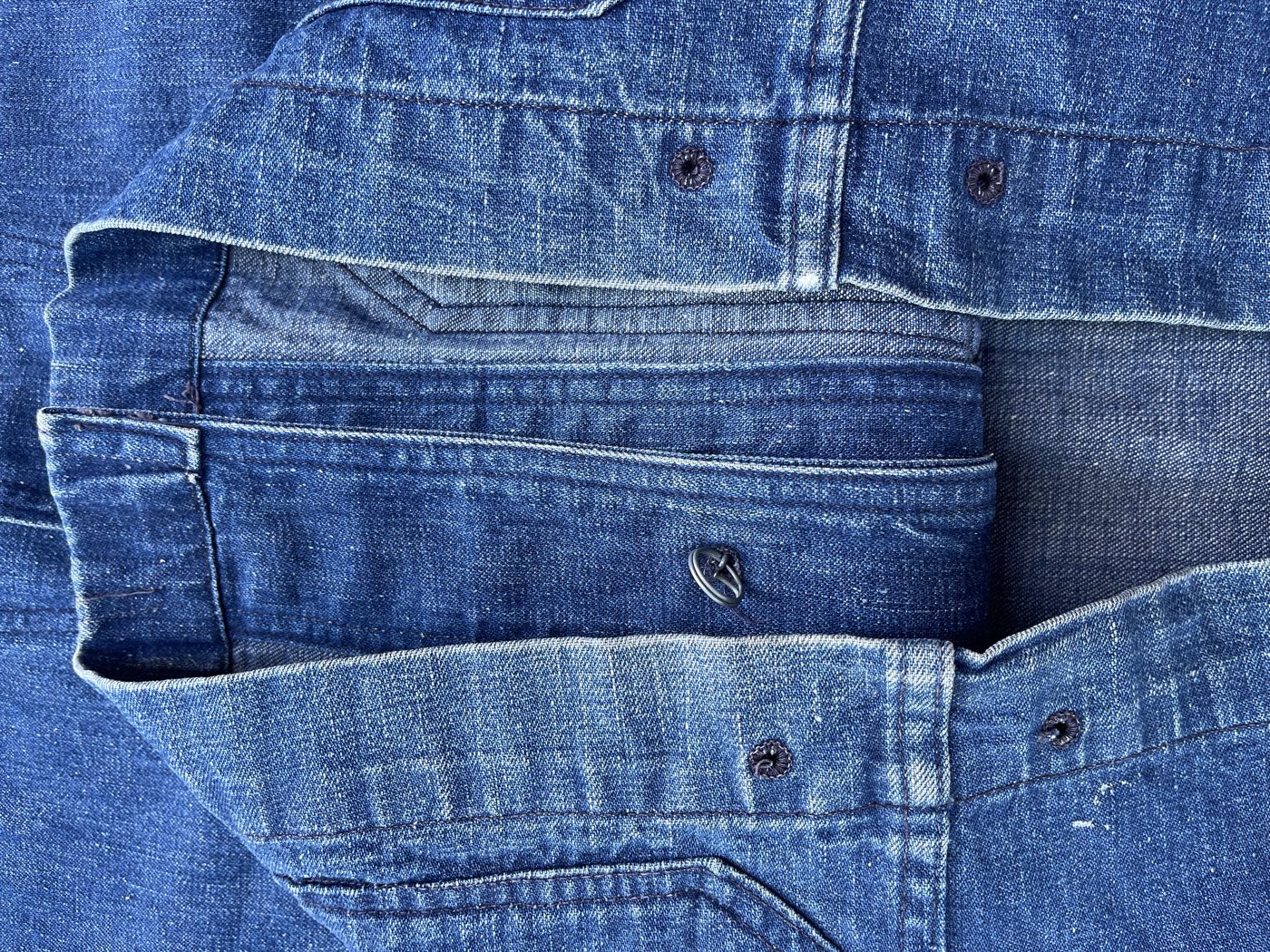
- A five-button front. The buttons are removable, hung on split rings through eyelets, so the jacket could be laundered without them.
- Open patch pockets with no flaps, at the hip and the chest, in more than one pattern.
- Small metal eyelets at the side seams near the hem, which collectors read as tie points for the clothes stops sailors used to hang laundry.
- No red tab, no leather or paper patch, no brand label. At most, a contractor label with a contract number and a size.
How do I date a Navy denim jacket or a pair of dungarees?
Start with the buttons
Collectors date these jackets first by the buttons, and the sequence they describe runs like this. Pre-war jumpers carried removable black-painted brass buttons. Early in the war, with metal restricted, plastic buttons of the same removable pattern appeared; dealers call them celluloid or bakelite. Late in the war the removable button gave way to a plain sewn-on donut button like the one on the trouser fly, and that pattern ran through the Korean War until stocks were used up. The buttons carry an anchor and often the words US NAVY. A jacket with all its original buttons on their rings is worth more than one with replacements, and one converted to a zipper has lost real value, however wearable it is.
Then the label and the contract number
Not every piece of issue denim has a label, and many have lost theirs. When one survives it can date the garment closely. Wartime Navy clothing contracts used a prefix that says who bought it: N for the Navy Department, a digit standing for the year, and an s for the Bureau of Supplies and Accounts, so a stamp reading something like NXsx followed by a number is a wartime contract. A collector database of those contracts covers roughly 1940 to 1945 and notes the numbering reset in March 1942 and April 1945. Postwar, N140s contracts came through the Navy Purchasing Office in New York, and later labels carry the year in the number itself. Never date from the label alone; read it with the buttons and the construction, and distrust any online table that claims to decode every number.
Then the construction
Wartime dungaree trousers are high-rise and wide-legged, with a button fly and two big patch pockets at the back that wrap from the thigh toward the seat. Early wartime pairs were cut without an outseam; later pairs have the seam and smaller pockets. Chambray shirts changed in 1942 to a simplified pattern with blue two-hole buttons and no pocket flaps, standard for the next twenty years, so a flapped pocket or brown cat-eye buttons say early war or before, and four-hole buttons say 1960s or later. Rate marks were not authorized on chambray shirts until 1951, so a WWII shirt should carry none.
What does the stencil on Navy denim mean?
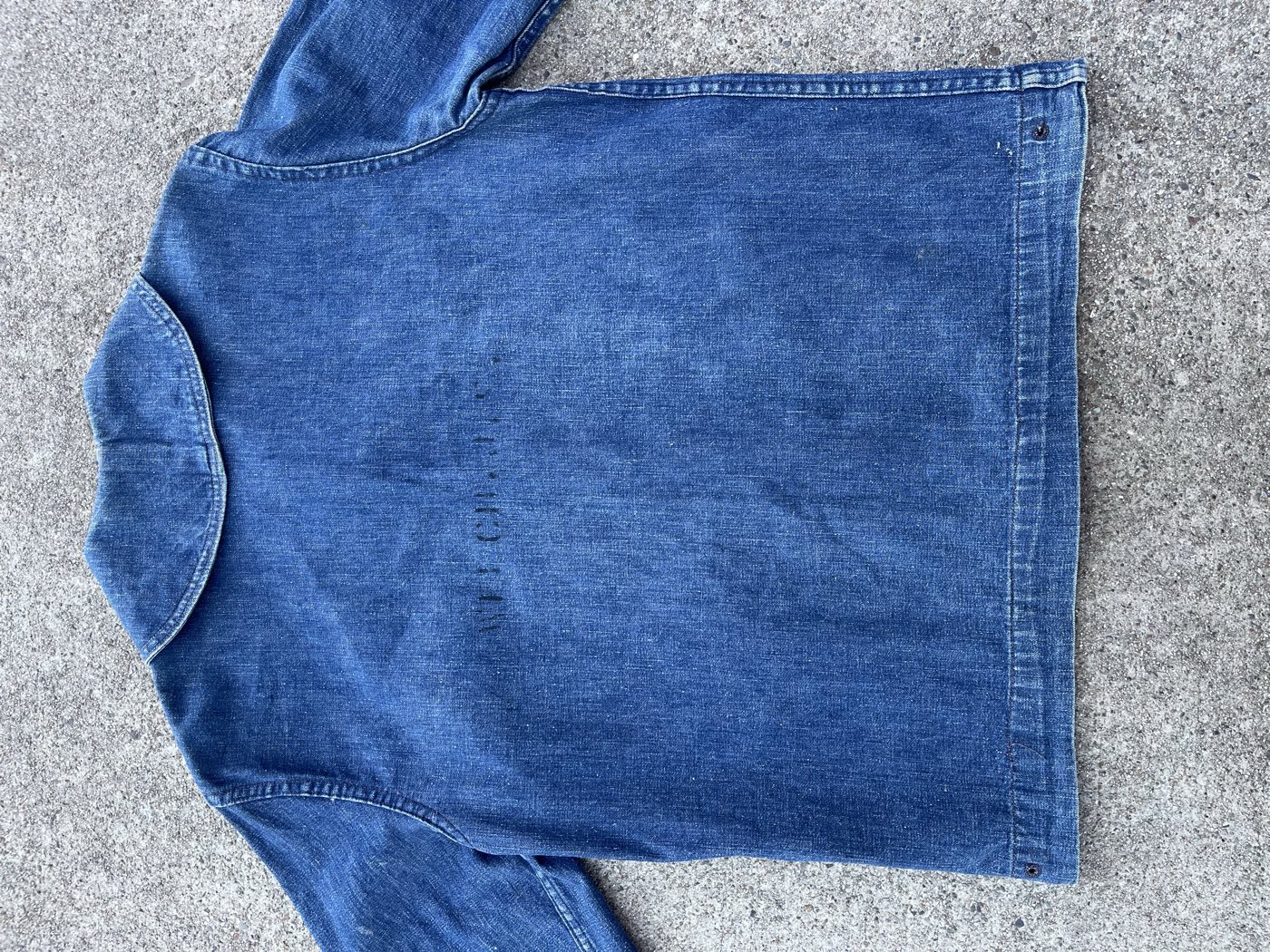
The stencil is the sailor. Navy regulations required every article of clothing to be marked with the owner’s name, meaning last name and initials, and his service number, in a set place on each garment, with a half-inch stencil or stamp where one was available. The wartime rule collectors quote called for black on white clothes and on dungarees and white on blue clothes; a postwar All Hands guide from April 1962 moved dungaree trousers to white, which is one reason stencils on old denim come in both colors. The regulation placements were tucked away: inside the waistband of the trousers, on the shirttail, inside the back hem of the working jacket. Plenty of sailors put the name big across the back or chest instead, which is why so many surviving jackets carry a faded surname where everyone could read it.
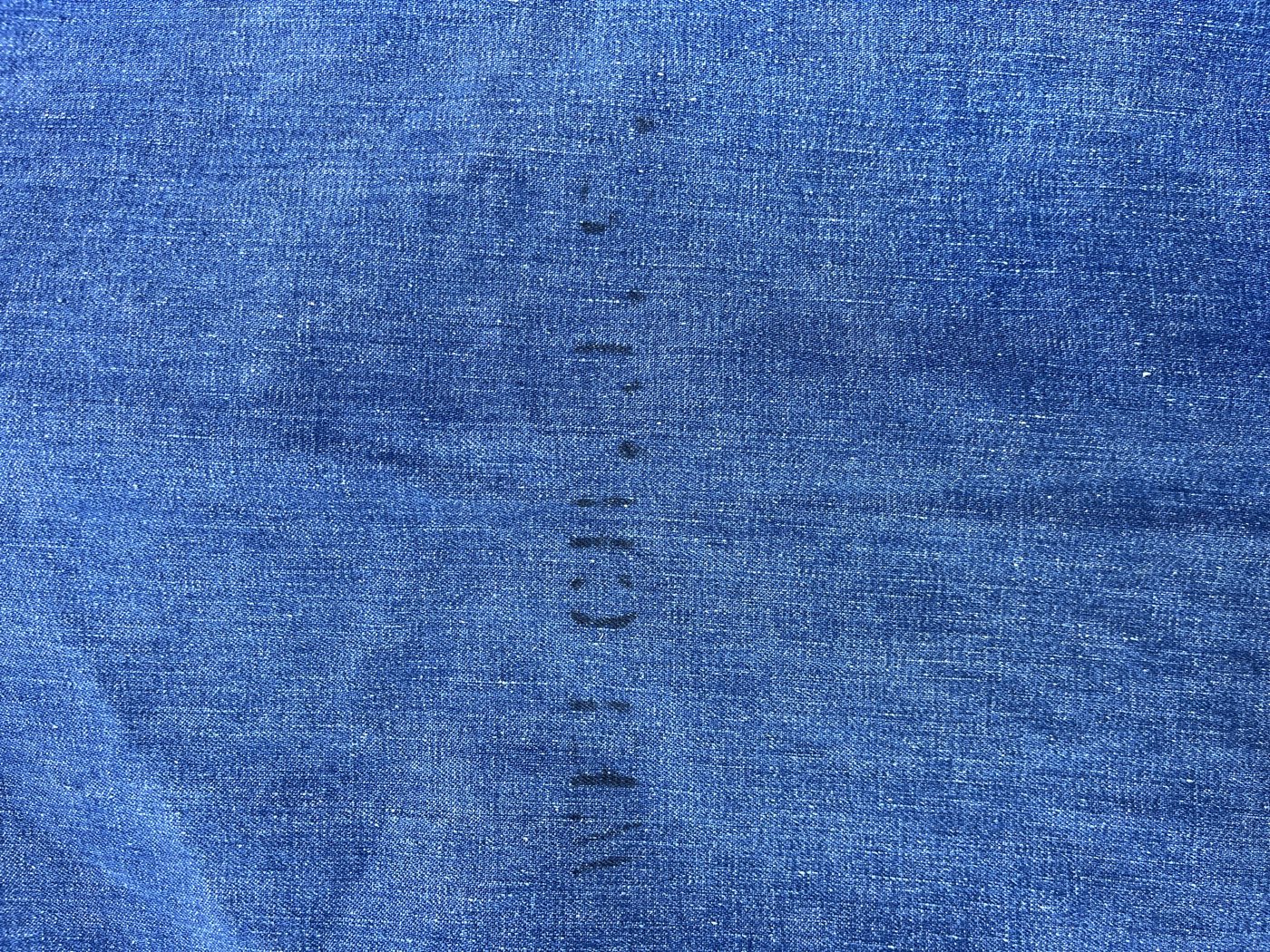
A legible name is a small piece of provenance and it belongs with the jacket. Some families can match it to a service record, a cruise book, or a photograph, and a named grouping is worth more than an anonymous garment. A USN stamp is a property mark rather than a personal one. A stencil that does not match the family name is not a problem: sailors bought and traded issue clothing, and regulations provided for stamping out the old name when a garment changed hands. A stencil is never damage. Do not try to wash it out.
How do I tell Navy issue denim from Levi’s or Lee of the same years?
A wartime sailor might have owned issue dungarees and a pair of 501s from home, and they are different markets, with 1940s Levi’s usually the more valuable garment. Navy denim is defined by what it lacks: no red tab, no arcuate stitching on the back pockets, no leather or paper patch, no rivets at the pocket corners, no brand anywhere. Its buttons carry an anchor or US NAVY or are plain donuts; a Levi’s top button of the period is branded. Navy trousers have the wrap-around patch pockets and the high wide cut; Levi’s have the five-pocket layout with the watch pocket. Lee’s workwear of the same years carries the Lee name on its buttons and label. Our guide to dating Levi’s walks through the branded side of that comparison if the bag turns out to hold both.
| Garment | Identifying marks | Typical range, September 2026, dealer asks |
|---|---|---|
| Shawl collar denim jacket, WWII | Shawl collar, removable anchor or US NAVY buttons on rings, open patch pockets, hem eyelets, stencil | About $225 to $550 at vintage and militaria dealers; eBay asks of $950 to $3,000 seen, unsupported by sales |
| Shawl collar jacket, late war to Korea | Same cut with sewn-on donut buttons | Lower end of the jacket range; still collected |
| Dungaree trousers, WWII | High rise, wide leg, button fly, wrap-around patch back pockets, no outseam on early pairs, waistband stencil | About $200 to $1,000 asked for wartime pairs; 1950s pairs nearer $200 |
| Chambray shirt, 1942 pattern | Blue two-hole buttons, no pocket flaps, contract stamp, name stencil | About $40 to $200 asked; the top end needs a contract stamp and a clean stencil |
| Chambray shirt, pre-1942 | Pocket flaps or brown cat-eye buttons | Scarcer, above the plain 1942 shirt; too few sales to state a figure |
What is WWII Navy denim actually worth?
Here is the honest state of the evidence. This category has no auction-house record; the pieces sell through vintage and militaria dealers, Etsy, Grailed and eBay, and the big marketplaces keep sold prices behind login walls. What can be read in the open, as of September 2026, is asking prices. A militaria dealer sold a wartime jacket with all its metal US NAVY buttons and a stenciled name at a $550 ask. Two vintage shops pricing in Canadian dollars sold worn examples at asks of about $325 and $529 Canadian, the second with a home-sewn zipper in place of its buttons. An Etsy listing for a 1940s jacket was marked at about $225. The eBay asks of $950 and $3,000 in the same month had no visible sales behind them. Read that as a market paying a few hundred dollars for the ordinary original, more for a big size in strong condition with its buttons and a readable stencil, and treat any four-figure number as a hope until someone shows you the sale.
One comparison keeps the number honest: a Levi’s Type 1 jacket of the same decade sells for many times as much. We paid $12,000 in cash, the same day, for a 1940s Type 1, and no Navy issue jacket approaches that. The Navy jacket is a wanted piece at a working price.
What should I not do to Navy denim before selling it?
- Do not wash it. The stencil and the paint splashes are the history, and a wash fades the stencil faster than anything.
- Do not replace or remove the buttons. Loose originals on their rings should stay with the jacket even if one has fallen off.
- Do not hem the trousers or cut the sleeves. Wartime length is part of what a collector is buying.
- Do not separate the pieces. A jacket, trousers, chambray shirt and white hat that came home together are worth more read together, and so are the papers and photographs that explain the name.
Is it legal to sell old Navy uniforms and denim?
Yes. Uniforms, working clothing, patches and insignia are lawful to buy and sell in the United States; only medals are restricted, and our military clothing page explains that line. If the bag also holds a dress uniform or a peacoat, our guide to old military uniforms covers keeping, donating and selling the whole grouping.
How do I sell WWII Navy denim?
Start with the read, not the sale. Send photos to California Vintage Buyers at (949) 449-1255 and we will tell you what the buttons, the label and the stencil say; sometimes the honest answer is that the jacket is a 1950s piece, and sometimes that the jeans beside it are the real money. In Southern California we come to you, from Navy households in San Diego and Long Beach to the Orange County garages where most of our denim turns up, and we pay cash the same visit. Outside California, we buy remotely: a free video call to inspect the pieces, a price agreed on the call, payment by PayPal before you ship, and shipping paid by us.
Common questions
- How much is a WWII Navy shawl collar denim jacket worth?
- As of September 2026, vintage and militaria dealers ask roughly $225 to $550 for an original WWII US Navy shawl collar denim jacket with honest wear; one dealer sold a stenciled example with all its metal US NAVY buttons at a $550 ask. Higher eBay asks of $950 to $3,000 have no visible sales behind them. There is no public auction record for these jackets, so treat every figure as an ask. Original buttons, a readable stencil, and a large size push a jacket toward the top.
- Why is there a name stenciled on my father’s Navy dungarees?
- Because Navy regulations required it. Every article of a sailor’s clothing had to be marked with his last name and initials and his service number, usually with a half-inch stencil, in a set place on each garment: inside the waistband of dungaree trousers, on the shirttail of the chambray shirt, inside the back hem of the working jacket. Many sailors also stenciled the name large across the back or chest. The stencil is provenance rather than damage, and it should never be washed out.
- How can I tell if a Navy denim jacket is from WWII or later?
- Look at the buttons first. Removable buttons hung on split rings, either black-painted brass or dark plastic marked with an anchor or US NAVY, are the pre-war and wartime pattern; plain sewn-on donut buttons like the ones on a trouser fly mark late-war production that continued through the Korean War. Then check for a contract stamp: a wartime Navy clothing contract starts with N, a year digit, and an s. Read the buttons, the stamp and the construction together rather than trusting any one of them.
- Are WWII Navy chambray shirts worth anything?
- Modestly. The Navy issued a similar blue chambray shirt from 1913 into the 1990s, so most old ones are postwar and bring $40 or so. A genuine WWII shirt has a wartime contract stamp, blue two-hole buttons, and, after the 1942 simplification, no pocket flaps; those are asked at up to about $200 as of September 2026, more with a clean name stencil. Pre-1942 shirts with flapped pockets or brown cat-eye buttons are scarcer still. Four-hole buttons or a rate mark mean a later shirt.
- How do I know if my USN denim jacket is a reproduction?
- The shawl collar jacket is one of the most reproduced workwear designs in the world, from $65 reenactment copies to Japanese brands charging far more, so check before you price it. Originals carry a stencil or the ghost of one, buttons with age on their paint or plastic, uneven indigo fading from years of wear, period repairs, and a contract stamp if any label survives. Reproductions have modern brand labels, even fading, bright buttons and stitching, and no service history. When in doubt, photograph the label and a button.
- Is the plain Navy jacket worth more than the old Levi’s in the same sea bag?
- Usually not. A WWII Navy shawl collar jacket is a wanted collector piece asked at a few hundred dollars, while a 1940s Levi’s Type 1 jacket or a pair of wartime 501s from the same bag can sell for thousands; we paid $12,000 in cash for a 1940s Type 1. The two are separate markets. Have everything in the bag read together before pricing any of it, because families often assume the branded jeans are ordinary and the issue jacket is the treasure, or the reverse.
Have something like this?
One phone call, from any state. A free video appraisal, the price agreed on the call, and payment through PayPal before you ship, with shipping on us. In Southern California we come to you and pay cash the same day.
Keep reading
- Grandpa’s uniform deserves a real answer, not a donation bin.→
- Sell vintage clothing in San Diego, a city built for our trade.→
- Sell vintage Levi’s in San Diego, where sea bags kept the good stuff.→
- Sell military memorabilia to buyers who understand what it meant.→
- Sell vintage workwear. The harder the life, the better it aged.→