Field Guide
How to Date Levi’s: A Step-by-Step Guide
Every pair of old Levi’s carries a stack of date stamps hidden in its details. Here is how to read them, one by one, down to a narrow window.
We buy from every state · free video appraisal · paid before you ship
By Sam Wingenbach and Jake Cover, the buyers behind our video appraisals and house calls · Updated September 30, 2026
Read the transcript
Hi guys, Sam here with California Vintage Buyers, and I want to help clear the air and give you a little bit of information on how do you know if your old Levi's you're looking at are worth the time to try to sell them or bound for Salvation Army and just get them out of here. There's not really value there. This is not an exhaustive list of things to look for, but it's just some key distinguishing factors, right? So I have a few pairs of pants in front of me and different eras. So we're going to go over with the newer ones, right? Here we have a pair of the year 2000 pants. How do I know that these are from the year 2000? Well, because if you see that dark 501XX right there, that style of lettering is from the 90s to the early 2000s. It's different than this stuff. Do you see the difference of that one right there? You can see the difference. We'll get to these in a minute. But if you see that block lettering on your pants, you're looking at 90s up to say 2004 or something like that. Another tell. Let's just say you don't have this patch here. You wore the belt a lot. He wore the belt. She wore the belt a lot. The patch is gone. How old are my pants? With these ones, you can also pop this guy out right here. And you have, see that number right there? 1000. It's actually not the number 1000. It's 10, 00, October the year 2000. So whatever number you're looking at right there on the tag, if it has this tag on the inside leg, look at that number and you're going to see probably 0497 or what have you. It's going to be month and year. Good to know. So if that's gone, check if it has one of those. If it doesn't have one of these, then you're looking at somewhere in the 80s, right? Or potentially older. So I have a pair of 80s here. Anything made in USA is going to say on this tag, made in USA, right? So see that right there? Made in USA. Made in USA. What does these not have? These don't have made in USA. See how that part's missing? Made in Guatemala in the 2000s. They outsourced all the manufacturing. Bummer. So still good pants. We'll still buy these if the wash is cool. But the collector factor is not there. So again, if you got a pile of 100 of these guys, we'll still buy them. Give us a call. Are you kidding me? But when it comes to like Levi's, it's the details that matter. So moving forward. Oh, another thing is the distinguishing factor. See how it's red, the 501. And this one's black. You see in red, you're seeing 80s. Right? So you're looking at made in USA. Got the little red 501. That was an 80s thing. Right? So that's a couple things. Then you go over to these guys. Now, this is also 80s, but these are early 80s. What's the distinguishing factor on these guys? Flip up the pant leg. Do you see that? That's called selvedge denim. They call them redlines. These are called redlines. Right? Anything 501, 1982, 83-ish, right around there, and previous is going to have this kind of thing. This makes the value go up a little bit higher. Right? Why do they call these redlines you're asking? Great question. Well, when they were brand new, like these puppies from the 70s, which are a fantastic sample, they had a red line. Then, selvedge denim. So what does selvedge denim mean? It means the pant leg was made out of one sheet of denim, and they slapped them together. That's the end of a sheet of denim. They put them together, and they sewed the pant leg. And so this is made out of one sheet, a little more collectible. These are redlines. These are redlines. If you see that, you're looking at redlines. Even if you don't see any red, you got a pair of redlines. Right? We'll buy all these guys. Now, if you see one of these things that has a capital E right there, it's even better. Right? If you're looking at dealing with a barn, a ranch, Uncle Bob's house, and you're clearing it out, and you found him in the attic or in the bottom of his closet or something, we're great buyers for all this stuff. And we've paid up to thousands before for certain types of Levi's. There's a collectible value. It all depends on what the details are. You know? It's like if you call the car dealership, and you're like, hey, what do y'all pay for cars? They're going to say, okay, well, yes, we buy cars. What's the make? Model? Mileage? How's the condition? All the things. Give us a call. Number is 949-449-1255. We'd love to help you discern what you got, make your sweet offer, and buy all that stuff and more.
If you only want to know whether your Levi’s are vintage at all, start with our five quick checks in How to Tell If Your Levi’s Are Vintage. That guide answers old or not in five minutes. This one goes further: how to place a garment in a specific era, sometimes within a few years, by reading the details the way a dealer does.
The method is simple. No single detail dates a pair of Levi’s on its own. Each one gives you a window: a start date, an end date, or both. Stack the windows on top of each other and the overlap is your answer. Work through the steps below in order, writing down each window as you go.
Quick reference: every dating signal on one page
Each row below gives you a window, not an answer. Find every row that matches your pair, then take the overlap. The steps after this table explain how to read each signal and what to do when two of them disagree.
| Detail | What you see | Date window |
|---|---|---|
| Red tab | No tab, and no torn stub | Pre-1936 |
| Red tab | Big E, printed one side only | 1936 to the early 1950s |
| Red tab | Big E, embroidered both sides | Mid-1950s to 1971 |
| Red tab | Small e | 1971 onward |
| Care tag | No care tag anywhere inside | Pre-1971 |
| Care tag | Care tag stitched in | 1971 or later |
| Patch | Real leather, even dried or torn | Until the mid-1950s |
| Patch | Pressed jacquard, card-like feel | Mid-1950s onward |
| Lot number | 501XX | Before the mid-1960s |
| Lot number | 501-0000 hyphenated style | Late 1960s into the 1970s |
| Back rivets | Exposed copper rivets | Before 1937 |
| Back rivets | Hidden: felt as bumps, not visible | 1937 to 1966 |
| Back rivets | None, bar tacks only | 1966 or later |
| Back cinch | Cinch strap and metal buckle | Before 1942 |
| Arcuate | Painted on, or worn to a ghost | Wartime, early 1940s |
| Arcuate | Uneven arcs that cross at the center | Until the mid-1960s |
| Arcuate | Perfectly parallel arcs | Mid-1960s onward |
| Outseam | Selvedge: clean edge, colored thread | Before about 1983 on 501s |
| Origin | Made in USA tag | Before the mid-2000s; last US plants closed 2003 |
How do I date vintage Levi’s in under a minute?
Five looks, in this order, and each one only narrows the window the last one left open. One: the red tab. LEVI’S in capitals means before 1971; a lowercase e means 1971 or later. Two: the inside of the waistband. No care tag at all agrees with a big E and means before 1971; a care tag with small digits at the bottom means the 1970s or later and the date codes guide reads them. Three: the patch. Leather means before about 1955, and a lot number ending in XX means before the mid-1960s. Four: the back pockets. Rivets hidden under the fabric mean 1937 to 1966; a strap and buckle across the waistband means before about 1942. Five: the cuffed outseam. A clean edge with a red thread line is selvedge, which on 501s means before about 1983 and is not the same as big E. The steps below take each look in turn, with what it proves and what it cannot.
Step 1: read the red tab
The red tab on the back pocket is the fastest clock on the garment. Levi’s introduced it in 1936, so a pair with no tab at all, and no torn stub where one used to be, may predate 1936 entirely. On very early examples the absence of a tab is a good sign, not a bad one. What a capital E proves, and what it does not, is its own question: the big E guide answers it.
- No tab, other early details present: pre-1936, or the earliest tab years on a garment that simply never got one.
- Big E tab lettered on one side only, blank on the back: roughly 1936 to the early 1950s.
- Big E tab embroidered on both sides: mid-1950s to 1971.
- Small e tab (lowercase letters after the capital L): 1971 onward.
A missing tab is not a dead end: check for a stub of red thread at the pocket edge, and let the other details carry the dating.
Step 2: look for a care tag
Turn the waistband inside out and check the inner seams. Federal care labeling rules arrived in 1971, so vintage Levi’s made before then have no care tag at all. A care tag stitched inside means 1971 or later, full stop. This is the cleanest dividing line in the whole exercise, and it pairs neatly with the tab: small e plus care tag confirms the post-1971 era twice over. On post-1971 pairs the tag then keeps talking: the small digits at the bottom encode the production month, a year digit, and the factory, and our date codes guide reads them step by step, along with the number stamped on the back of the top button.
The most common dating mistake we see: reading the number stamped on the back of the top button as a year. It is a factory code, not a date. A 555 stamp names the Valencia Street plant in San Francisco, which ran from 1906 to 2002, so it turns up on 1980s and 1990s pairs as well as older ones. The care tag carries the same trap in a different form, because through the 1970s and 1980s it prints only a single year digit: a 7 can mean 1977 or 1987, and only the construction settles which.
Step 3: read the patch
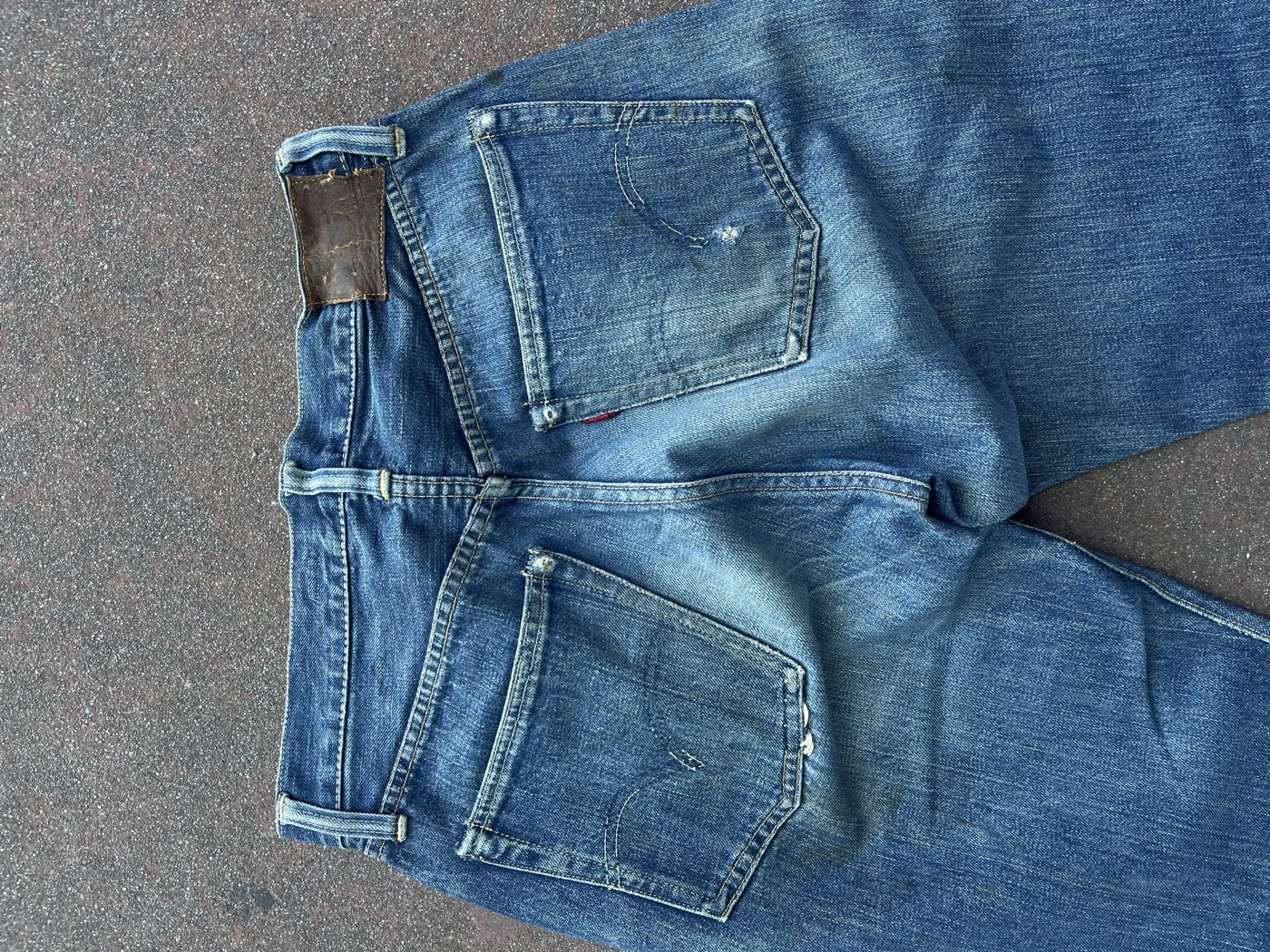
The two-horse patch on the back waistband dates the garment by both material and text. Real leather patches were used until the mid-1950s; after that Levi’s switched to the pressed jacquard patch with a card-like feel. A leather patch, even one that has dried, cracked, or partly torn away, points to the early decades.
Then read the lot number printed on the patch. The XX suffix, as in 501XX, marks the earlier era: Levi’s dropped the XX around the mid-1960s. Later patches read simply 501, and by the late 1960s and 1970s you see the hyphenated style, 501-0000 for shrink-to-fit and similar codes like 501-0115 for other finishes. A patch that says 501XX and a patch that says 501-0000 can be twenty years apart on jeans that look similar at arm’s length.
Step 4: check the rivets
Run your fingers inside the back pockets. From 1937 to 1966, Levi’s concealed the back pocket rivets under the fabric to stop them scratching saddles and school chairs, so you will feel hard bumps under the cloth with nothing visible outside. Those hidden rivets bracket a valuable thirty-year window. Exposed copper rivets on the back pockets push the date before 1937. No rivets at all, just heavy stitched bar tacks at the pocket corners, means 1966 or later.
Step 5: look for a back cinch
A cinch strap with a metal buckle across the back waistband is the oldest signal most people will ever encounter. Levi’s dropped the cinch in 1942, when wartime regulations stripped away metal and fabric that was not structural. A buckle-back pair of 501s predates 1942 regardless of anything else you find, and belongs in careful hands immediately; the buckle-back guide explains why the buckle means before 1942 and not the 1800s. Crotch rivets and suspender buttons disappeared in the same wartime housecleaning.
Step 6: study the arcuate
The arcuate is the double arc stitched across each back pocket, and it has its own timeline. During World War II the government classed it as decorative, so Levi’s could not sew it. Instead, wartime pairs had the arcs painted on, and on surviving examples the paint is usually worn to a ghost or gone entirely. Plain back pockets on jeans with other early-1940s details may be a wartime pair, which collectors treat as a category of its own.
After the war the stitching returned, and how it was sewn dates the pair further. Until the mid-1960s the arcuate was sewn with a single needle machine in two passes, so the arcs wander slightly, the spacing varies, and the two lines often cross at the center to form a small diamond. From the mid-1960s onward a double needle machine sewed both lines at once, leaving arcs that run perfectly parallel from end to end. Uneven, hand-guided arcs are an early signal; machine-perfect arcs are a later one.
Step 7: cuff the leg and check for selvedge
Turn up the hem and look at the inside edge of the outseam. A clean self-finished edge with a line of colored thread, usually red on 501s, is selvedge denim from the narrow shuttle looms Levi’s used until the early 1980s. A fuzzy overlocked edge means modern wide-loom denim. For 501s, selvedge alone places the pair before about 1983, which matters because plenty of small e, care-tag jeans from the 1970s and early 80s still carry it, and the market pays attention.
Step 8: check where it was made
Late-era Levi’s divide once more by country of origin. Imported production grew through the 1980s and 1990s, and the last American Levi’s factories closed in 2003. A Made in USA tag therefore puts a pair before the mid-2000s, and American-made 501s from the 1980s and 90s have built a genuine collector market of their own, especially in Japan. It is the youngest signal on this list, but no longer a trivial one.
How old are my Levi's? Putting the windows together
Now stack your findings. Say you found a both-sides big E tab, no care tag, hidden rivets you can feel but not see, a jacquard patch reading 501XX, and slightly uneven single needle arcs. The tab says mid-1950s to 1971. No care tag agrees. Hidden rivets say no later than 1966. The patch material says after the mid-1950s, and the XX says before the mid-1960s. The overlap is a window of roughly 1955 to 1966, which is exactly the kind of answer a buyer needs to price the pair seriously.
Expect the occasional contradiction. Levi’s was a factory, not a museum: old stocks of tabs, patches, and buttons got used up after official changeover dates, and transitional pairs mix features from adjacent eras. A replaced button or a period repair can also muddy one signal. When two details disagree, trust the harder-to-fake ones, construction and rivets over patch and tab, and widen the window rather than forcing a single year.
When details disagree, trust construction over labels: rivets and stitching are harder to swap than a patch or a tab.
What year of Levi's is worth money? Why the year matters
Dating is not trivia. The market has cliffs at almost every line above: 1942 for buckle-backs and wartime pairs, 1966 for hidden rivets, 1971 for the big E. Two pairs separated by five years of production can be separated by thousands of dollars in value, which is why quick offers from buyers who cannot read these details tend to run low. They price their own uncertainty. A pair dated honestly can be priced honestly.
Here is what those cliffs look like in money. Find the window you landed on above, then read across. These are honest working ranges for pairs in ordinary vintage condition, not records and not promises, and condition, size, and originality move every one of them.
| Dating window | What places it there | Typical range, as of August 2026 |
|---|---|---|
| Pre-1942 buckle-back | Cinch strap and buckle across the back waistband | No reliable published range; read individually, and the early auction records run into six figures |
| Big E 501s, before 1971 | Capital-E red tab, no care tag | $500 to $10,000 and up; a documented 1960s pair sold at $2,040 |
| Small e redline, 1970s to mid-1980s | Small e tab, care tag present, red selvedge line in the outseam | $200 to $1,000 |
| Type II jacket, 507XX | Two pleated chest pockets, no side pockets | $800 to $1,500 typical |
| Big E Type III trucker | Pointed chest pocket flaps, capital-E tab | $150 to $2,000 and up |
| Any of the above at the Levi’s trade-in counter | The counter reads none of the details on this page | Up to $30 for jeans or a Trucker Jacket, paid as a gift card rather than cash |
The last row is the reason dating is worth an afternoon. Levi’s own SecondHand program, read against its published trade-in values in September 2026, pays a flat $30 for any pair made more than twenty years ago. It does not look at the tab, the rivets, or the cinch, so a 1950s pair and a 1998 pair are worth the same thirty dollars to it. Every number in the rows above is what the same garment is worth to someone who does look.
What if the pair looks too clean, too small, or is not a Levi’s at all?
Four look-alikes trip up the steps above, and each one has its own guide. A pair or jacket with a big E tab and hidden rivets but a modern sewn-in care label is most likely a Levi’s Vintage Clothing reproduction: how to tell LVC from an original settles it from the inside of the garment. A child-size pair with a capital E and a lot number like 503ZXX or 503BXX on the patch is scarce and collected, while most kids’ pairs from the 1970s onward are not: the kids’ Levi’s guide separates the two. A pair with a lazy S stitch on the back pockets is Lee, which hid its date stamps in different places: dating Lee against Levi’s sets each detail beside its Levi’s twin. And a shawl collar denim jacket or a pair of dungarees with a name stenciled inside usually came out of a Navy sea bag rather than a Levi’s factory: the WWII Navy denim guide reads the buttons, the stencil and the label.
What to do with a pair you think is early
Photograph everything in daylight: the tab, the patch, the inside of the waistband, the back pockets inside and out, the cuffed outseam, and the whole garment front and back. Then do nothing to the jeans. Do not wash them, repair them, or press them; original condition is a large part of the value you just dated. Then call or text California Vintage Buyers at (949) 449-1255. We buy vintage Levi’s and other old denim from every state and walk through these same details with you as we go. Anywhere in the country that happens on a free video appraisal: we agree the price on the call and send payment through PayPal before you ship, with shipping on us. In Southern California we come to you instead and pay cash on the spot. The read is free and carries no obligation. Sometimes the honest answer is a 1980s pair worth a modest sum, and sometimes the windows overlap on a year that changes the conversation entirely.
Common questions
- How do I date a pair of Levi’s?
- Read the red tab first (capital E before 1971), then the back-pocket rivets (hidden through 1966), the waist patch (leather before the mid-1950s), and the care tag. Together they place the decade.
- What year did Levi’s change the big E to a little e?
- 1971. A capital-E LEVI’S tab means the garment predates 1971, which is the clearest single dating marker on the jeans.
- Does made in USA mean a pair of Levi’s is vintage?
- Increasingly, yes. Levi’s closed its last US factories in the early 2000s, so a made in USA tag is now a vintage marker in itself, though the tab and rivets date the pair more precisely.
- What does 501XX mean on the patch?
- The XX suffix marks the earlier era. Levi’s dropped it around the mid-1960s, so a patch reading 501XX places the pair before then, while later patches read simply 501 and the hyphenated 501-0000 style belongs to the late 1960s and 1970s. Two pairs that look identical at arm’s length can be twenty years apart on this detail alone.
- Do Levi’s with no red tab have any value?
- Often more, not less. Levi’s introduced the tab in 1936, so a pair with no tab and no torn red stub at the pocket edge may predate 1936 entirely. Check the other early signals, an exposed-rivet back pocket, a cinch buckle, a leather patch, and if they agree you are holding something that should be looked at before anything else happens to it.
- How can I tell a 1950s pair from a 1970s pair?
- Two checks settle it in seconds. A care tag stitched inside means 1971 or later, full stop, because federal care labeling arrived that year. Hidden back-pocket rivets, which you can feel as hard bumps but cannot see, ran from 1937 to 1966. No care tag plus hidden rivets puts you firmly in the earlier window.
- What are my Levi’s worth once I have dated them?
- Read against the market in August 2026: big E 501s made before 1971 run $500 to $10,000 and up, with a documented 1960s pair at $2,040; small e redline pairs from the 1970s into the mid-1980s run $200 to $1,000; a Type II 507XX jacket is typically $800 to $1,500; a big E Type III trucker runs $150 to $2,000 and up. Condition, size, and originality move all of it, and a pre-1942 buckle-back is read individually rather than by range.
- Does the number on the back of the Levi’s button tell me the year?
- No. It is a factory code, not a date. A 555 stamp names the Valencia Street plant in San Francisco, which ran from 1906 to 2002, so it appears on 1980s and 1990s pairs as well as older ones. The care tag has a related trap: through the 1970s and 1980s it prints only one year digit, so a 7 can mean 1977 or 1987, and the construction is what settles the decade.
Have something like this?
One phone call, from any state. A free video appraisal, the price agreed on the call, and payment through PayPal before you ship, with shipping on us. In Southern California we come to you and pay cash the same day.
Keep reading
- How to Tell If Your Levi’s Are Vintage→
- Levi’s Date Codes: How to Read the Care Tag, Button Stamps, and Lot Numbers→
- Big E Levi’s: What the Capital E Means and What They Are Worth→
- Levi’s Tab Colors: What Orange, Silver, White, Black, and Blank Tabs Mean→
- Made in USA Levi’s: What 1980s and 1990s American-Made Levi’s Are Worth→
- Old Jeans With a Buckle on the Back: What a Buckle-Back Is and What It Is Worth→
- Is My Levi’s Jacket or 501 an Original or a Levi’s Vintage Clothing Reproduction?→
- Are Old Kids’ Levi’s Worth Anything? 503ZXX, 503B and Little Levi’s→
- How to Date Vintage Lee Jeans and Jackets (and Tell Them From Levi’s)→
- What Is WWII Navy Denim Worth? Deck Jackets, Dungarees and Chambray→
- Are Old Levi’s 501s Worth Anything? Real 2026 Prices→
- What Is a Vintage Levi’s Jacket Worth in 2026?→
- Where to Sell Vintage Levi’s From Anywhere in the US (2026)→
- Sell vintage Levi’s to people who know what they’re holding.→