Field Guide
How to Date Vintage Lee Jeans and Jackets (and Tell Them From Levi’s)
Lee hid its date stamps in different places than Levi’s did. Here is where to look on the pair in your hands, and what each detail means next to its Levi’s equivalent.
We buy from every state · free video appraisal · paid before you ship
By Sam Wingenbach and Jake Cover, the buyers behind our video appraisals and house calls · Updated October 2, 2026
Read the transcript
Guys, I've lost my mind. I've become a doll collector. I'm just kidding. Please, no more dolls. I get calls every day, Cabbage Patch and whatnot. I'm going to pass on those. But Buddy Lee dolls were always buying. What on earth is a Buddy Lee doll? Look at this cute guy. So back in, I'd say, the 20s they started doing this. Probably went up to about the 50s. They would make dolls as an advertising thing for their clothing companies. We all know Lee. Look at that. A little pair of mini britches on him. Cute as a button. Look at these fun ones. You know, he's just a daggum old railroad conductor. You know what I'm saying? These things are so fun. If you have these guys, we're buying these things because it's a piece of advertising. It's more so about vintage clothing. People like these because, hey, it's an old piece of advertising history, yada yada. They made Texaco Buddy Lee dolls. They made Coca-Cola Buddy Lee dolls. You know, you've got Coca-Cola britches and stuff. But mainly Lee. Lee did this stuff. Levi's didn't do this stuff. Nobody else did. Lee did it. And it was a great way to kind of capture from children generationally. You know what I mean? If you're a boy in 1938 playing with a Buddy Lee doll, what's the pants you're going to be wearing when you're 20 years old in 1952? You're probably going to get some Lees on. So genius marketing play by them. But all that to say, these are probably the only dolls we buy. So we get a lot of calls for dolls. The doll market, late 90s, like probably peaked. And as people were passing away, dolls are hitting the market. And Gen X and Gen Zers, millennials, they're afraid of dolls. They think of horror movies. So I would say if you have anything like this or anything old denim or old clothing advertising related, we're always buying that. We love that stuff. Give us a call. 949-449-1255. Bye-bye.
The short answer: date old Lee by four things. A hair-on-hide patch means 1936 to the mid-1940s. A lazy S stitch on the back pockets means the mid-1940s or later. Red on the Lee Riders tag runs through the mid-1950s, black and gold follows, and MR beside the name means 1970s or later. A Gripper Zipper pull leans 1950s and 60s. Text photos to (949) 449-1255 for a free read.
Most people who find old jeans in a parent’s garage look for the red tab first, and when there is none they assume the pair is nothing. Lee never used one. Some of the most collectible American denim ever made carries a small black tag and a plain leather patch instead. Sellers say old, buyers say vintage, and on Lee the difference is written in the tag wording, the zipper pull and the stitching on the back pockets. This guide walks each signal with photographs of pieces we bought, and sets every one beside the Levi’s signal a seller is more likely to know.
Is it Lee or Levi’s? The three-second check
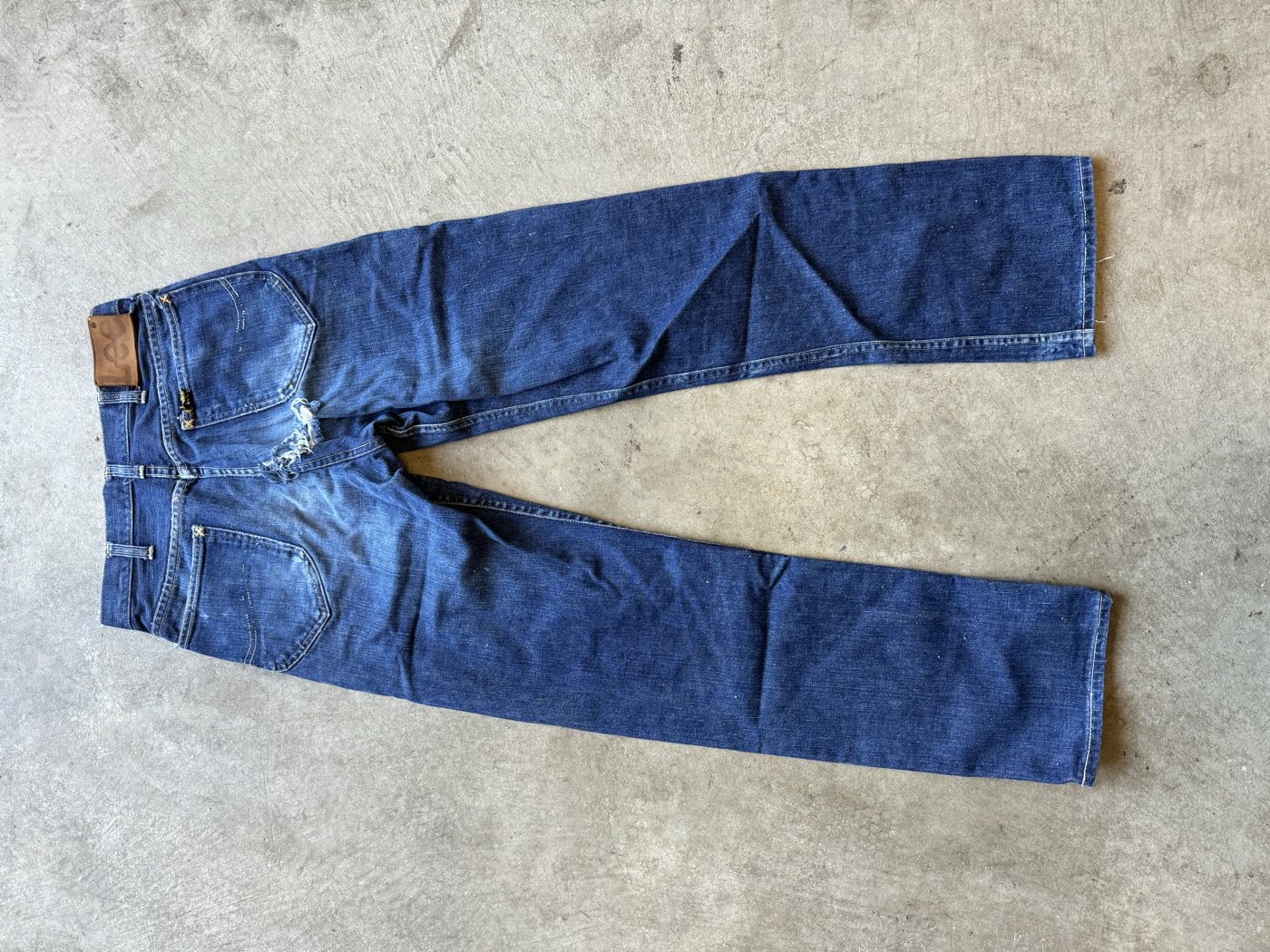
Turn the jeans over. Levi’s back pockets carry the arcuate, two arcs meeting in the middle like a gull in flight, on every pair since the 1870s and as a registered trademark since 1943. Lee pockets carry the lazy S, a long wave across each pocket that collectors read as a steer’s horns when the two are seen together. Then the patch: Levi’s uses a two-horse patch on the right of the waistband; Lee uses plain leather with the wavy Lee script in the same place, and on early pairs the leather still has hair on it. Then the fly. Lee zipped its 101Z in the mid-1920s, decades before Levi’s zipped a 501, so a zipper on an obviously old pair of work jeans is a Lee signal, not a sign of a later date.
What do the tags on old Lee jeans mean?
Lee’s waistband tag does most of the dating. The Lee Riders name goes back to the mid-1930s in trademark records, and the cowboy line was gathered under the Riders label in the mid-1940s, so a tag reading Lee Riders is 1940s or later. Color comes next. Collectors place red on the Lee Riders tag through the mid-1950s and say the red was gone by the 1960s, leaving the black and gold tag most people find. The marks beside the name refine that: a plain name or a TM reads earlier, a small R in a circle is read as 1960s onward, and MR beside the name is 1970s or later. Sanforized, meaning the denim was pre-shrunk at the mill, appears on Lee tags from the 1930s and 40s onward and is a quality note rather than a tight date. Union Made ran for decades; collectors disagree on when it left, placing the end somewhere between the mid-1960s and the late 1970s, so treat it as pre-1980 and let the other details narrow it.
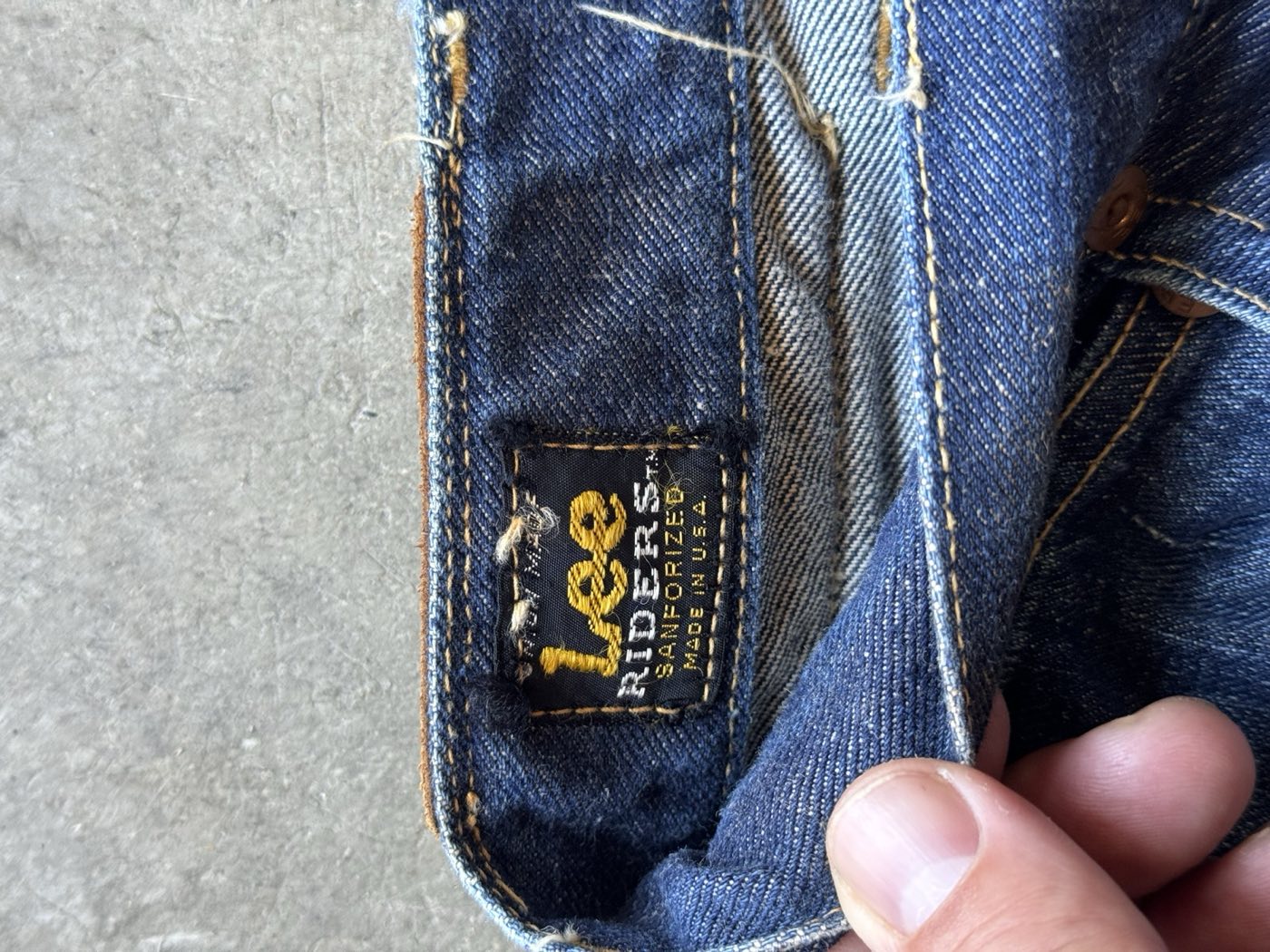
- Red and gold Lee Riders tag: collectors place it in the 1950s, gone by the 1960s.
- Black and gold tag with a plain name or TM: after the red era and before the R mark, which reads as 1960s onward.
- Black and gold tag with a small R: 1960s and later.
- MR beside the Lee name: 1970s or later.
- Union Made anywhere on the tag: pre-1980; the exact end is disputed.
- A separate care label sewn inside: after the federal care labeling rules of 1971, the same cliff Levi’s has.
What does the zipper pull tell me?
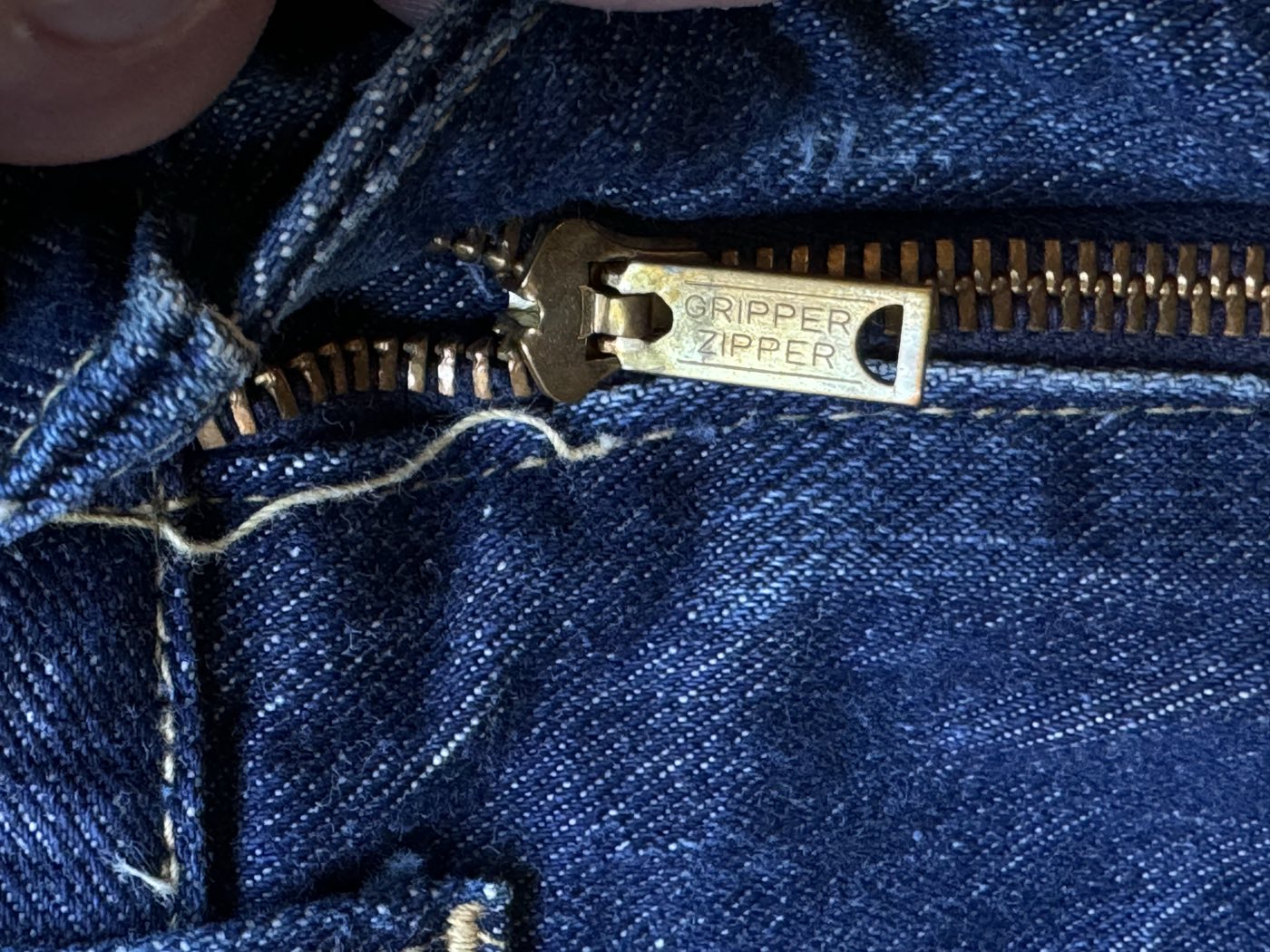
Lee was the zipper company. Sources place the first zip-fly jean, the 101Z, in 1926 or 1927, sold under the Whizit name, while Levi’s stayed with buttons on the 501 for decades. That makes the pull a dating tool on Lee in a way it never is on a 501. A brass pull stamped Gripper Zipper, made by Scovill of Waterbury, Connecticut, is what collectors expect on Lee jeans from the late 1940s through the 1960s; a Talon pull is what they expect on 1970s pairs. A modern YKK pull on a pair with an old tag usually means the zipper was replaced, and original hardware is part of what a collector pays for.
What is the lazy S on the back pockets?
The lazy S is Lee’s answer to the Levi’s arcuate, and it is a date in itself. Collectors place its introduction in the mid-1940s; published timelines give either 1944 or 1946, so treat the mid-1940s as the line. Back pockets with no lazy S and other early details may be earlier still. On the earliest examples the wave was guided by an operator, so no two pockets match, and the thick thread was often the first thing to wear away. Look also at the pocket corners: Lee used crossed bar tacks rather than exposed rivets so the pockets would not scratch a saddle. Levi’s hid its back pocket rivets under the fabric from 1937 to 1966 for the same reason, and a Levi’s pair with no rivets at all is 1966 or later. Same problem, two solutions, two date lines.
Hair-on-hide patch, or plain leather?
Lee stitched a patch of cowhide with the hair still on it to the waistband starting in 1936 (one source says 1938), the Lee name branded into the hide the way a steer would be. Those patches ran to the mid-1940s and were replaced around 1946 by the twitch patch, plain leather carrying the wavy Lee script, meant to look like a steer flinching from the iron. A hair-on-hide patch is the strongest age signal on any Lee garment and puts the piece in the bracket where four figures is realistic. On the twitch patch, the small R beside the name from the 1960s onward is the next dating step. The Levi’s parallel is material rather than design: a real leather two-horse patch until the mid-1950s, a pressed card-like patch after.
What do the Lee model numbers mean? 101, 101Z, 101B, 101J and 101LJ
Lee’s cowboy pant arrived in the mid-1920s and was given the style number 101. The letters after it name the closure or the garment: Z is the zipper fly, B is the button fly, J is the jacket, and LJ is the lined jacket. So 101Z is a zip-fly Lee Riders jean, 101B its button-fly twin, 101J the trim rider jacket, and 101LJ that jacket with the blanket lining and corduroy collar.
How do I date a Lee Storm Rider jacket?
The 101J rider jacket dates from the mid-1930s. Lee redesigned it in 1948, with a patent applied for that July and granted in April 1949, and the blanket-lined, corduroy-collared 101LJ followed in 1949. The Storm Rider name came later: Heddels dates its first commercial use to November 11, 1953, and Kontoor, Lee’s parent company, says the jacket was officially rebranded in 1954. That gap is where the money is. A blanket-lined 101LJ made before the Storm Rider name, roughly 1949 to 1953, brings $500 or more and is close to unobtainable, per Heddels and our own reading of the market. Jackets carrying the name trade in a wide band, about $40 to $600 as of September 2026, with 1970s and 80s examples mostly $75 to $250 and 1950s and 60s examples roughly $200 to $600. The neck label follows the jeans tag rules, R for the 1960s and MR for the 1970s, and hand-warmer pockets cut into the front place a Storm Rider in the second half of the 1980s or later.
What about Lee carpenter and painter pants?
The same tag rules apply to Lee’s work styles, and the work styles are where the oldest tags survive, because nobody threw away pants that were still holding up. Look for the Lee name drawn inside a little house outline on a white or black tag. Collectors call it the House Mark and generally place it in the 1940s, beside Union Made, Sanforized and Reg. U.S. Pat. Off. Then the hardware: a button fly with donut-shaped fly buttons, a waist button stamped Union Made, suspender buttons, copper rivets, a hammer loop and a ruler pocket down one leg are all mid-century construction.
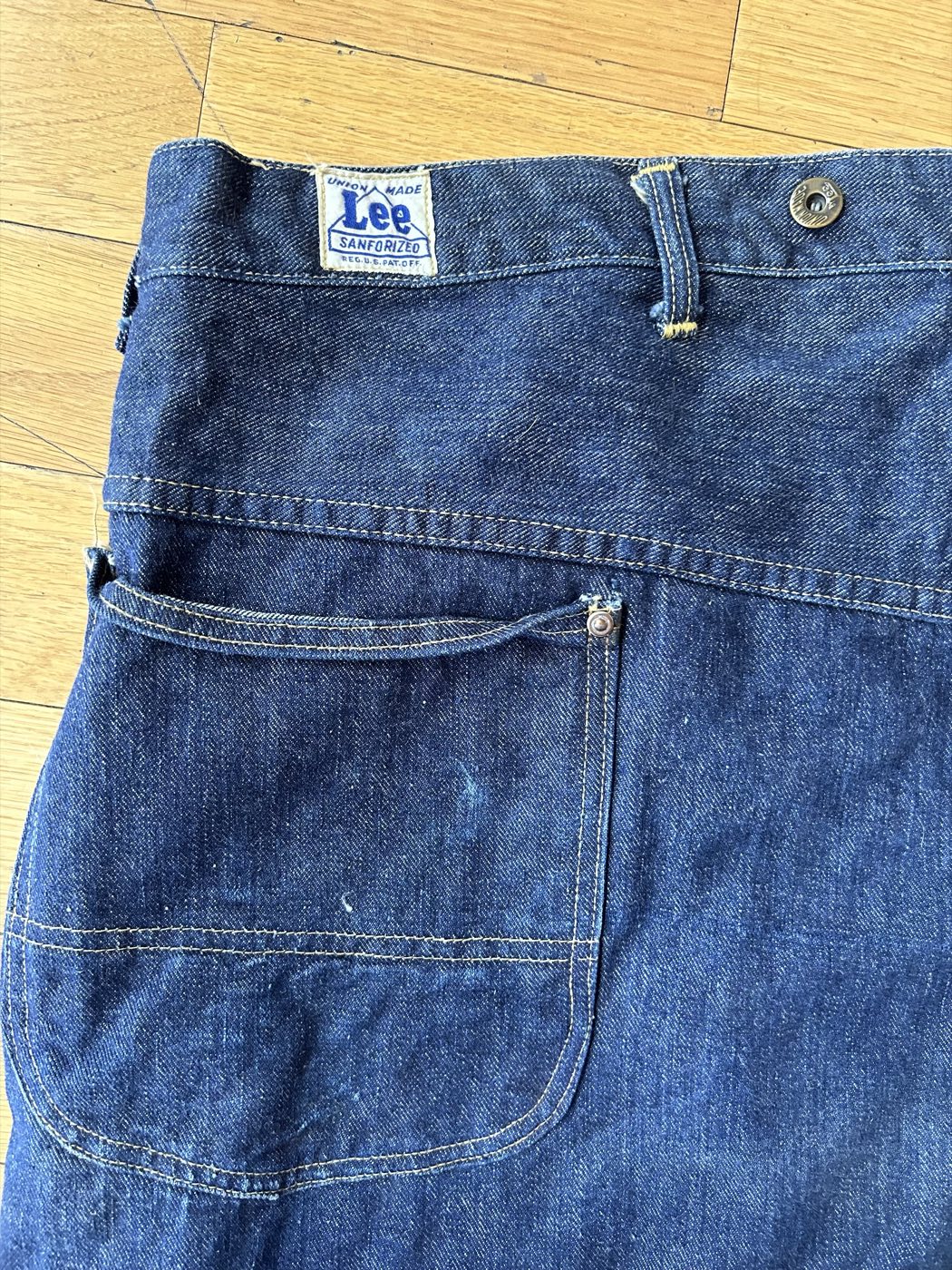
Work styles are bought by the detail rather than the brand. A 1940s button-fly pair with the House Mark tag and original hardware is a collector garment; a 1980s zip-fly pair is good workwear money and no more. Our workwear page covers the chore coats and coveralls that usually come out of the same closet.
Lee versus Levi’s: the same clock, different hands
Sellers who know a little about Levi’s tend to apply Levi’s rules to Lee and land in the wrong decade. The Levi’s column comes from our Levi’s dating guide; the Lee column is this page.
| Signal | On Lee | On Levi’s | What it dates |
|---|---|---|---|
| Back pocket stitch | Lazy S wave, from the mid-1940s | Arcuate arcs, since the 1870s; painted on in wartime | Lee: mid-1940s or later. Levi’s: painted or missing arcs mean the early 1940s |
| Pocket corners | Crossed bar tacks | Hidden rivets 1937 to 1966, none after | Levi’s only: no rivets means 1966 or later |
| Waistband patch | Hair-on-hide 1936 to mid-1940s; twitch leather from about 1946; R from the 1960s | Leather two-horse patch to the mid-1950s; pressed card patch after | Patch material is a decade marker on both |
| Fly | Zipper standard since the mid-1920s (101Z); 101B is the button fly | Button fly on 501s throughout the vintage era | A zipper is not a late signal on Lee |
| Brand tag | Red Lee Riders tag through the mid-1950s; black and gold by the 1960s; MR means 1970s or later | Red tab: big E before 1971, small e from 1971 | Each brand’s cleanest single cliff |
| Care label | Present from 1971 | Present from 1971 | Same federal rule, same line |
| Zipper pull | Gripper Zipper leans 1950s and 60s; Talon leans 1970s | Not a signal on button-fly 501s | Lee only |
| Button stamp | Union Made around the rim on mid-century work styles | Factory number; 555 is the Valencia Street plant, 1906 to 2002, not a date | Neither is a year |
| Outseam | Left-hand twill, softer fade | Right-hand twill; red-line selvedge to about the mid-1980s | Selvedge alone is not a pre-1971 signal |
How do I put the Lee signals together?
Stack the windows the way you would with Levi’s. Say the tag is black and gold with a TM and no R, the pull says Gripper Zipper, the patch is plain leather with the wavy script, and the pockets carry a faded lazy S. The tag says after the red era and before the R. The pull says 1950s or 60s. The patch and the lazy S both say after the mid-1940s. The overlap is roughly the late 1950s into the early 1960s, a window a buyer can price. Expect contradictions: Lee used up old tags and zippers after changeover dates, and a replaced pull or re-sewn patch throws one signal off. When details disagree, trust the ones that are hard to swap, the stitching and the hardware, over the tag.
If you are outside California, distance changes only the format: we read the tags together on a video call, agree a price on the call, and send payment through PayPal before you ship, with shipping on us. In Southern California we buy vintage Lee, Levi’s and Wrangler on free house calls and at our Laguna Hills warehouse by appointment, and pay cash the same visit. For what each era of Lee brings, the Lee and Wrangler value guide carries the ranges; for the Levi’s in the same box, the 501 value guide does the same. Whatever you find, do not wash it, repair it or replace the zipper. The pair photographed above was worth reading exactly as it came out of the closet.
Common questions
- How can I tell Lee jeans from Levi’s without a tag?
- Look at the back pockets and the fly. Levi’s pockets carry the arcuate, two arcs meeting in the middle; Lee pockets carry the lazy S, a single long wave across each pocket, with crossed bar tacks at the corners instead of rivets. A zipper fly on an old pair of work jeans points to Lee, which zipped its 101Z in the mid-1920s while Levi’s kept buttons on the 501. Lee denim is also left-hand twill, which fades softer than Levi’s.
- What does the Gripper Zipper on my Lee jeans mean?
- A brass pull stamped Gripper Zipper was made by Scovill of Waterbury, Connecticut, and is the zipper collectors expect on Lee jeans and jackets from the late 1940s through the 1960s. A Talon pull is the usual 1970s zipper, and a modern YKK pull on an old-looking pair usually means the zipper was replaced. On Lee, unlike button-fly Levi’s, the pull is a genuine dating signal, and original hardware is part of the value.
- Is a red Lee Riders tag older than a black and gold one?
- Generally yes. Collectors place red on the Lee Riders waistband tag through the mid-1950s and say the red was gone by the 1960s, leaving the black and gold tag most families find. Within the black and gold era, the marks beside the name refine it: a plain name or TM reads earlier, a small R is read as 1960s onward, and MR beside Lee means the 1970s or later. A separate care label sewn inside adds the same 1971 line Levi’s has.
- What is the difference between Lee 101Z, 101B, 101J and 101LJ?
- The 101 is Lee’s cowboy jean, given its style number in the mid-1920s, and the letters name the closure or the garment. Z is the zipper fly, B is the button fly, J is the trim rider jacket, and LJ is the lined jacket with the blanket lining and corduroy collar that became the Storm Rider. So a tag reading 101Z is a zip-fly Lee Riders jean, and a 101LJ made before the Storm Rider name appeared in late 1953 is the rarest jacket in the family.
- Why is a Lee jacket without the Storm Rider name worth more than one with it?
- Because the name is a date. Lee introduced the blanket-lined, corduroy-collared 101LJ in 1949 and first used the Storm Rider name commercially on November 11, 1953, with the official rebrand in 1954. A lined jacket from that short window carries no Storm Rider label, brings $500 or more, and is close to unobtainable. Jackets with the name trade from about $40 to $600 as of September 2026, with 1950s and 60s examples roughly $200 to $600.
- Does Union Made on a Lee tag tell me the year?
- Only loosely. Union Made ran on Lee waistband tags and buttons for decades, and collectors disagree on when it stopped, placing the end somewhere between the mid-1960s and the late 1970s. Read it as pre-1980 and let the other details narrow the window: the color of the Lee Riders tag, whether a TM, an R or MR sits beside the name, the brand on the zipper pull, and whether a separate care label was sewn inside after 1971.
Have something like this?
One phone call, from any state. A free video appraisal, the price agreed on the call, and payment through PayPal before you ship, with shipping on us. In Southern California we come to you and pay cash the same day.
Keep reading
- Where to Sell Vintage Levi’s From Anywhere in the US (2026)→
- Sell vintage Levi’s to people who know what they’re holding.→
- Sell vintage workwear. The harder the life, the better it aged.→
- Sell western wear to buyers who live and breathe it.→
- Sell vintage clothing in Orange County.→
- Sell vintage Carhartt to people who know what a union label means.→