Field Guide
Are Old Levi’s 501s Worth Anything? Real 2026 Prices
The same cut of jeans can sell for forty dollars or for thousands. The difference lives in details most owners have never checked.
We buy from every state · free video appraisal · paid before you ship
By Sam Wingenbach and Jake Cover, the buyers behind our video appraisals and house calls · Updated October 13, 2026
Read the transcript
Hi guys, Sam here with California Vintage Buyers, and I want to help clear the air and give you a little bit of information on how do you know if your old Levi's you're looking at are worth the time to try to sell them or bound for Salvation Army and just get them out of here. There's not really value there. This is not an exhaustive list of things to look for, but it's just some key distinguishing factors, right? So I have a few pairs of pants in front of me and different eras. So we're going to go over with the newer ones, right? Here we have a pair of the year 2000 pants. How do I know that these are from the year 2000? Well, because if you see that dark 501XX right there, that style of lettering is from the 90s to the early 2000s. It's different than this stuff. Do you see the difference of that one right there? You can see the difference. We'll get to these in a minute. But if you see that block lettering on your pants, you're looking at 90s up to say 2004 or something like that. Another tell. Let's just say you don't have this patch here. You wore the belt a lot. He wore the belt. She wore the belt a lot. The patch is gone. How old are my pants? With these ones, you can also pop this guy out right here. And you have, see that number right there? 1000. It's actually not the number 1000. It's 10, 00, October the year 2000. So whatever number you're looking at right there on the tag, if it has this tag on the inside leg, look at that number and you're going to see probably 0497 or what have you. It's going to be month and year. Good to know. So if that's gone, check if it has one of those. If it doesn't have one of these, then you're looking at somewhere in the 80s, right? Or potentially older. So I have a pair of 80s here. Anything made in USA is going to say on this tag, made in USA, right? So see that right there? Made in USA. Made in USA. What does these not have? These don't have made in USA. See how that part's missing? Made in Guatemala in the 2000s. They outsourced all the manufacturing. Bummer. So still good pants. We'll still buy these if the wash is cool. But the collector factor is not there. So again, if you got a pile of 100 of these guys, we'll still buy them. Give us a call. Are you kidding me? But when it comes to like Levi's, it's the details that matter. So moving forward. Oh, another thing is the distinguishing factor. See how it's red, the 501. And this one's black. You see in red, you're seeing 80s. Right? So you're looking at made in USA. Got the little red 501. That was an 80s thing. Right? So that's a couple things. Then you go over to these guys. Now, this is also 80s, but these are early 80s. What's the distinguishing factor on these guys? Flip up the pant leg. Do you see that? That's called selvedge denim. They call them redlines. These are called redlines. Right? Anything 501, 1982, 83-ish, right around there, and previous is going to have this kind of thing. This makes the value go up a little bit higher. Right? Why do they call these redlines you're asking? Great question. Well, when they were brand new, like these puppies from the 70s, which are a fantastic sample, they had a red line. Then, selvedge denim. So what does selvedge denim mean? It means the pant leg was made out of one sheet of denim, and they slapped them together. That's the end of a sheet of denim. They put them together, and they sewed the pant leg. And so this is made out of one sheet, a little more collectible. These are redlines. These are redlines. If you see that, you're looking at redlines. Even if you don't see any red, you got a pair of redlines. Right? We'll buy all these guys. Now, if you see one of these things that has a capital E right there, it's even better. Right? If you're looking at dealing with a barn, a ranch, Uncle Bob's house, and you're clearing it out, and you found him in the attic or in the bottom of his closet or something, we're great buyers for all this stuff. And we've paid up to thousands before for certain types of Levi's. There's a collectible value. It all depends on what the details are. You know? It's like if you call the car dealership, and you're like, hey, what do y'all pay for cars? They're going to say, okay, well, yes, we buy cars. What's the make? Model? Mileage? How's the condition? All the things. Give us a call. Number is 949-449-1255. We'd love to help you discern what you got, make your sweet offer, and buy all that stuff and more.
The short answer, as of September 2026 and read from eBay sold results between June and early September: most worn 1980s and 90s American-made 501s sell for $40 to $150, and deadstock pairs still wearing their tags about $300 to $900. Redline selvedge pairs from 1971 to the early 1980s mostly bring $200 to $1,000. Wearable big E pairs from the 1950s and 1960s sold for roughly $540 to $2,500. Pre-war buckle-backs sit above all of it, with a record mine-found pair at $87,400 in 2022. The fastest checks are the red tab, the cuffed outseam, and the patch. Text photos of those three details to (949) 449-1255 for a free same-day read.
Two pairs of vintage Levi’s 501s can look nearly identical across a room and differ in value by a hundred times. The difference lives in details: the tab, the patch, the rivets, the selvedge line, the year the denim came off the loom. We handle vintage denim every week, and our largest purchase to date was denim from exactly this era: $12,000 in cash, the same day, in June 2026, for a 1940s Levi’s Type 1 jacket, sold to us by a former vintage dealer who knew exactly what he had. The same details that priced that jacket price your jeans, so here is how the market reads 501s, era by era.
How much are vintage Levi's 501s worth? Value by era
Here is the whole market at a glance before the detail. The fastest way to place your pair is to find the single ID detail in the middle column, then read the sold prices beside it. Every number below is explained in full further down, and every one is dated: they are eBay completed sales read through WatchCount on September 11, 2026, and a listing that sold on a best offer may have closed below its shown price.
| Era and model | Fastest ID detail | What they sold for, June to September 2026 |
|---|---|---|
| Buckle-back, before 1942 | Cinch buckle across the back waistband | The top of the market; none sold on eBay in this window, and a record mine-found pair brought $87,400 at auction in 2022 |
| WWII S501XX, 1942 to 1946 | Painted-on arcuate, plain donut-hole fly buttons | None sold on eBay in this window; read individually |
| 501XX golden era, 1947 to mid-1950s | Leather patch, hidden rivets, big E tab | $700 to $2,500 across four hidden-rivet pairs |
| Big E, mid-1950s to 1971 | Jacquard patch, both-sides big E tab | $540 to $1,600 for wearable 1960s pairs; thrashed small pairs about $60 |
| Redline selvedge, 1971 to early 1980s | Small e tab, red selvedge line in the cuff | $200 to $1,000 for 14 of 20 sales; best auctions $1,025 and $1,201 |
| Made in USA, 1980s to 1990s | No selvedge, Made in USA on the tag | $40 to $150 worn; $299 to $899 deadstock with tags |
Buckle-back 501s, before 1942: the top of the market
The earliest collectible 501s have a cinch buckle on the back waistband, suspender buttons, and exposed rivets everywhere, including one at the base of the fly. These are the jeans that make auction headlines, and the records are public: a mine-recovered 1880s pair brought $87,400 at auction in 2022, and a pair attributed to 1873 changed hands for $100,000 in 2023. Those are records, not typical expectations, but they set the ceiling that pulls the whole pre-war market up, and Levi’s carries the premium over every store brand of the period. We found no buckle-back Levi’s among eBay sold results for June to early September 2026, which says how rarely they surface. Even a damaged buckle-back, torn, stained, or incomplete, is worth real money: so few pairs survived that condition matters less here than anywhere else in denim. Whatever you are holding, get real eyes on it before it goes anywhere.
WWII S501XX, roughly 1942 to 1946
Wartime rationing stripped the 501 down. The back cinch disappeared, the arcuate stitching on the back pockets was replaced with paint that has usually worn away, and hardware was simplified, including the plain donut-hole fly buttons collectors look for. The S stood for simplified. These pairs are scarce, historically loaded, and the Japanese and international collector market pursues them hard. We do not publish a range for these. No wartime 501 turned up among eBay sold results for June to early September 2026, and the figures that circulate online are not tied to any sale we can date, so each pair is read on its own details.
1947 to the mid-1950s: the 501XX golden era
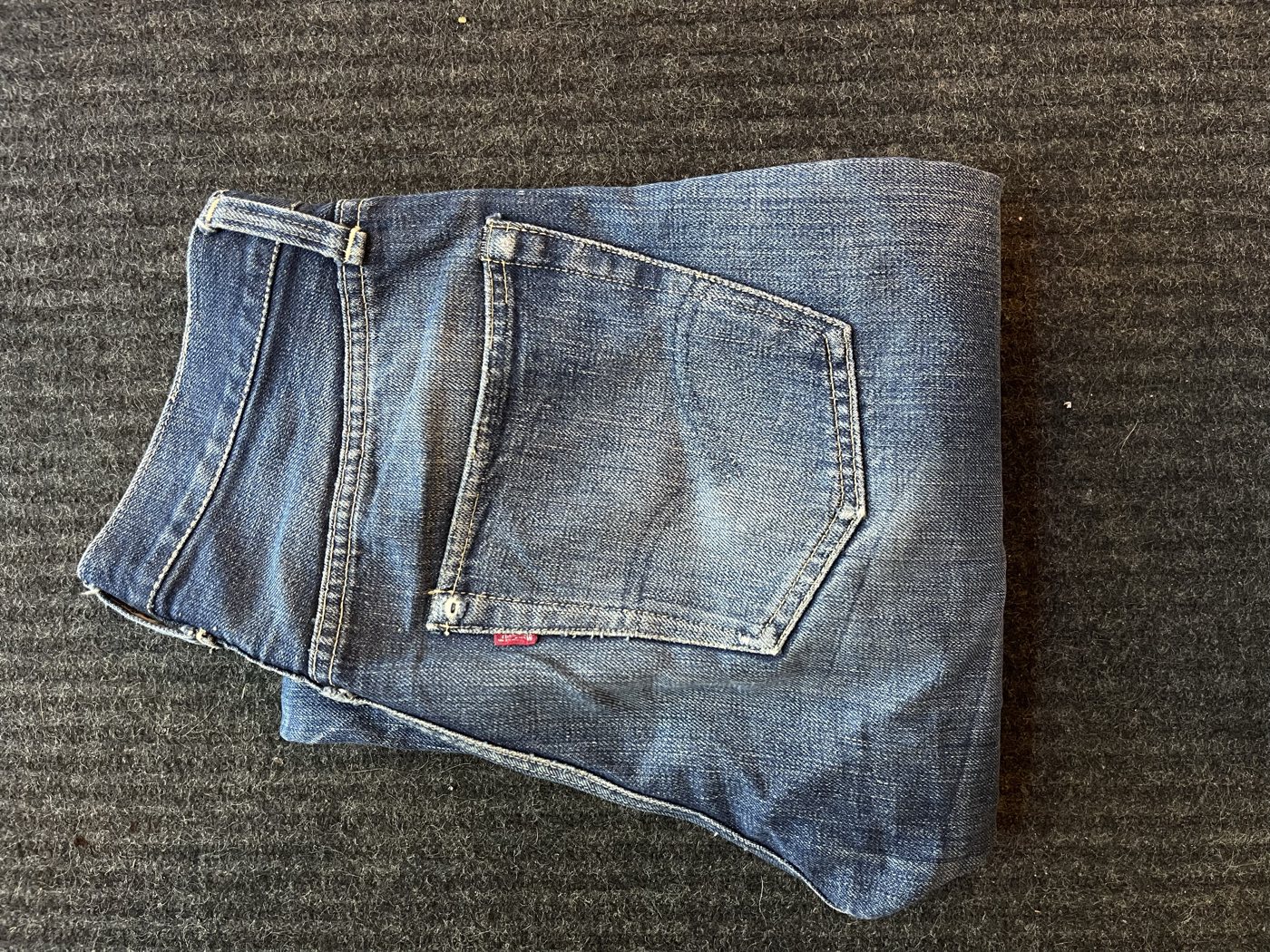
The postwar 501XX is the pair most collectors picture: leather patch on the waistband, hidden rivets under the back pockets, big E red tab, and the slim postwar cut. Four hidden-rivet pairs described as 1940s or 1950s sold on eBay between June and early August 2026: $700 for a 26-inch waist, $1,452, $1,735 for a distressed, fair-condition 36 that drew 47 bids, and $2,500 for a 27-inch waist with its leather patch. Two of the four were very small waists, and the size section below explains why that holds a price down. Deadstock from this window is rare enough to be priced one pair at a time. If your jeans have a leather patch of any kind, even dried, cracked, or partial, stop and get real eyes on them before they go anywhere.
Big E, mid-1950s to 1971
Around the mid-1950s the leather patch gave way to the card-like jacquard patch, and in 1966 the hidden pocket rivets were replaced with bar-tack stitching. Through all of it, the red tab still read LEVI’S in capital letters; the big E guide covers one-sided versus two-sided tabs and the modern capital E cases. In eBay sales from June to August 2026, wearable 1960s big E 501s sold for $540 to $1,600, the older hidden-rivet pairs above reached $2,500, and two thrashed, fair-condition 28-inch pairs went for $60 each, so condition and size decide where a pair lands. This is the era that still turns up in Southern California closets and garages with some regularity.
Redline selvedge, 1971 to the early 1980s
In 1971 the tab switched to a lowercase e, but Levi’s kept weaving 501 denim on narrow shuttle looms into the mid-1980s. Cuff the jeans: a clean outseam edge with a red thread line is redline selvedge, and it has a genuine market. Of 20 redline 501s sold on eBay between mid-June and early September 2026, 14 brought $200 to $1,000, two auctions for 36 by 31 pairs from one seller closed at $1,025 and $1,201, and small pairs, several in fair condition, went for $60 to $160. A fuzzy overlocked edge means later, wide-loom denim.
1980s and 1990s, made in USA
Non-selvedge American-made 501s are the entry level of the vintage market, but they are a real market, especially in larger sizes and honest fades. Most pairs bring $40 to $150, and the best worn pairs sold on eBay between June and early September 2026 topped out around $175. Deadstock is a different market: 1980s and 1990s 501s still carrying their original flasher tags sold for $299 to $899 in the same window, so if the tags are on, leave them on. Levi’s closed its last US factories at the end of 2003, so made in USA on the tag is itself becoming a vintage marker; the Made in USA guide covers this era pair by pair.
The size premium nobody mentions
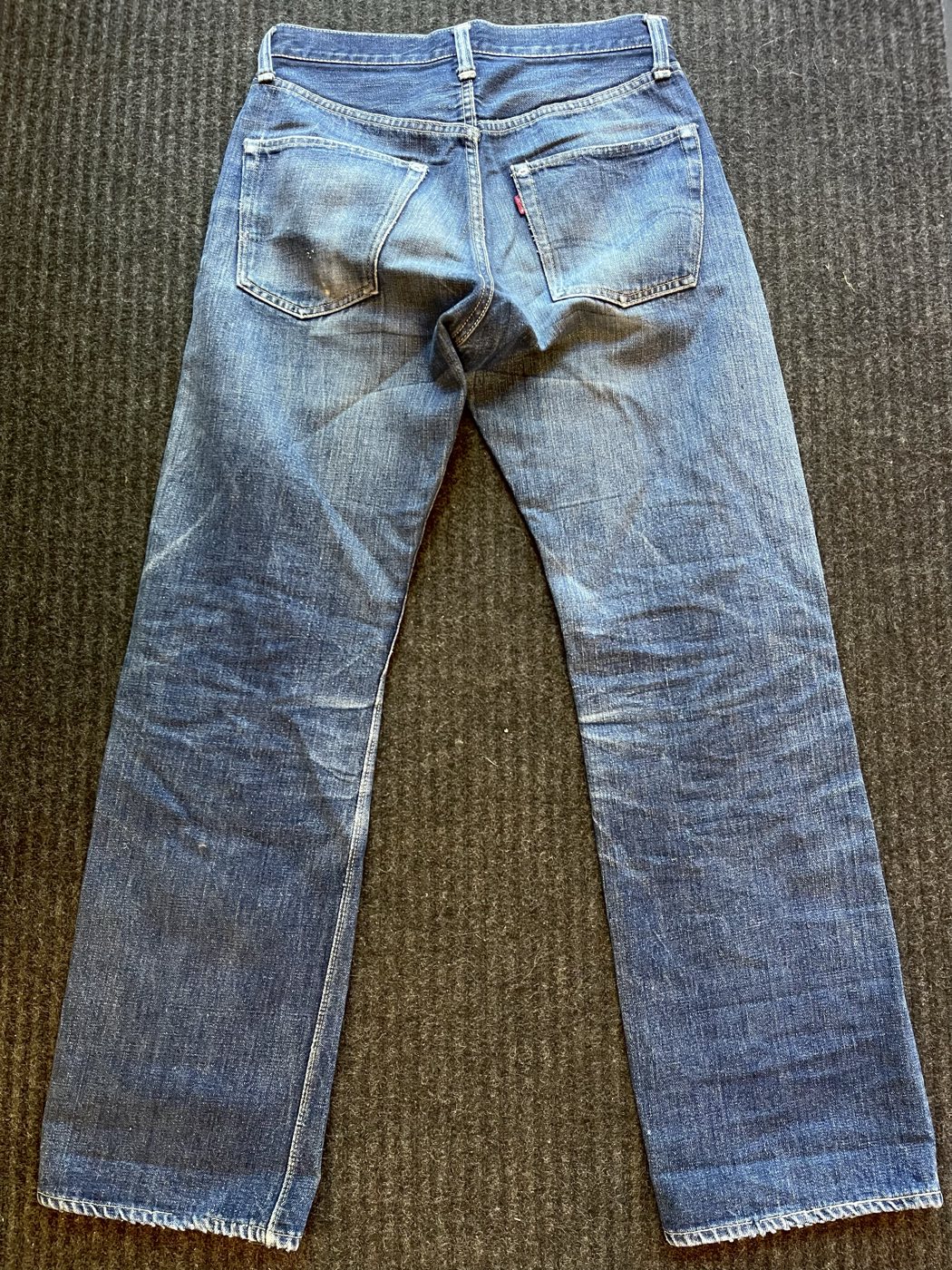
Collectors mostly want to wear these jeans, and the strongest demand sits at measured waists of 33 to 38 inches. A pair in that window can bring twice what an identical pair brings at a 29 or a 44. Measure the actual waist flat and double it, because vintage denim shrank and the number on the patch often no longer matches reality. Length matters too: long inseams survived less often, since work pants got hemmed and worn through.
How much does condition matter on old 501s?
For pairs from the 1960s onward, condition and fades drive the price. Even natural wear patterns, the honeycombs behind the knees, the wallet outline, the trainline down the crease, are features the market pays for, while thin crotches, blown knees, and stains discount hard. For anything pre-1955, rarity does most of the work: a buckle-back with holes is still a serious object, and honest damage is priced in rather than disqualifying.
What kills value
- Washing. Collectors pay a premium for unwashed, high-contrast denim. One trip through the machine can flatten the fades and cost hundreds or thousands of dollars.
- Hemming. Cutting and re-hemming the legs is permanent. Original chain-stitched hems, even worn ones, are worth keeping exactly as they are.
- Repairs. Iron-on patches and home machine darning read as damage plus damage. Leave holes alone; a specialist buyer would rather see the hole.
- Bleach and dye. Any attempt to freshen the color ends the collector conversation.
- Guessing by brand alone. A 1992 pair and a 1952 pair are both 501s. They differ in value by a hundred times.
- Damp storage. Denim left folded in a humid garage or a sealed plastic tote develops mildew spots and foxing stains that do not wash out and discount a pair hard. Store it dry and loose, out of direct sun.
- Cutting the tags off deadstock. A 1980s or 1990s pair with its original flasher tags still attached sold for $299 to $899 on eBay between June and early September 2026; the same pair worn is usually a $40 to $150 pair of jeans.
Do nothing to the jeans. Do not wash them, do not repair them, do not hem them. The market pays most for pairs exactly as they were found.
How to spot fake vintage Levi's
Since the late 1990s, Levi’s Vintage Clothing has reproduced its own historic models with period-correct details: leather patches, cinch buckles, big E tabs, hidden rivets. These are well-made jeans, and they fool people constantly, including resellers. Look inside: LVC pairs carry modern care tags, modern lot stampings, and country-of-origin marks from modern factories. Japanese reproduction brands like Warehouse, Fullcount, and Evisu build superb shuttle-loom denim too, but they label it as their own.
A used LVC pair is typically a $100 to $300 pair of jeans, not a $2,500 one: LVC 501s sold on eBay for $99 to $200 between June and August 2026, and a pair titled as a 1966 big E but carrying the LVC style number 66501 sold for $311. If a supposed 1940s pair looks crisp, smells new, or has bright printed tags inside, be skeptical. This is exactly the kind of call California Vintage Buyers makes in seconds from photos, free, for sellers in every state: text the tab, the patch, and the inside labels to (949) 449-1255 before anyone pays or accepts real money.
Where to sell vintage Levi's 501s
The best prices for early 501s come from a small, knowledgeable, international pool of collectors and dealers, with Japan the historic center of the market. Generalist buyers who cannot read the details price their own uncertainty, which is why quick offers on old denim run low. A buyer who can date the pair from the rivets and the stitching can pay for what the jeans actually are, and should be willing to explain the reasoning in front of you.
What to do if you have a pair
Photograph them in daylight: front, back, the red tab, the patch, the inside of the waistband, and the cuffed outseam. Then do nothing else to them. Call or text California Vintage Buyers at (949) 449-1255 rather than a general consignment shop: we handle vintage denim every week and buy 501s from every state. Anywhere outside Southern California we read the pair together on a free video appraisal, agree the price on the call, and send payment through PayPal before you ship, with shipping on us. In Southern California we come to you, explain what we see as we see it, and pay cash on the spot. Sometimes the honest answer is a fifty dollar pair of jeans. When it is a two thousand dollar pair, you will know exactly why.
Common questions
- How much are vintage Levi’s 501s worth?
- As of September 2026, anywhere from about $40 for worn 1980s and 1990s American-made pairs to the top of the collector market for pre-1942 buckle-backs, where a record mine-found pair brought $87,400 at auction in 2022. The era, the tab, the patch, and the selvedge line set the number. Call or text photos of the tab and patch to California Vintage Buyers at (949) 449-1255 for a same-day answer; we buy from every state.
- What is redline selvedge on 501s?
- Cuff the jeans and look at the outseam. A clean edge with a red thread line is redline selvedge, woven on narrow looms into the mid-1980s, and it has a real market: 14 of 20 redline 501s sold on eBay between June and early September 2026 brought $200 to $1,000.
- Does size affect vintage 501 value?
- Yes, more than most owners expect. Measured waists of 33 to 38 inches draw the strongest demand and can bring twice what an identical pair brings in a very small or very large size. Measure the waist flat and double it.
- Is redline selvedge the same as big E?
- No, and confusing the two is the most common dating error in vintage denim. Redline selvedge ran into the mid-1980s, well past the 1971 switch from the capital E to the lowercase e. Plenty of small e, care-tag pairs from the 1970s and early 80s still carry redline, and the market pays attention to them on their own terms.
- What does a back cinch buckle mean on 501s?
- It means the pair predates about 1942, when the War Production Board stripped out metal and fabric that was not structural. Crotch rivets and suspender buttons disappeared in the same wartime housecleaning. A buckle-back pair belongs in careful hands immediately, and it does not mean the 1800s, which is a claim you will see repeated and should ignore.
- What are 1970s small e 501s worth?
- Mostly $200 to $1,000 for redline selvedge pairs in eBay sales from June to early September 2026, which is far from nothing and surprises most owners. Pre-1971 big E 501s start higher: wearable 1960s pairs sold for $540 to $1,600 in the same window, and older hidden-rivet pairs up to $2,500. Measure the waist flat and double it before asking anyone for a number, because size moves this market hard.
- What would a pair of Levi’s from the 1960s be worth?
- If the red tab reads LEVI’S in capitals and there is no care tag inside, it is a big E pair from before 1971, and wearable 1960s big E 501s sold on eBay for $540 to $1,600 between June and August 2026. Pairs made before 1966 also have rivets hidden under the back pockets, which pushes them toward the top. Thrashed, small pairs from the same decade sold for about $60, so condition and measured waist size decide where yours lands. Call or text photos of the tab, the patch and the cuffed outseam to California Vintage Buyers at (949) 449-1255, from any state.
- What are deadstock vintage Levi’s 501s worth?
- More than most people expect, as long as the tags are still on. 1980s and 1990s American-made 501s carrying their original flasher tags sold on eBay for $299 to $899 between June and early September 2026, several times what the same pair brings worn. Do not wash them, do not try them on, and do not cut the tags. Older deadstock, from the big E years or earlier, is rare enough to be read one pair at a time.
Have something like this?
One phone call, from any state. A free video appraisal, the price agreed on the call, and payment through PayPal before you ship, with shipping on us. In Southern California we come to you and pay cash the same day.
Keep reading
- How to Date Levi’s: A Step-by-Step Guide→
- Levi’s Date Codes: How to Read the Care Tag, Button Stamps, and Lot Numbers→
- Made in USA Levi’s: What 1980s and 1990s American-Made Levi’s Are Worth→
- What Is a Vintage Levi’s Jacket Worth in 2026?→
- Where to Sell Vintage Levi’s From Anywhere in the US (2026)→
- How to Photograph Vintage Levi’s for an Accurate Offer→
- Sell vintage Levi’s to people who know what they’re holding.→
- Sell vintage Levi’s in Orange County to buyers based right in Laguna Hills.→