Field Guide
What Is Old Turquoise Jewelry Worth?
Most turquoise jewelry is worth a little. A small fraction is worth a great deal. The difference is the stone, the silver, and who made it.
Think you have one? A real person reads your photos, usually the same day.
By Sam Wingenbach and Jake Cover, the buyers who make our house calls · Updated August 29, 2026
Read the transcript
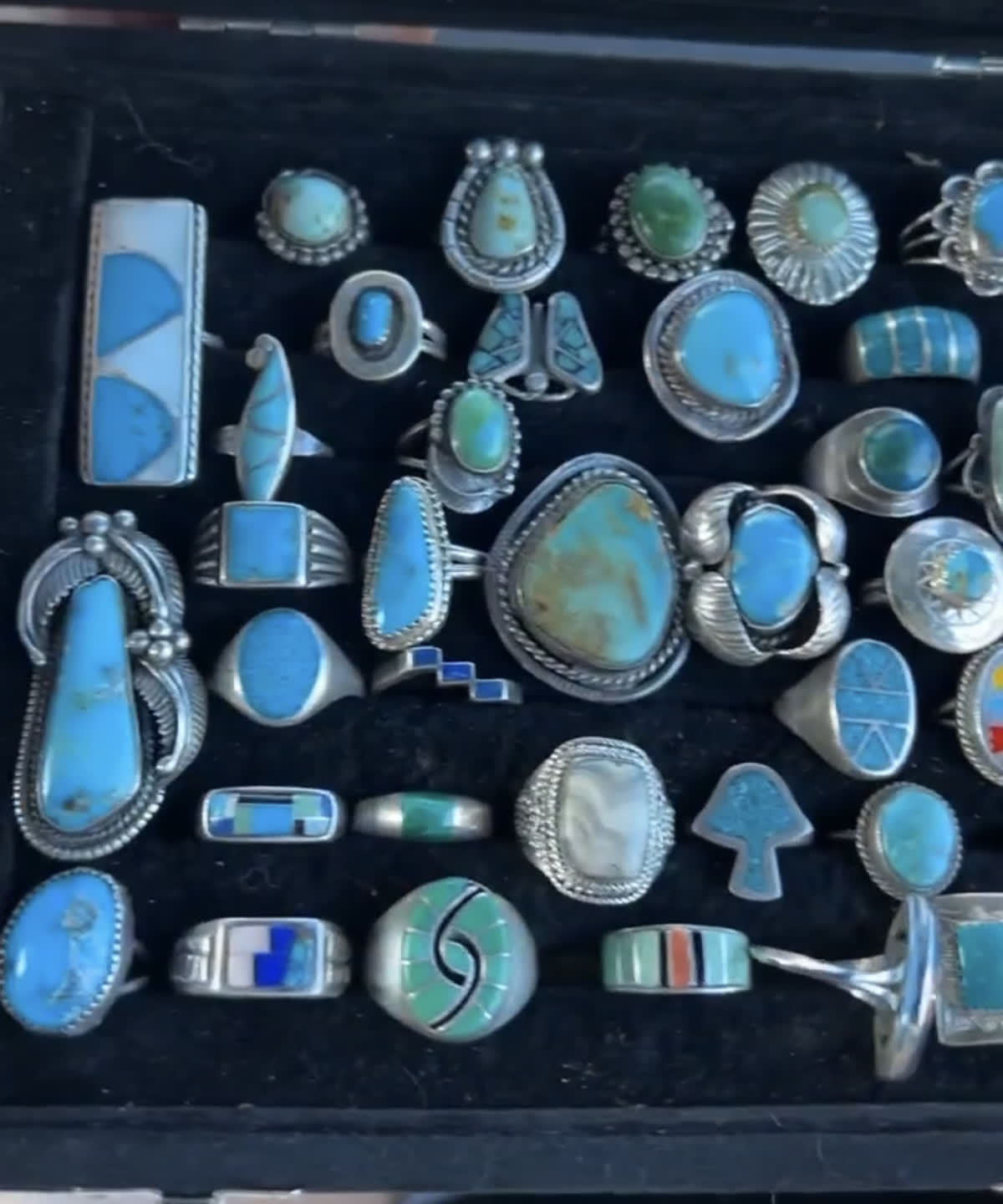
Hey guys, Sam here at California Vintage Buyers in beautiful Orange County, California. Today we're going to talk a little bit about turquoise jewelry. When did it start? Well, late 1800s, they started mining silver and turquoise out of the ground in the beautiful deserts of Arizona, New Mexico, and Native American tribes such as the Navajo, the Hopi, the Zuni, they started making handcrafted beautiful jewelry out of it. And it has since become pretty collectible. And so we love the stuff personally and we are purveyors of it. And as you can see, they spent a lot of time making a lot of this stuff. We have some really old stuff, Fred Harvey era kinds of things, all the way up to just new 80s, 90s fun hearts kind of stuff. So we're into it all. If you've inherited any of this kind of stuff or you have some that you don't really wear much anymore, we would love to buy it and we pay fair prices for it. Please give us a call, 949-449-1255. We can come to you. We go all over Southern California. But yeah, great examples of the kind of things we buy. When in doubt, text us photos to that number or give us a call, 949-449-1255.
Turquoise jewelry is one of the hardest things for a family to value on its own, because two squash blossom necklaces that look nearly identical can differ in price by a factor of fifty. The difference is almost never visible across the room. It lives in whether the stone is natural, who set it, and which mine it came from. This guide walks through how the market actually prices old turquoise and Native American silver, so you know what you are holding before anyone makes an offer.
The first question: is the turquoise even real
Before anything else, the market sorts turquoise into four categories, and the gap between them is enormous. Almost all of a piece’s value rides on this one distinction.
- Natural turquoise: dug from the ground and cut, with nothing added but a polish. Rare, especially in high grade, and the foundation of serious value.
- Stabilized turquoise: real turquoise that was too soft to use, infused with resin to harden it. Common in modern work, honest when disclosed, but a fraction of natural value.
- Block or reconstituted: turquoise dust or chips pressed with binder, or dyed howlite and magnesite standing in for turquoise. This is the material in most inexpensive jewelry.
- Imitation: plastic, dyed ceramic, and glass. No turquoise content at all.
You cannot always tell these apart by eye, and reputable buyers do not pretend otherwise. Uniform color with no variation, a suspiciously low weight, and a price that was low when new all point toward treated or fake material. A stone with natural matrix variation, real heft, and age is worth a closer look.
| Turquoise type | How to spot it | What it signals for value |
|---|---|---|
| Natural | Matrix variation, real heft, color that has aged | The foundation of serious value |
| Stabilized | Even color, lighter weight, resin-hardened | A fraction of natural, honest when disclosed |
| Block or reconstituted | Uniform color, very light, low price when new | Costume level, pressed dust or dyed howlite |
| Imitation | Plastic, glass, or dyed ceramic, no matrix depth | No turquoise content and no turquoise value |
The silver matters as much as the stone
Old Native American jewelry, Navajo, Zuni, and Hopi above all, is valued as much for the silverwork as for the turquoise. Hand-stamped sterling, hand-pulled wirework, and the weight of coin silver in early pieces carry real value on their own. A heavy, hand-built sterling cuff with modest turquoise can outvalue a light, mass-produced piece set with a better stone. Our Navajo jewelry guide goes deeper on the silver side: squash blossoms, concho belt phases, ingot silver, and the hallmarks that multiply value. Our Zuni jewelry guide does the same for the stone side: petit point and needlepoint, channel inlay, fetish carving, and the makers whose names change the number. Our Hopi jewelry guide covers the third tradition, the sawn two-layer overlay that usually carries no stone at all and is the most often underestimated of the three. Our Kewa guide covers the fourth, the bead tradition of the pueblo long called Santo Domingo: hand-rolled heishi, mosaic on shell, and the Depression-era thunderbird necklaces built from car battery casings.
Hallmarks and signatures
Turn the piece over. From roughly the 1970s onward many Native artists stamped a hallmark, a name, initials, or a symbol, into the back. A documented signature from a known silversmith can multiply value several times over. Earlier work, before hallmarking was common, is often unsigned, which does not lower its value but makes attribution a job for someone who handles the work regularly.
Old Pawn
Old Pawn refers to jewelry that was pawned at trading posts, often by the makers or their families, and never reclaimed. The term gets used loosely, but genuine old pawn carries age, hand construction, and natural stone, and collectors pay for it. The phrase alone on a tag means nothing; the construction is what proves it.
How much is old turquoise jewelry worth? What the market actually pays
Ranges, not promises. Condition, size, stone quality, and maker move every figure below.
- Costume and block-turquoise jewelry: $5 to $60. Pretty, wearable, not an investment.
- Modern stabilized-turquoise sterling, Native-made: $50 to $400 depending on weight and work.
- Older natural-turquoise sterling pieces, rings and small cuffs: $200 to $1,500.
- Squash blossom necklaces: $500 to $5,000 for most genuine older examples, with fine natural-stone and signed pieces running well beyond.
- Signed work by collected silversmiths, or high-grade single-mine stones: $5,000 to $25,000 and up. The ceiling here is set by named artists and famous mines, not by size.
Which turquoise mines are worth the most? The mines that move the needle
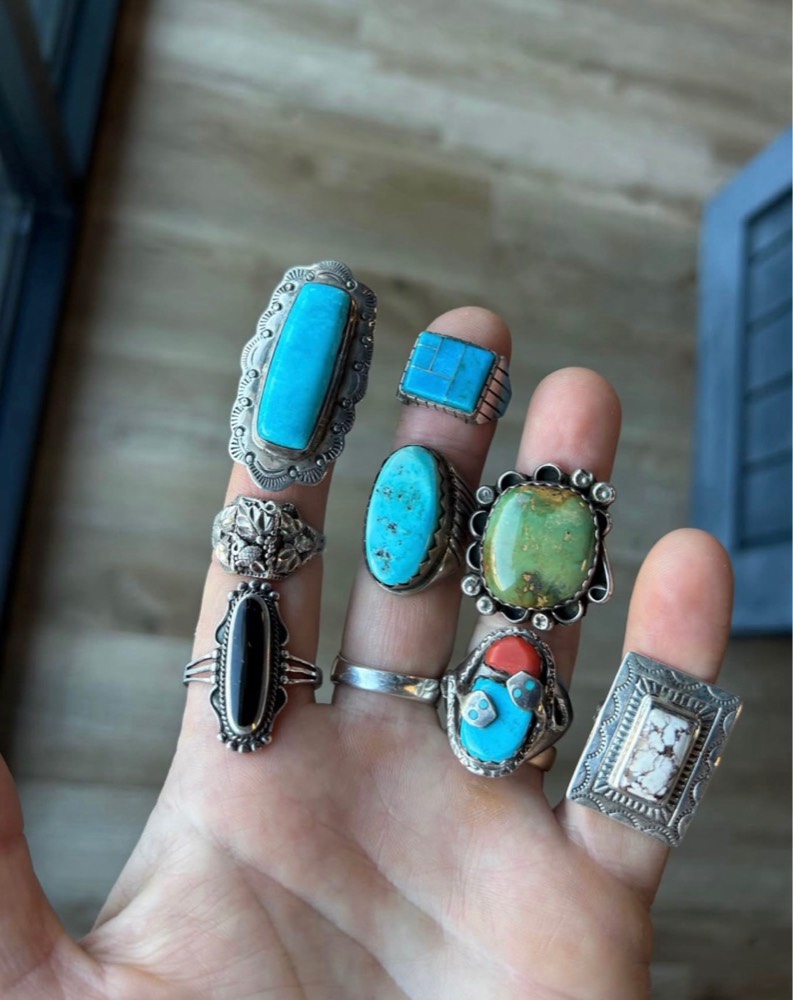
Among collectors, the source mine can matter as much as the maker. Stones from American mines that are now closed, Lander Blue, Lone Mountain, Number Eight, Bisbee, Morenci, command premiums far above generic turquoise because the supply is finite and the color and matrix are distinctive. You usually cannot identify a mine from a photo with certainty, but documented or attributed mine stones are where the largest numbers live. The premium follows verified attribution, not the name itself: a mine name on a handwritten tag or a family story raises nothing until someone who handles these stones regularly agrees with it.
The details that multiply value
- Natural, untreated stone with genuine matrix and depth of color.
- Heavy hand-built sterling or coin silver, with hand stamping and hand-pulled wire.
- A documented hallmark or signature from a known maker.
- Provenance: the trading post tag, a purchase receipt, a photograph of the original owner wearing it.
- Scale and presence: large early cuffs and full squash blossom necklaces in original condition.
The mistakes that destroy value
- Polishing it bright. Collectors prize the dark patina in the recesses of old silver. A jewelry-cleaning cloth or dip can strip decades of value in minutes.
- Ultrasonic or chemical cleaning. Turquoise is porous and soft. Solvents and ultrasonic baths can discolor or crack the stone permanently.
- Replacing or regluing stones with modern epoxy. A repair done outside the tradition lowers value and can be hard to reverse.
- Selling by weight as scrap silver. Genuine old Native jewelry is worth far more as jewelry than the melt value of its silver. Scrapping it is a permanent loss.
- Assuming Southwest style means Native made. A great deal of turquoise-look jewelry was made for the tourist trade and overseas. Style is not origin.
- Breaking up a matched set. A squash blossom necklace with its original earrings, or a stamped concho belt with every concho present, is worth more whole than sold one piece at a time. Splitting a set to move it faster usually leaves money behind.
The honest rule: do not clean it, do not polish it, do not repair it. Leave the patina and the stone exactly as they are, put the piece in a soft cloth or padded box, and get knowledgeable eyes on it before you do anything else.
What to do if you have a piece
Photograph the front, the back including any hallmark, and a close view of the stone, all in daylight. Weigh it if you can. Then have it read by someone who handles Native American and turquoise jewelry regularly. On silver-mounted pieces we identify, and the read costs nothing either way. The honest answer is sometimes that a piece is costume jewelry. When it is a four-figure squash blossom, you will know exactly why, and you will know it before anyone offers you melt.
Common questions
- How do I know if turquoise is real or stabilized?
- Natural, untreated turquoise is uncommon and valuable, while most modern stones are stabilized or reconstituted. Weight, hardness, and the backing tell the story, and a knowledgeable buyer can usually spot treatment in person.
- Is old pawn turquoise jewelry worth more?
- Often yes. Old pawn refers to older Native American silver and turquoise, and genuine early pieces with good stones and hallmarks bring more than contemporary tourist jewelry. The maker and the silverwork matter as much as the stone.
- Does a hallmark increase turquoise jewelry value?
- A recognized Navajo, Zuni, or Hopi maker’s hallmark can multiply value well beyond the metal and stone. Unsigned pieces are judged on craftsmanship and stone quality alone.
- How much less is stabilized turquoise worth than natural?
- The trade rule of thumb is that high grade natural stone runs around ten times the price per carat of stabilized material. Treat that as directional rather than exact, because it varies by grade and by mine, but the order of magnitude is the point: treatment is not a detail, it is most of the value.
- How rare is natural untreated turquoise?
- Rare enough that assuming your stone is treated is the safer starting point. Trade sources put natural at under three percent of the turquoise on the market, with something like 90 to 95 percent stabilized or otherwise enhanced. Turquoise dense enough to cut without treatment is genuinely uncommon, which is exactly why the untreated stones carry the premium.
- What is block turquoise?
- Block is not turquoise at all. It is dyed plastic or resin pressed into a turquoise-like material, and it shows up constantly in tourist jewelry. The tells are colour that sits flat with no depth, matrix that repeats too regularly, and a piece that feels light for its size. Natural stone shows variation and wear that follows the shape of the setting.
- Does the mine a turquoise stone came from affect value?
- Yes, and named mines carry named prices. Lone Mountain, Lander Blue, Bisbee, Morenci, and Number 8 are the names collectors chase, and several of those mines are long closed, which is what supports the premium. Attribution to a mine is a specialist judgement and worth getting before selling.
Have something like this?
One phone call and we come to you, anywhere in Southern California. Free visit, honest evaluation, cash the same day.
Keep reading
- What Is Navajo Jewelry Worth?→
- How to tell Lone Mountain from Lander Blue, and either from a tourist piece.→
- How to tell what your Native American jewelry actually is.→
- What Is Costume Jewelry Worth?→
- Orange County jewelry boxes are full of names nobody checked.→
- Old pawn is the good stuff, and the melt counter cannot see why.→
- Sterling or Silverplate: How to Read the Marks→