Field Guide
What Is Navajo Jewelry Worth?
A squash blossom necklace can be a $400 piece or a $9,000 piece, and the difference is rarely visible across a room. Here is what the market actually reads: the silver, the stone, the era, and the hand.
Think you have one? Text a photo to (949) 449-1255
By Sam Wingenbach and Jake Cover, the buyers who make our house calls · Updated August 29, 2026
The short answer: most genuine older Navajo squash blossom necklaces sell in the $400 to $1,500 range at auction, with strong pieces well above (an old pawn example realised $4,050 in 2026). Concho belts we deliberately do not put a single figure on, because reliable realised results are scarce and most numbers circulating online are dealer asking prices; early first and second phase belts are the valuable end by a wide margin. Older sterling cuffs and rings with natural turquoise commonly run a few hundred dollars, with heavy early ingot work above that. Signed work by collected masters like Kenneth Begay or Lee Yazzie is priced by the name as much as the material. Text photos of the front, the back, and any hallmark to (949) 449-1255 for a same-day read.
Navajo jewelry is the most widely owned and most widely misjudged category in the American Southwest. It ends up in Southern California closets by the thousands: bought on a road trip through Gallup in 1974, inherited from a grandmother who loved it, or found in an estate with no paperwork and no story. Two heavy silver cuffs that look nearly identical on a table can differ in price by a factor of twenty, and the reason is almost never the one people expect. It is not size, and it is not shine. It is the silver itself, the stone in it, the decade it was made, and whose hands made it. This guide walks through how the market reads all four.
The short history that explains the prices
Navajo people were the first silversmiths in the Southwest. The tradition begins in the 1850s with Atsidi Sani, who learned metalwork from Mexican smiths and taught others, and it spread widely after the Navajo returned from imprisonment at Bosque Redondo in 1868. The earliest work is silver alone: heavy, hammered, stamped with dies the smiths made themselves from worn-out files. Turquoise entered the silver later, by most accounts around 1880. That sequence matters for value, because the oldest and most sought-after Navajo pieces are often the plainest ones, and a family looking at an unstoned silver bracelet frequently assumes it is the cheap one in the box when it is the opposite.
How much is Navajo jewelry worth by era?
Ranges, not promises. Condition, size, stone quality, and maker move every figure below, and a single documented hallmark can reset the whole number.
| What you have | The tell | Honest range |
|---|---|---|
| Southwest style costume or import | Light weight, even color stone, no silver mark | $10 to $60 |
| Fred Harvey era tourist silver, about 1900 to 1950s | Thin gauge, stamped arrows and thunderbirds, machine regularity | $40 to $300 |
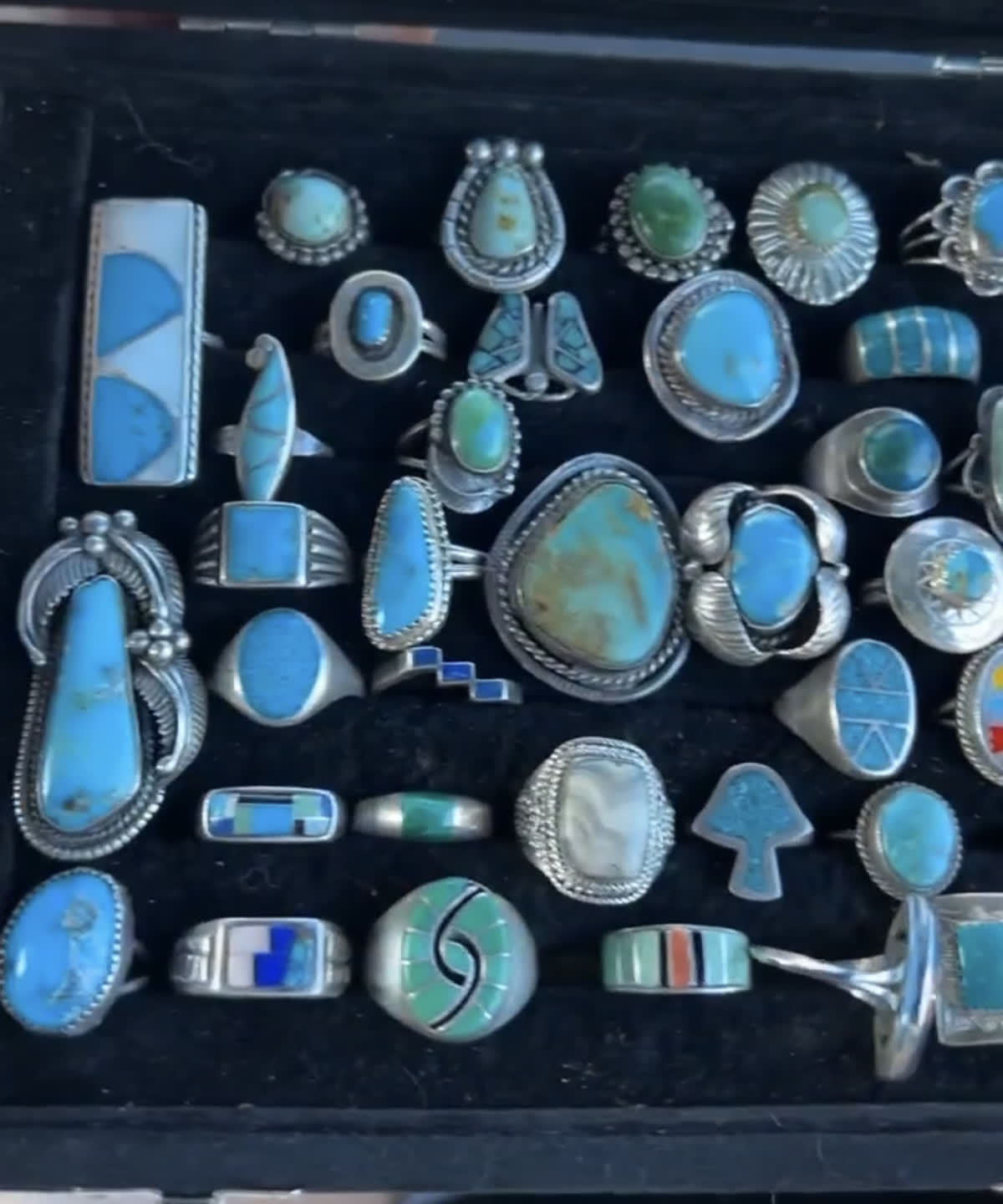
| Mid-century Navajo sterling ring or small cuff | Hand stamping, natural stone, sterling mark | $200 to $1,500 |
| Heavy early ingot cuff | Thick uneven silver, deep hand stamping, no sterling mark | Well above the mid-century pieces; ranges vary widely |
| Squash blossom necklace, genuine older example | Hand-formed blossoms, cast or hand-worked naja, natural stone | $400 to $1,500 typical at auction; strong pieces above |
| Concho belt, mid-century stamped sterling | Repeating stamped conchos on leather, sterling marks | Realised data is scarce; have it read rather than quoted |
| First or second phase concho belt | Plain scalloped conchos, diamond slot or soldered back loop | The valuable end by a wide margin; get it looked at |
| Signed work by a collected master | A known hallmark on the back | The hallmark can multiply value; worth identifying first |
What is a squash blossom necklace worth?
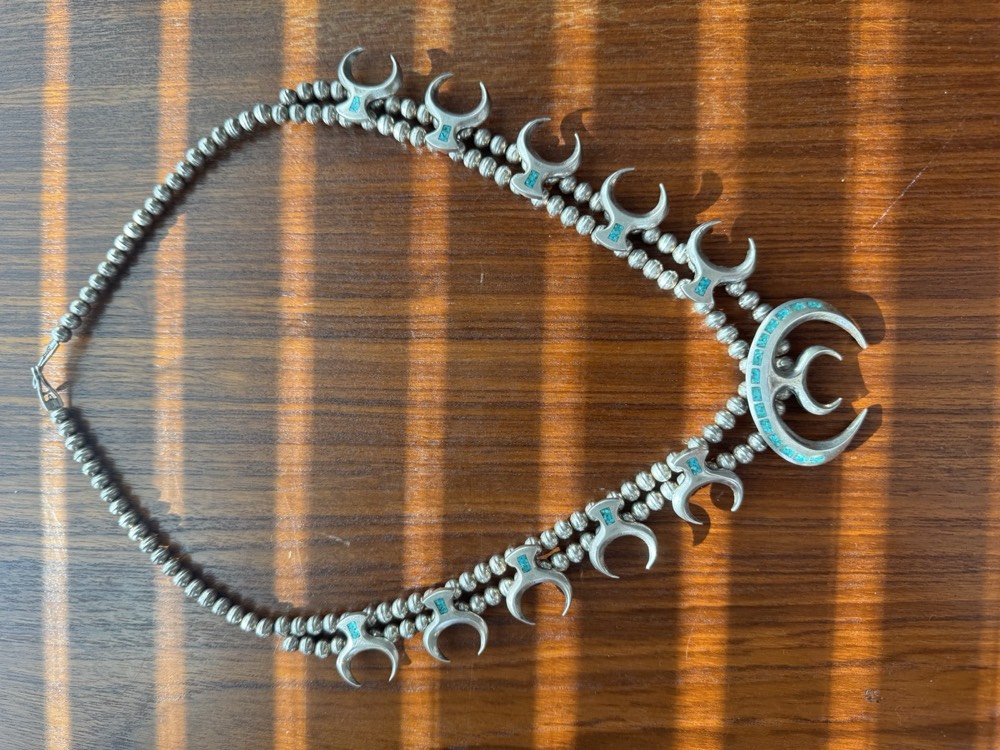
The squash blossom is the form everyone pictures, and it is a genuinely Navajo invention assembled from borrowed parts. The flared beads take their shape from Spanish and Mexican pomegranate ornaments worn on clothing, and the crescent pendant, the naja, descends from an ornament that hung on Spanish horse bridles and is far older than that. Navajo smiths brought the two together in the 1870s and 1880s, and the design has never gone out of production since.
What separates a $400 necklace from a $9,000 one is construction and stone. Look at how the blossoms are made: hand-formed petals soldered onto hollow beads, each one slightly different from its neighbor, point to older handwork, while identical stamped blossoms suggest later or commercial production. Look at the naja, which in strong pieces is the heaviest and most individual element. Then look at the turquoise, because natural untreated stone with real matrix carries value that stabilized or block material simply does not. A necklace with all three, hand-built beads, a substantial naja, and natural stone, sits at the top of the common range before a signature is even considered.
What is a concho belt worth? The three phases
Concho belts are dated by how the silver attaches to the leather, and collectors use a three-phase shorthand that is worth knowing because it is the single fastest age check on a belt.
| Phase | Roughly when | How to recognize it |
|---|---|---|
| First phase | 1870s to about 1880 | Plain oval conchos, scalloped edges, a diamond-shaped slot cut through the center for the belt to pass through |
| Second phase | About 1880 to 1900 | A loop soldered on the back instead of the slot, which freed the center for repousse and stampwork |
| Third phase | Twentieth century onward | Turquoise set into the conchos, butterfly spacers between them, and much greater variety |
Most belts that come out of Southern California estates are third phase, and a good heavy one is a real piece of jewelry worth well into four figures. First and second phase belts are scarce, and any belt whose conchos have a slot rather than a loop should be photographed and shown to someone before it goes anywhere.
Ingot silver, coin silver, and sheet
Before rolled sheet silver became easy to buy in the 1930s, Navajo smiths melted coins into ingots and hammered them into shape. That silver looks and feels different: thicker in the middle than at the edges, slightly uneven, with a surface that shows the hammer. Coin silver runs about .900 fine and sterling .925, so a piece with no sterling stamp is not automatically suspect. It is often the reverse, since the stamp became common only as commercial sheet took over. Uniform thickness, machine-crisp edges, and a clean sterling mark usually mean a later piece, which can still be excellent work but is rarely the oldest thing in the box.
Fred Harvey era silver, and why it still sells
From roughly 1900 into the 1950s, the railroad tourist trade drove enormous production of light-gauge silver sold at hotels and trading posts along the routes, work now collected under the Fred Harvey name. It is thinner than traditional pieces, stamped with the arrows, thunderbirds, and bows that tourists expected, and often made in workshop conditions with some machine help. Collectors know exactly what it is and buy it anyway, typically in the $40 to $300 range, more for strong examples. One honest note about the symbols: the whirling log appears on a good deal of pre-1940 Southwestern silver, where it is an old and unrelated Navajo design element, and smiths across the region stopped using it around 1940 after it was appropriated in Europe. Its presence on a piece is an age marker, not a message.
Is unsigned Navajo jewelry worth anything? Why most old work has no hallmark
Turn the piece over. Navajo silversmiths did not routinely sign their work until the middle of the twentieth century, and hallmarking became widespread only from the 1950s through the 1970s onward. An unsigned old cuff is normal and loses nothing for it; age, construction, and stampwork do the identifying. A signature on the back, though, can multiply the number several times, because a handful of makers are collected by name. Our hallmarks guide covers where the mark hides on each kind of piece, what each sort of stamp means, and the realised results behind the names that actually move a price.
- Kenneth Begay (1913 to 1977), often called the father of modern Navajo jewelry, whose clean, sculptural silver at the White Hogan in Scottsdale changed what the work could look like.
- Harvey Begay, his son, who trained as an engineer and carried the same design language forward.
- Lee Yazzie and Raymond Yazzie, brothers from Gallup whose precision inlay in high-grade natural turquoise sits at the top of the contemporary market.
- Jesse Monongya, of Navajo and Hopi parentage, known for inlaid night-sky and bear designs.
- Fred Peshlakai, son of the nineteenth-century smith known as Slender Maker of Silver, and Mark Chee, both collected for mid-century work.
Hallmarks are also faked, and attributions get repeated on tags until they sound official. A name written on a paper label is not a signature, and a signature is not proof by itself. Anything with a five-figure name attached deserves to be looked at in person rather than sold from a photograph.
The stone decides much of the rest
Whether the turquoise is natural, stabilized, or block material moves value more than almost anything else on the piece, and the categories are not always separable by eye. Stones from closed American mines like Lander Blue, Lone Mountain, Number Eight, and Bisbee command premiums far above generic material because the supply ended. Our turquoise guide covers all of that in detail, including how to tell natural stone from treated and what each is worth.
How to tell if jewelry is really Navajo
A great deal of Southwest-style jewelry was made for the tourist market or overseas and was never Native made. Technique is the first sort: Navajo work leans on heavy silver and stampwork, Zuni on precise stone cutting such as petit point and channel inlay, Hopi on cut-and-soldered overlay, and Kewa, the current name for Santo Domingo Pueblo, on hand-rolled heishi and mosaic. The Indian Arts and Crafts Act of 1990 makes it unlawful to sell goods in a way that falsely suggests they are Indian produced or the product of a particular tribe, which protects both buyers and makers. In practice it means the claim on the tag carries legal weight, and it means an honest buyer says plainly when a piece is Southwest style rather than Navajo. We do, and it is sometimes the least popular sentence of the visit.
The mistakes that destroy value
- Polishing it bright. The dark patina in the recesses of old silver is exactly what collectors pay for, and a dip or a polishing cloth can strip decades of age in one afternoon.
- Ultrasonic or chemical cleaning. Turquoise is porous and soft, and solvents and vibration can discolor or crack a stone permanently.
- Selling it as scrap silver. Genuine old Navajo work is worth far more as jewelry than as metal, and melting is not reversible. Have any piece read as jewelry first.
- Regluing or replacing stones with modern epoxy. A repair done outside the tradition lowers value and is difficult to undo.
- Breaking up a set. A squash blossom with its original earrings, or a concho belt with every concho and the buckle present, is worth more whole than piece by piece.
- Throwing away the paperwork. An old pawn ticket, a trading post tag, a receipt, or a photograph of the original owner wearing it all add real money, because provenance is scarce in this category.
The honest rule: do not clean it, do not polish it, do not repair it, and do not let anything be sold by weight before it has been identified. Wrap the piece in a soft cloth, keep any tags or paperwork with it, and get knowledgeable eyes on it first.
What old pawn means, and what it does not
Old pawn describes jewelry pawned at trading posts, often by the makers or their families, and never reclaimed. Real old pawn carries age, hand construction, natural stone, and frequently the wear of having been worn hard, and collectors pay for it. The phrase itself is used loosely by sellers and means nothing on its own. What proves it is the construction and, when it survives, the original pawn ticket. We read old pawn regularly and do it the same way every time: the construction first, the stone second, the tag last. What you get from us is the identification, free.
What to do if you have a piece
Photograph the front, the back including any hallmark, and a close view of the stone, all in daylight. Keep any old tags or paperwork with the piece. Then have it read by someone who handles Navajo and turquoise jewelry regularly. We name what we see, tribe, technique, and era, in person across Southern California or on a free video call anywhere in the country, and we buy the pieces we can place. It costs nothing and nothing is owed. The honest answer is sometimes that a necklace is a $200 necklace, and we say so. When it is a $6,000 one, you will know exactly which details made it that.
Common questions
- How much is a Navajo squash blossom necklace worth?
- Most genuine older squash blossom necklaces sell in the $400 to $1,500 range at auction, and the strong ones go well above it: an old pawn sterling and turquoise example realised $4,050 in 2026. The value sits in hand-formed blossoms, a substantial naja, and natural untreated stone. Text photos of the front, the back, and any hallmark to (949) 449-1255 for a same-day read.
- How can I tell if Navajo jewelry is old?
- Look at the silver before the stone. Older pieces were hammered from melted coin silver, so the metal is thick, slightly uneven, and shows the hammer, and often carries no sterling stamp because that mark spread only as commercial sheet silver took over in the 1930s. Machine-crisp edges and uniform thickness usually mean a later piece.
- Is unsigned Navajo jewelry worth anything?
- Yes, and often a great deal. Navajo silversmiths did not routinely hallmark their work until the middle of the twentieth century, so most early pieces are unsigned by nature. Age, construction, stampwork, and the stone identify a piece. A signature from a collected maker adds value rather than being required for it.
- Should I clean or polish old Navajo silver before selling it?
- No. The dark patina in the recesses of old silver is part of what collectors pay for, and a polishing cloth or a dip can strip decades of age in an afternoon. Turquoise is also porous, so ultrasonic and chemical cleaners can crack or discolor the stone permanently. Leave the piece exactly as it is.
- Is a Navajo concho belt worth more than its silver?
- Almost always, because the phase, the stampwork, the age, and the stone all carry value that a metal price ignores. By realised auction results, which we trust over dealer asking prices, anonymous mid-century stamped and sandcast belts bring roughly $500 to $2,000, artist-signed later work commonly $1,000 to $2,000, and genuine classic-period first phase belts from the 1870s and 1880s run into five figures: documented examples realised $22,500 and $24,400. A first-phase-style belt of early 1900s manufacture sits in between, around $6,000. Check how the conchos attach: a diamond slot cut through the center is the oldest construction, and a soldered back loop came next.
Have something like this?
One phone call and we come to you, anywhere in Southern California. Free visit, honest evaluation, cash the same day.
Keep reading
- What Is Old Turquoise Jewelry Worth?→
- Sterling or Silverplate: How to Read the Marks→
- How to tell what your Native American jewelry actually is.→
- A squash blossom necklace is worth far more than the silver in it.→
- A good concho belt is silver worth reading, not silver worth melting.→
- Old pawn is the good stuff, and the melt counter cannot see why.→
- How to tell Lone Mountain from Lander Blue, and either from a tourist piece.→