Field Guide
What Is Zuni Jewelry Worth?
Zuni work is priced by the stone, not by the metal, and a cuff holding two hundred hand-cut stones is a different object from the one beside it holding twelve. Here is how the market reads the difference.
Think you have one? Text a photo to (949) 449-1255
By Sam Wingenbach and Jake Cover, the buyers who make our house calls · Updated August 20, 2026
The short answer: an ordinary contemporary Zuni petit point or needlepoint ring commonly runs $75 to $300, a mid-century cluster bracelet with dozens of matched hand-cut stones $300 to $900, and a full needlepoint squash blossom necklace $800 to $2,500 with exceptional examples above. Channel inlay knifewing and sunface pins typically bring $150 to $700. Documented work by an early master such as Leekya Deyuse or Dan Simplicio sits far above all of that and should be researched rather than quoted. Realised auction data for Zuni work is thinner than for Navajo, so read every figure here as the middle of a wide band. Text photos of the front, the back, and any hallmark to (949) 449-1255 for a same-day read.
Zuni jewelry is the most technically demanding work in the Southwest and the most consistently underpriced when it changes hands. It arrives in Southern California estates constantly, usually mixed in a drawer with Navajo silver that looks superficially similar, and it gets sorted by weight or by shine when neither has much to do with what it is worth. A Zuni piece is a lapidary object first. The silver is a setting for stonework, sometimes hundreds of individually cut and fitted stones, and the labour in that stonework is where the value sits. This guide covers how to recognise Zuni work, how the market prices each technique, and the handful of ordinary household mistakes that quietly destroy the number.
Zuni vs Navajo jewelry: why they are priced differently
The two traditions answer different questions. Navajo silversmithing, which begins in the 1850s, is about the metal: heavy ingot, deep hand stamping, form built from silver outward. Zuni people had been cutting and fitting stone and shell for centuries before silver reached the pueblo, and by the usual account silversmithing came to Zuni around 1872, when a Zuni man named Lanyade learned it from the Navajo smith Atsidi Chon. What Zuni makers did with it was characteristic: they used the silver as a frame for lapidary work they already knew how to do better than anyone. That is why a Zuni cuff can be light in the hand and still be the most valuable thing in the box, and why pricing one by its metal is the single most expensive mistake in this category.
The techniques, and how to recognise each
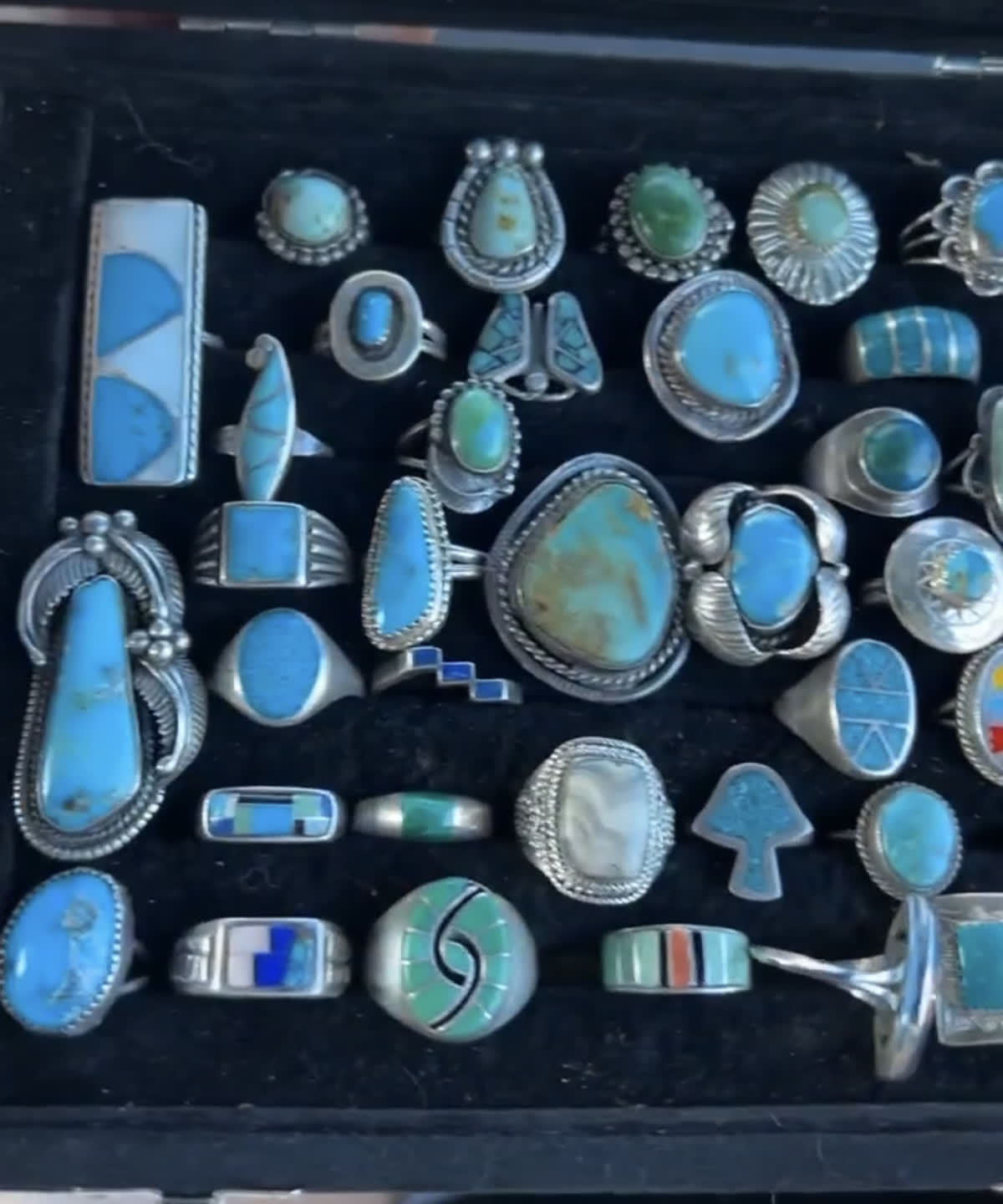
Almost every Zuni piece is one of six things. Identifying which one you are holding takes about ten seconds once you know what separates them, and it is the first thing any honest read establishes.
| Technique | What you are looking at | The fastest tell |
|---|---|---|
| Cluster work | Larger oval or round cabochons radiating around a center stone | Each stone sits in its own bezel with silver drops or twisted wire between them |
| Petit point | Small hand-cut stones, rounded at one end and pointed at the other | The teardrop outline, repeated dozens of times, every stone separately bezel set |
| Needlepoint | Slender stones pointed at both ends | A single stone looks like a needle or a grain of rice sharpened at each tip |
| Channel inlay | Stones cut to fit compartments and ground flush | Draw a fingernail across it: the surface is level, with thin metal walls between every stone |
| Mosaic or stone-on-stone inlay | Stones and shell fitted against one another on a backing | Little or no metal showing between the stones themselves |
| Fetish carving | Small animals carved in stone, shell, or antler | Carved in the round rather than set into anything |
Petit point and needlepoint get confused constantly, including by people selling them, and the difference is worth holding onto because it is genuinely just the shape of one stone. Petit point stones are pointed at one end and rounded at the other, a teardrop. Needlepoint stones come to a point at both ends. Neither is automatically worth more than the other. What moves the price is the count, the consistency of the cutting, and whether every stone is still present and original.
How much is Zuni jewelry worth?
Ranges, not promises. Stone quality, stone count, condition, and a documented maker move every figure below, and one attributed hallmark can reset the whole number. One honest caveat specific to this category: reliable realised auction results for Zuni work are scarcer than for Navajo, and a good deal of what circulates online is dealer asking price rather than anything anybody paid. Where we are not confident, we say so rather than inventing precision.
| What you have | The tell | Honest range |
|---|---|---|
| Zuni style import or chip inlay tourist piece | Crushed stone set in resin, or factory-uniform stones with no individual bezels | $15 to $75 |
| Contemporary petit point or needlepoint ring | Hand-cut stones each in its own bezel, maker’s initials common on the back | $75 to $300 |
| Mid-century cluster, petit point, or needlepoint bracelet | Dozens of matched hand-cut stones, silver drops and twisted wire | $300 to $900, strong examples above |
| Full needlepoint or petit point squash blossom necklace | Hundreds of matched stones carried through the blossoms and the naja | $800 to $2,500, exceptional stone-count examples above |
| Channel inlay knifewing, sunface, or rainbow man pin | Stones ground flush inside thin metal channel walls | $150 to $700, signed mid-century work above |
| Multi-strand carved fetish necklace | Individually carved birds or animals strung on hand-rolled heishi | $250 to $1,500 by carver and strand count |
| Single fetish carving by a known contemporary carver | Initials or a signature on the underside | $100 to $600 typical |
| Documented work by an early master | Attribution, frequently traced to the C.G. Wallace collection | The top of the market by a wide margin; have it researched, not quoted |
Fetish carvings and fetish necklaces
Carved animals are their own market and one of the few Zuni categories where a beginner can misjudge by an order of magnitude in either direction. A fetish is a small animal carved in turquoise, jet, shell, serpentine, antler, or picture stone, often with an offering bundle of stone or shell bound to its back with sinew. The six directional animals, mountain lion, bear, badger, wolf, eagle, and mole, recur most. Age, carver, and the stone all matter, and the older Wallace-era carvings by makers like Leekya Deyuse are collected as sculpture rather than as jewelry. Fetish necklaces string dozens of tiny carvings along hand-rolled heishi, and they are valued by the quality and consistency of the carving before anything else. Because these pieces carry religious meaning at Zuni, a serious buyer treats them with the plainness they deserve and does not dress up a description to inflate a price.
The stones, and why the mine matters
Zuni cluster and needlepoint work leans heavily on clear, even, light blue turquoise, and a great deal of the best of it came from the Sleeping Beauty mine in Arizona, which closed to turquoise production in 2012. Supply ending does what supply ending always does, and clean Sleeping Beauty stone now carries a premium that has nothing to do with the piece it sits in. Kingman, Lone Mountain, and Number Eight material show up too. Beyond turquoise, Zuni inlay uses deep red Mediterranean coral, spiny oyster, jet, mother of pearl, and abalone, and coral supply has tightened enough over the past few decades that older pieces with good coral are worth reading carefully. Whether a stone is natural, stabilized, or block material is not always separable by eye, and our turquoise guide covers exactly how that call gets made.
Hallmarks, and the makers collectors chase
Turn the piece over. Zuni makers, like Navajo makers, did not routinely sign their work until the middle of the twentieth century, so an unsigned older piece is normal and loses nothing for being unsigned. Age, cutting quality, and construction identify it instead. From roughly the 1970s onward, initials or a name on the back became common. A handful of names change the number substantially:
- Leekya Deyuse (about 1889 to 1966), the most celebrated Zuni carver, whose figures and leaf-carved turquoise are collected as fine art.
- Teddy Weahkee (about 1890 to 1965), carver, painter, and inlay maker of the same generation.
- Dan Simplicio (1917 to 1969), known for nugget turquoise and coral work with a sculptural, unmistakable hand.
- Frank Dishta and the Dishta family, whose flush-set inlay clusters are known by the family name as a style.
- Lambert Homer Sr. and Jr., collected for precise mid-century inlay.
- Effie Calavaza, recognised immediately by the snake motif wrapped around her settings.
- The Quandelacy family, whose contemporary bear fetishes with inlaid heartlines are among the most widely collected carvings being made today.
Two cautions on names. Attributions to early masters frequently trace back to C.G. Wallace, the trader at Zuni from 1918 whose collection was dispersed at auction in 1975, and paperwork tying a piece to that sale is worth keeping and worth verifying. And a name written on a paper tag is not a signature. Anything carrying a five-figure name deserves to be looked at properly rather than sold from a photograph.
Is it Zuni, or Zuni style
A great deal of Southwest-style jewelry was made for the tourist trade or overseas and was never Native made. Technique sorts most of it quickly: Zuni work is stone-forward and precise, Navajo leans on heavy silver and stampwork, Hopi uses cut-and-soldered overlay over an oxidized base, and Kewa, the current name for Santo Domingo Pueblo, is known for hand-rolled heishi and mosaic on shell. The clearest single tell on an imitation is the stonework itself. Genuine petit point and needlepoint stones vary slightly from one another because a person cut each one, and each sits in its own bezel. Uniform stones with no bezels, or crushed stone suspended in resin, point somewhere else. The Indian Arts and Crafts Act of 1990 makes it unlawful to sell goods in a way that falsely suggests they are Indian produced or the product of a particular tribe, which is why the claim on a tag carries legal weight and why an honest read says plainly when a piece is Zuni style rather than Zuni.
The mistakes that destroy value
- Ultrasonic or steam cleaning. Turquoise is porous and soft, and older inlay is frequently bedded in natural pitch or early adhesives that vibration and heat will loosen. This is the fastest way to turn an intact piece into a damaged one.
- Polishing it bright. The darkened recesses in old metalwork are part of what the collector market pays for, and a dip or a polishing cloth strips decades of age in an afternoon.
- Replacing a missing stone with modern epoxy or an off-colour cabochon. A bad repair costs more value than the gap it filled.
- Letting it be sold by weight. Zuni work is worth far more as jewelry than as anything else, and melting is not reversible.
- Breaking up a set. Squash blossom necklaces made with matching earrings, and bracelet-and-ring pairs, are worth more together than apart.
- Storing needlepoint pieces loose in a drawer. Those slender stones stand proud of the setting, catch on everything, and pop out.
- Throwing away the paperwork. Old pawn tickets, trading post tags, auction paperwork, and a photograph of the original owner wearing it all add real money, because provenance is scarce here.
The honest rule: do not clean it, do not polish it, do not repair it, and do not let anything be priced by weight before it has been identified. Wrap the piece in a soft cloth, keep every tag and scrap of paperwork with it, and get knowledgeable eyes on it first.
A missing stone, which is the question we get most
One stone gone from a needlepoint cuff holding a hundred and fifty of them is not the disaster it feels like. Buyers in this category expect some loss on a worn mid-century piece and price it accordingly. What genuinely hurts is the repair: matching the cut, the colour, and the age of a fifty-year-old hand-cut stone is difficult work, and an obvious modern replacement or a smear of epoxy reads instantly and costs more than the empty bezel did. Leave the gap, keep the stone if you still have it, and disclose it. Let whoever ends up with the piece decide whether to have it done properly.
What to do if you have a piece
Photograph the front, the back including any hallmark, and one close view of the stonework in daylight, close enough that the individual stones and their settings are visible. Keep any old tags or paperwork with the piece. Then have it read by someone who handles Southwestern jewelry regularly. We name what we see, tribe, technique, era, and maker where a maker can be established, in person across Southern California or on a free video call anywhere in the country. We have no stake in the answer, and if you decide to sell the jewelry we know the buyers who take Zuni work seriously and will point you to the right one. The rugs, baskets, pottery, katsina carvings, and Southwestern paintings that so often come out of the same closet are things we do buy, in person and for cash. The identification costs nothing either way, and the honest answer is sometimes that a bracelet is a $200 bracelet. When it is a $4,000 one, you will know exactly which details made it that.
Common questions
- How much is Zuni jewelry worth?
- A contemporary petit point or needlepoint ring commonly runs $75 to $300, a mid-century cluster bracelet with dozens of matched hand-cut stones $300 to $900, and a full needlepoint squash blossom necklace $800 to $2,500 with exceptional examples above. Channel inlay pins typically bring $150 to $700. Realised auction data for Zuni work is thinner than for Navajo, so treat every figure as the middle of a wide band. Text photos of the front, the back, and any hallmark to (949) 449-1255 for a same-day read.
- What is the difference between petit point and needlepoint?
- It is the shape of a single stone. Petit point stones are pointed at one end and rounded at the other, a teardrop outline. Needlepoint stones come to a point at both ends, like a needle or a grain of rice sharpened at each tip. Neither is automatically worth more. What moves the price is the stone count, how consistently the stones were cut, and whether all of them are still present and original.
- How can I tell Zuni jewelry from Navajo jewelry?
- Look at which one is doing the work, the stone or the metal. Zuni pieces are stone-forward and precise: dozens or hundreds of individually cut stones, each in its own bezel, or inlay ground perfectly flush. Navajo work leans on heavy metal and deep hand stampwork, often with one large stone or none at all. Hopi uses cut-and-soldered overlay over a dark base, and Kewa, the current name for Santo Domingo Pueblo, is known for hand-rolled heishi.
- Is unsigned Zuni jewelry worth anything?
- Yes. Zuni makers did not routinely sign their work until the middle of the twentieth century, so most older pieces are unsigned by nature and lose nothing for it. Age, cutting quality, and construction identify a piece. Initials or a name on the back became common only from about the 1970s onward, and a documented maker adds value rather than being required for it.
- Should I replace a missing stone before selling Zuni jewelry?
- No. Buyers expect some stone loss on a worn mid-century piece and price it accordingly. Matching the cut, colour, and age of a hand-cut stone from fifty years ago is difficult work, and an obvious modern replacement or a smear of epoxy reads instantly and costs more value than the empty bezel did. Leave the gap, keep the loose stone if you have it, and disclose it.
Have something like this?
One phone call and we come to you, anywhere in Southern California. Free visit, honest evaluation, cash the same day.
Keep reading
- How to tell what your Native American jewelry actually is.→
- How to tell Lone Mountain from Lander Blue, and either from a tourist piece.→
- Old pawn is the good stuff, and the melt counter cannot see why.→
- A squash blossom necklace is worth far more than the silver in it.→
- Sell the rug for what the weaver put into it.→