Sell to Us · Squash Blossom Necklaces
A squash blossom necklace is worth far more than the silver in it.
Free visit · cash offers · no obligation
California Vintage Buyers reads squash blossom necklaces free: the naja, the stampwork, the age and the turquoise, from a photo, the same day, with nothing owed. A heavy old necklace with natural stone belongs to the collector market, and we say so. The Southwestern rugs, pottery and art around it get a cash offer on a free house call. Call (949) 449-1255.
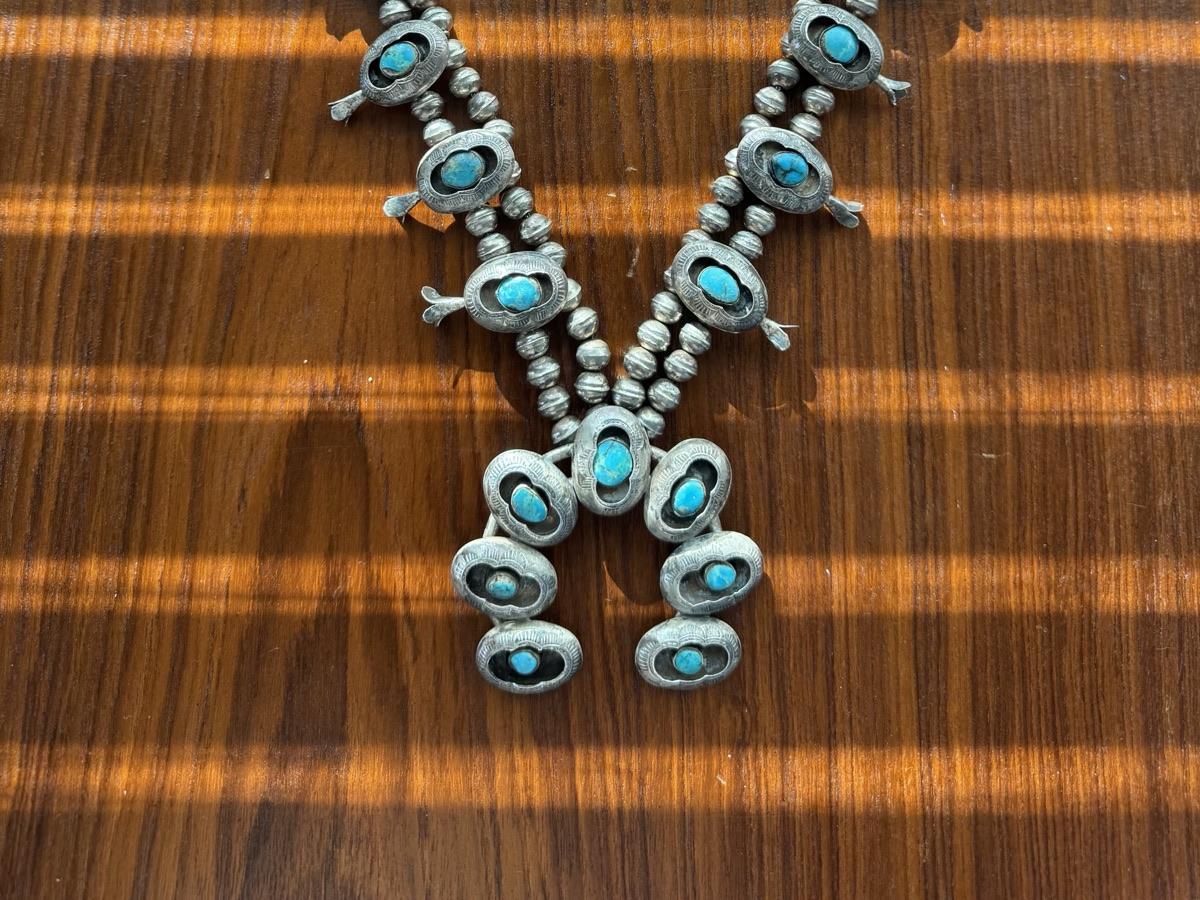
The squash blossom is the most recognizable form in all of Southwestern jewelry, and one of the most misunderstood at the point of sale. The crescent at the bottom, the naja, was adapted by Navajo silversmiths from Moorish and Spanish pendants, and the flowered beads up the sides come from a Spanish silver ornament Europeans knew as the pomegranate blossom. The form came together in the 1870s and 1880s and never left. That history is exactly what a scrap counter cannot pay you for.
We read squash blossom necklaces the way collectors read them: the naja, the stampwork, the age, and above all the turquoise. A heavy old necklace with natural high-grade stone belongs to the collector market, not the melt pile. What we offer here is the read, free and with nothing owed. We are California Vintage Buyers, and the rugs, pottery, and Western art that tend to share a house with a necklace like this are things we do buy.
What to look at first
The naja
The crescent pendant. Its size, casting, stampwork, and any center stone or hand tell us the era and the maker’s skill before anything else.
Text us a photo Send us a photoThe stone
Natural high-grade turquoise can be worth many times a stabilized or block set. Named mines like Lone Mountain, Lander Blue, and Bisbee bring named prices, and coral strands carry their own value.
Text us a photo Send us a photoAge and construction
Ingot silver, hand-pulled wire, and honest wear mark early pieces. Old pawn examples from the trading post era are the ones we get most excited about.
Text us a photo Send us a photoSigned contemporary work
A hallmark from a recognized Navajo or Pueblo master can multiply the value of an otherwise similar necklace. Finding the stamp is part of the read.
Text us a photo Send us a photoDo not let anyone weigh it
The heartbreak we see most in this category is a family selling a grandmother’s squash blossom to a counter that pays by the gram. A necklace that would bring a strong collector price gets melted for a fraction of it, and it is gone for good. Before any scale is involved, text photos to (949) 449-1255, front and back, plus any stamps on the naja. We will tell you the same day whether it is a tourist piece or something the market wants, and roughly what that is worth. Nothing is owed for hearing it, and plenty of families use us exactly as a second opinion against a jewelry-counter quote.
Why It Matters
The difference between ordinary and valuable is in the details: a stitch, a hallmark, a date code. Knowing them is our entire job.
How it works
Call or text photos.
A real conversation about what you have, no pressure to sell.
We come to you.
We look at everything, at your pace. We know what we're seeing.
Cash offer, same visit.
A fair price on the spot, or a full estate sale run for you.
Common questions
How can I tell if my squash blossom is old?
Early necklaces show hand-pulled wire, ingot silver, individually stamped beads, and honest wear at the contact points. Newer pieces are more uniform and often lighter. We read those tells in person or from clear photos, and the age matters as much as the weight.
Some of the turquoise is missing or cracked. Is it still worth something?
Usually, yes. A missing or damaged stone is often repairable, and a strong old necklace holds most of its value with a stone out. Do not pry anything loose or attempt a repair before it is looked at, since original stones and settings are a large part of what is being valued.
Is a squash blossom worth more than its silver weight?
Almost always, and often by a wide margin. The naja, the stampwork, the stone, and the age carry the value, none of which a melt price reflects. That is exactly why it should be read as jewelry before any scale gets near it. We identify them, and the identification is free.
How do I photograph a squash blossom for valuation?
Five photographs settle most questions: the whole necklace laid flat on a plain surface, the naja alone from the front, the back of the naja, one blossom close up, and any hallmark stamped on the reverse. Daylight, no flash. That set is usually enough for a same-day read without anyone driving anywhere.
What is the naja and why does it matter so much?
The naja is the crescent that hangs at the bottom, a form Navajo silversmiths adapted from Moorish and Spanish pendants. Its size, how it was cast or worked, the stampwork on it, and any centre stone tell you more about the era and the maker's skill than the rest of the necklace does. It is the first thing a knowledgeable buyer looks at.
Is a squash blossom with missing stones still sellable?
Usually yes, and the loss is smaller than owners fear. A missing or cracked stone is often repairable and a strong old necklace holds most of its value with one out. What you must not do is pry anything loose, glue a replacement in, or have a stone swapped before it is valued, because original stones and settings are a large part of what is being judged.
Know what it’s worth before you sell.
Our field guides explain how the market actually prices these things. No fishing, no hype: real ranges and the details that move them.
One call. We’ll take it
from there.
(949) 449-12555.0 on Google · Free visit, no obligation · Cash the same visit
Mon-Sat 6 am-8 pm · Sun 8 am-5 pm
A real person answers seven days a week, weekends included. Photos sent today are usually answered the same day.
Or send your photos online Photos on your phone? Text them to (949) 449-1255
Also from California Vintage Buyers
- How to tell what your Native American jewelry actually is.→
- How to tell Lone Mountain from Lander Blue, and either from a tourist piece.→
- A good concho belt is silver worth reading, not silver worth melting.→
- Sell the rug for what the weaver put into it.→
- Huntington Beach jewelry boxes were filled in the sixties, and nobody has read them since.→
- Long Beach jewelry boxes came home from the sea and the shipyard.→