Field Guide
How to Identify Where Turquoise Is From (and Why the Mine Matters)
Everyone wants the stone to be Lander Blue. No visual test can prove it is, paperwork can, and on finished jewelry the maker usually moves the price far more than the mine. Here is the honest version of turquoise mine identification.
Think you have one? A real person reads your photos, usually the same day.
By Sam Wingenbach and Jake Cover, the buyers who make our house calls · Updated August 29, 2026
The short answer: no one can prove where a turquoise stone came from by looking at it. There is no visual, non-destructive test that settles mine origin; every tell narrows the field and none closes it. Documentation closes it. And on finished jewelry, the maker and the silverwork usually move the price far more than the mine name does.
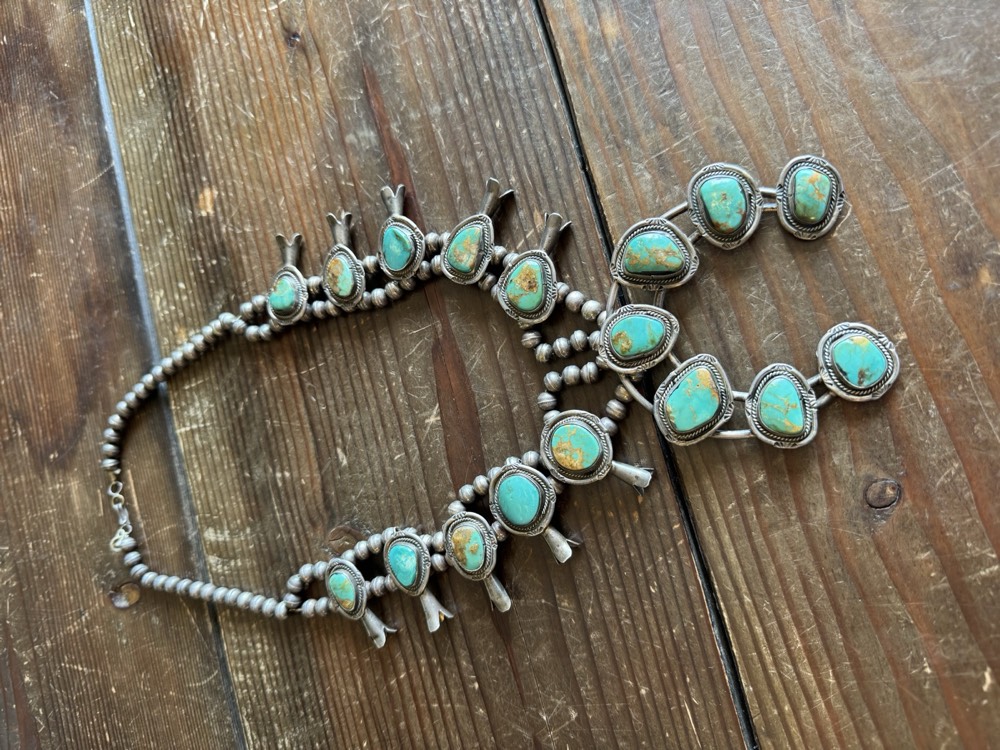
Turquoise carries more origin mythology than any other American stone. Families arrive with a necklace and a sentence that begins with a mine name: it is Bisbee, grandfather said, or the tag reads Number 8. This guide explains what those names mean, what appearance can and cannot prove, which stories are marketing, and where the money in a piece actually lives.
Can you tell which mine turquoise came from by looking at it?
No, not with certainty, and the people closest to the evidence say so. Peer-reviewed provenance research reports that even trace-element chemistry has had limited success attributing turquoise to a mine. GIA does not issue mine-of-origin reports for turquoise and treats origin as a minor pricing factor next to quality. The auction houses that publish results usually do not name a mine at all, and when they do, the attribution is generally the consignor's claim repeated by the cataloguer.
The trade concedes the problem in print. Perry Null Trading, a Gallup trader, says Kingman stones are routinely relabelled upward as Number 8, Lander Blue, Morenci, or Sleeping Beauty, and the misnaming compounds at each resale. That is why the honest vocabulary in this market is consistent with Lander Blue or catalogued as Number 8, and never this is Lander Blue. We use that vocabulary ourselves, and a seller should be wary of anyone who does not.
What actually proves where a turquoise stone is from?
Documents, and almost nothing else. The evidence that moves a careful cataloguer is a dated trading-post or dealer receipt, an old pawn ticket, a known artist documented as working with stone from a known mine, or a written collection history. Everything else, including a confident family story and a handwritten tag, is a claim waiting for support.
- A dated trading-post or dealer receipt that names the stone
- An old pawn ticket that has traveled with the piece
- A maker documented as sourcing from a specific mine in a specific period
- A written collection history, ideally with photographs of the piece being worn
This is why the same object can honestly be described two ways. With paperwork it is a Lander Blue necklace. Without paperwork it is a spiderweb turquoise necklace consistent with Lander Blue, and the market gap between those two descriptions is roughly ten times.
Does the turquoise mine matter more than the maker?
No. On finished jewelry the mine name is close to a footnote. Across the realized results we can verify, price tracked the maker, the quality of the silverwork, the period, the condition, and the provenance, and only then the stone's pedigree. The clearest single demonstration comes from one auction house: an unsigned Navajo watch cuff set with a Bisbee stone realized $219 in 2022, and a Charles Loloma ring set with a Bisbee stone realized $9,450 in 2023. Same mine, same house, about forty times apart, and the difference is the signature. Our hallmarks guide follows that thread: which marks mean what, and which names carry a market of their own.
The named-stone premium is real at the very top, but it follows verified attribution, not the name on a tag. If you are valuing a whole piece rather than a stone, start with our old turquoise jewelry guide and our Navajo jewelry guide, because the hand that made the piece usually decides more of the number than the mine ever will.
What does turquoise from each famous mine look like?
Each mine has a signature look, and each signature is imitated, which is exactly why the looks narrow the field without closing it. Here are the eight names sellers ask about most, what is consistent with each, and the confusion trap that catches people.
| Mine | Status | Consistent with it | The trap |
|---|---|---|---|
| Lander Blue (NV) | Found 1973, worked out after roughly 100 pounds | Tight black spiderweb over deep blue, small stones, 1970s Navajo settings | New Lander, a different nearby mine, shows similar web in green; catalogues also use plain Lander for other Lander County mines |
| Bisbee (AZ) | Copper byproduct; the Lavender Pit ran 1950 to 1974, now closed | Deep blue with reddish chocolate matrix | Far more red-matrix turquoise exists than Bisbee ever produced, including Chinese material cut and sold to imitate it |
| Sleeping Beauty (AZ) | Turquoise recovery ended August 2012; old stock only | Uniform sky blue with little or no matrix | The single most imitated look in the trade; clean blue proves nothing |
| Morenci (AZ) | Nothing produced commercially since the mid-1980s | Blue stone with metallic pyrite flecks that polish like specks of bright metal | Kingman also carries pyrite and is vastly more abundant |
| Kingman (AZ) | In essentially continuous production since about 1900 | Huge range: bright blue nuggets, black matrix, pyrite, birdseye patterning | About 95 percent of Kingman rough is stabilized; frequently relabelled upward as rarer mines |
| Number 8 (NV) | Worked out; a famous 1950 pocket yielded over 1,600 pounds | Spiderweb matrix, golden brown through black, often nodule-cut stones | Only about 10 percent of output was gem grade; a tray of perfect matched stones suggests treated or block material |
| Cerrillos (NM) | Oldest documented North American source; commercially exhausted | Tan and khaki green through pale blue, a very wide range | The name is used loosely for almost any green-brown Southwestern stone |
| Royston (NV) | Still producing; Otteson family claims since 1958 | Blue running into green within one stone, gold to dark brown matrix | Even a correct call is a district call, not a mine call; Carico Lake and others pass for it |
Lander Blue: the most faked name in the Southwest
Lander Blue is a tiny Nevada pocket found in 1973, when Rita Hapgood, a Battle Mountain blackjack dealer, picked up nuggets on a walk, filed the Mary Louise Lode claim, and later sold it for $10,000. It was a hat mine, a deposit small enough to be covered by a hat, and trade accounts say it was worked out after roughly 100 pounds of high-grade spiderweb material. A fixed supply plus a famous name makes it the most casually misattributed turquoise in the Southwest. A Gallup trader puts it plainly: there seems to be more Lander Blue for sale than was ever mined.
The realized record is thinner than the legend. A four-piece 1970s Navajo set brought approximately $112,000 in 2022, but that figure is reported by the selling venue itself and is not a verified record. The widely quoted $23,180 Lander Blue squash blossom is wrong twice over: the auction house's own archive records $21,960 including premium, and the lot was catalogued as Lander turquoise, a county-level label, with Lander Blue appearing nowhere on the page. Meanwhile a 21-stone reference collection of Southwest cabochons, laminated mine map included, brought $400 all in at Bonhams in 2015, roughly $19 a stone.
Two traps to carry with you. Green spiderweb sold as Lander is almost certainly New Lander, a different nearby mine whose material is mostly variscite rather than turquoise. And catalogues legitimately write Lander for other Lander County mines, so read the mine name, not the county.
Kingman: where most of the mislabeling starts
Kingman, from the Mineral Park district in Arizona, has been in essentially continuous production since about 1900, which makes it the workhorse of the trade and the source of most misattribution. Roughly 95 percent of Kingman rough is stabilized or pressed into blocks, per reporting from the operation itself, so treatment status matters more than origin for most Kingman stones. Know the naming trap too: Kingman, Turquoise Mountain, and Ithaca Peak all come from the same district, and the premium names are often ordinary Kingman. When a rare-mine story arrives on a bright blue stone, Kingman is the statistical answer.
How do you know the turquoise is even real?
Settle this before any mine conversation, because these tests are more reliable than anything about origin. Turquoise runs Mohs 5 to 6 and resists a steel pin, while dyed howlite and magnesite, the common imitations, are much softer and show dye pooled in their cracks under a loupe. The trade baseline is blunt: 90 to 95 percent of turquoise on the market is stabilized or otherwise treated, and natural high grade is under about 3 percent. Treated is the norm, and saying so out loud is simple honesty.
- Dye check: color concentrated along cracks and drill holes, or color that lifts onto an acetone swab on a hidden spot, points to dye. Resin-stabilized genuine stone can show faint transfer, which means treated, not fake.
- Matrix feel: a fingernail catches in the crevices of natural matrix; on molded block and painted simulants the matrix sits flush and uniform.
- Block and reconstituted: plastic-bound material feels warm rather than cool, shows unnaturally even color across a large stone, and can show gas bubbles or a mold seam.
- Never run a destructive test, a hot needle or a scratch on a visible face, on a piece you may want to sell.
Which turquoise stories should you stop repeating?
The turquoise trade runs on repeated stories, and a surprising number of the famous ones cannot be traced to any record. These circulate constantly, and none of them survived verification. Treat each one as marketing until someone shows you a document.
- The rarest and most valuable turquoise in the world. No independent market study or price index ranks mines by realized value; the phrase is a dealer superlative, repeated even by selling venues.
- Any per-carat price for any of these mines. Not one per-carat figure in the category survived verification; every one traced to a dealer asking price or an uncited blog.
- The Kingman mine is closed. The copper mine at Mineral Park has been dormant since December 2014, but turquoise mining and processing there continues.
- Sleeping Beauty's closure removed 20 percent of the world's turquoise supply. Traceable only to an AI-generated content site, with no production data behind it.
- Coronado sent Cerrillos turquoise to Spain in 1541. Always framed as legend, never documented. The documented Cerrillos story is better anyway: the oldest known source in North America, mined commercially from 1879 to roughly 1912 by the American Turquoise Company, which was genuinely tied to Tiffany and Co.
- Bisbee miners smuggled stones out in lunch boxes. Color, not fact.
- A Lander Blue squash blossom sold for $23,180. The house's own record shows $21,960 including premium, and the lot was catalogued as Lander turquoise, not Lander Blue.
What should you do with a piece that might have a named stone?
Photograph it in daylight: the front, the back with any hallmark, and a close view of the stone and its matrix. Keep every scrap of paper with it, because in this category a receipt can be worth more than any amount of polish. Then get it read by someone who handles Native American and turquoise jewelry regularly. We identify these pieces free, in person across Southern California or over a quick video call, we say plainly what the stone is consistent with and what it is not, and we point sellers to the reputable specialist buyers who handle the top of this market, usually the same day.
One more note about what tends to surface from the same closets. The Navajo rugs, the baskets, the pottery, and the Southwestern paintings that come out alongside these collections are pieces we actively buy, and they travel well with the same house call.
The honest rule: the mine story adds money only when it is documented. Do not clean the piece, do not reglue a loose stone, keep every tag and ticket, and let the paperwork, not the matrix, make the claim.
Common questions
- Can a lab or jeweler certify which mine my turquoise came from?
- No. GIA does not issue mine-of-origin reports for turquoise, peer-reviewed provenance research reports limited success even with trace-element chemistry, and no reliable kitchen-table test exists. Attribution rests on documents: a dated receipt, an old pawn ticket, a maker's documented supply, or a written collection history.
- What proves a stone is really Lander Blue?
- Paperwork, not appearance. Tight black spiderweb over deep blue is consistent with Lander Blue, but the trade itself concedes there is more Lander Blue for sale than the mine's roughly 100 pounds ever produced. A dated receipt or documented history closes the question; without one, honest sellers say consistent with, never is.
- Is green spiderweb turquoise Lander Blue?
- Almost certainly not. New Lander, a different nearby Nevada mine, produces similar black spiderweb in green, yellow-green, and orange material that is mostly variscite or chalcosiderite rather than turquoise. Green web sold as Lander is nearly always New Lander, and catalogues also use plain Lander for other Lander County mines.
- Is Kingman turquoise natural?
- Usually not in the strict sense. About 95 percent of Kingman rough is stabilized with resin or pressed into blocks, per reporting from the operation itself. Kingman is real turquoise from a real, still-producing mine, but a Kingman stone offered as natural with no cutter or provenance chain is, on the base rate, stabilized.
- Is Sleeping Beauty turquoise still being mined?
- No. Turquoise recovery at the Globe-Miami operation ended in August 2012 when the mine went copper-only, so everything on the market is old stock. Kingman is the opposite case: its copper mine has been dormant since 2014 while turquoise production there continues.
- Why do two pieces with the same mine's stone sell for wildly different prices?
- Because the maker, the silverwork, the period, the condition, and the provenance set the price, and the mine name is close to a footnote. At the same auction house, an unsigned Navajo watch cuff with a Bisbee stone realized $219 in 2022 and a Charles Loloma ring with a Bisbee stone realized $9,450 in 2023, about forty times apart. Text photos of the front and back to (949) 449-1255 for a free same-day read.
Have something like this?
One phone call and we come to you, anywhere in Southern California. Free visit, honest evaluation, cash the same day.
Keep reading