Field Guide
Are Old Kids’ Levi’s Worth Anything? 503ZXX, 503B and Little Levi’s
A child’s pair of old Levi’s is the pair most families throw away first. A few of them are the scarcest denim in the house.
We buy from every state · free video appraisal · paid before you ship
By Sam Wingenbach and Jake Cover, the buyers behind our video appraisals and house calls · Updated September 6, 2026
Read the transcript
Hi guys, Sam here with California Vintage Buyers, and I want to help clear the air and give you a little bit of information on how do you know if your old Levi's you're looking at are worth the time to try to sell them or bound for Salvation Army and just get them out of here. There's not really value there. This is not an exhaustive list of things to look for, but it's just some key distinguishing factors, right? So I have a few pairs of pants in front of me and different eras. So we're going to go over with the newer ones, right? Here we have a pair of the year 2000 pants. How do I know that these are from the year 2000? Well, because if you see that dark 501XX right there, that style of lettering is from the 90s to the early 2000s. It's different than this stuff. Do you see the difference of that one right there? You can see the difference. We'll get to these in a minute. But if you see that block lettering on your pants, you're looking at 90s up to say 2004 or something like that. Another tell. Let's just say you don't have this patch here. You wore the belt a lot. He wore the belt. She wore the belt a lot. The patch is gone. How old are my pants? With these ones, you can also pop this guy out right here. And you have, see that number right there? 1000. It's actually not the number 1000. It's 10, 00, October the year 2000. So whatever number you're looking at right there on the tag, if it has this tag on the inside leg, look at that number and you're going to see probably 0497 or what have you. It's going to be month and year. Good to know. So if that's gone, check if it has one of those. If it doesn't have one of these, then you're looking at somewhere in the 80s, right? Or potentially older. So I have a pair of 80s here. Anything made in USA is going to say on this tag, made in USA, right? So see that right there? Made in USA. Made in USA. What does these not have? These don't have made in USA. See how that part's missing? Made in Guatemala in the 2000s. They outsourced all the manufacturing. Bummer. So still good pants. We'll still buy these if the wash is cool. But the collector factor is not there. So again, if you got a pile of 100 of these guys, we'll still buy them. Give us a call. Are you kidding me? But when it comes to like Levi's, it's the details that matter. So moving forward. Oh, another thing is the distinguishing factor. See how it's red, the 501. And this one's black. You see in red, you're seeing 80s. Right? So you're looking at made in USA. Got the little red 501. That was an 80s thing. Right? So that's a couple things. Then you go over to these guys. Now, this is also 80s, but these are early 80s. What's the distinguishing factor on these guys? Flip up the pant leg. Do you see that? That's called selvedge denim. They call them redlines. These are called redlines. Right? Anything 501, 1982, 83-ish, right around there, and previous is going to have this kind of thing. This makes the value go up a little bit higher. Right? Why do they call these redlines you're asking? Great question. Well, when they were brand new, like these puppies from the 70s, which are a fantastic sample, they had a red line. Then, selvedge denim. So what does selvedge denim mean? It means the pant leg was made out of one sheet of denim, and they slapped them together. That's the end of a sheet of denim. They put them together, and they sewed the pant leg. And so this is made out of one sheet, a little more collectible. These are redlines. These are redlines. If you see that, you're looking at redlines. Even if you don't see any red, you got a pair of redlines. Right? We'll buy all these guys. Now, if you see one of these things that has a capital E right there, it's even better. Right? If you're looking at dealing with a barn, a ranch, Uncle Bob's house, and you're clearing it out, and you found him in the attic or in the bottom of his closet or something, we're great buyers for all this stuff. And we've paid up to thousands before for certain types of Levi's. There's a collectible value. It all depends on what the details are. You know? It's like if you call the car dealership, and you're like, hey, what do y'all pay for cars? They're going to say, okay, well, yes, we buy cars. What's the make? Model? Mileage? How's the condition? All the things. Give us a call. Number is 949-449-1255. We'd love to help you discern what you got, make your sweet offer, and buy all that stuff and more.
The short answer: yes, sometimes. Child-size Levi’s made before 1971, with a capital E on the red tab and a lot number like 503ZXX or 503BXX on the patch, are scarce and collected, and the best 1950s pairs are priced by Japanese dealers above $2,000. Kids’ Levi’s from the 1970s onward, including most Little Levi’s, usually bring $10 to $50. Text patch and tab photos to (949) 449-1255.
Kids’ jeans are the last thing anyone expects to be worth money, which is exactly why the old ones are rare. A pair bought for a six-year-old in 1958 was worn hard, handed down, patched, and finally cut into shorts or thrown out. Almost none survived. So if you are standing in a garage holding a very small pair of old Levi’s with a leather-look patch and a red tab, slow down. This guide explains what the numbers on the patch mean, how to tell how old the pair is using the same signals as adult Levi’s, and what the pair is honestly worth, including the caution that the market for children’s sizes is thinner than the market for a 32 waist.
What does 503ZXX mean on a pair of kids’ Levi’s?
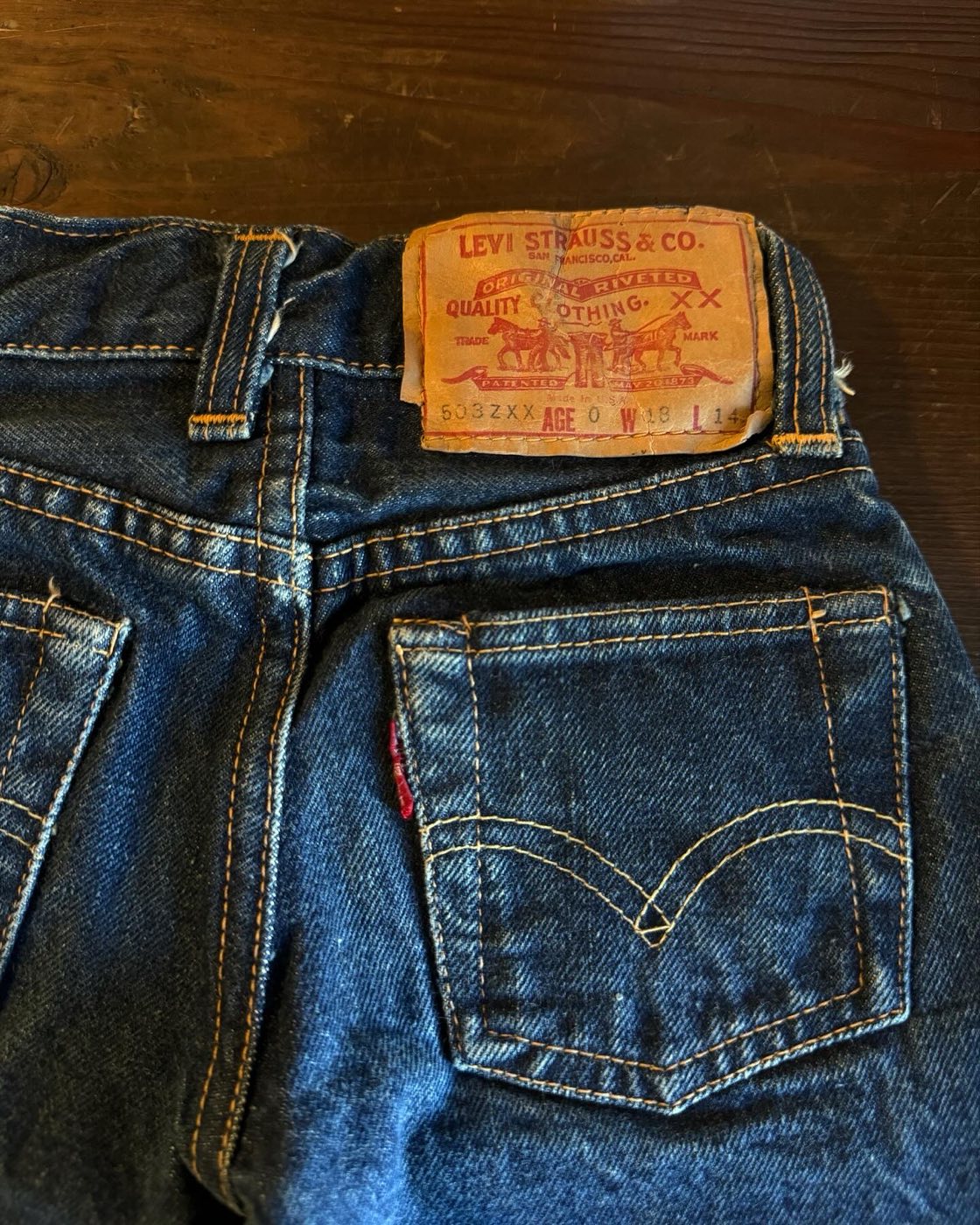
The lot number on the patch is the factory’s own name for the cut. 501 is the adult button-fly jean. 503 was the children’s cut built to the same pattern, and the letters after it tell you more. Z means a zipper fly: Levi’s introduced a zippered version of the adult 501, the 501Z, in the mid-1950s to win over East Coast buyers who were used to zippers, and the children’s pairs of the era carried the same letter. XX marks the heavy denim of the earlier decades, and Levi’s dropped the XX suffix around the mid-1960s, so a 503ZXX patch places a pair before then. Our pair reads 503ZXX with a size line of Age 0, W 18, L 14, and our read is 1950s to early 1960s.
One trap worth naming: a pair marked 503BXX is not automatically a kids’ pair. Collectors call the 503B the little brother of the 501XX, a button-fly cut nearly identical to an early 501, and they argue about what the B stands for. The boys’ line theory is the common one, but 503B pairs turn up in adult waists, often 33 to 42 inches, which is why some collectors think the A and B suffixes named denim grades rather than customers. Measure the waist before assuming anything.
What is the difference between 503ZXX, 503B and Little Levi’s?
| What the patch or label says | What it means | Era, as far as we can verify |
|---|---|---|
| 503ZXX | Children’s version of the 501 with a zipper fly (Z) in heavy XX denim; sized by age plus waist and length | 1950s into the early 1960s; XX dropped around the mid-1960s |
| 503B or 503BXX | The little brother of the 501XX: a button-fly cut nearly identical to an early 501; the B is debated and adult waists are common | 1940s to 1960s; postwar pairs with hidden rivets are the ones dealers price highest |
| 501Z or 501ZXX | The adult 501 with a zipper fly, introduced in the mid-1950s for the East Coast; not a kids’ cut, but it explains the Z | Mid-1950s onward |
| Little Levi’s | The name Levi’s put on its children’s line; the pieces that surface are mostly orange tab, Made in USA jeans and trucker jackets | 1980s and later, on the pieces we can verify |
| Koveralls | Levi’s 1912 one-piece denim playsuit for children, the company’s first children’s denim | 1910s to 1930s |
That table stops where our verification stops. Levi’s made other youth cuts and renumbered them over the decades, and the online lists disagree with each other, so we do not publish a full code table. If your patch reads something else, photograph it and ask.
Why would anyone pay real money for a child’s old jeans?
- Scarcity. Adult work jeans were retired to the garage; children’s jeans were worn until they fell apart and then cut down. Survivors from before 1971 are far rarer than adult pairs from the same year.
- Display. A toddler-size 1950s pair with a two-horse patch and a red tab is the same object as a 1950s 501, built from the same denim on the same line, at a scale that hangs on a wall. That is part of why dealers want them.
- Japan. Japanese dealers have been flying to the United States to buy old American denim since the 1980s, and children’s sizes are part of that trade. A Japanese shop run by a vintage magazine listed a 1950s age 0 503ZXX with a leather patch at 345,000 yen, over $2,000, after a California buying trip; it sold out. The same shop says a deadstock example with its paper flasher and guarantee ticket goes above a million yen. Those are a dealer’s prices, not what a seller receives.
- Small-size collectors. Adult vintage denim already carries a premium in smaller waists, because the buyers are younger and slimmer than the ranch hands the jeans were made for. Kids’ pairs sit at the far end of that curve.
If you are outside California, none of this requires a drive: we buy vintage Levi’s remotely, with a free video call, a price agreed on the call, payment through PayPal before you ship, and shipping paid by us.
How do I tell how old a pair of kids’ Levi’s is?
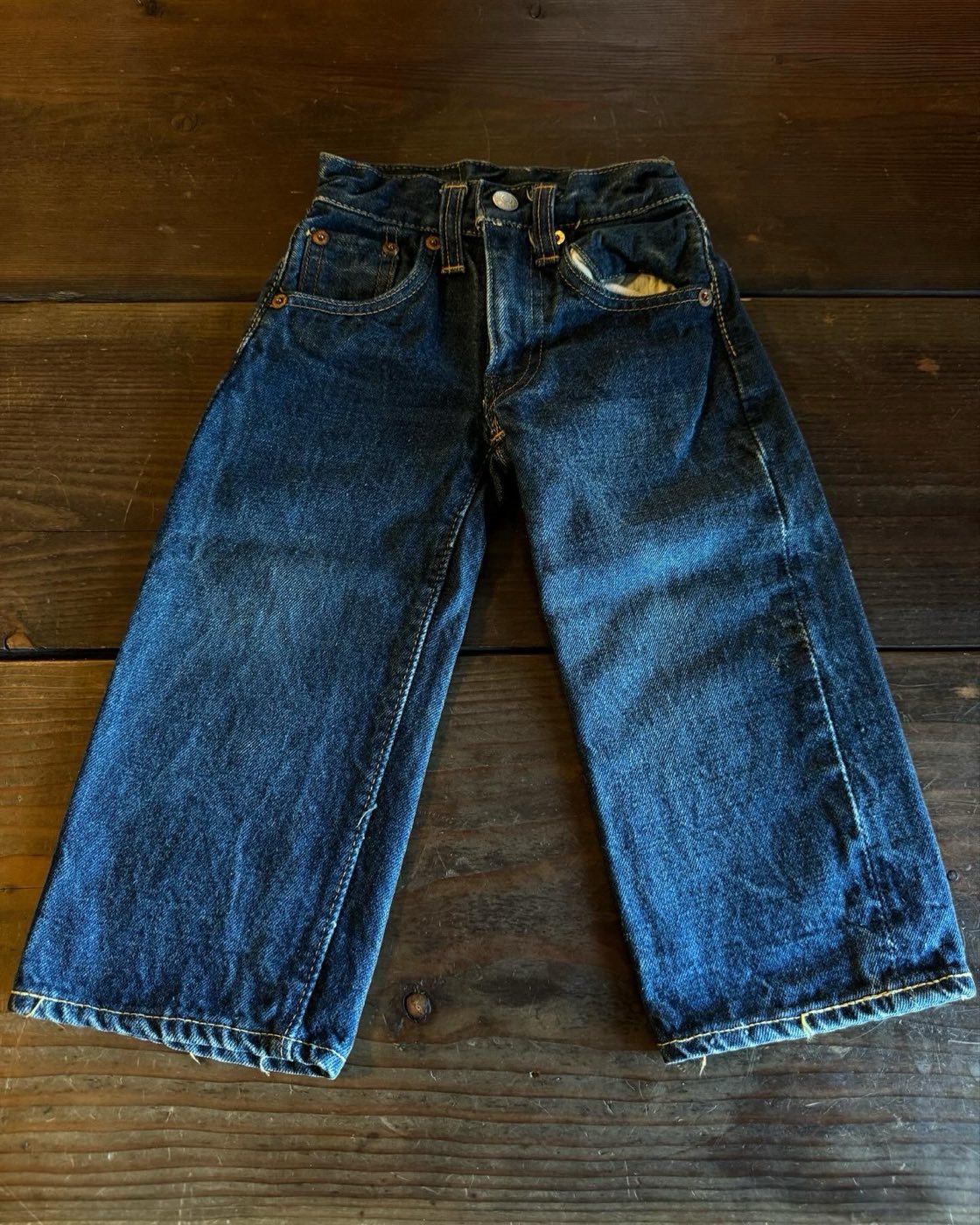
The same signals that date an adult pair date a child’s pair, because the children’s cuts were built on the same line with the same hardware. Check them in this order.
- The red tab. A capital E in LEVI’S means the pair was made before 1971. A lowercase e means 1971 or later.
- The care tag. Care labeling began in 1971, so a pair with no care tag inside the waistband predates it. If there is a tag, the date codes guide reads the digits on it.
- The patch. XX after the lot number places the pair before the mid-1960s. A size line written as an age, then a waist and a length, is how Levi’s marked children’s pairs of that era.
- The back pockets. Hidden rivets, covered by the fabric rather than showing, were used through 1966, and they appear on the children’s cuts too.
- The tab color. Levi’s introduced the orange tab in 1969 for its less expensive fashion lines, so an orange tab means 1969 or later; on children’s pieces it often comes with a Little Levi’s label.
Two things that fool people. Redline selvedge inside the outseam is not the same as big E; selvedge ran into the mid-1980s. And a small waist alone proves nothing, because a great many 1980s and 90s Levi’s were made for children and are simply small. Our step-by-step dating guide and the adult 501 value guide carry the full signal-by-signal detail.
What are old kids’ Levi’s actually worth?
Here is the honest state of the evidence as of September 2026. We looked for published auction results for a 1950s 503ZXX and did not find one; what exists are dealer asking prices, which are ceilings a dealer hopes for, not what a seller is paid. Everything below is labelled by kind.
| Pair | Figure | What kind of figure, and when |
|---|---|---|
| 1950s 503ZXX, age 0, leather patch | 345,000 yen, over $2,000 | A Japanese vintage shop’s asking price, since sold out, read September 2026 |
| 1947 era 503B and 503BXX, 27 and 28 inch waists | $880 and $1,000 | A vintage dealer’s asking prices, both sold out, read September 2026 |
| 1960s adult big E 501, for comparison | $2,040 | Realized at auction in Anchorage; the documented mid-market adult figure |
| Youth-size vintage Levi’s, sold ten pairs to a lot | $50 to $100 per lot | Auction estimates, Dennis Auction Service, New Jersey, January 8, 2021 |
| 1980s Little Levi’s orange tab, Made in USA | $25 for jeans, $48 for a trucker jacket | Dealer asking prices, both sold, read September 2026 |
Read that table as a shape, not a price list. Pre-1971 children’s pairs with the patch and the tab intact are genuinely wanted and can bring hundreds of dollars, with the earliest and cleanest 1950s pairs priced far higher by the dealers who resell them to collectors. Most kids’ Levi’s from the 1970s onward bring $10 to $50 a pair, and the 1980s Made in USA orange tab pieces sit at the top of that band. The caution is real: a children’s pair has fewer buyers than the adult pair beside it, so it sells more slowly and for less, and a buyer who has to hold it for a year will price that in. When we make an offer on a kids’ pair, we price it off the same signals as the adult pair and then say out loud how much the thinner market costs it.
What should I do with the pair I found?
Do nothing to it. Do not wash it, do not mend the knees, do not cut the hem. Photograph the patch straight on and the red tab up close, in daylight, and call or text them to California Vintage Buyers at (949) 449-1255. We buy vintage Levi’s from every state, by video call with payment before you ship, and with free house calls across Southern California, and the honest answer is sometimes that a small pair is a ten dollar pair. When it is a 1950s 503ZXX, you will know exactly why.
Common questions
- Are old kids’ Levi’s worth anything?
- Sometimes, and the age decides it. A child-size pair made before 1971, with a capital E on the red tab and a lot number such as 503ZXX on the patch, is scarce because children’s jeans were worn out rather than kept, and collectors and Japanese dealers pay for the survivors. Kids’ Levi’s from the 1970s onward, including most Little Levi’s, usually bring $10 to $50 a pair. Photograph the patch and the tab before deciding anything.
- What does 503ZXX mean on Levi’s?
- 503 was Levi’s children’s cut, built on the same pattern as the adult 501. The Z means a zipper fly, the same letter Levi’s used on the adult 501Z it introduced in the mid-1950s, and XX marks the heavy denim of the earlier decades, a suffix dropped around the mid-1960s. The size on a 503ZXX patch is written as an age plus a waist and a length, which is itself a sign of a children’s pair.
- Is a Levi’s 503B a kids’ pair?
- Not necessarily. Collectors call the 503B the little brother of the 501XX, a button-fly cut nearly identical to an early 501, and they disagree about the B. The boys’ line theory is the usual one, but 503B pairs turn up in adult waists, often 33 to 42 inches, so some collectors think the A and B suffixes named denim grades. Measure the waist across the top before assuming it was made for a child.
- Why are vintage kids’ jeans so rare?
- Because nobody saved them. An adult’s work jeans were retired to a garage or a closet; a child’s jeans were worn until the knees went, handed to a younger sibling, cut into shorts, and thrown away. Very few children’s pairs from before 1971 survived, which is why a toddler-size 1950s Levi’s pair with its patch and red tab intact is a collected object, and why a Japanese dealer priced one at 345,000 yen, over $2,000, in 2026.
- How do I date a child’s pair of Levi’s?
- The same way as an adult pair, because the children’s cuts used the same tab, patch and hardware. A capital E on the red tab means before 1971; no care tag inside the waistband also means before 1971; XX after the lot number means before the mid-1960s; hidden back-pocket rivets mean 1966 or earlier. An orange tab, which Levi’s introduced in 1969, means 1969 or later, and it is the tab most Little Levi’s pieces carry. A small waist by itself dates nothing.
Have something like this?
One phone call, from any state. A free video appraisal, the price agreed on the call, and payment through PayPal before you ship, with shipping on us. In Southern California we come to you and pay cash the same day.
Keep reading
- Sell vintage Levi’s to people who know what they’re holding.→
- Levi’s Tab Colors: What Orange, Silver, White, Black, and Blank Tabs Mean→
- Sell vintage clothing in Orange County.→
- Sell vintage Levi’s in Huntington Beach, where the work clothes outlived the work.→
- Alaska kept its Levi’s. We pay what they’re actually worth.→