Field Guide
Levi’s Tab Colors: What Orange, Silver, White, Black, and Blank Tabs Mean
The little flag on the back pocket is a color code. Red is the classic line, and every other color marks a different family of Levi’s, made in different years for different buyers, and worth very different money today.
Think you have one? A real person reads your photos, usually the same day.
By Sam Wingenbach and Jake Cover, the buyers who make our house calls · Updated October 6, 2026
The short answer: the tab color tells you which Levi’s line a garment belongs to. Red is the core line, the 501s and jackets, since 1936. Orange marked the fashion fits, bell-bottoms and boot cuts, from 1969 to 1999. Silver Tab was the baggy line launched in 1988. White tabs were used on corduroy and other non-denim lines of the 1960s and 70s, and a black tab with gold letters marked Sta-Prest permanent press. A blank red tab is a modern pair made that way on purpose. Red tab pairs from before 1971 are the collector market; the other colors mostly bring tens of dollars, with the best orange tabs reaching a few hundred. Free tab reads at (949) 449-1255.
Most people learn about the tab from the big E question, whether the red flag reads LEVI’S in capitals or Levi’s with a small e. That question has its own guide. But a lot of the jeans that come out of closets and garages carry a tab that is not red at all, and the color changes the story before the lettering does. Levi Strauss and Co used tab colors to sort its own catalog, so the color is the quickest way to know which family a pair came from. Here is what each one means, roughly when it was used, and what that family sells for now.
What does each Levi’s tab color mean?
| Tab | What it marked | Years on vintage pieces | Typical range, with the date it was read |
|---|---|---|---|
| Red, LEVI’S in capitals (big E) | The core line: 501s, Type 1, 2, and 3 jackets | 1936 to 1971 | 1960s 501s sold for $540 to $1,600 and hidden-rivet 1940s and 50s pairs for $700 to $2,500 on eBay between June and early September 2026 |
| Red, Levi’s with a small e | The same core line after the lettering change | 1971 onward | Redline selvedge pairs mostly $200 to $1,000; worn 1980s and 90s Made in USA 501s $40 to $150, read September 2026 |
| Orange | Fashion fits: bell-bottoms, boot cuts, slimmer jeans | 1969 to 1999, revived in 2017 | Worn 1970s 646 bell-bottoms about $70 to $105 in marketplace listings read October 2026; 1969 to 1971 capital E orange tabs often a few hundred dollars |
| Silver Tab | The baggy and loose fits of the late 1980s and 1990s | From 1988, faded out in the 2000s, back in the early 2020s | Worn 1990s pairs about $25 to $105 in marketplace listings read October 2026 |
| White | Corduroy and other non-denim lines, and the women’s line, per collector guides | 1960s and 1970s | 1970s white tab cords about $30 to $150 in marketplace listings read October 2026 |
| Black with gold letters | Sta-Prest permanent-press pants | From the 1964 season | No reliable figure on record; read individually |
| Blank red, only the ® mark | A modern pair made blank on purpose to protect the trademark | Modern production | Priced as used modern clothing |
A note on those figures. The red tab ranges come from eBay sold results we read sale by sale in September 2026. The orange, Silver, and white tab ranges are marketplace listings we read in October 2026, a mix of asking and sold prices rather than auction results, because the sold data for these lines is thin and harder to reach. Treat them as the honest neighborhood, not a quote.
What does an orange tab on Levi’s mean?
It means the pair belongs to Levi’s fashion line rather than its classic workwear line. According to Levi Strauss and Co, the orange tab arrived in 1969 to set apart the newer cuts, the bell-bottoms, the boot cuts, and the slimmer jeans aimed at younger buyers, so designers could experiment without touching the 501. The company made orange tab garments until 1999 and brought the line back in 2017. So an orange tab is never earlier than 1969, and a vintage one is almost always from the 1970s, 80s, or 90s. The common lots you will see are 646 bell-bottoms, 684 big bells, and 517 boot cuts.
The orange tab that collectors chase is the short first run. Orange tabs made from 1969 to 1971 read LEVI’S in capitals, because they predate the lettering change, so they are genuine big E tabs on genuine 1960s jeans. They sell into a smaller market than a red tab 501 of the same years, but the right cut in the right size often brings a few hundred dollars, as of September 2026. A worn 1970s orange tab with a small e is a good, wearable piece of vintage: 646 bell-bottoms made in the USA were listing and selling at about $70 to $105 in October 2026, with a never-worn pair still carrying its tags offered at $400.
Are Silver Tab Levi’s vintage?
Some are, and the label inside tells you which. Levi’s introduced Silver Tab in 1988, and by the company’s own account it was a big success, the line that rode the baggy, loose-fit look of the late 1980s and 1990s. It faded out in the 2000s and came back in the early 2020s, with a full relaunch for fall 2022, so a new Silver Tab is easy to buy today. A vintage one has a care label with no barcode or a simple older format, and some read Made in USA, which fits the years before Levi’s closed its last American plants in 2003. A Silver Tab with a modern barcoded label and an overseas country of origin is a recent pair.
For value, Silver Tab is a fashion market, not a collector market. Worn 1990s Silver Tab baggy jeans were listing and selling at about $25 to $105 in October 2026, with most between $35 and $80; washes, fits, and sizes that match the current baggy trend sit at the top. That is real money for a pair from the back of a closet, and it is also why we tell people honestly that a Silver Tab is not the pair to hold out for.
What is a white tab Levi’s?
Collector guides tie the white tab to Levi’s corduroy and other non-denim lines of the 1960s and 1970s, and to the women’s line of the same years. In practice the white tab you will meet is on a pair of cords: straight 519s, flared 646 and 684 cuts, and other 1970s corduroy pants in brown, tan, black, and blue. In October 2026, 1970s white tab corduroys were listing at about $30 to $150, with clean, unfaded colors and popular flare cuts at the top. Levi’s Vintage Clothing now reproduces the 1960s white tab cords new, so a white tab with a modern care label is a reproduction, not a find.
What does a black tab with gold letters mean?
On Levi’s history pages, a black tab with gold lettering marks Sta-Prest, the permanent-press process. Levi Strauss and Co produced its first Sta-Prest garments in 1963 and offered them for the 1964 season, as no-iron twill and sateen slacks, and the line became a 1960s favorite. Levi’s also used black tabs on women’s black denim and on some men’s items, so a black tab alone does not prove Sta-Prest; read the label in the waistband for the name. We have no reliable price record for vintage Sta-Prest, so we read each pair individually rather than quote a range.
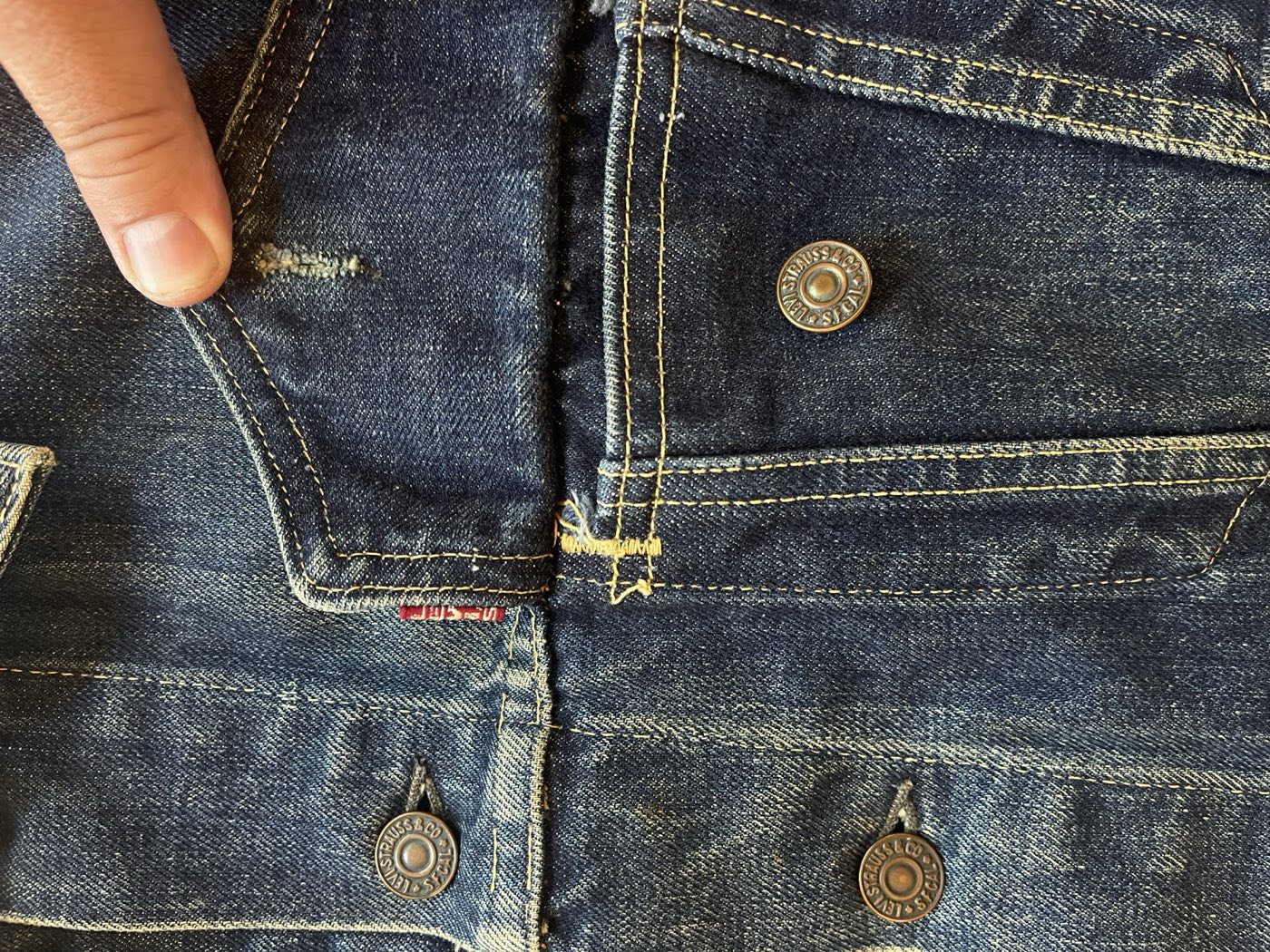
What does a blank Levi’s tab mean?
A red tab with no lettering, only the registered trademark mark, is a modern pair made that way on purpose. Levi Strauss and Co says about one tab in ten on its current garments is woven blank to show that the company owns the tab itself as a trademark, not just the name on it. It is not a vintage tab with the letters worn away. Its reproduction line, Levi’s Vintage Clothing, always carries the name. The other blank case is the truly old one: Levi’s added the tab in 1936, so a pair with no tab at all and other early details can be very old, which is a different conversation entirely and worth a careful read.
How do I tell a vintage tab from a modern revival?
Orange tabs, Silver Tabs, white tab cords, and even the capital E have all been revived or reproduced in recent years, so the tab color dates the line, and the label dates the pair. Check these together.
- The care label. Care labels became standard on US clothing in 1971; a vintage orange, Silver, or white tab has an older label, or none at all on the earliest 1969 to 1971 orange tabs, and a modern revival has a barcoded one.
- The country of origin. Made in USA fits the vintage decades, since the last American Levi’s plants closed in 2003; an overseas label on a tab color that claims the 1970s is a later pair.
- The capitals. A capital E means before 1971 on a red or orange tab, except on reproductions and on the premium products Levi’s has marked with a capital E since 2018, and those carry modern care labels.
- The date codes. A post-1971 care label carries small printed digits for the month, year, and factory, which the date codes guide reads.
- The reproduction line. Levi’s Vintage Clothing remakes orange tab and white tab pieces as well as red tab 501s, and the reproduction guide covers how to spot one.
The mistakes that cost money
- Pricing every Levi’s like a big E 501. An orange or Silver Tab pair is a good pair of vintage jeans, not a collector object, and a seller who holds out for a four-figure number usually ends up not selling at all.
- The opposite mistake: assuming a red tab is ordinary. A capital E red tab, or a small e pair with a red selvedge line in the cuff, belongs in a different conversation; the big E guide explains why.
- Cutting out the care label. On a post-1971 pair it is the dating evidence, and without it nobody can separate a 1978 pair from a 2018 revival.
- Washing or altering before selling. Fades, original hems, and untouched flares are what buyers pay for; a hot wash or a tailor’s hem takes them away for good.
- Trading vintage in for a gift card. Checked in August 2026, Levi’s SecondHand pays $30 in store credit for jeans made more than twenty years ago, whatever the pair is, and the trade cannot be undone.
- Splitting a matched lot carelessly. A run of orange tab bell-bottoms or white tab cords in one size range sells better together to the right buyer than one pair at a time.
How do I get a Levi’s tab read and sold?
Photograph the tab close up in daylight, the inside care label or waistband, the back of the top button, and the whole pair front and back. The photo guide lists the shots and what each one proves, and the Levi’s identifier turns them into a first answer. Then call or text California Vintage Buyers at (949) 449-1255. We read Levi’s of every tab color every week and buy them from every state: anywhere in the country we look at the pairs together on a video call, agree the price on the call, and pay through PayPal before you ship, with shipping on us. In Southern California we come to you and pay cash the same visit. We will tell you plainly which pairs are ordinary and which one is worth knowing about. For the full dating method, see how to date Levi’s.
Common questions
- Are orange tab Levi’s worth anything?
- Yes, modestly, and a few are worth more. Levi’s used the orange tab from 1969 to 1999 for its fashion fits, so most orange tabs are 1970s to 1990s bell-bottoms and boot cuts. Worn 1970s 646 bell-bottoms made in the USA were listing and selling at about $70 to $105 in October 2026. The short first run, from 1969 to 1971, reads LEVI’S in capitals, and the right cut in the right size often brings a few hundred dollars.
- When did Levi’s make Silver Tab jeans?
- Levi’s introduced Silver Tab in 1988 for the baggy and loose fits of the late 1980s and 1990s. The line faded out in the 2000s and came back in the early 2020s, with a full relaunch for fall 2022. A vintage Silver Tab usually has an older care label without a barcode and some read Made in USA, which fits the years before Levi’s closed its last American plants in 2003.
- What does a white tab on Levi’s mean?
- Collector guides tie the white tab to Levi’s corduroy and other non-denim lines of the 1960s and 1970s, and to its women’s line of those years. Most white tabs found today are on 1970s corduroy pants, which were listing at about $30 to $150 in October 2026. Levi’s Vintage Clothing also makes new white tab cords, so a modern care label means a reproduction.
- Which Levi’s tab color is the most valuable?
- Red, when it reads LEVI’S in capitals. A big E red tab means the core line before 1971, and 1960s big E 501s sold for $540 to $1,600 on eBay between June and early September 2026, with older hidden-rivet pairs higher. Orange, Silver, and white tabs mostly bring tens of dollars, and the best early orange tabs a few hundred, so color sorts the line and the lettering sorts the era.
Have something like this?
One phone call and we come to you, anywhere in Southern California. Free visit, honest evaluation, cash the same day.
Keep reading
- Big E Levi’s: What the Capital E Means and What They Are Worth→
- How to Date Levi’s: A Step-by-Step Guide→
- Levi’s Date Codes: How to Read the Care Tag, Button Stamps, and Lot Numbers→
- Is My Levi’s Jacket or 501 an Original or a Levi’s Vintage Clothing Reproduction?→
- Sell vintage Levi’s to people who know what they’re holding.→