Field Guide
1920s and 1930s Levi’s: How to Tell If Yours Are That Old and What They Are Worth
Levi’s from before the Second World War are the pairs with a buckle on the back. Whether they also have belt loops, suspender buttons, bare rivets and a red tab tells you which half of which decade, and the inside tells you whether they are old at all.
We buy from every state · free video appraisal · paid before you ship
By Sam Wingenbach and Jake Cover, the buyers behind our video appraisals and house calls · Updated November 10, 2026
The short answer: Levi’s jeans from the 1920s and 1930s have a buckled strap across the back of the waist and a leather patch. Belt loops arrived in 1922, the red tab in 1936, and the back pocket rivets were covered in 1937, so a pair with bare back pocket rivets and no red tab is from before 1936. Original pairs this old are rare enough that each one is priced on its own: we found no public record of an ordinary sale in 2026, and two museum-grade pairs carried auction estimates of $50,000 to $70,000 each in November 2023. Levi’s has reissued its 1922, 1933 and 1937 jeans, so check the inside first. California Vintage Buyers buys pre-war Levi’s from every state. Call or text (949) 449-1255.
Which 1920s or 1930s Levi’s jeans do I have?
Four details sort the two decades, and none of them needs a tool: belt loops, suspender buttons, the rivets on the back pockets and the red tab. The years for the two main models follow the model list in Heddels’ 501 collector’s guide, the reference most collectors use.
| Years | Waistband | Back pocket rivets | Red tab |
|---|---|---|---|
| 1920 to 1922 | Buckle back and suspender buttons, no belt loops | Bare copper, in plain sight | None |
| 1922 to 1936 | Belt loops added; buckle back and suspender buttons kept | Bare copper, in plain sight | None |
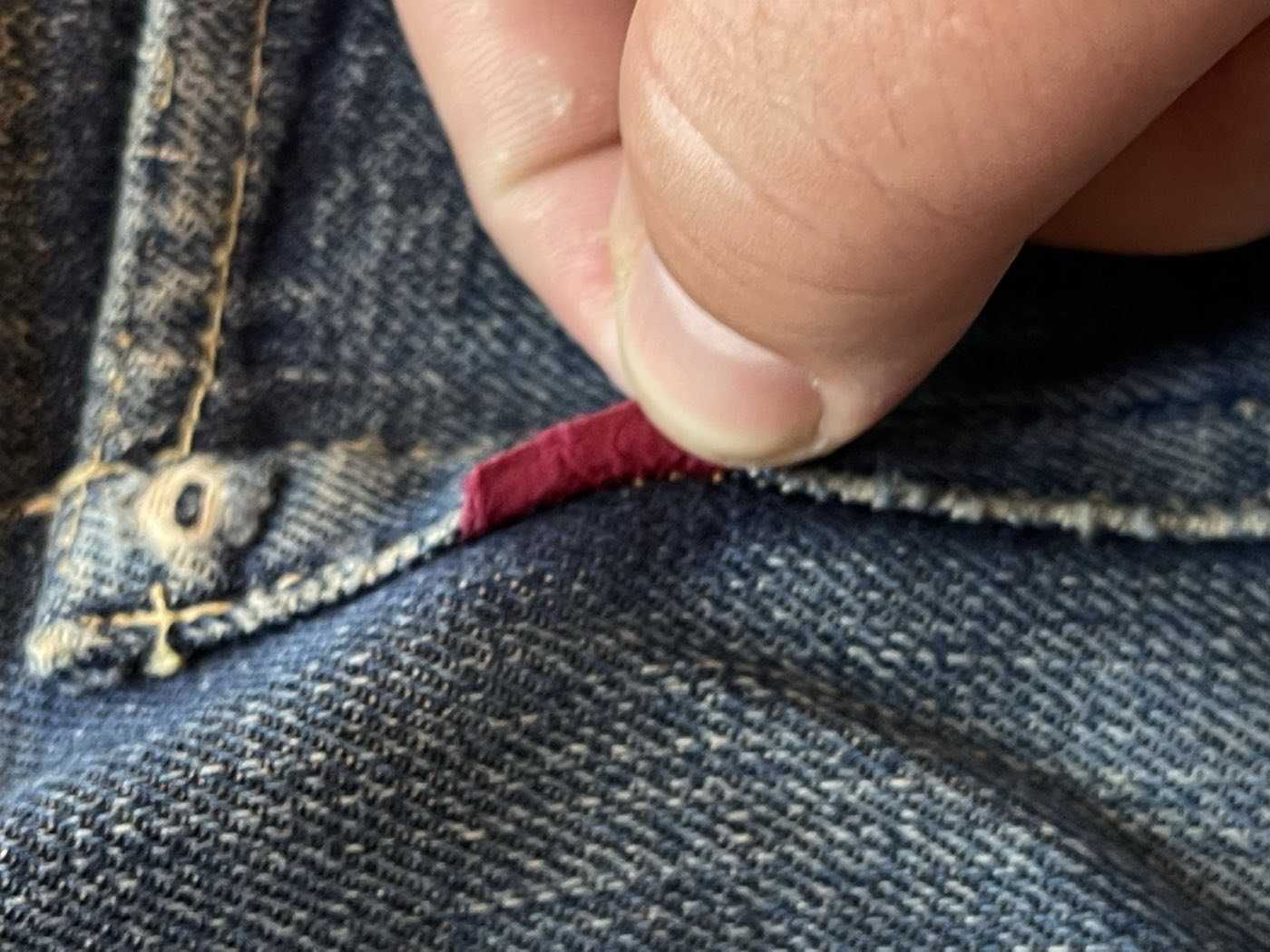
| 1936 to 1941 | Belt loops and buckle back; suspender buttons gone about 1937 | Covered by the denim from 1937 | LEVI’S on one side only, from 1936 |
All three carry a leather patch on the waistband, a rivet at the base of the fly, curved stitching on the back pockets and no care label of any kind. Heddels writes that Levi’s used Cone Mills denim exclusively by 1922, and that Cone developed a 10 ounce denim with a red line on the edge for the 501 in 1927. That red line stayed until the mid-1980s, so it shows the denim is old but does not date a pair to these decades. The 501 dating guide walks through every tell in order.
What does a buckle on the back of Levi’s mean?
The strap and buckle, called a cinch, tightened the waist before men wore belts. Levi’s added belt loops in 1922 and kept the cinch beside them until the wartime rules of the early 1940s took it off for good, so a buckle back means the pair was made before the war. Many men cut the strap off to wear a belt, and some stores kept scissors at the counter for it. Two cut stubs or a row of empty stitch holes count the same as the buckle. The buckle-back guide covers these pairs in full.
What is the NRA label with a blue eagle?
Some Levi’s made from 1933 to 1935 carry a small white cloth label printed with a blue eagle and the letters NRA. It stands for the National Recovery Administration, the Depression-era program whose labor rules the company followed; it has nothing to do with rifles. The Levi Strauss and Co. Archives hold a 1930s denim jacket with the label. It narrows a garment to about three years, but Levi’s 1933 reissue copies the label too, so it never proves an original by itself.
What about 1920s and 1930s Levi’s jackets?
Levi’s had one denim jacket through both decades: the Type 1, lot 506XX, with one chest pocket, pleats down the front and a buckle at the back. The company called it a blouse until its 1938 catalog. Three changes date it.
| Years | Chest pocket | Red tab | Back buckle |
|---|---|---|---|
| Before 1928 | No flap | None | Silver, with pin teeth |
| 1928 to 1936 | Flap added in 1928 | None | Silver, with pin teeth |
| 1936 to 1941 | Flap | LEVI’S on one side only, from 1936 | Silver, with pin teeth |
A Type 1 with no pocket flap can also be a wartime jacket, because the flap came off again in 1941; the wartime one has a red tab and plain donut buttons with a hole in the middle. The Type 1 guide shows each version.
Did Levi’s make anything else in the 1920s and 1930s?
- The No. 2 line: Lot 201 jeans and the Lot 213 jacket, a cheaper grade sold beside the 501 from about 1890 until around the Second World War. The 201 has a cloth patch where the 501 has leather. The 213 and 201 guide covers both.
- Lady Levi’s, Lot 701: introduced in the fall of 1934, which Levi’s calls the first jeans made exclusively for women. The 701 guide dates them.
- Not Levi’s at all: before the war nearly every maker of work pants used a buckle back. JCPenney’s Foremost line copied the 501XX closely, and Montgomery Ward and Lee sold their own. Read the buttons, which carry the maker’s name. Store-brand pairs still sell: a 1930s Foremost buckle-back pair brought $2,600 at auction on October 1, 2022.
Are mine from the 1920s or 1930s, or a reissue?
This is the check that matters most, because the reissues far outnumber the originals. Levi’s Vintage Clothing has remade the 1922, 1933 and 1937 501, the 1936 Type 1 jacket, the 1920s Lot 201 and Lot 213 in 2025, and in August 2026 a 1942 501 with a buckle back. The outside of a reissue matches, down to the buckle, the leather patch and the suspender buttons. The inside gives it away: a reissue has a printed care or size label sewn inside with a style number and a country of origin, and many 1990s reissues have 555 on the button backs. A pair from the 1920s or 1930s has no care label at all, because US care labels began in 1971. The reproduction guide lists the rest of the tells.
What are 1920s and 1930s Levi’s worth?
The honest answer is that there is no everyday price range, because so few originals change hands in public. We looked for a recorded sale of an ordinary worn 1920s or 1930s 501XX in November 2026 and found none. What exists is the ceiling, the floor set by later pairs, and a few neighbors.
| What it is | Price, with the date and source |
|---|---|
| 1920s 501XX with no red tab, from a famous collection | Auction estimate of $50,000 to $70,000, Joopiter, November 2023. An estimate, not a sale price |
| 1930s 501XX with a red tab and hidden rivets, same sale | Auction estimate of $50,000 to $70,000, Joopiter, November 2023. An estimate, not a sale price |
| A high quality 501 from the early twentieth century | Can draw over $25,000 at auction, per Heddels’ collector’s guide, written in 2016 |
| 1930s JCPenney Foremost buckle-back, a store brand | Sold for $2,600 at auction, October 1, 2022 |
| Pre-war Type 1 jacket with a one-sided tab | One listed by a US seller at about $2,300, October 28, 2026 (asking price). Worn Type 1s of any year typically bring $2,000 to $8,000, our August 2026 read |
| Original Lot 201 jeans or Lot 213 jacket | No range on record; they surface rarely and are priced one at a time |
| For scale: 1940s and 1950s 501XX with hidden rivets | Sold for about $700 to $2,500 on eBay, June to August 2026. Pre-war pairs sit above these |
The two estimates at the top are for museum-grade pairs with a well-known owner, and yours is almost certainly not one of them. Between that ceiling and the later pairs, what decides the number is the same list every time: how dark the denim still is, whether the patch and the buckle survive, a size a grown adult can wear today, and whether anyone has washed, mended or altered the pair. Wear does not disqualify it. The damaged Levi’s guide sets out what holes and stains really cost.
Mistakes that destroy value
- Washing them. The dark color a wash takes out does not come back.
- Trimming the stubs of a cut buckle strap, or snipping off the suspender buttons to tidy the waistband. Those are the proof of age.
- Mending holes, sewing on patches or hemming the legs before a buyer has seen the pair.
- Flattening or peeling a curled leather patch. Old leather is brittle and breaks.
- Pricing from a reissue listing, or from the estimate on a museum pair.
- Deciding they cannot be Levi’s because there is no red tab. Before 1936 there was none.
- Throwing them out because they are stiff, stained or were found in a barn, a trunk or a mine. That is where pre-war pairs come from.
Where do pairs this old turn up?
Rarely in a closet. Pre-war Levi’s were work clothes, worn out and thrown away, so the survivors tend to come from places nobody cleaned for decades: a trunk in an attic, a ranch outbuilding, a mine. If that is where yours came from, photograph them where they lie before you move anything, and read old jeans found in a mine or the farm and ranch cleanout guide first.
Where can I sell 1920s or 1930s Levi’s?
For a pair this old you have four real routes. An auction house reaches the collectors who pay the most, takes a commission, and is slow. Listing them yourself on eBay or Grailed keeps more of the price if you can photograph the details and answer hard questions; the route comparison sets out each platform’s cut. A vintage shop pays less and pays at once. California Vintage Buyers buys pre-war Levi’s jeans and jackets from every state: we look at them together on a free video call, agree the price on the call, and pay through PayPal before you ship, with shipping on us. In Southern California we come to you and pay cash the same visit; we paid $12,000 cash, the same day, for a 1940s Type 1 jacket. If yours belong at auction, we will say so. Start with the photo guide, then call or text (949) 449-1255.
Common questions
- How can I tell if my Levi’s are from the 1920s or 1930s?
- Look for a buckled strap on the back of the waist, a leather patch and no care label inside. Then check three things: no belt loops means before 1922, bare copper rivets on the back pockets with no red tab means before 1936, and a red tab lettered on one side with the buckle still there means 1936 to 1941.
- What are 1930s Levi’s jeans worth?
- Each original pair is priced on its own, because so few sell in public. Two museum-grade pairs, one from the 1920s and one from the 1930s, carried auction estimates of $50,000 to $70,000 each in November 2023, and 1940s and 1950s pairs sold for about $700 to $2,500 on eBay in summer 2026; pre-war pairs sit above those. California Vintage Buyers gives free reads from any state at (949) 449-1255.
- Do 1920s Levi’s have a red tab?
- No. Levi’s introduced the red tab in 1936, so jeans and jackets from the 1920s and early 1930s never had one. A pair with a buckle back, bare back pocket rivets and no tab, and no torn stub where a tab was, points to before 1936.
- Are my 1933 or 1937 Levi’s real or a reissue?
- Levi’s Vintage Clothing has remade the 1922, 1933 and 1937 501, and the outside matches the originals. Look inside: a reissue has a printed care or size label with a style number and a country of origin, and many 1990s reissues have 555 on the button backs. An original has no care label, because US care labels began in 1971.
- Where can I sell Levi’s from the 1920s or 1930s?
- California Vintage Buyers buys pre-war Levi’s jeans and jackets from every state: text photos of the waistband, back pockets, patch and fly buttons to (949) 449-1255, agree the price on a free video call, and get paid through PayPal before you ship, with shipping on us. For a museum-grade pair an auction house is also a real route, and we will say so.
Have something like this?
One phone call, from any state. A free video appraisal, the price agreed on the call, and payment through PayPal before you ship, with shipping on us. In Southern California we come to you and pay cash the same day.
Keep reading
- How to Date Levi’s 501 Jeans: The Year-by-Year Tells, 1890s to 1971→
- Old Jeans With a Buckle on the Back: What a Buckle-Back Is and What It Is Worth→
- Levi’s Type 1 Jacket (506XX): How to Date It, What It Is Worth, and Where to Sell It→
- Levi’s Lot 213 Jacket and Lot 201 Jeans: Original or Reissue, and Where to Sell Them→
- Levi’s 701: What Old Lady Levi’s Jeans Are Worth and How to Date Them→
- 1940s Levi’s: How to Tell If Yours Are From the 1940s and What They Are Worth→
- Old Jeans Found in Mines: The Real Finds and What They Sold For→
- Is My Levi’s Jacket or 501 an Original or a Levi’s Vintage Clothing Reproduction?→
- Ripped, Stained, or Thrashed: Are Damaged Old Levi’s Still Worth Money?→
- Where to Sell Old and Vintage Levi’s Jeans From Any State (2026)→
- Sell your Levi’s 501XX jeans from any state, paid before you ship.→
- Sell vintage Levi’s to people who know what they’re holding.→