Field Guide
How to Date Levi’s 501 Jeans: The Year-by-Year Tells, 1890s to 1971
Every change Levi’s made to the 501 before 1971 left a mark you can find in two minutes without tools. Here is the order to check them in, and what each one says about the year.
We buy from every state · free video appraisal · paid before you ship
By Sam Wingenbach and Jake Cover, the buyers behind our video appraisals and house calls · Updated November 9, 2026
Read the transcript
This Short has no spoken words, only music and on-screen text. What it shows: Run a thumb over the top corners of the back pockets on a pair of old Levi's: two small bumps under the cloth are hidden rivets, used from 1937 to 1966. In eBay sales from June to early September 2026, 1940s and 1950s hidden-rivet pairs sold for $700 to $2,500. A buckle across the back means jeans made before about 1942 (on a one-pocket jacket the buckle runs to the early 1950s), not the 1800s. Text a photo to California Vintage Buyers at (949) 449-1255 for a free answer the same day.
The short answer: to date Levi’s 501 jeans made before 1971, check six things in this order. A buckled strap on the back means before the Second World War. Suspender buttons mean about 1937 or earlier. Bare copper rivets on the back pockets mean before 1937; rivets hidden under the denim mean 1937 to 1966. A leather patch means before the mid-1950s. A red tab lettered on one side only means before about 1951, and a capital E on the tab means before 1971. No care label inside confirms all of it. California Vintage Buyers dates and buys old 501s from every state: call or text photos to (949) 449-1255.
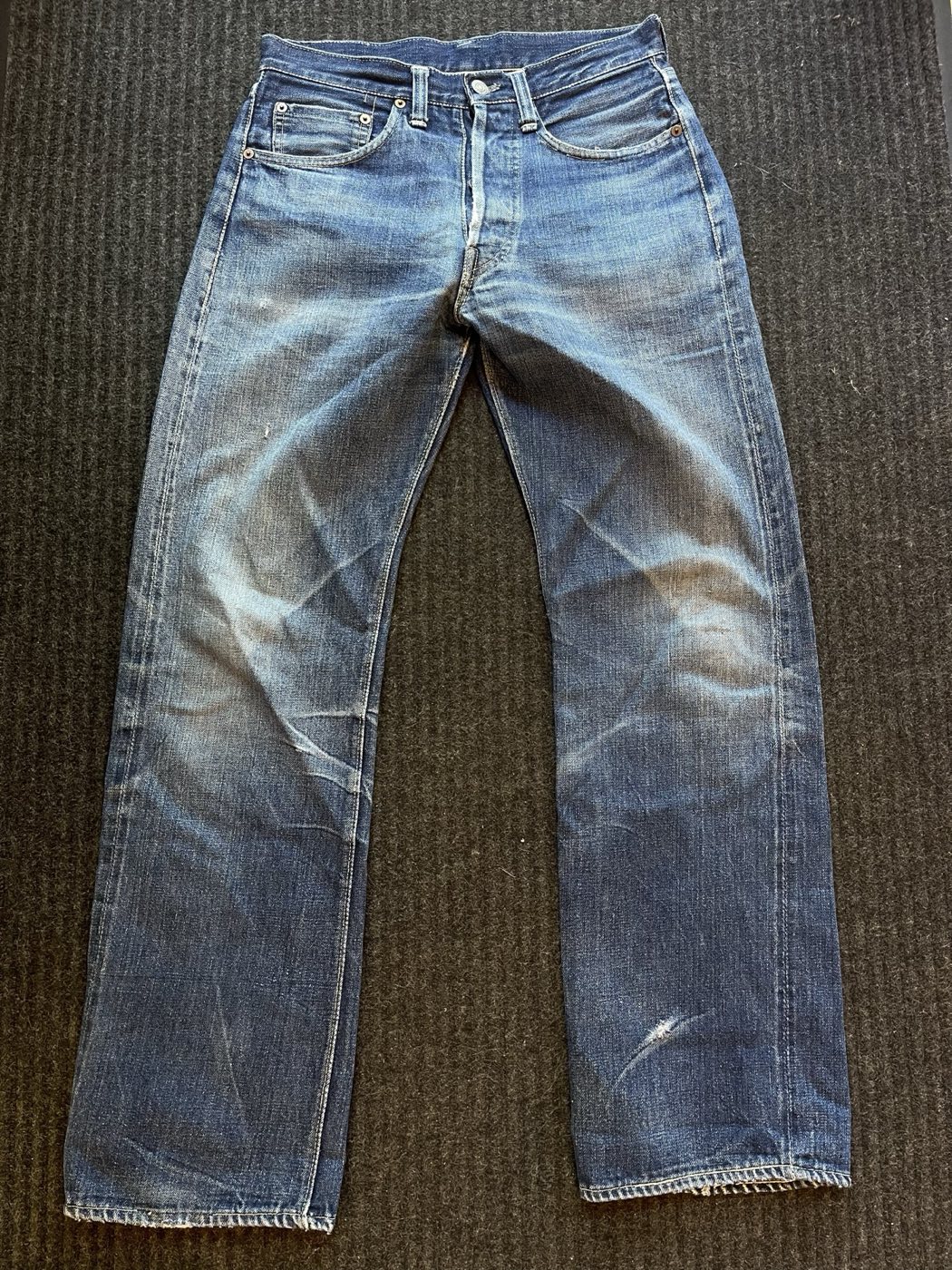
Levi’s 501 timeline: what changed, and when
| Years | What the pair has | What it is called |
|---|---|---|
| Before about 1901 | One back pocket, a buckle back, suspender buttons, no belt loops | The earliest riveted pairs |
| About 1901 to 1922 | Two back pockets, buckle back, suspender buttons, still no belt loops | Early 501 |
| 1922 to 1936 | Belt loops added; buckle back and suspender buttons kept; bare rivets on the back pockets; no red tab | Buckle-back 501XX |
| 1936 to 1941 | Red tab arrives in 1936; back pocket rivets covered from 1937; suspender buttons gone about 1937; buckle back still there | Buckle-back 501XX with a tab |
| 1942 to 1947 | No buckle back, no crotch rivet, no watch pocket rivets, painted back pocket stitching, plain donut buttons | WWII S501XX |
| 1947 to mid-1950s | Sewn back pocket stitching with a small diamond in the middle, leather patch, hidden rivets, tab lettered on one side until about 1951 | Post-war 501XX |
| Mid-1950s to mid-1960s | Leather-like patch that sellers call paper, tab lettered on both sides, hidden rivets | Paper patch 501XX |
| Mid-1960s to 1971 | XX dropped from the patch, back pocket rivets replaced by stitching by 1966, capital E still on the tab | Big E 501 |
The years for the 1936 to 1962 models follow the model list in Heddels’ 501 collector’s guide, which is the reference most collectors use; the belt loop, red tab and rivet dates are Levi Strauss and Co.’s own. Boundary years are approximate, because Levi’s used up old parts before starting new ones.
Is there a buckle on the back?
A strap with a buckle across the back of the waistband is called a cinch, and it tightened the waist before men wore belts. Levi’s added belt loops in 1922 and kept the cinch alongside them until the wartime rules of the early 1940s took it off for good. A buckle back therefore means before the war. Many men cut the strap off to wear a belt, so look for two cut stubs or a row of empty stitch holes where it sat. The buckle-back guide covers the 1930s pairs in full.
Do old Levi’s 501s have suspender buttons?
The early ones do. Buttons sewn around the outside of the waistband for suspenders were standard until about 1937. A pair with suspender buttons and no belt loops is before 1922. A pair with both is 1922 to about 1937. Later pairs sometimes carry buttons a tailor added on the inside, which date nothing.
What do the rivets on the back pockets tell you?
- Bare copper rivets you can see at the top corners of the back pockets: before 1937.
- Hidden rivets: turn the pocket inside out and you find the rivet under the denim. Levi’s covered them in 1937 after complaints about scratched saddles and furniture, and kept them until 1966.
- No rivets on the back pockets at all, only heavy stitching: 1966 or later.
- A rivet at the base of the fly, called the crotch rivet: before the war. It came off in the wartime changes and never returned.
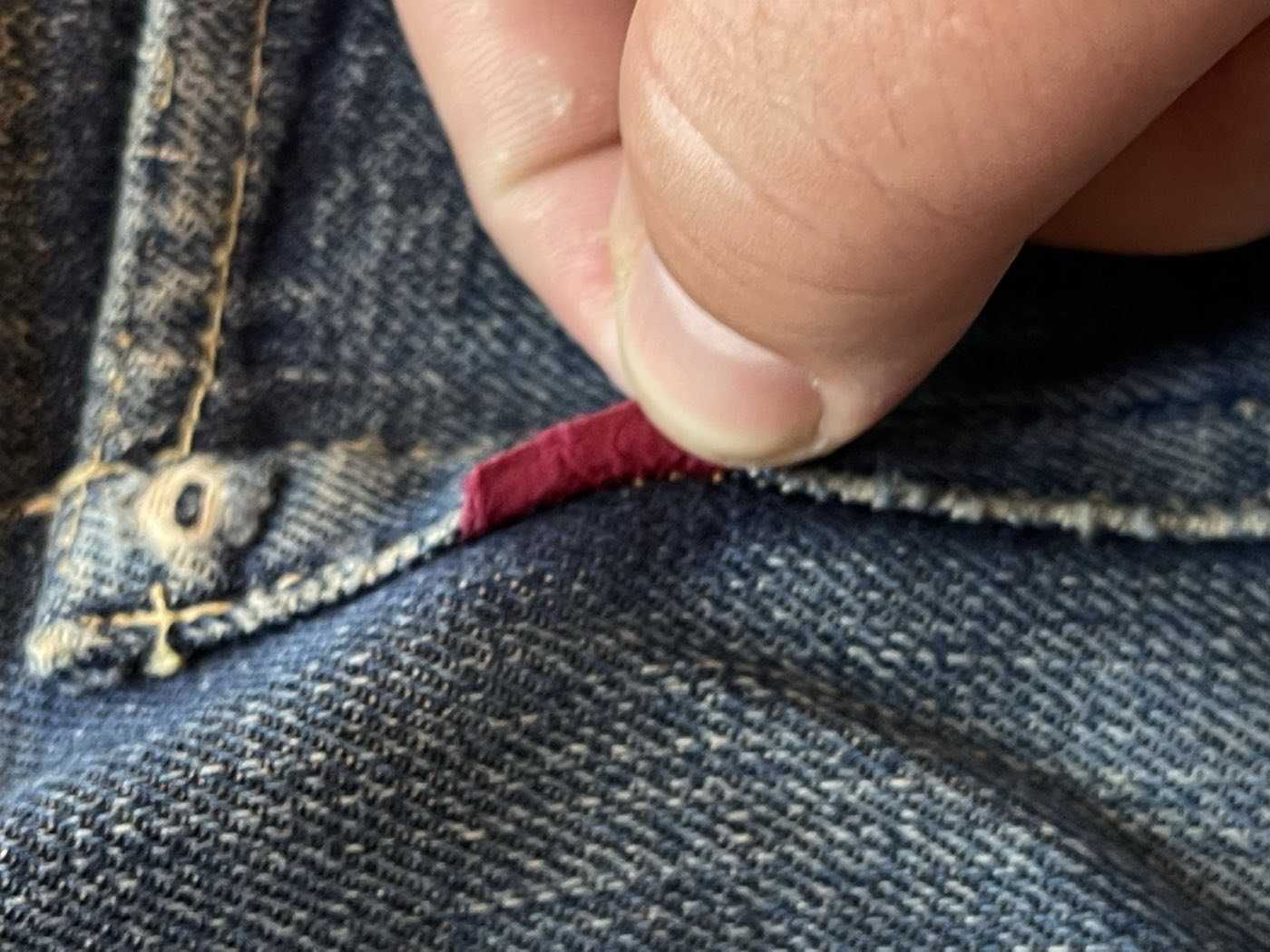
Is the patch leather or paper?
The patch on the back of the waistband was leather until the mid-1950s. Old leather shrinks, darkens and cracks, and is often half missing, which is normal and still reads as leather. From about 1955 Levi’s used a leather-like material that most sellers call a paper patch. If the patch still shows the lot number, 501XX is the name through the mid-1960s; XX marked the extra heavy denim, and it was dropped from the patch around the mid-1960s. A patch reading S501XX is the wartime pair.
What does the red tab say?
- No tab, and no torn stub where one was: before 1936, the year the tab was introduced.
- LEVI’S on one side and blank on the other: 1936 to about 1951.
- LEVI’S on both sides, with a capital E: about 1951 to 1971.
- Levi’s with a small e: 1971 or later, and outside this guide. The date-code guide reads those from the care label.
How do I spot a WWII 501?
The wartime pair, 1942 to 1947, is the one where things are missing. No buckle back, no crotch rivet, no rivets on the small watch pocket, and back pockets that look blank because the curved stitching was painted on and has usually worn away. The buttons are plain donut buttons with a hole in the middle, some with a laurel leaf. Blank back pockets alone prove nothing; it is the set of details together. The WWII guide shows each one.
Original or reissue? The check that matters most
Levi’s Vintage Clothing has remade nearly every pair in the table: the 1890, 1922, 1933, 1937, 1944, 1947, 1954, 1955 and 1966 models, with buckle backs, leather patches, hidden rivets and capital E tabs on the outside. The inside gives a reissue away. Look for a printed label sewn inside with a style number and a country of origin, and for 555 stamped on the back of the buttons on many 1990s reissues. No original made before 1971 has a care label, because US care labels began that year. The reproduction guide lists the rest of the tells.
What is each era of 501 worth?
| Era | Price, with the date and source |
|---|---|
| 1880s pairs recovered from mines | $87,400 at auction, October 1, 2022; the record sales are single pieces, not a price range |
| Buckle-back 501XX, before the war | The top of the market; each pair is priced on its own |
| WWII S501XX | More than $6,000 in good condition, per Heddels’ collector’s guide |
| 1940s and 1950s 501XX with hidden rivets | Sold for about $700 to $2,500 on eBay, June to August 2026 |
| Big E 501, before 1971 | Can bring $500 or more, our read as of August 2026 |
Wear does not disqualify a pair. Fading, repairs and paint are part of what collectors pay for, and the damaged Levi’s guide sets out what holes and stains really cost. Do not wash, mend or cut anything before someone has looked. For prices across every era, see what old 501s are worth.
Where can I sell old 501s once I know the year?
California Vintage Buyers buys Levi’s 501 jeans made in 1971 and earlier from every state. Text photos to (949) 449-1255, we look at the pair together on a free video call, agree the price on the call, and pay through PayPal before you ship, with shipping on us. In Southern California we come to you and pay cash the same visit. If your pair would bring more listed yourself, we will say so; the route comparison sets out every option.
Common questions
- How can I tell what year my Levi’s 501s are?
- Check the back of the pair. A buckle back means before the Second World War; suspender buttons mean about 1937 or earlier; rivets hidden inside the back pockets mean 1937 to 1966; a leather patch means before the mid-1950s; a red tab lettered on one side means before about 1951; and a capital E on the tab means before 1971.
- What does 501XX mean?
- 501 is the lot number of Levi’s button-fly jean, and XX marked the extra heavy denim it was cut from. The XX stayed on the patch until around the mid-1960s, so a patch reading 501XX points to a pair older than that, unless a care label inside shows it is a reissue.
- When did Levi’s stop putting a buckle on the back of 501s?
- During the Second World War. Levi’s added belt loops in 1922 and kept the buckled back strap, called a cinch, until wartime rules removed it in the early 1940s. It did not come back when the post-war 501 returned in 1947.
- Are hidden rivets a sign of valuable Levi’s?
- They are a sign of an old pair. Levi’s hid the back pocket rivets under the denim from 1937 and dropped them by 1966. Original 1940s and 1950s 501XX with hidden rivets sold for about $700 to $2,500 on eBay in summer 2026. California Vintage Buyers gives free reads from any state at (949) 449-1255.
- Who buys really old Levi’s 501 jeans?
- California Vintage Buyers buys 501s made in 1971 and earlier from every state: text photos of the patch, the back pockets, the red tab and a button back to (949) 449-1255, agree the price on a free video call, and get paid through PayPal before you ship, with shipping on us.
Have something like this?
One phone call, from any state. A free video appraisal, the price agreed on the call, and payment through PayPal before you ship, with shipping on us. In Southern California we come to you and pay cash the same day.
Keep reading
- Sell your Levi’s 501XX jeans from any state, paid before you ship.→
- Sell your WWII Levi’s from any state, paid before you ship.→
- Sell your big E Levi’s from any state, paid before you ship.→
- Are Old Levi’s 501s Worth Anything? Real 2026 Prices→
- Old Jeans With a Buckle on the Back: What a Buckle-Back Is and What It Is Worth→
- WWII Levi’s: How to Spot an S501XX or S506XX and What It Is Worth→
- 1920s and 1930s Levi’s: How to Tell If Yours Are That Old and What They Are Worth→
- 1940s Levi’s: How to Tell If Yours Are From the 1940s and What They Are Worth→
- 1950s Levi’s: How to Tell If Yours Are From the 1950s and What They Are Worth→
- Big E Levi’s: What the Capital E Means and What They Are Worth→
- Is My Levi’s Jacket or 501 an Original or a Levi’s Vintage Clothing Reproduction?→