Field Guide
Old Jeans With a Buckle on the Back: What a Buckle-Back Is and What It Is Worth
The strap and buckle across the back waistband is called a cinch. It dates the pair, it does not by itself name the maker, and it is the one detail in old denim that should stop a garage cleanout cold.
We buy from every state · free video appraisal · paid before you ship
By Sam Wingenbach and Jake Cover, the buyers behind our video appraisals and house calls · Updated October 2, 2026
Read the transcript
Hi guys, Sam here with California Vintage Buyers, and I want to help clear the air and give you a little bit of information on how do you know if your old Levi's you're looking at are worth the time to try to sell them or bound for Salvation Army and just get them out of here. There's not really value there. This is not an exhaustive list of things to look for, but it's just some key distinguishing factors, right? So I have a few pairs of pants in front of me and different eras. So we're going to go over with the newer ones, right? Here we have a pair of the year 2000 pants. How do I know that these are from the year 2000? Well, because if you see that dark 501XX right there, that style of lettering is from the 90s to the early 2000s. It's different than this stuff. Do you see the difference of that one right there? You can see the difference. We'll get to these in a minute. But if you see that block lettering on your pants, you're looking at 90s up to say 2004 or something like that. Another tell. Let's just say you don't have this patch here. You wore the belt a lot. He wore the belt. She wore the belt a lot. The patch is gone. How old are my pants? With these ones, you can also pop this guy out right here. And you have, see that number right there? 1000. It's actually not the number 1000. It's 10, 00, October the year 2000. So whatever number you're looking at right there on the tag, if it has this tag on the inside leg, look at that number and you're going to see probably 0497 or what have you. It's going to be month and year. Good to know. So if that's gone, check if it has one of those. If it doesn't have one of these, then you're looking at somewhere in the 80s, right? Or potentially older. So I have a pair of 80s here. Anything made in USA is going to say on this tag, made in USA, right? So see that right there? Made in USA. Made in USA. What does these not have? These don't have made in USA. See how that part's missing? Made in Guatemala in the 2000s. They outsourced all the manufacturing. Bummer. So still good pants. We'll still buy these if the wash is cool. But the collector factor is not there. So again, if you got a pile of 100 of these guys, we'll still buy them. Give us a call. Are you kidding me? But when it comes to like Levi's, it's the details that matter. So moving forward. Oh, another thing is the distinguishing factor. See how it's red, the 501. And this one's black. You see in red, you're seeing 80s. Right? So you're looking at made in USA. Got the little red 501. That was an 80s thing. Right? So that's a couple things. Then you go over to these guys. Now, this is also 80s, but these are early 80s. What's the distinguishing factor on these guys? Flip up the pant leg. Do you see that? That's called selvedge denim. They call them redlines. These are called redlines. Right? Anything 501, 1982, 83-ish, right around there, and previous is going to have this kind of thing. This makes the value go up a little bit higher. Right? Why do they call these redlines you're asking? Great question. Well, when they were brand new, like these puppies from the 70s, which are a fantastic sample, they had a red line. Then, selvedge denim. So what does selvedge denim mean? It means the pant leg was made out of one sheet of denim, and they slapped them together. That's the end of a sheet of denim. They put them together, and they sewed the pant leg. And so this is made out of one sheet, a little more collectible. These are redlines. These are redlines. If you see that, you're looking at redlines. Even if you don't see any red, you got a pair of redlines. Right? We'll buy all these guys. Now, if you see one of these things that has a capital E right there, it's even better. Right? If you're looking at dealing with a barn, a ranch, Uncle Bob's house, and you're clearing it out, and you found him in the attic or in the bottom of his closet or something, we're great buyers for all this stuff. And we've paid up to thousands before for certain types of Levi's. There's a collectible value. It all depends on what the details are. You know? It's like if you call the car dealership, and you're like, hey, what do y'all pay for cars? They're going to say, okay, well, yes, we buy cars. What's the make? Model? Mileage? How's the condition? All the things. Give us a call. Number is 949-449-1255. We'd love to help you discern what you got, make your sweet offer, and buy all that stuff and more.
The short answer: a buckle on the back of old jeans is a cinch, and it means the pair was made before about 1942, when wartime rules removed it. That is pre-war, not the 1800s. There is no reliable published price range for Levi’s buckle-backs; every pair is read individually, and even torn, stained, or mine-found pairs sell. Text photos to (949) 449-1255 for a free same-day read.
Most people who type this question are standing in a garage or a storage unit holding a pair of stiff old work pants with a small metal buckle on a strap across the back. Sellers call them old jeans. Dealers call them buckle-backs or cinch-backs, and they are the most sought-after everyday find in American denim. This guide explains what the buckle is, why it stopped, how to tell Levi’s from the store brands that copied them, and what the pair is honestly worth.
What is the buckle on the back of old jeans?
It is a cinch: a short strap of denim with a metal buckle, sewn across the back waistband or yoke, that lets the wearer pull the waist tighter. It existed because belts were not yet universal on work clothes. Levi’s riveted waist overalls, the ancestor of the 501, were held up by suspenders and adjusted by the cinch from the beginning. Belt loops did not arrive on Levi’s jeans until 1922, and even then the company kept both the suspender buttons and the cinch for men who preferred them. Levi Strauss & Co. tells the story itself: younger men who wanted a belt cut the cinch off, and some stores kept scissors at the counter for the purpose.
That detail matters today. A cut stub where the cinch used to be is not damage in the ordinary sense; it is period evidence that the pair is old enough to have had one, and a buyer who knows the history reads it that way.
Why did Levi’s stop putting the buckle on jeans?
The Second World War ended it. Levi’s garments were classed as staple work clothing under the War Production Board, and its rules on conserving fabric and metal reshaped the 501 during the war years. The back cinch went, along with the crotch rivet and the rivets on the watch pocket. The arcuate stitching on the back pockets was ruled decorative, so the company painted it on instead, with a label promising the paint was only for the duration. On surviving wartime pairs the paint is usually gone, which is why a 1940s pair with blank back pockets is a signal rather than a defect.
When post-war production settled in 1947, the arcuate came back, sewn with a double-needle machine that leaves a small diamond where the arcs meet. The cinch and the crotch rivet did not come back. The house wording is before about 1942, and the about is honest: Levi’s Vintage Clothing reissued a 1942 pair in August 2026 that still carries its cinch alongside hidden rivets and a big E tab, which shows the change happened mid-stream rather than on a single day.
A buckle-back does not mean the 1800s. It means before about 1942. The gap between those two claims is tens of thousands of dollars, and honest sellers and honest buyers keep them apart. Genuine 19th-century denim is established by construction, hardware, and provenance read together, never by the buckle alone.
What else should I look for on a buckle-back pair?
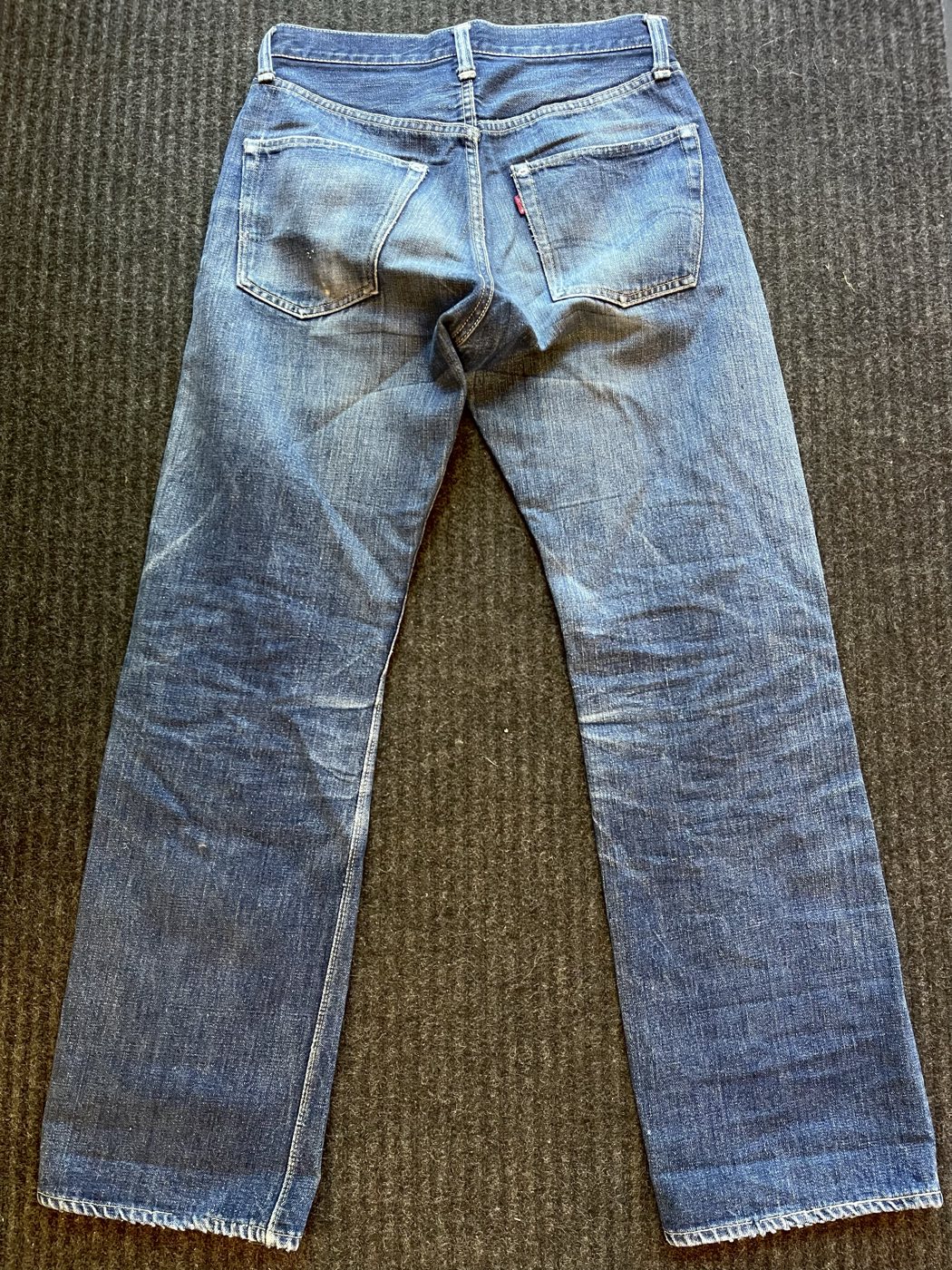
The cinch never travels alone. Pre-war jeans carry companion details, and each one narrows the window or points to the maker. Check them in daylight before anyone touches the pair.
| What you see | What it proves | The honest caveat |
|---|---|---|
| A strap and metal buckle across the back waistband of jeans | Made before about 1942 | Store brands and modern reproductions carry the same buckle, so it dates the pair without naming the maker |
| A cut stub where the cinch was | Same pre-war window; wearers cut them off to wear a belt | Worth less than an intact cinch, but the era holds and the pair still sells |
| Suspender buttons on the waistband | On Levi’s, roughly 1937 or earlier; Levi’s own 1937 reproduction has none | Store brands kept suspender buttons later, so this signal is weaker off-brand |
| Exposed copper rivets on the back pockets | Before 1937 on Levi’s, when the rivets were covered after complaints about scratched saddles | Covered rivets can wear back through; feel for a bump before deciding |
| A rivet at the base of the fly | Pre-war construction; removed during the war and never returned on Levi’s | Lee and the store brands used a crotch rivet too |
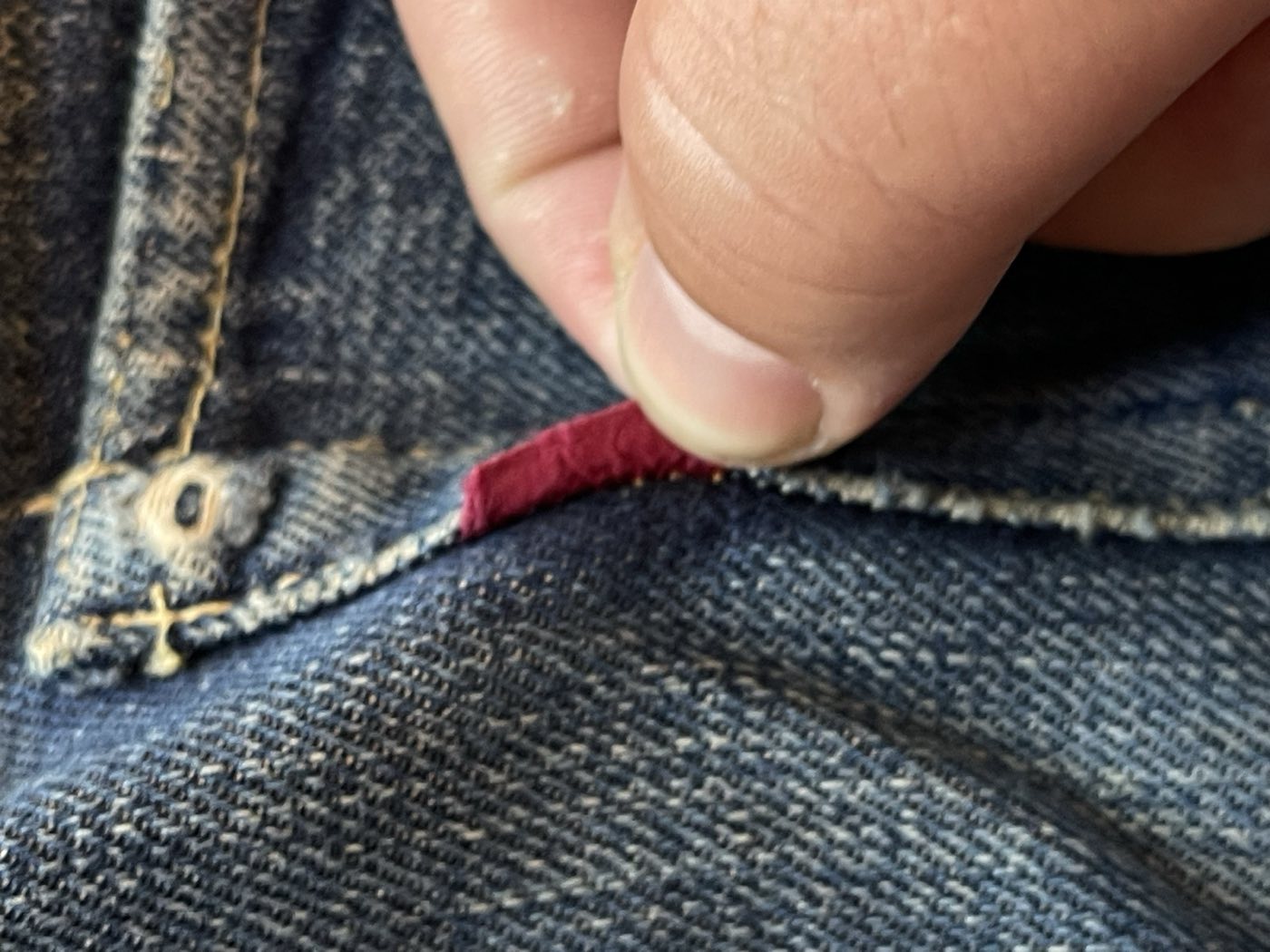
| No red tab and no torn stub at the pocket edge | Before 1936 on Levi’s, or a store brand that never had one | Check the other signals before calling it early |
| Blank or faintly painted back pockets, no cinch | A wartime pair, roughly 1942 to 1947 | Not a buckle-back, but scarce and collected in its own right |
| A cinch on a denim jacket rather than jeans | A Type I jacket, made into the early 1950s | Jackets kept the cinch until the Type II replaced it in 1953, so on a jacket the buckle does not mean pre-war |
Is my buckle-back pair Levi’s or a store brand?
This is the question that decides the most money, and the buckle cannot answer it, because before the war nearly every maker of work pants used one. The mail-order and department store houses copied Levi’s closely. JCPenney launched its Foremost workwear line around 1922 and built its jeans as near copies of the 501XX: the same count of rivets, similar buttons, the same SOLIDE buckle on the back, and an arcuate on the pockets close enough to fool a glance. Montgomery Ward sold cinch-back jeans with a crotch rivet and its own rivet and pocket-stitch designs. Lee’s Cowboy pants, introduced in the 1920s for saddle work, carried a cinch, suspender buttons, and a crotch rivet of their own, with Lee’s distinctive pocket shape.
So read the hardware and the patch, not the strap. Levi’s stamped its own name on the fly and waist buttons and used the two-horse leather patch on the back waistband; from 1936 a red tab sits at the right back pocket. Foremost is usually caught at the buttons, which carry the store’s own marking, and on later pairs the arcuate flattens into a straight double bar. Lee reads as Lee from the pocket shape and its own labels. Our Lee versus Levi’s dating guide walks those differences with photos, and the eight-step dating guide covers every Levi’s signal in order.
A store-brand buckle-back is not a consolation prize. A 1930s JCPenney Foremost buckle-back pair, 33 by 31 and in very good condition, sold for $2,600 at a HiBid auction on October 1, 2022, and another 1930s Foremost pair was listed at $2,284 in our July 2026 research pass, an asking price rather than a sale. Heddels’ April 2025 guide to Foremost puts pre-war models from the high hundreds into five figures for the best examples and post-1947 pairs at a few hundred dollars at most; that is one publication’s read, not a promise. Any pre-war cinch-back pair, whatever the name on the buttons, deserves a real reading before it is priced as old work pants.
How much are buckle-back jeans worth?
The honest position first: there is no reliable published price range for Levi’s buckle-back jeans. The pairs are too scarce, too varied in era, size, and condition, and too often sold privately for any bracket to hold up. Every pair is read individually. What the public record does hold is a set of ceilings, and they prove the market is real.
| The pair | Sold or valued | Price | Read it as |
|---|---|---|---|
| 1880s mine-recovered Levi’s, found by Michael Harris | October 1, 2022, Durango Vintage Festivus | $87,400 | A realized sale, confirmed by national press |
| Nevada mine pair attributed to 1873 | September 30, 2023 | $100,000 | The 1873 date is the seller’s attribution, not authenticated by Levi’s |
| 1880s Nevada pair bought back by Levi’s itself | 2001, eBay | $46,532 | The company buying its own history |
| 1893 Solomon Warner trunk pair, Tucson | 2018 | About $100,000 | A private sale, not an auction |
| 1930s JCPenney Foremost buckle-back, store brand | October 1, 2022, HiBid | $2,600 | A realized sale; the everyday scale of the pre-war market |
Read those rows the way we do. The six-figure results are 19th-century, mine-found, or trunk-found pairs with documented stories, and they are ceilings, never expectations. A 1930s Levi’s buckle-back from a Southern California ranch trunk is a different object from an 1880s pair out of a Nevada shaft, and it is priced as what it is: era, size, completeness, and condition read together, with the Levi’s name carrying a premium over every store brand. Measured waists in the low to mid thirties draw the strongest bidding, because collectors mostly intend to wear what they buy. Our 501 value guide sets the buckle-back era against every later one, and the mine-find guide carries the full record behind the top rows.
One sentence for readers outside California, because buckle-backs surface everywhere: we buy vintage denim remotely, with a free video call to read the pair, a price agreed on the call, payment by PayPal before you ship anything, and shipping paid by us. Across Southern California we come to the house, read the pair in front of you, and pay cash the same visit.
Could my buckle-back pair be a reproduction?
Yes, and this is the trap that catches confident sellers. Levi’s Vintage Clothing reproduces its own cinch-back garments in period detail: the 1937 501XX with a cinch, covered back rivets, and a red tab, made in Japan; the 1936 Type I jacket, lot 506XX, with a cinch, exposed rivets, and a big E tab; and, as of August 2026, the transitional 1942 501. Japanese and American heritage brands make cinch-backs of their own. A buckle proves nothing by itself, so look for what a 1930s factory could not have produced: a woven care label inside the waistband, a modern lot or size label, uniformly crisp denim with no age to the threads. A 555 button stamp is the Valencia Street plant, which made early LVC pieces as well as 1980s and 1990s pairs, so it is not automatically old. The reproduction guide covers the tells piece by piece, and the date codes guide explains what button stamps and care tags can and cannot prove.
What should I do with a buckle-back pair before selling it?
- Do not wash it. Dirt is not hurting the pair, and washing strips the original condition collectors pay for. This is the one irreversible mistake in this whole category.
- Do not repair it. No patches, no darning, no iron-on anything. Damage is priced in; amateur repairs are damage on top of damage.
- Do not cut off the cinch, and do not remove a stub. Both are part of the pair’s record.
- Keep it with whatever it was found with: the trunk, the other clothes, any papers or photographs. Provenance is part of the price.
- Measure the waist flat and double it. The number on the patch, if there is one, no longer matches after ninety years of shrink and wear.
- Photograph the back waistband, both sides of the buttons, the patch, the inside of a back pocket, and the tab area, in daylight, before anyone handles the pair further.
Do damaged or mine-found buckle-backs still sell?
Yes, more reliably than in any other corner of denim. The record pairs in the table above came out of mines and trunks stiff with a century of dust. So few pre-war pairs survived that condition matters less here than anywhere else: a torn knee, a missing pocket, dried leather where the patch was, and heavy staining are read as wear on a scarce object rather than as reasons to pass. What a buyer needs to see is the era and the maker, and those survive damage. A cinch-back pair that looks beyond saving is exactly the pair to photograph rather than throw away.
Common questions
- Are buckle-back jeans always Levi’s?
- No. Before the Second World War nearly every maker of work pants used a back cinch. JCPenney’s Foremost line copied the 501XX closely, down to the buckle and a look-alike arcuate, Montgomery Ward sold cinch-back jeans with a crotch rivet, and Lee’s Cowboy pants carried a cinch too. Read the buttons and the patch, not the strap: Levi’s stamped its own name on the buttons and used the two-horse leather patch. Store-brand buckle-backs still sell; a 1930s Foremost pair brought $2,600 at auction in October 2022.
- My old jeans have the buckle cut off. Do they still count as a buckle-back?
- Yes. Once belt loops arrived in 1922, men who wanted to wear a belt often cut the cinch off, and Levi Strauss & Co. records that some stores kept scissors at the counter for it. A cut stub across the back waistband is period evidence that the pair is old enough to have had a cinch, which still places it before about 1942. An intact cinch brings more than a stub, but the era holds and the pair is worth reading.
- Can a new pair of jeans have a buckle on the back?
- Yes, so the buckle alone proves nothing. Levi’s Vintage Clothing reproduces the 1937 501XX with a cinch, covered rivets, and a red tab, the 1936 Type I jacket with a cinch and exposed rivets, and as of August 2026 a transitional 1942 501 that keeps its cinch. Heritage brands in Japan and America make cinch-backs too. Look for what a 1930s factory could not have made: a woven care label inside the waistband, modern size labels, and denim with no age in the threads.
- Does a buckle on the back of a denim jacket mean the same thing as on jeans?
- No, and the difference is a decade. On jeans the cinch was removed under wartime rules around 1942, so a buckle-back pair is pre-war. Levi’s Type I jackets, lot 506XX, kept their cinch after the war and only lost it when the Type II with its buttoned side tabs replaced them in 1953. A one-pocket jacket with a buckle is a Type I from anywhere between the 1930s and the early 1950s, which is still a serious garment, but the buckle does not date it before the war.
- What is the difference between a buckle-back and a wartime 501?
- The cinch. Wartime pairs, made roughly 1942 to 1947 under War Production Board rules, have no back cinch, no crotch rivet, no watch-pocket rivets, and back pockets where the arcuate was painted rather than sewn, so the pockets usually read blank today. A buckle-back predates those changes. Both are scarce and both are collected; a wartime pair is not a lesser buckle-back, it is its own category, and a plain-pocketed 1940s pair should never be dismissed as ordinary.
- What photos do you need to read a buckle-back pair?
- Six, all in daylight: the whole back with the cinch or its stub in frame, the fly buttons and the back of one button if it turns, the leather patch or the place it used to be, the inside of a back pocket so the rivets show, the red tab area at the right back pocket, and the waistband measured flat with a tape in the shot. Text them to California Vintage Buyers at (949) 449-1255 and we answer the same day, free, whether or not you sell, from any state.
Have something like this?
One phone call, from any state. A free video appraisal, the price agreed on the call, and payment through PayPal before you ship, with shipping on us. In Southern California we come to you and pay cash the same day.
Keep reading
- Sell vintage Levi’s to people who know what they’re holding.→
- The best denim in California is still coming out of inland barns.→
- Sell vintage workwear. The harder the life, the better it aged.→
- Alaska kept its Levi’s. We pay what they’re actually worth.→
- Sell vintage Levi’s in Orange County to buyers based right in Laguna Hills.→