Field Guide
Is My Levi’s Jacket or 501 an Original or a Levi’s Vintage Clothing Reproduction?
The most expensive misreading in vintage denim runs both ways: a reproduction priced as an original, or an original binned because it looks too clean. The inside of the garment settles it.
We buy from every state · free video appraisal · paid before you ship
By Sam Wingenbach and Jake Cover, the buyers behind our video appraisals and house calls · Updated October 2, 2026
Read the transcript
Hi guys, Sam here with California Vintage Buyers, and I want to help clear the air and give you a little bit of information on how do you know if your old Levi's you're looking at are worth the time to try to sell them or bound for Salvation Army and just get them out of here. There's not really value there. This is not an exhaustive list of things to look for, but it's just some key distinguishing factors, right? So I have a few pairs of pants in front of me and different eras. So we're going to go over with the newer ones, right? Here we have a pair of the year 2000 pants. How do I know that these are from the year 2000? Well, because if you see that dark 501XX right there, that style of lettering is from the 90s to the early 2000s. It's different than this stuff. Do you see the difference of that one right there? You can see the difference. We'll get to these in a minute. But if you see that block lettering on your pants, you're looking at 90s up to say 2004 or something like that. Another tell. Let's just say you don't have this patch here. You wore the belt a lot. He wore the belt. She wore the belt a lot. The patch is gone. How old are my pants? With these ones, you can also pop this guy out right here. And you have, see that number right there? 1000. It's actually not the number 1000. It's 10, 00, October the year 2000. So whatever number you're looking at right there on the tag, if it has this tag on the inside leg, look at that number and you're going to see probably 0497 or what have you. It's going to be month and year. Good to know. So if that's gone, check if it has one of those. If it doesn't have one of these, then you're looking at somewhere in the 80s, right? Or potentially older. So I have a pair of 80s here. Anything made in USA is going to say on this tag, made in USA, right? So see that right there? Made in USA. Made in USA. What does these not have? These don't have made in USA. See how that part's missing? Made in Guatemala in the 2000s. They outsourced all the manufacturing. Bummer. So still good pants. We'll still buy these if the wash is cool. But the collector factor is not there. So again, if you got a pile of 100 of these guys, we'll still buy them. Give us a call. Are you kidding me? But when it comes to like Levi's, it's the details that matter. So moving forward. Oh, another thing is the distinguishing factor. See how it's red, the 501. And this one's black. You see in red, you're seeing 80s. Right? So you're looking at made in USA. Got the little red 501. That was an 80s thing. Right? So that's a couple things. Then you go over to these guys. Now, this is also 80s, but these are early 80s. What's the distinguishing factor on these guys? Flip up the pant leg. Do you see that? That's called selvedge denim. They call them redlines. These are called redlines. Right? Anything 501, 1982, 83-ish, right around there, and previous is going to have this kind of thing. This makes the value go up a little bit higher. Right? Why do they call these redlines you're asking? Great question. Well, when they were brand new, like these puppies from the 70s, which are a fantastic sample, they had a red line. Then, selvedge denim. So what does selvedge denim mean? It means the pant leg was made out of one sheet of denim, and they slapped them together. That's the end of a sheet of denim. They put them together, and they sewed the pant leg. And so this is made out of one sheet, a little more collectible. These are redlines. These are redlines. If you see that, you're looking at redlines. Even if you don't see any red, you got a pair of redlines. Right? We'll buy all these guys. Now, if you see one of these things that has a capital E right there, it's even better. Right? If you're looking at dealing with a barn, a ranch, Uncle Bob's house, and you're clearing it out, and you found him in the attic or in the bottom of his closet or something, we're great buyers for all this stuff. And we've paid up to thousands before for certain types of Levi's. There's a collectible value. It all depends on what the details are. You know? It's like if you call the car dealership, and you're like, hey, what do y'all pay for cars? They're going to say, okay, well, yes, we buy cars. What's the make? Model? Mileage? How's the condition? All the things. Give us a call. Number is 949-449-1255. We'd love to help you discern what you got, make your sweet offer, and buy all that stuff and more.
The short answer: open the garment and read the inside. An original Levi’s made before 1971 has no care label. A Levi’s Vintage Clothing reproduction copies the big E tab, the patch, and the hidden rivets, but carries a modern sewn-in care label with a country of origin, and usually a tag that reads Levi’s Vintage Clothing. Text photos of the inside to (949) 449-1255 for a free read.
Sellers say old and buyers say vintage, and the pair in your hands might be neither. Since the late 1990s, Levi’s has sold careful reproductions of its own archive under the Levi’s Vintage Clothing name, LVC for short, and those jeans and jackets are now old enough to have been worn, faded, inherited, and found in a garage beside the real thing. Nobody should feel foolish for being fooled. But the gap is enormous: a Type 1 jacket from the 1940s typically brings $2,000 to $8,000 worn, as of August 2026, while a reproduction of the same jacket sells for a few hundred dollars new.
What is Levi’s Vintage Clothing, and what does it reproduce?
Levi’s Vintage Clothing is the company’s own reproduction line, launched in the late 1990s after Levi’s Japan had been issuing replicas of archive pieces since the late 1980s. The premise is faithful copying: a historical garment is taken from the archive, graded into a full run of sizes, and remade with its period details intact. The current roster runs from an 1870s riveted overall through 501 jeans dated 1922, 1933, 1937, 1944, 1947, 1954 and 1955, plus a 1966 model first issued for the Japanese market in the 1990s. Jackets follow the same pattern: a 1936 Type I, a wartime S506XX, a 1953 Type II and a 1960s Type III, each with the lot number of the original on the patch.
That last point is the whole problem. A 507XX patch on a reproduction reads 507XX. A reproduction of a pre-1971 jean carries a capital E on the red tab because the original did. The patch, the hidden rivets, the cinch buckle: all copied. From three feet away, an LVC piece is designed to look exactly like the thing collectors chase, which is why a family can read a few-hundred-dollar garment as a several-thousand-dollar one.
How do I tell a Levi’s Vintage Clothing reproduction from an original?
Turn it inside out. Everything LVC copies is on the outside; everything that identifies it is on the inside, because a modern garment has to carry a care and fiber-content label, and the reproductions do. That rule has been in force since 1971, the same year the red tab changed from capital E to lowercase e. So a big E tab beside a sewn-in care label is two things that cannot both be true of an original. Old outside plus modern inside means reproduction.
- A tag reading Levi’s Vintage Clothing, sewn into the waistband or the collar. This is the clearest single tell, and most LVC pieces carry one.
- A modern care label, often with a barcode, listing fiber content and washing instructions. Originals made before 1971 have nothing of the kind.
- A country of origin. LVC has been sewn in Turkey, Bulgaria, Japan and Italy over the years, and for a period in the United States. Any of those printed inside a garment that looks like 1955 is the answer.
- Paper hangtags, on unworn pieces, naming the year being reproduced, such as 1947 501. An original never had a hangtag that named its own year.
- Denim that is new, rigid, or factory washed. A factory wash does not look like fifty years of a man wearing his jeans to work.
What does the inside of an original look like?
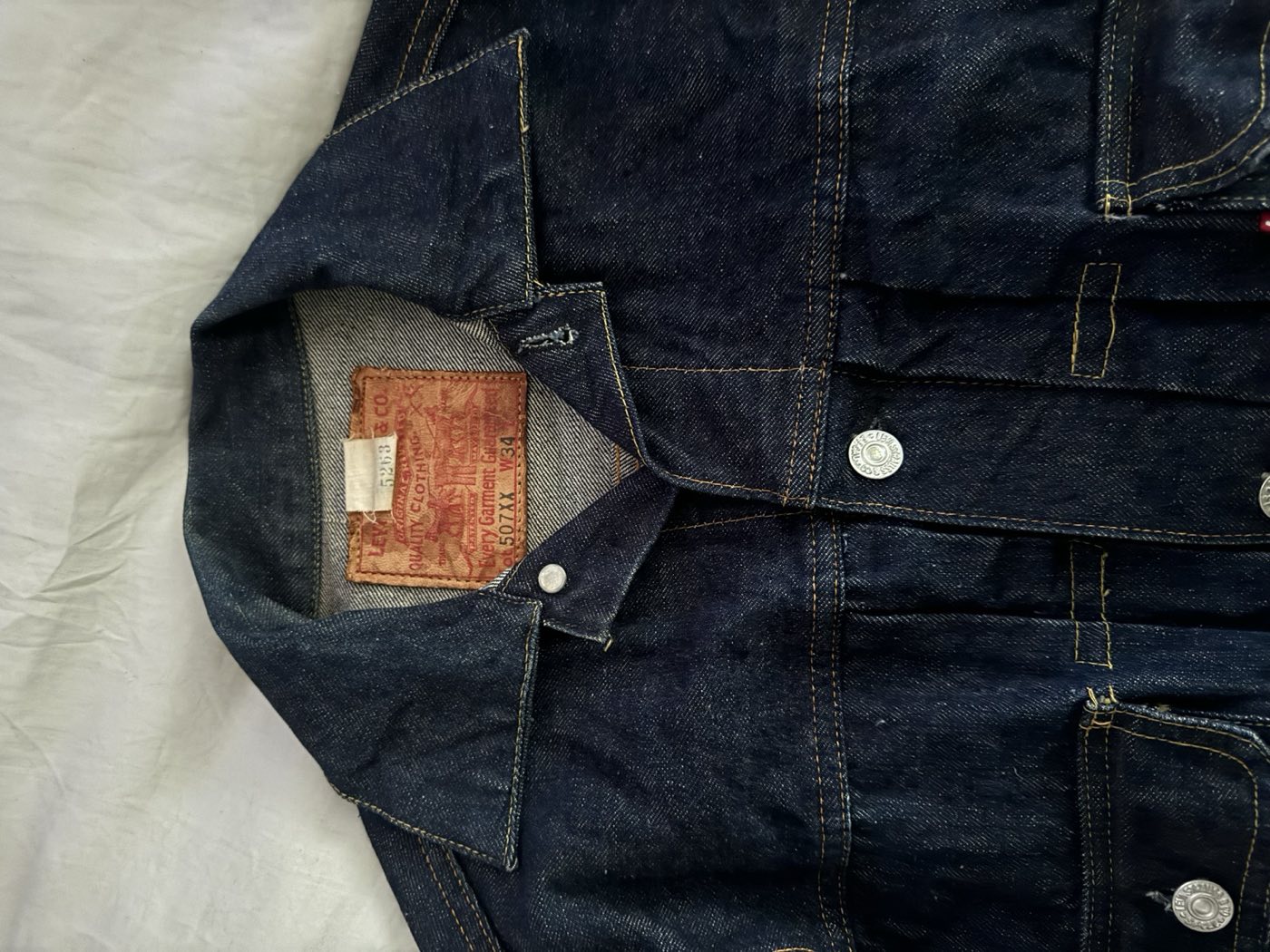
Quieter than you expect. A 1950s 507XX jacket has its patch at the collar with the lot number and size on it, and no other labels anywhere: no care tag, no content tag, no brand tag in the seams. A jacket like the one below has told you what it is by having almost nothing to say.
What about early LVC made at Valencia Street with a 555 button?
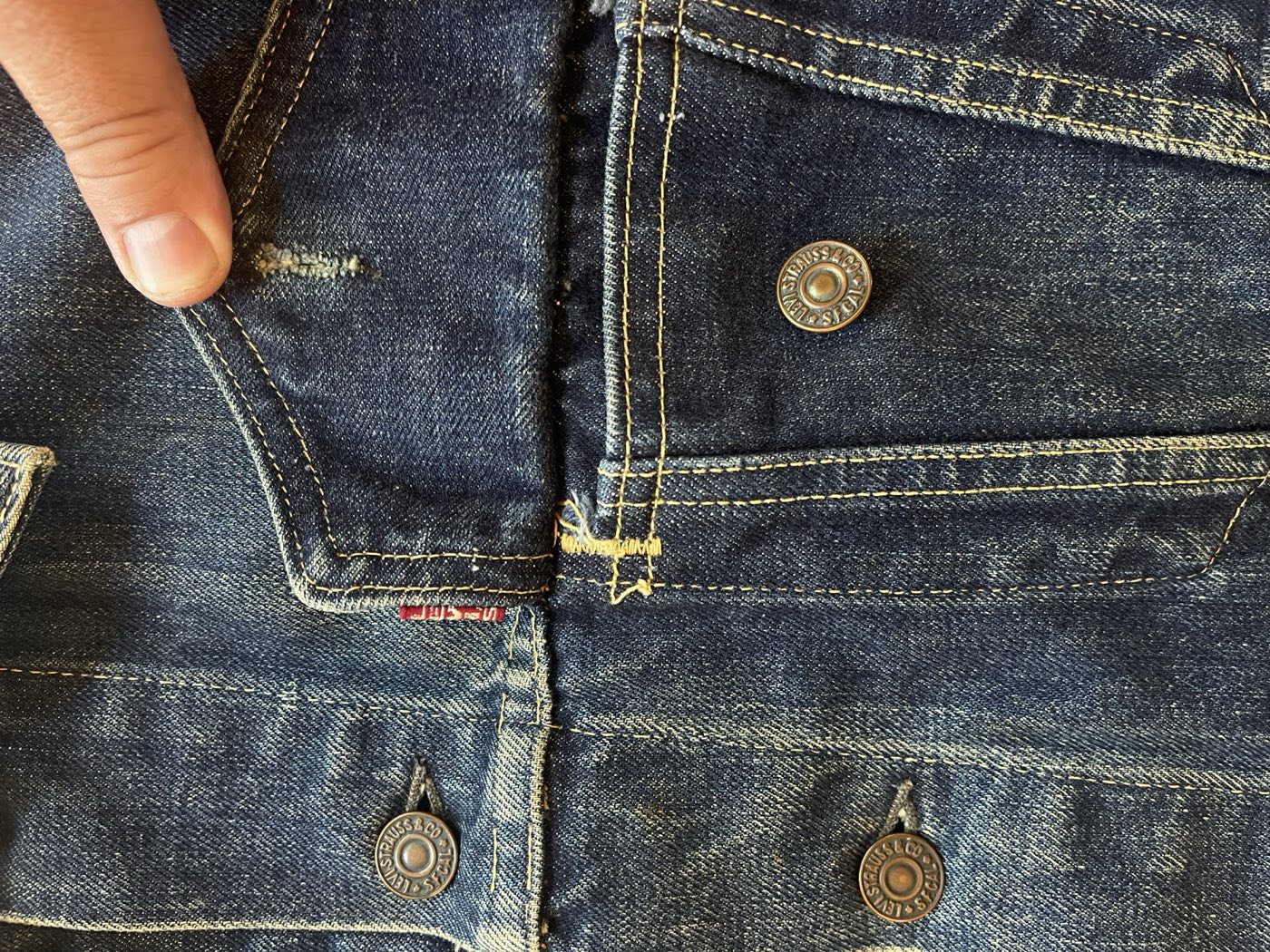
This is the one exception that catches careful people. When the reproduction line began in the late 1990s, early runs were sewn at Levi’s own Valencia Street plant in San Francisco, the factory that operated from 1906 until 2002, and those pieces carry the 555 factory stamp on the back of the buttons and a Made in USA origin. So a reproduction can be American-made and can carry the same button stamp as a genuine 1980s or 1990s Valencia pair. What it cannot shed is the modern care label. Read the 555 alongside the inside of the garment, never alone; the date codes guide covers what the stamp does and does not prove.
| Feature | Original vintage Levi’s | Levi’s Vintage Clothing reproduction |
|---|---|---|
| Red tab | Capital E on pieces made before 1971, lowercase e after | Capital E copied on reproductions of pre-1971 models |
| Care label | None before 1971; a plain paper or cloth tag after | Modern sewn-in care and fiber-content label, often barcoded |
| Country of origin | United States; the last US Levi’s plant closed in 2003 | Turkey, Bulgaria, Japan, Italy, or US-made early runs |
| Inner brand tag | None | Usually a tag reading Levi’s Vintage Clothing |
| Lot number on the patch | 501XX, 506XX, 507XX, 557XX as made | The same lot number, copied |
| Button stamp | Single digits and low codes on early pairs; 555 on Valencia pairs into 2002 | 555 on late-1990s to 2002 Valencia runs; other codes abroad |
| Hangtags | Only on true deadstock | Paper tags naming the reproduced year on unworn pieces |
| Wear | Decades of real use, or untouched deadstock | New, factory washed, or a few years of wear |
Can an original be too clean to be real?
Yes, and this is the misreading that runs the other way. Families give away originals because a dark, stiff, unfaded pair looks like something bought last year. Deadstock is real: garments never sold or worn that sat folded in a stockroom or a drawer for sixty years. The most valuable Levi’s garment on record, a wartime S506XXE Type 1 that set the Guinness record at £260,590, roughly $346,000, is museum-grade deadstock. Nobody should price a family jacket against that, but it proves the principle: clean is not a tell against age. The inside is the tell, in both directions.
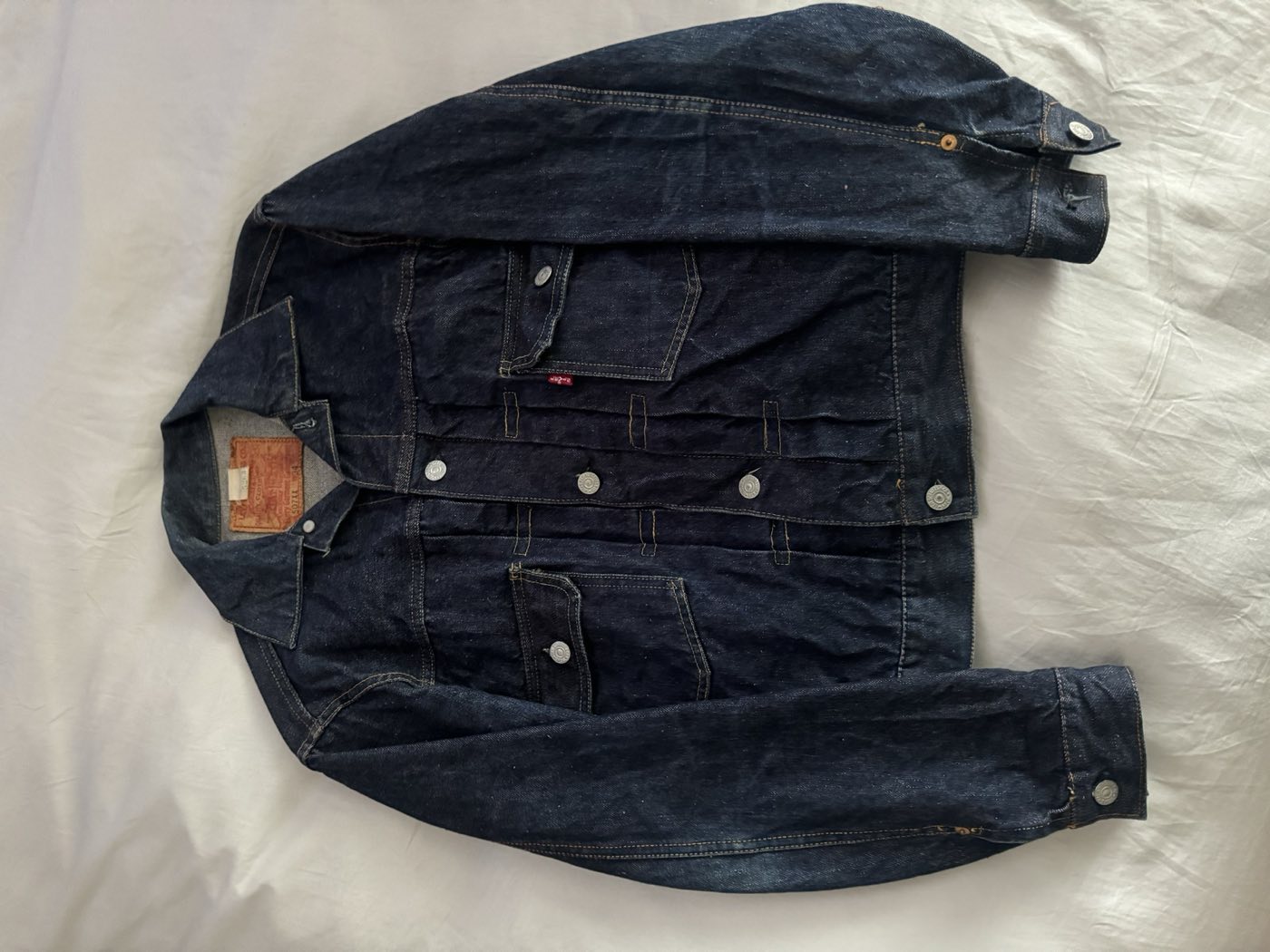
The honest rule before selling anything is the same either way: do nothing to it. Do not wash a dark original to make it look older, and do not wash a reproduction to make it look worn. The five-check identification guide walks the outside signals; this guide is the inside.
What about 1990s Japanese reproductions and the Capital E line?
Two other things get called LVC and are not. Levi’s Japan began issuing replicas of archive models in the late 1980s, years before the American reproduction line existed, and 1990s Japanese-market pieces now circulate in the United States. They carry Japanese inner labels and their own patch numbering, and collectors track them as a category of their own. None is an original, and a photo of the inside identifies them the same way.
Levi’s Capital E is a different thing again: a United States premium line sold from 2006 through 2009 and replaced by Levi’s Made and Crafted in 2010. It was a contemporary fashion line, not a reproduction program, and its garments are labeled as Capital E. When a seller types capital E they almost always mean the tab, which is the pre-1971 signal the big E value guide prices, not this line.
Is an LVC piece worth anything?
Yes, as a good modern garment with a resale market of its own, and no, not as vintage. New, a European stockist lists LVC 501 reproductions at roughly 280 to 650 euros and the jackets at about 440 euros as of September 2026; those are retail prices, not resale values. Used LVC generally trades below what it cost new, and the early runs sewn at Valencia Street with the 555 button have a following among collectors, with specialty sellers asking well above the original price; asks, not sales. For contrast, Levi’s own SecondHand trade-in counter, checked against its published values in August 2026, offers $30 for LVC jeans and $35 for an LVC jacket of any age, paid as a gift card rather than cash.
The stakes: a pre-1971 big E 501 can bring $500 or more, and a 1950s Type 2 jacket typically brings $800 to $1,500, both as of August 2026, while a reproduction of either is a modest used garment. Getting the identification right is worth more than any negotiation that follows.
How do I be honest with a buyer either way?
Say what the inside says, before the price conversation starts. A reproduction is not a fake and there is nothing to hide; the only harm comes from describing it as vintage. The same honesty protects you the other way: a buyer who knows you have read the inside knows you will notice if their offer prices an original as a reproduction.
- Photograph the tab, the patch, the buttons, and every label inside before you describe the garment to anyone.
- If a tag reads Levi’s Vintage Clothing, lead with that. Describe it as an LVC reproduction of whatever year the patch or hangtag names.
- If there is no care label and no inner tag, say so, and let the buyer confirm the era from the outside details.
- Do not wash, repair, or press anything. Original condition is the value on an original, and honesty is the value on a reproduction.
- Ask the buyer to name which one they think it is and why. California Vintage Buyers will answer in one sentence for sellers in every state: text the inside and the outside to (949) 449-1255.
What do collectors check that a photo read settles?
Beyond the labels, experienced buyers look at things that are hard to describe and easy to see: the weight and hand of the denim, the way wear sits along the seams, the thread color where it has faded, and the shape of a pocket flap or a pleat against known originals. None of those is a rule a stranger can apply from a list, and we do not pretend otherwise. They are why a two-minute photo read by someone who has bought the originals usually ends the question.
We read Levi’s jackets and jeans every week, reproductions and originals both, and the read is free wherever you are. If you are outside California, we buy vintage denim remotely: a free video call, a price agreed on the call, payment by PayPal before you ship, and shipping paid by us. Across Southern California we come to you, or see pieces at our Laguna Hills warehouse by appointment, and pay cash the same visit. If the inside says Levi’s Vintage Clothing, we will say so plainly and tell you what it is honestly worth. If it says nothing at all, the jacket types guide is where to go next.
Common questions
- How can I tell if my Levi’s are a Levi’s Vintage Clothing reproduction?
- Turn them inside out. An original made before 1971 has no care label of any kind. A Levi’s Vintage Clothing reproduction copies the capital E tab, the patch and the hidden rivets on the outside but carries a modern sewn-in care and fiber-content label, often barcoded, with a country of origin, and usually a tag that reads Levi’s Vintage Clothing in the waistband or collar. Old outside plus modern inside means reproduction. Text photos of the inside to (949) 449-1255 for a free read.
- Are Levi’s Vintage Clothing jeans fake?
- No. They are Levi’s own reproductions of its archive, made since the late 1990s and sold openly as reproductions with the year they copy on the hangtag. The only problem is when a piece is described or priced as vintage. An LVC pair is a well-made modern garment with a modest resale market; an original of the same model can be worth many times more, which is why the inside of the garment matters more than the outside.
- My Levi’s say Made in Turkey but have a big E tab and a leather patch. What are they?
- A Levi’s Vintage Clothing reproduction. LVC has been sewn in Turkey, Bulgaria, Japan and Italy, and for a period in the United States, and every one of those pieces carries a modern care label with its country of origin. An original Levi’s garment was American-made, and one with a capital E tab was made before 1971, when care labels did not yet exist. The country printed inside is the answer.
- Can a reproduction Levi’s have a 555 button and say Made in USA?
- Yes. The earliest Levi’s Vintage Clothing runs in the late 1990s were sewn at the Valencia Street plant in San Francisco, which operated from 1906 to 2002, so they carry the 555 stamp on the back of the buttons and an American origin. What they cannot shed is the modern care label sewn inside. A 555 stamp with no care label points to a genuine Valencia pair; a 555 stamp beside a modern care label on a piece that looks like 1947 is early LVC.
- Was Levi’s Capital E a vintage reproduction line?
- No. Levi’s Capital E was a United States premium fashion line sold from 2006 through 2009 and replaced by Levi’s Made and Crafted in 2010. Its garments are labeled as Capital E and are modern designs, not copies of archive pieces. When sellers type capital E they almost always mean the red tab, where a capital E means the garment was made before 1971, which is a different question from this line entirely.
- My old Levi’s jacket looks brand new. Does that mean it is a reproduction?
- Not by itself. Deadstock originals exist: garments never sold or worn that sat folded for decades, and the record-setting Levi’s garment, a wartime Type 1 that brought £260,590, roughly $346,000, at the ceiling of the market, was museum-grade deadstock. Clean is not a tell against age. Check the inside: a dark, stiff jacket with a paper patch, no care label and no inner brand tag is an original however new it looks. Do not wash it.
Have something like this?
One phone call, from any state. A free video appraisal, the price agreed on the call, and payment through PayPal before you ship, with shipping on us. In Southern California we come to you and pay cash the same day.
Keep reading
- Sell vintage Levi’s to people who know what they’re holding.→
- Levi’s Tab Colors: What Orange, Silver, White, Black, and Blank Tabs Mean→
- A free, honest read on your vintage clothing. Usually the same day.→
- Sell vintage clothing in Orange County.→
- Sell vintage Levi’s in Huntington Beach, where the work clothes outlived the work.→