Field Guide
Levi's Denim Jacket Types: How to Tell a Type 1, Type 2, and Type 3 Apart
Every vintage Levi's jacket belongs to one of three families, and you can tell which in about ten seconds by counting pockets and looking at the seams. The details after that decide whether it is a nice old jacket or a very valuable one. Every jacket pictured below is one we bought.
We buy from every state · free video appraisal · paid before you ship
By Sam Wingenbach and Jake Cover, the buyers behind our video appraisals and house calls · Updated September 30, 2026
Read the transcript
What's up guys? On my way. About to go see a sweet Type 1. Nice old, I think it's an early 50s one. A mother who's in her 90s and her daughter reached out to us. And got some cash here. So we're going to go check it out. See how it goes. Alrighty guys, just got it. The thing is tiny. They were beyond thrilled with my price I offered. I think I overpaid for sure. This thing would probably barely fit my 7 year old. But you know what? It's cool, man. It's still a Type 1. But I definitely think I overpaid. Pretty sweet. Check out, it still has the leather patch. Crazy. Most of the time after washing, or people just used to cut those things off back in the day. But got the Type 1. Yeah. Came out of the gate real strong, and the pleats are all busted on it and stuff. But you know what? We still love it. Still 40s Levi's. But I definitely think I overpaid. But they threw in a tie. Look at this old 50s horse tie. Isn't that cool? Gosh, I'll wear this thing to a wedding. Anyways, very cool. Add to the collection. Success, I guess we'd call that. Maybe. Because I paid a lot. All right, well, here she is. Just wanted to show you. Super cool. Looks like a shotgun shell went off accidentally while it was in the pocket. But that happens sometimes.
The short answer: one chest pocket with a cinch at the back means Type 1 (lot 506XX, made into the early 1950s). Two pockets with knife pleats beside the buttons means Type 2 (lot 507XX, introduced 1953). Two pointed-flap pockets with tapered seams running down the body means Type 3, the trucker (lot 557XX, introduced 1962). California Vintage Buyers buys all three from every state: a free video appraisal and PayPal before you ship anywhere in the country, or cash the same visit in Southern California. Call or text photos to (949) 449-1255.
Which Levi's jacket type do I have? The ten second check
| Type 1 (506XX) | Type 2 (507XX) | Type 3 (557XX) | |
|---|---|---|---|
| Chest pockets | One | Two | Two, pointed flaps |
| Front detail | Knife pleats, cinch back | Knife pleats, no cinch | Tapered V seams, no pleats |
| Years made | 1905 to about 1952 | 1953 to 1962 | 1962 onward (renumbered 70505 later) |
| Patch | Leather | Leather early, then paper | Paper |
Levi's never printed Type 1, 2, or 3 anywhere on the jackets. Those are collector names for three distinct designs, and the lot number on the patch (506XX, 507XX, 557XX) is the factory's own name for each. Patches wear off, though, which is why the pocket-and-seam check matters: the cut identifies the jacket even when the patch is long gone. It is the first thing we check ourselves when a jacket comes out of a closet on an Orange County house call.
Type 1 (506XX): 1905 to 1952, the one-pocket jacket
In plain words: one pocket on the chest, pleats running down the front, and a small buckle strap across the lower back. Families who find one rarely know its name. It is the most valuable Levi's jacket there is: honest worn examples typically bring $2,000 to $8,000 as of our July 2026 read, and exceptional ones far more. Levi's launched it in 1905, added the flap on the chest pocket in 1928 and the red tab in 1936, and replaced it with the Type 2 in 1953.
On the biggest sizes, look at the back as well. The narrow selvedge denim of the day was not wide enough to cut a large back in one piece, so Levi's sewed it from two, and the line of stitching down the middle forms a T. Collectors call these T-backs, or split backs. The T marks a large size, not an older year, and it is the construction of the record jacket: a WWII-era Type 1 split back that set a Guinness record at roughly $346,000 in 2026.
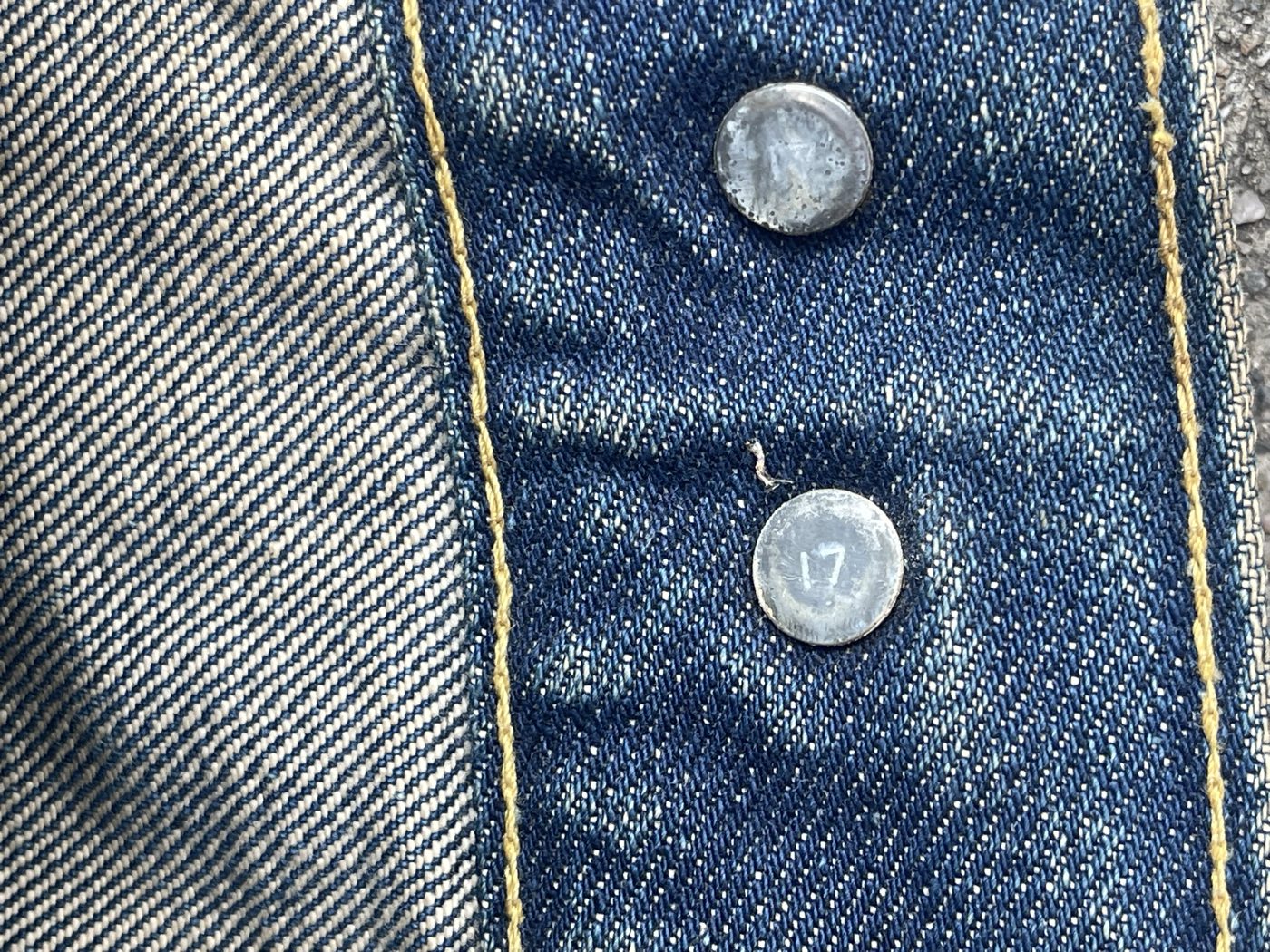
One check before you get excited: turn the jacket inside out. An original has no care tag sewn into a side seam, while a Levi's Vintage Clothing reproduction of the 506XX does. If yours has none, do not wash or repair it, and call or text photos of the front, the back, the red tab and the buttons to California Vintage Buyers at (949) 449-1255. We read Type 1s free the same day and buy them from every state, with payment through PayPal before you ship.
Type 2 (507XX): 1953 to 1962
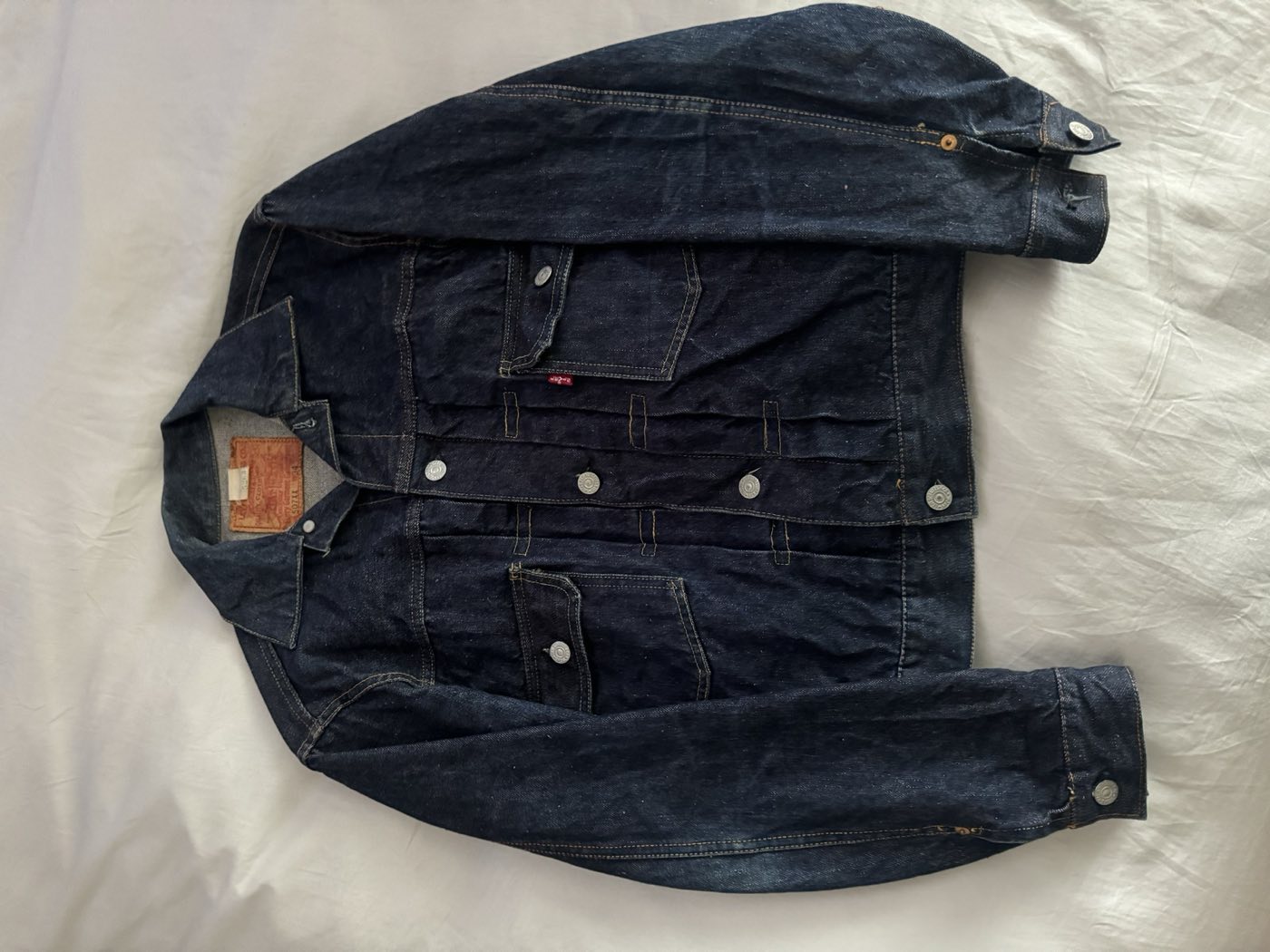
The Type 2 replaced the Type 1 in 1953. Two flapped chest pockets, knife pleats running down from each pocket to the waist, buttoned side tabs instead of a back cinch. It was on the back of every fifties icon you can name, which is a real part of why collectors chase it today.
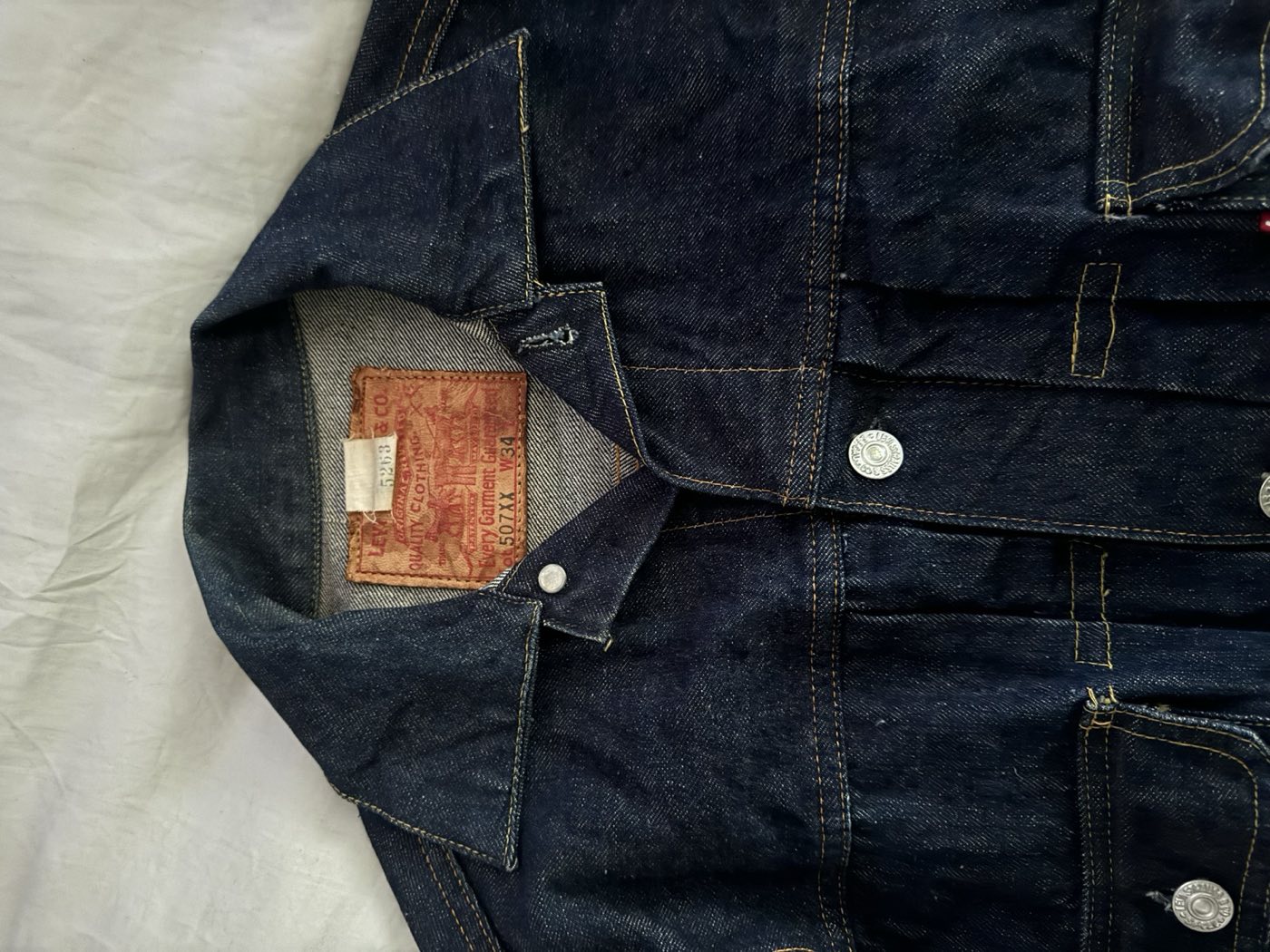
Within the Type 2 run, the patch material narrows the date. The earliest 507XX jackets carry a leather patch; by the mid fifties it changed to the pressed paper style. Telling the two apart on a worn jacket is easier than it sounds. Leather goes dark brown and cracks in a spidery web across the surface, and a torn edge looks fibrous. Paper stays tan, creases rather than cracks, and tears in straight lines that separate into layers at the edge. A readable patch of either kind adds real money, because it removes all doubt about what the jacket is.
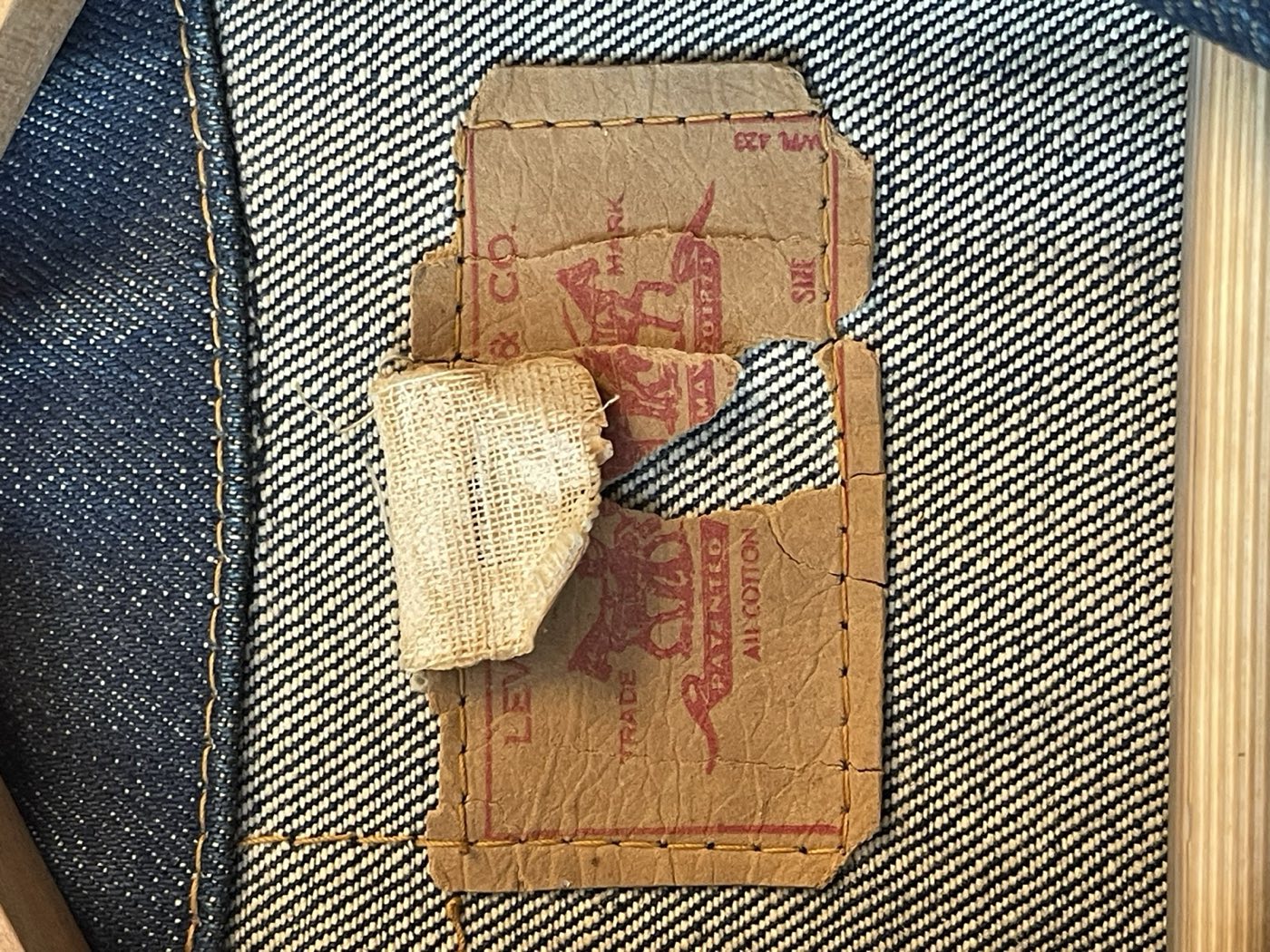
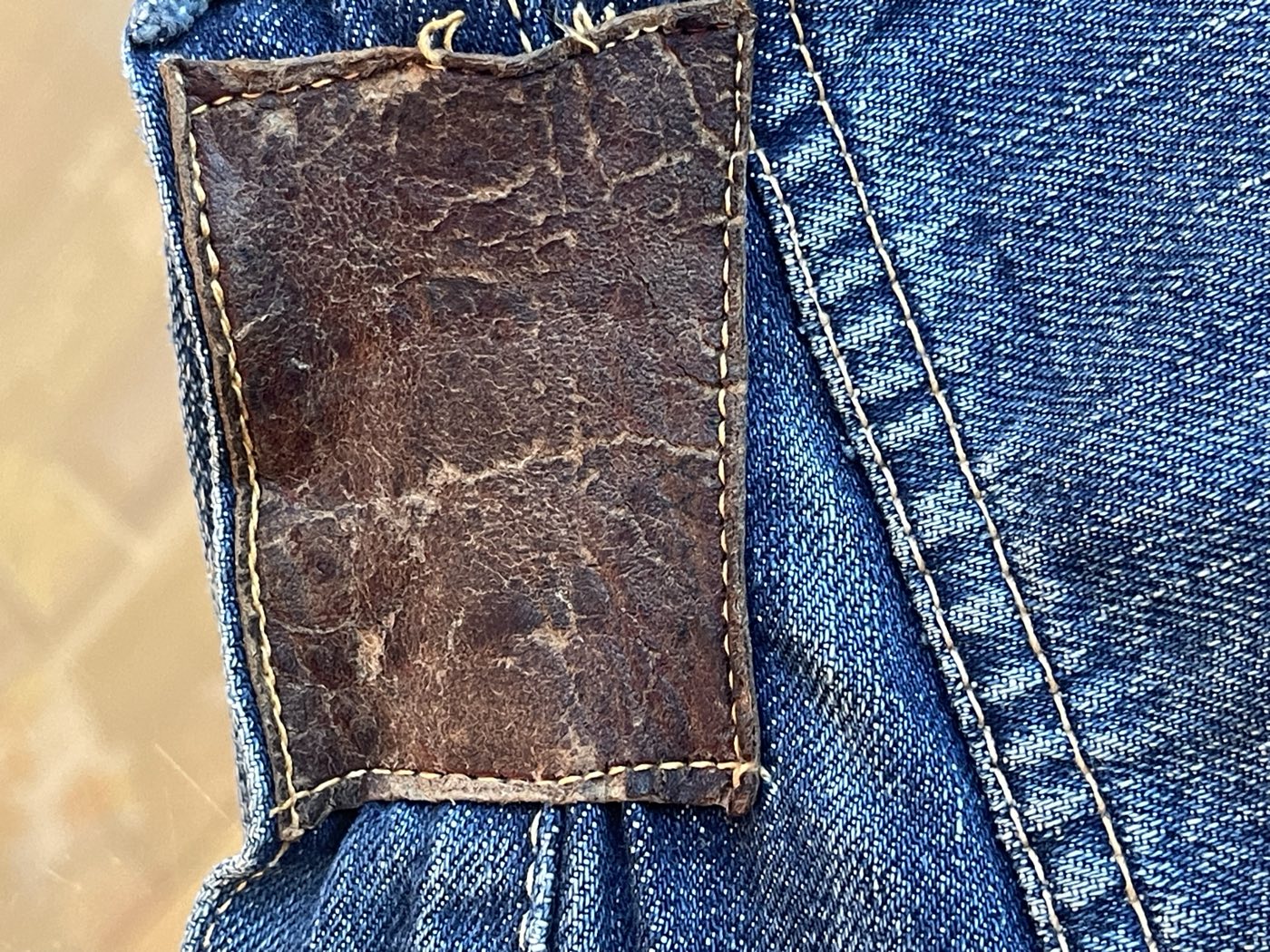
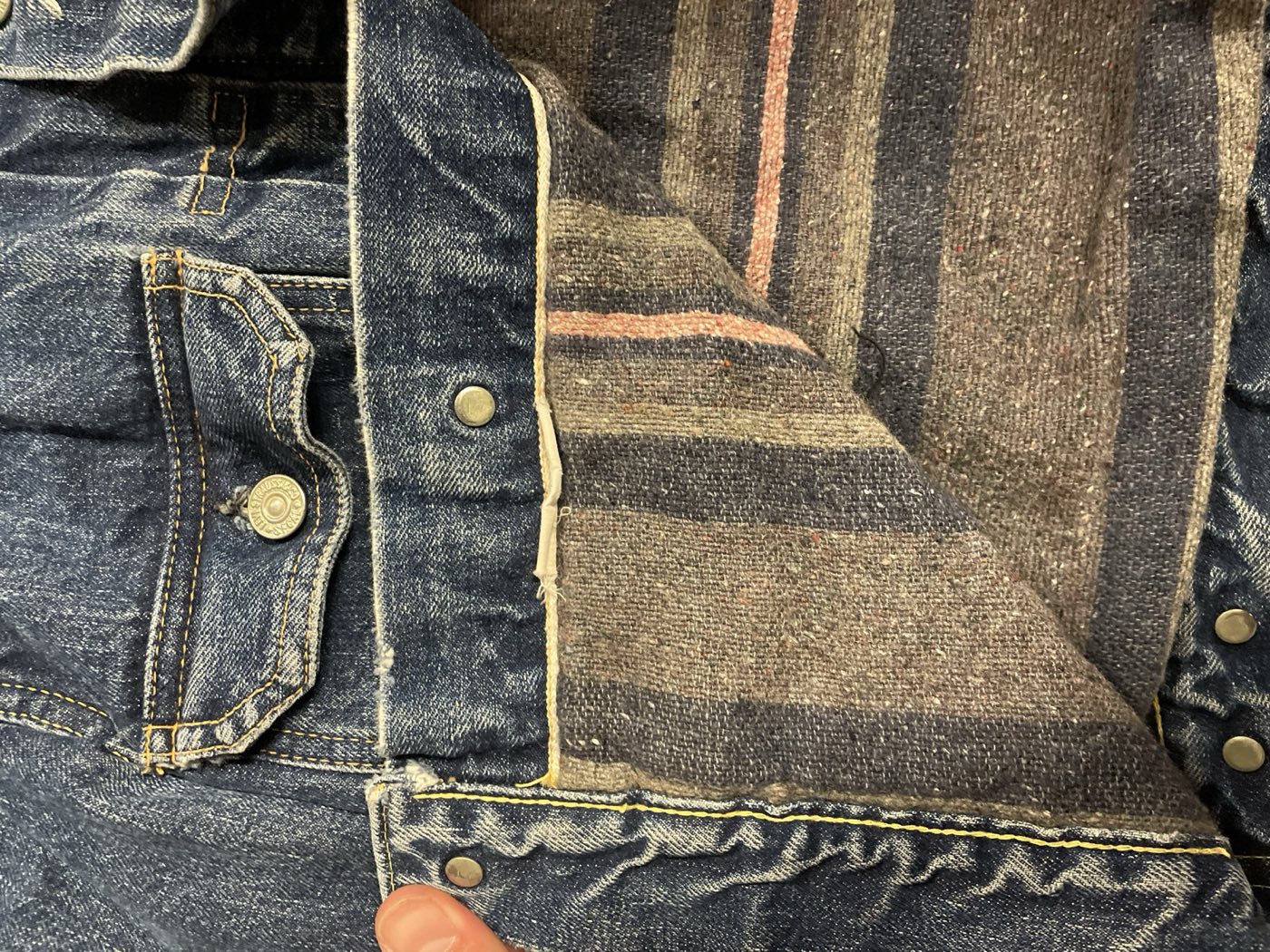
Blanket lined Type 2s exist too, with a striped wool blanket sewn inside for winter work. The lining marks nothing about rarity by itself, but lined examples in good shape have their own following.
Type 3 (557XX): 1962 onward, the trucker
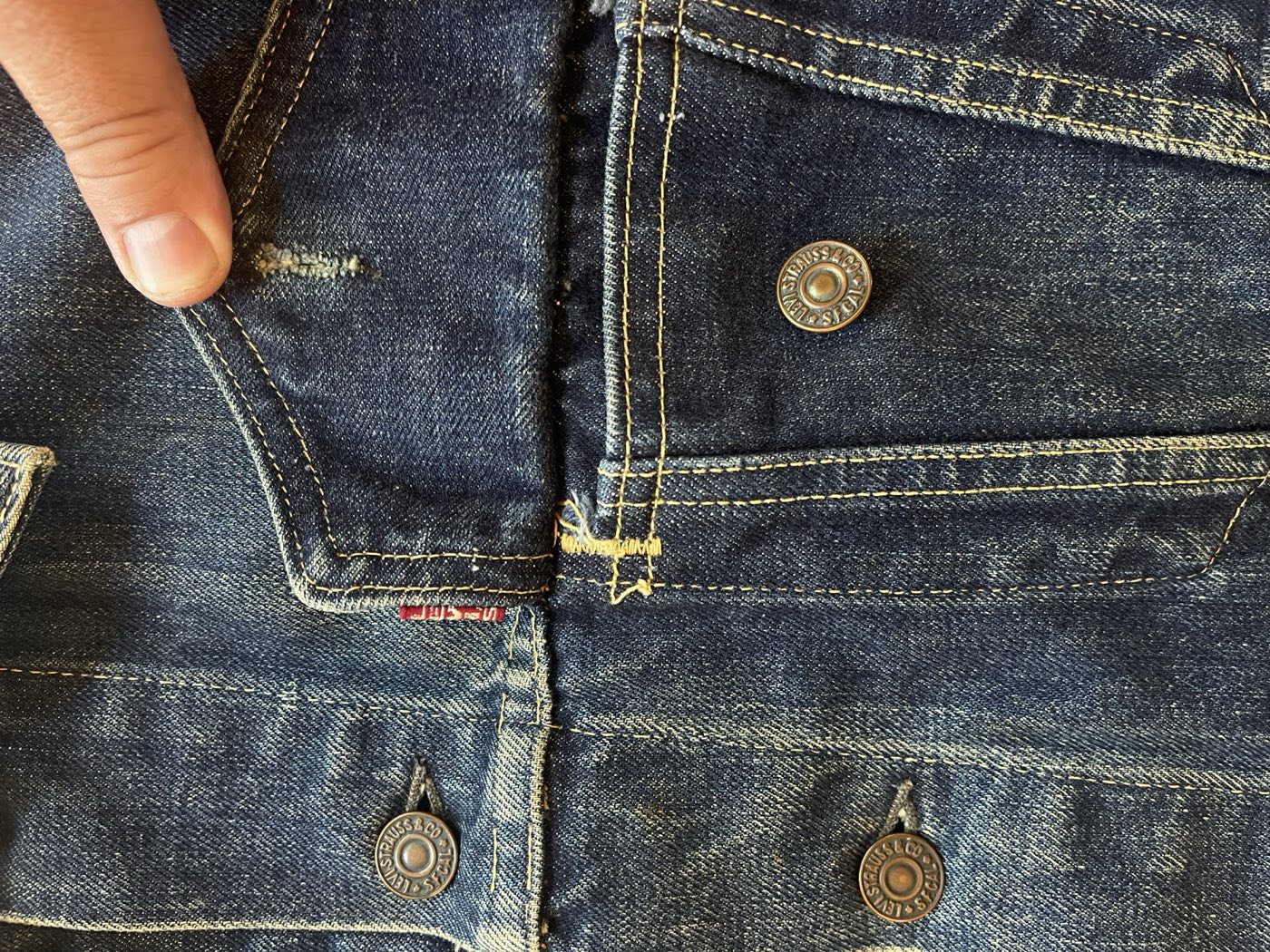
The value line inside the Type 3 family is the red tab: a capital E means 1962 to 1971 and the collector bracket, a lowercase e means 1971 or later. The big E guide explains what the capital letter proves and where a reproduction can fake it.
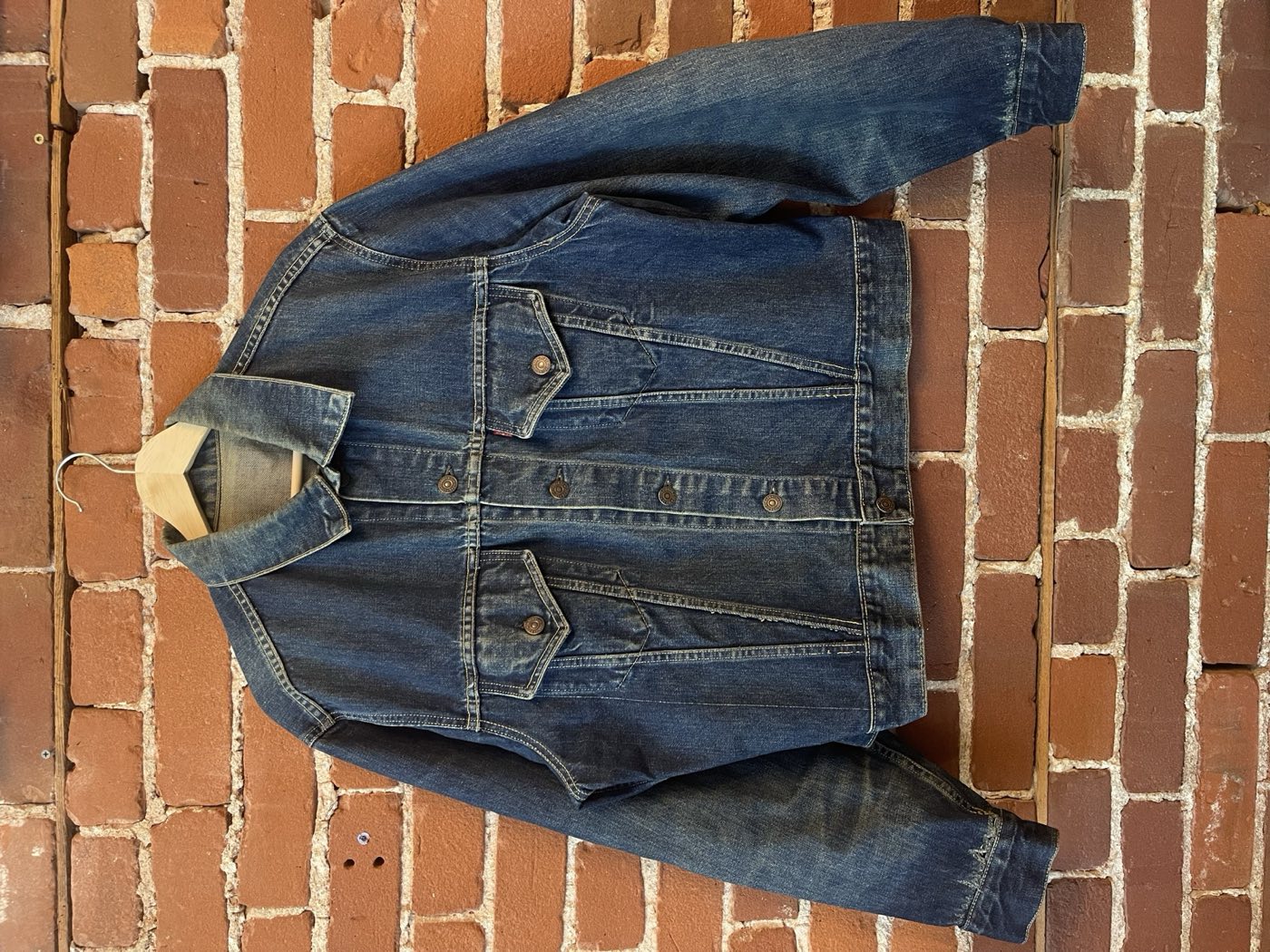
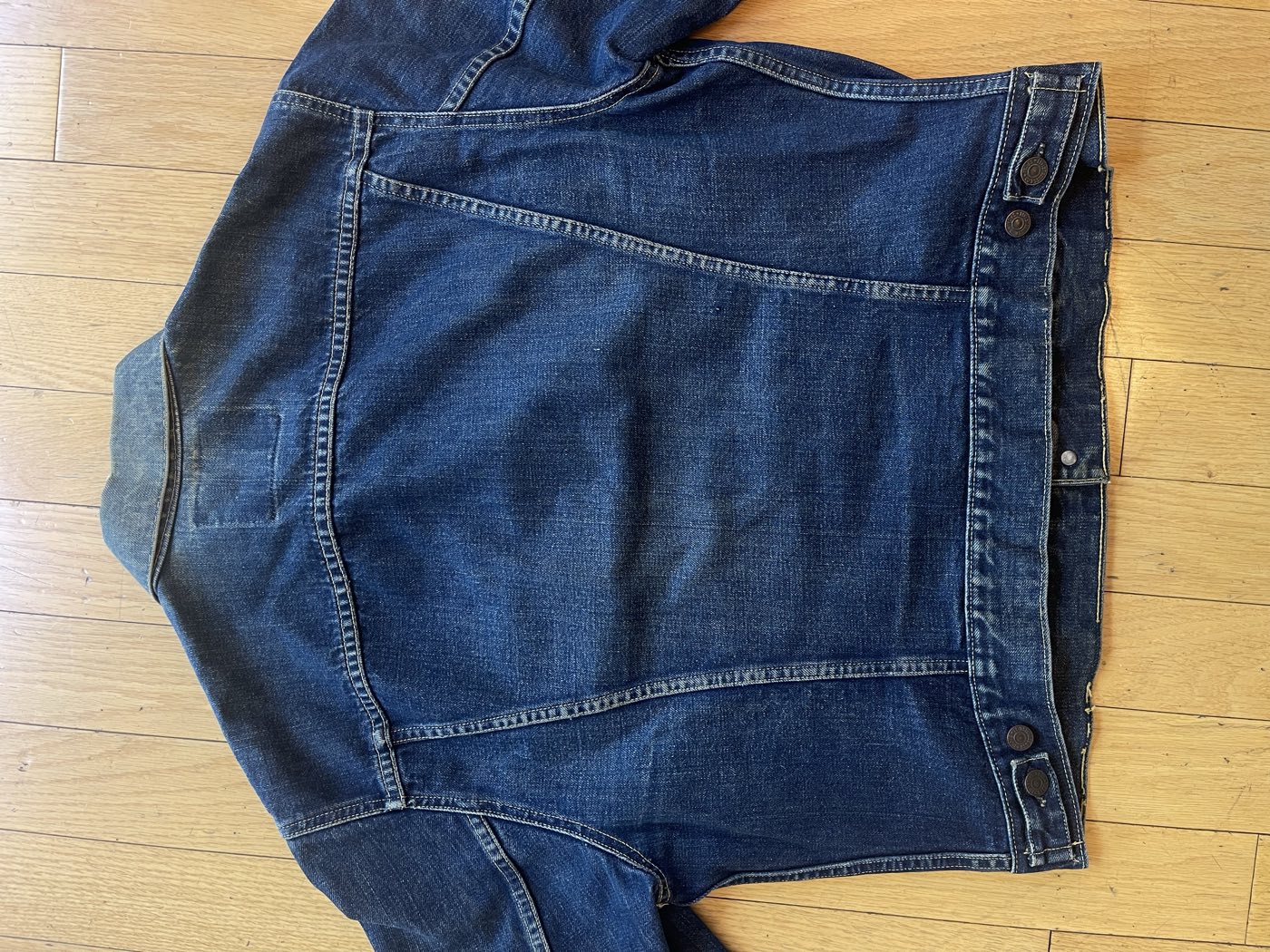
In 1962 the pleats disappeared and the modern trucker shape arrived: two pointed pocket flaps and long tapered seams running down the front. The 557XX is the jacket everyone pictures when they hear denim jacket, and the earliest ones, with a capital E on the red tab, are the collectible ones.
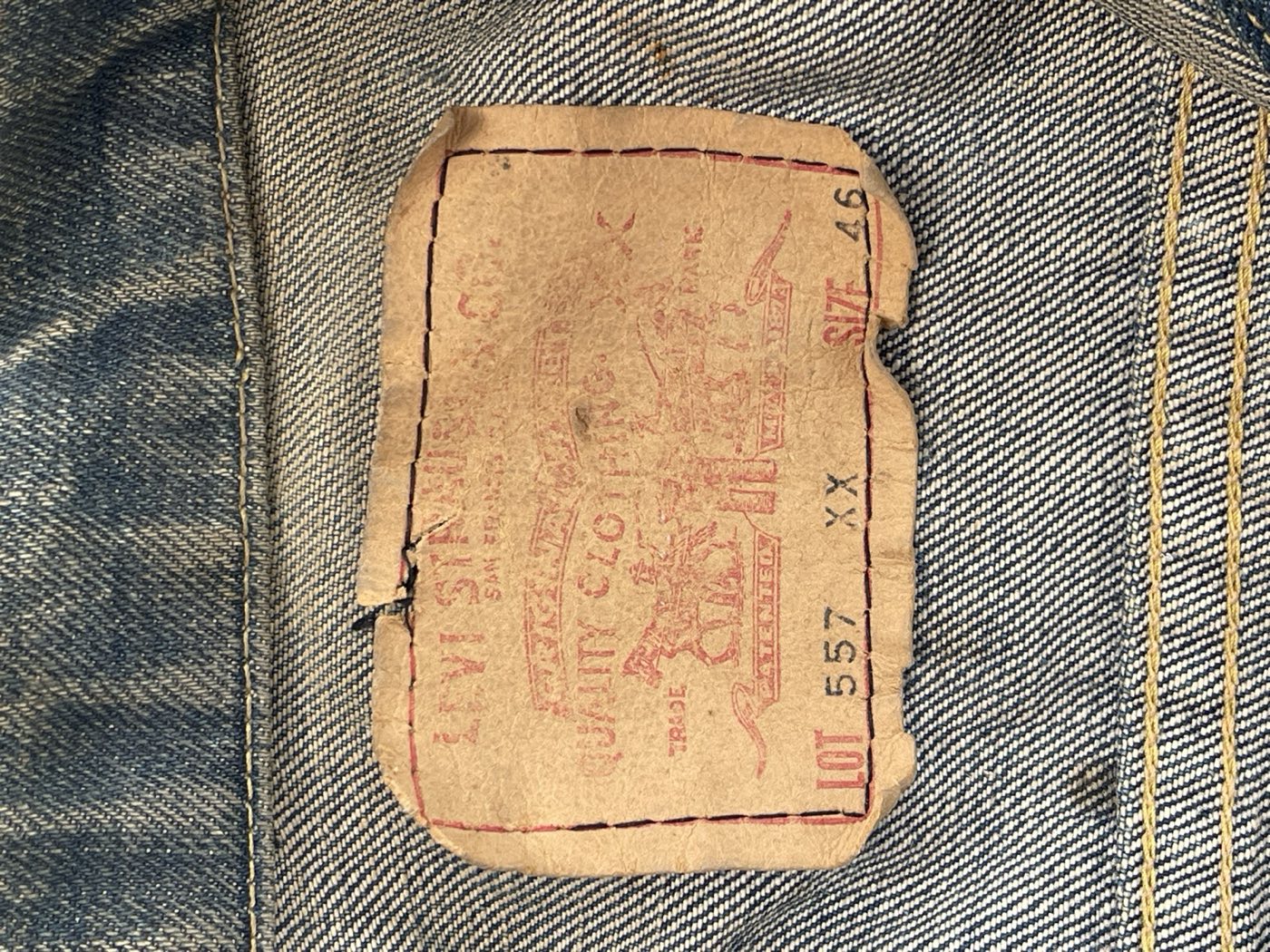
Two details are worth a close look on any trucker. First the tab: a capital E (Big E) means made before 1971. Second the size: vintage jackets ran small and mostly survived in small sizes, so a 44 or 46 that fits a modern frame is genuinely hard to find and priced accordingly.
Patches, pins, and why we leave them on
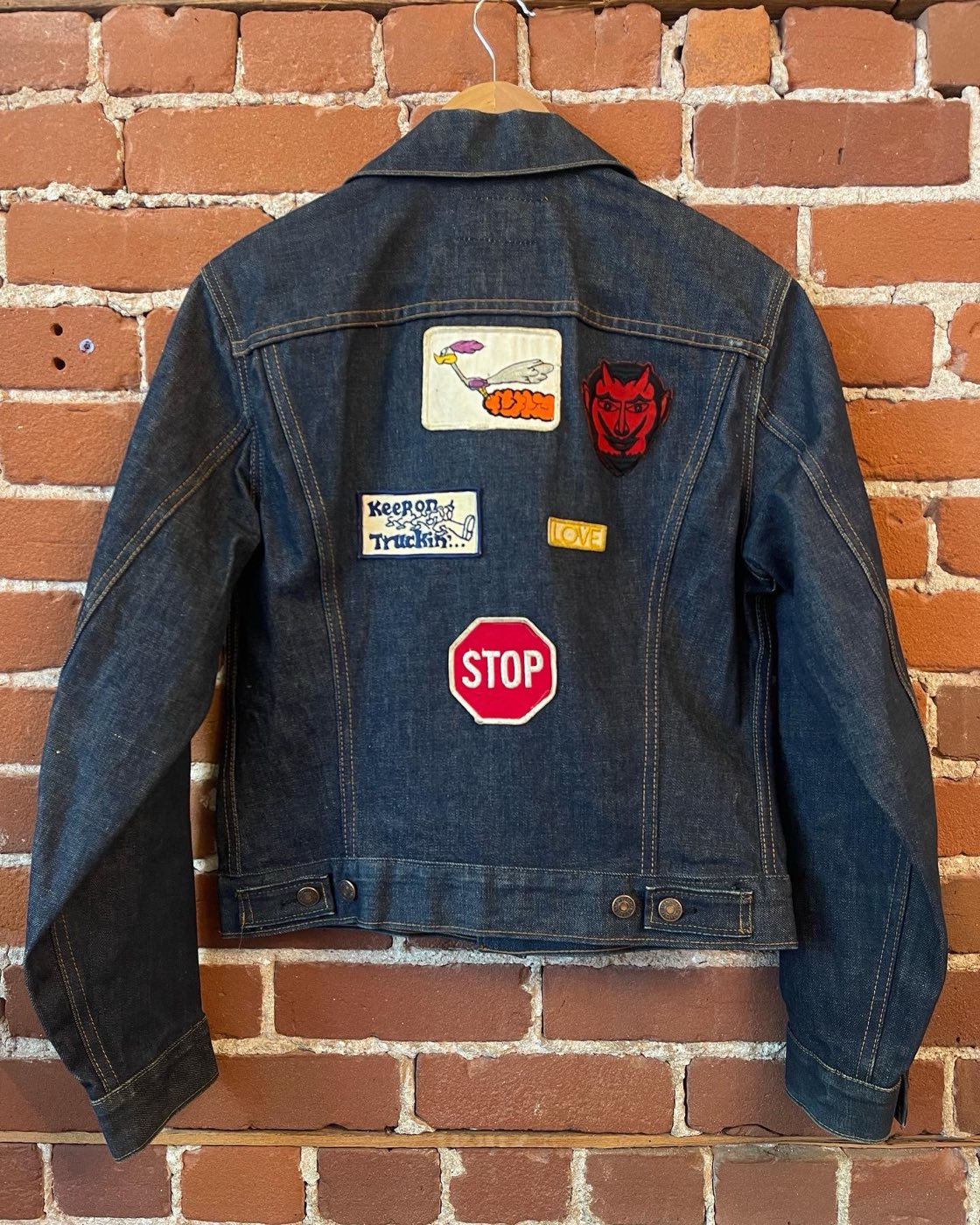
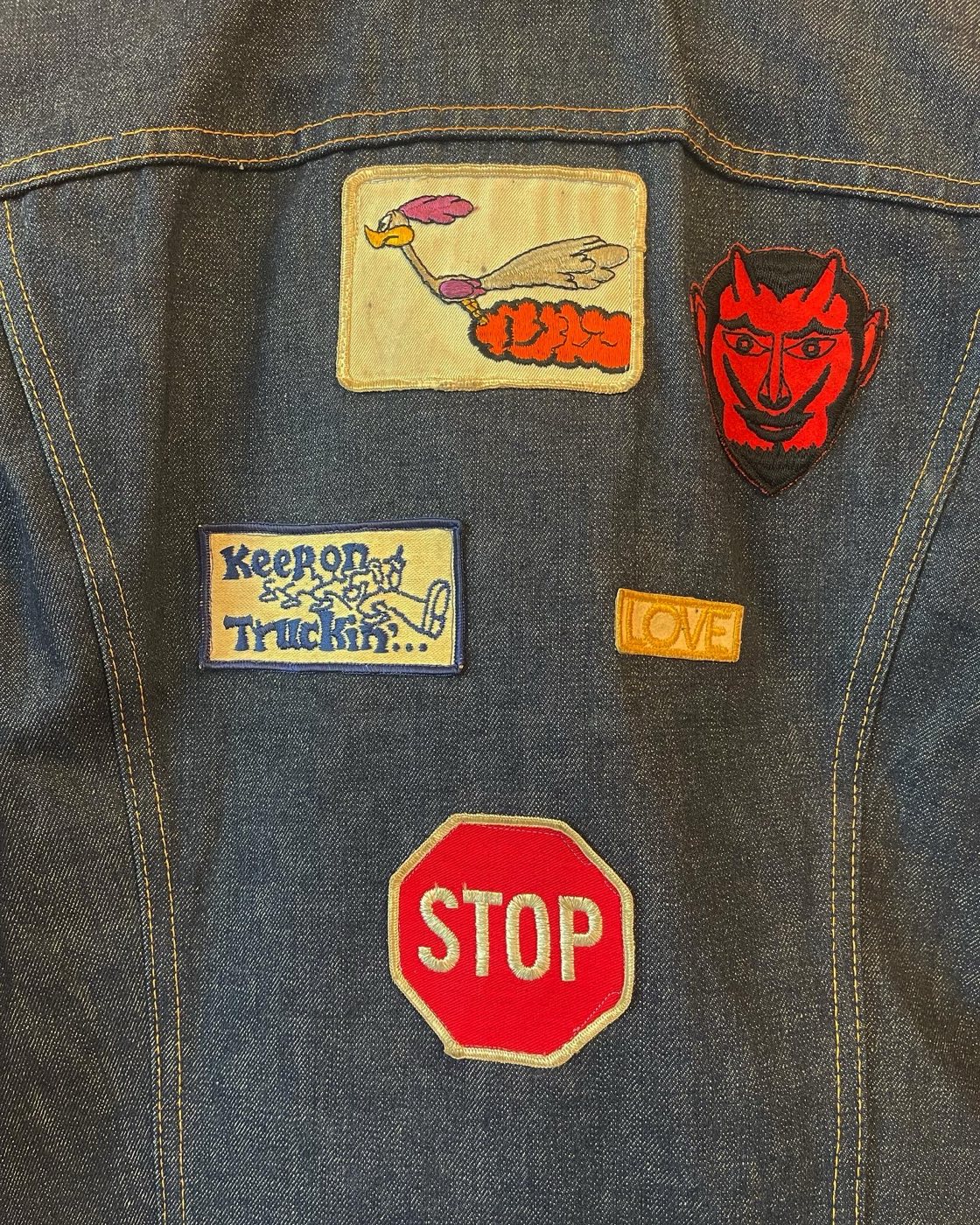
A jacket someone lived in for years often carries the patches they sewed on at the time. The instinct is to pick them off and sell a clean jacket. Do not. Period patches are dated evidence of when the jacket was worn, they are collectible in their own right, and taking them off leaves needle holes and a shadow in the denim that no buyer can unsee. The same goes for the rest of the old clothing in the closet it came out of: let it be looked at before anything is sorted or cleaned.
What about Type 1?
The Type 1 (506XX) is the one pocket, cinch back original, made from 1936 into the early 1950s, and it is the rarest of the three by a wide margin. Wartime examples have their own quirks, because the government's War Production Board stripped details like the cinch to save metal and fabric around 1942. At the extreme top, a museum grade WWII era Type 1 set a Guinness record when it sold for roughly $346,000 in 2026. Most survivors are not that, but any one pocket Levi's jacket deserves a careful look before it goes anywhere near a donation pile. We paid $12,000 in cash for one 1940s Type 1, and the seller was a dealer who knew exactly what he had.
What are Levi's Type 1, 2, and 3 jackets worth?
Honest ranges, as of August 2026. Type 2 507XX jackets typically bring $800 to $1,500, with exceptional dark examples going higher. Big E Type 3 truckers run $150 to $2,000 or more depending on condition, fade, and size. Type 1s start in the low thousands and climb steeply with age and condition. Condition moves every one of these numbers: original hardware, no repairs, and honest fade beat washed, repaired, or altered every time.
| Type | Years | Typical collector range | What Levi's own trade-in pays |
|---|---|---|---|
| Type 1 (506XX) | 1936 to about 1952 | Low thousands and up, steeply by age and condition | Up to $30, as a gift card |
| Type 2 (507XX) | 1953 to 1962 | $800 to $1,500 typical, dark examples higher | Up to $30, as a gift card |
| Type 3 (557XX), Big E | 1962 to 1971 | $150 to $2,000 or more by fade, condition, and size | Up to $30, as a gift card |
| Type 3, small e | 1971 onward | Read in person; the fade and the size carry it | Up to $30 if made more than twenty years ago, as a gift card |
Why the trade-in counter is not a valuation
Sellers often check what Levi's itself will give them before calling anyone else, so it is worth knowing what that number is. Under the Levi's SecondHand trade-in program, checked against their own published values in September 2026, a Trucker Jacket made more than twenty years ago is worth up to $30, and so is any jacket from the premium lines like Levi's Vintage Clothing, regardless of age. Jackets from the last ten years bring $5 to $20. All of it is paid as a gift card for Levi's merchandise rather than cash, and a jacket they cannot resell earns nothing at all.
That program is a perfectly reasonable way to clear a closet of ordinary modern denim. It is simply not a reading of what a jacket is. The same $30 ceiling covers a 1950s Type 2 and any ordinary trucker from the 1990s, because the counter is not looking at the patch, the pleats, or the tab. A Type 2 that trades in for a $30 gift card is a jacket that typically sells into the collector market for $800 to $1,500. Before any jacket goes to any counter, ours included, find out which of the three types you are holding.
Three misreadings we see on jacket types
The first is treating the lot number as proof of age. Levi's Vintage Clothing reproduces the 506XX and 507XX faithfully, period patch and lot number included, so a patch reading 507XX does not by itself make a jacket old. Modern production carries a fabric content and care tag sewn into a side seam, which the originals do not have, and LVC marks its own jackets on an inner tag. Check inside the jacket before you believe the patch; the reproduction guide walks the two side by side.
The second is assuming a 70505 is not vintage. The Type 3 was simply renumbered from 557XX to 70505, so a 70505 is the same jacket under a later lot number, not a fake and not a different design. It just means you are looking at a later trucker, and its value comes from the tab, the fade, and the size rather than from the number on the patch.
The third is reading a cinch back as nineteenth century. The back cinch is genuinely a Type 1 marker, but the War Production Board had it stripped from production around 1942 to save metal, so a buckle back means pre-war, not necessarily pre-1900. That is still an uncommon and valuable jacket. It is just a 1930s or early 1940s one rather than the museum piece a seller sometimes hopes for, and we would rather say that plainly than let anyone plan around the wrong number.
If the jacket is not in California
Jacket identification questions come from everywhere, and the type checks on this page work the same in Ohio as they do in Orange County. So does selling to California Vintage Buyers: call or text (949) 449-1255. For sellers outside Southern California we buy remotely: photos or a video call first, the jacket looked at together, a price agreed on the call, payment sent by PayPal before anything is packed, and shipping paid by us. Nobody has to drive anywhere or trust a mail-in envelope with a jacket worth four figures.
- Do not wash it. Collectors pay for the dirt and the fade exactly as they are.
- Do not repair it. A period hole is worth more than a modern patch.
- Do not cut the patch off or remove the tab, ever.
- Photograph the patch, the tab, the buttons, and the seams. That is everything a buyer needs.
Found a jacket like these in a closet or an estate? Call or text photos of the front, the patch, and the red tab to California Vintage Buyers at (949) 449-1255. We read it for free, tell you honestly what it is, and if you want to sell, we buy from every state: paid through PayPal before you ship, or in cash at your door in Southern California.
Common questions
- How do I tell if my Levi’s jacket is a Type 1, Type 2, or Type 3?
- Count the chest pockets and look at the front seams. One pocket with a cinch at the back is a Type 1 (lot 506XX, made into the early 1950s). Two pockets with knife pleats beside the buttons is a Type 2 (507XX, 1953 to 1962). Two pointed-flap pockets with long tapered seams and no pleats is a Type 3 trucker (557XX, 1962 onward).
- What does Big E mean on a Levi’s jacket?
- Look at the red tab: if LEVI’S is stitched with a capital E, the jacket was made before 1971, when the logo changed to a lowercase e. On a Type 3 trucker, Big E is the line between an ordinary used jacket and a collectible one worth hundreds to a couple of thousand dollars.
- How much is a vintage Levi’s Type 2 jacket worth?
- Typical Type 2 507XX jackets bring $800 to $1,500 as of August 2026, with dark, unwashed examples with a readable patch going higher. Big E Type 3 truckers run about $150 to $2,000 or more depending on fade, condition, and size, and larger sizes like a 44 or 46 carry a real premium because so few survived.
- Should I wash or repair a vintage denim jacket before selling it?
- No. Collectors pay for original condition: the dirt, the fade, and even period damage are part of the value, and a wash or a modern repair can cut the price in half. Leave it exactly as found and text photos of the front, patch, and red tab to (949) 449-1255 for a free read.
- What does Levi’s pay for a trade-in denim jacket?
- Under the Levi’s SecondHand program, checked against their published values in September 2026, a Trucker Jacket made more than twenty years ago is worth up to $30, paid as a gift card for Levi’s merchandise rather than cash. The counter does not read the patch or the pleats, so the same $30 ceiling covers a 1950s Type 2 that sells into the collector market for $800 to $1,500.
- Does a 507XX patch mean the jacket is really from the 1950s?
- Not on its own. Levi’s Vintage Clothing reproduces the 506XX and 507XX with period-style patches and lot numbers. Modern production carries a fabric content and care tag sewn into a side seam, which original jackets do not have, so check inside the jacket before trusting the patch.
- Can I sell a vintage Levi’s jacket if I do not live in California?
- Yes. California Vintage Buyers buys denim remotely from every state: photos or a video call first, the jacket looked at together, the price agreed on the call, and payment sent by PayPal before you ship, with shipping paid by us. Call or text photos of the patch, the red tab, and the buttons to (949) 449-1255 to start.
Have something like this?
One phone call, from any state. A free video appraisal, the price agreed on the call, and payment through PayPal before you ship, with shipping on us. In Southern California we come to you and pay cash the same day.