Field Guide
How Much Are Old Levi’s Worth in 2026?
Most bring $40 to $150, read from eBay sold results in the summer of 2026. The right pair brings thousands, and the records run to $87,400 and beyond. Five details separate one from the other, and you can check all five at your kitchen table.
We buy from every state · free video appraisal · paid before you ship
By Sam Wingenbach and Jake Cover, the buyers behind our video appraisals and house calls · Updated September 30, 2026
Read the transcript
Hi guys, Sam here with California Vintage Buyers, and I want to help clear the air and give you a little bit of information on how do you know if your old Levi's you're looking at are worth the time to try to sell them or bound for Salvation Army and just get them out of here. There's not really value there. This is not an exhaustive list of things to look for, but it's just some key distinguishing factors, right? So I have a few pairs of pants in front of me and different eras. So we're going to go over with the newer ones, right? Here we have a pair of the year 2000 pants. How do I know that these are from the year 2000? Well, because if you see that dark 501XX right there, that style of lettering is from the 90s to the early 2000s. It's different than this stuff. Do you see the difference of that one right there? You can see the difference. We'll get to these in a minute. But if you see that block lettering on your pants, you're looking at 90s up to say 2004 or something like that. Another tell. Let's just say you don't have this patch here. You wore the belt a lot. He wore the belt. She wore the belt a lot. The patch is gone. How old are my pants? With these ones, you can also pop this guy out right here. And you have, see that number right there? 1000. It's actually not the number 1000. It's 10, 00, October the year 2000. So whatever number you're looking at right there on the tag, if it has this tag on the inside leg, look at that number and you're going to see probably 0497 or what have you. It's going to be month and year. Good to know. So if that's gone, check if it has one of those. If it doesn't have one of these, then you're looking at somewhere in the 80s, right? Or potentially older. So I have a pair of 80s here. Anything made in USA is going to say on this tag, made in USA, right? So see that right there? Made in USA. Made in USA. What does these not have? These don't have made in USA. See how that part's missing? Made in Guatemala in the 2000s. They outsourced all the manufacturing. Bummer. So still good pants. We'll still buy these if the wash is cool. But the collector factor is not there. So again, if you got a pile of 100 of these guys, we'll still buy them. Give us a call. Are you kidding me? But when it comes to like Levi's, it's the details that matter. So moving forward. Oh, another thing is the distinguishing factor. See how it's red, the 501. And this one's black. You see in red, you're seeing 80s. Right? So you're looking at made in USA. Got the little red 501. That was an 80s thing. Right? So that's a couple things. Then you go over to these guys. Now, this is also 80s, but these are early 80s. What's the distinguishing factor on these guys? Flip up the pant leg. Do you see that? That's called selvedge denim. They call them redlines. These are called redlines. Right? Anything 501, 1982, 83-ish, right around there, and previous is going to have this kind of thing. This makes the value go up a little bit higher. Right? Why do they call these redlines you're asking? Great question. Well, when they were brand new, like these puppies from the 70s, which are a fantastic sample, they had a red line. Then, selvedge denim. So what does selvedge denim mean? It means the pant leg was made out of one sheet of denim, and they slapped them together. That's the end of a sheet of denim. They put them together, and they sewed the pant leg. And so this is made out of one sheet, a little more collectible. These are redlines. These are redlines. If you see that, you're looking at redlines. Even if you don't see any red, you got a pair of redlines. Right? We'll buy all these guys. Now, if you see one of these things that has a capital E right there, it's even better. Right? If you're looking at dealing with a barn, a ranch, Uncle Bob's house, and you're clearing it out, and you found him in the attic or in the bottom of his closet or something, we're great buyers for all this stuff. And we've paid up to thousands before for certain types of Levi's. There's a collectible value. It all depends on what the details are. You know? It's like if you call the car dealership, and you're like, hey, what do y'all pay for cars? They're going to say, okay, well, yes, we buy cars. What's the make? Model? Mileage? How's the condition? All the things. Give us a call. Number is 949-449-1255. We'd love to help you discern what you got, make your sweet offer, and buy all that stuff and more.
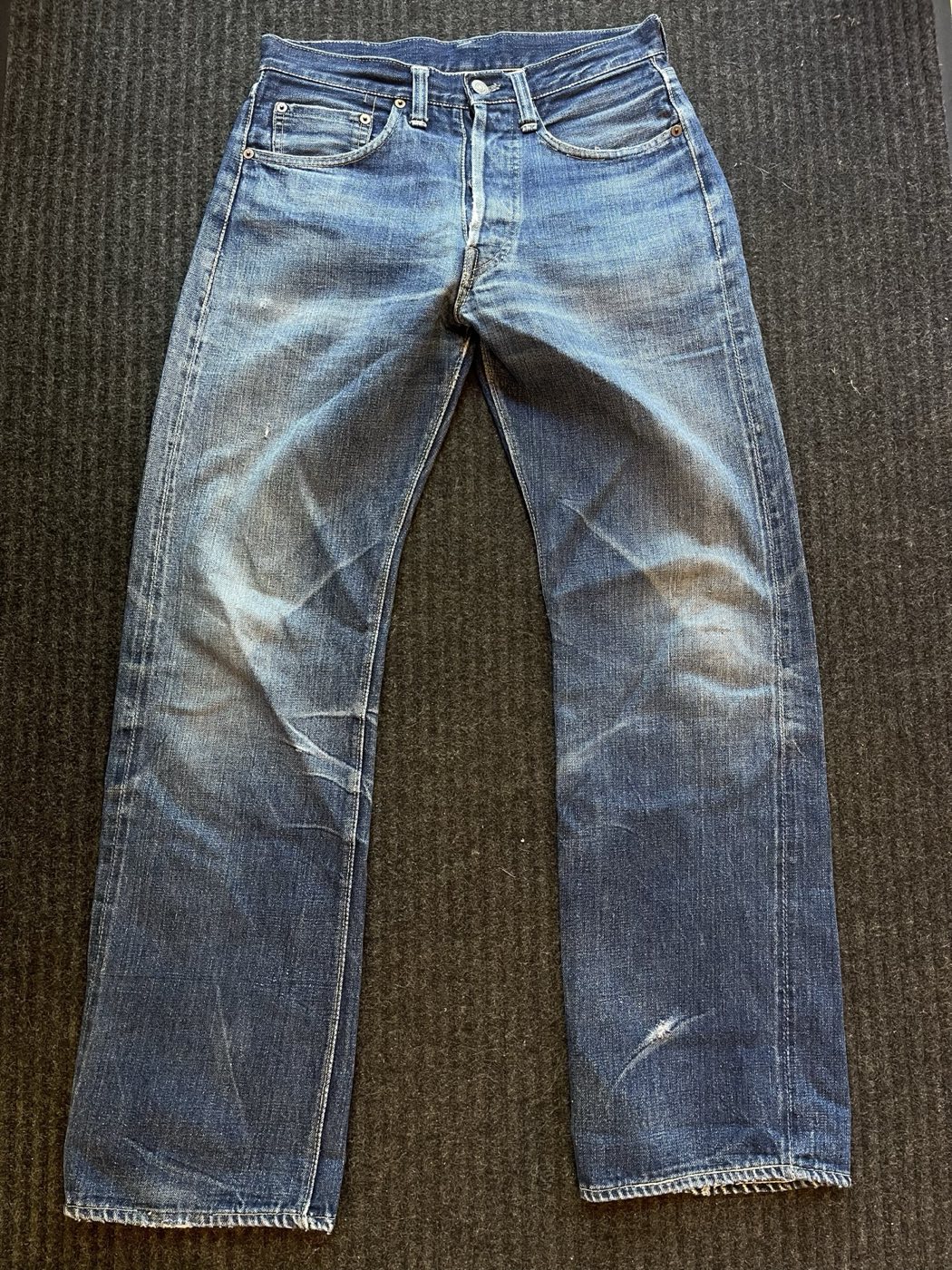
This is the question we answer more than any other, so here is the honest shape of it up front. Most old Levi’s, the American-made pairs from the 1980s and 1990s hanging in millions of closets, sold for $40 to $150 on eBay between June and early September 2026. A smaller group, the selvedge and big E pairs, brings hundreds to thousands. And a tiny group at the top, the pre-war denim, jeans and jackets both, sells for what nice cars cost: we recently paid $12,000 in cash, the same day, for a 1940s Type 1 jacket, and mine-found pairs of jeans have brought $87,400 and beyond at auction. The difference between those tiers is not luck. It is a handful of physical details you can check yourself in about ninety seconds, and this guide walks you through every one.
Old Levi’s value chart: the whole market in two tables
Find your pair in the first table or your jacket in the second, confirm it with the detail in the middle, and read the honest range. The jeans figures are eBay completed sales read between June and early September 2026, which are sale prices and not asking prices. The jacket figures are our market read from July 2026, the last time we verified that side end to end. Every number is explained in depth in our era-specific guides.
| Jeans: what you have | The tell | What they sold for, June to September 2026 |
|---|---|---|
| 501s, 1980s to 1990s, made in USA | Made in USA on the tag, fuzzy overlocked seam inside the leg | $40 to $150 worn; $299 to $899 deadstock with the flasher tags still on |
| Redline selvedge 501s, 1971 to early 1980s | Small e red tab, clean outseam edge with a red thread line | $200 to $1,000 for 14 of 20 sales; the best two auctions $1,025 and $1,201 |
| Big E 501s, mid-1950s to 1971 | Capital E on the red tab, jacquard patch | $540 to $1,600 for wearable 1960s pairs; thrashed small pairs about $60 |
| 501XX golden era, 1947 to mid-1950s | Leather patch, hidden rivets, capital E tab | $700 to $2,500 across four hidden-rivet pairs |
| WWII S501XX, 1942 to 1946 | Painted-on arcuate, plain donut-hole fly buttons | None sold on eBay in this window; read individually |
| Buckle-back 501s, before 1942 | Cinch buckle across the back waistband | The top of the market; none sold in this window, and a record mine-found pair brought $87,400 at auction in 2022 |
| Jackets: what you have | The tell | Typical range, read July 2026 |
|---|---|---|
| Type 3 trucker, small e | Two pointed-flap pockets, lowercase e tab | $50 to $300 |
| Type 3 trucker, big E era | Two pointed-flap pockets, no side waist tabs, capital E tab | $150 to $2,000 and beyond |
| Type 2 jacket, 1953 to 1962 | Two pockets, side tabs at the waist | $800 to $1,500; the strongest example we have observed listed at $4,800 |
| Type 1 jacket, 1905 to 1952 | One pocket, cinch back, front pleats | $2,000 to $8,000 worn; exceptional pieces far above |
One warning before you touch anything: do not wash them, do not repair them, do not cut a single thread. More denim value is destroyed in the week before a sale than in the previous fifty years. Then call or text California Vintage Buyers at (949) 449-1255 for a free read: we buy old Levi’s from every state and pay before you ship.
Prefer to be walked through it? Our free sixty second identification assistant asks five questions about the tab, the cinch, the arcuate, the care tag, and the cuff, and hands you the probable era with an honest range.
How to tell if old Levi's are valuable: the ninety-second inspection
Five details place almost any Levi’s garment in the table above. Work through them in order.
- The red tab. A capital E reading LEVI’S dates the garment before 1971, the single most valuable signal in denim. The tab itself first appeared in 1936, so no tab at all can mean either a very early piece or a very ordinary one, which is exactly when a photo to an expert helps.
- The care tag. Care labeling became federal law in 1971, so no care tag at all means a pre-1971 garment. If a tag is present, the small digits at the bottom encode the month, year, and factory: our date codes guide reads them step by step.
- The cuff check. Turn up the hem and look at the outseam inside the leg. A clean woven edge with a red thread line is redline selvedge, woven on narrow looms into the mid-1980s. A fuzzy overlocked edge means later, wide-loom denim.
- The patch. A leather waist patch points before the mid-1950s. The card-like jacquard patch came after. A missing patch does not sink a pair; the other details still date it.
- The hardware. Hidden rivets under the back pockets ran through 1966. A cinch buckle across the back waistband means pre-war, roughly before 1942, and at that point stop checking and get real eyes on it.
Our how to identify vintage Levi’s and how to date Levi’s guides walk each of these with photos, the date codes guide reads the care tag and button numbers on post-1971 pairs, and the 501 value guide and jacket value guide price every era in detail. This page is the map; those are the streets.
The records, and how to read them
The headlines are real. A mine-recovered pair of 1880s Levi’s brought $87,400 at auction in October 2022. A pair attributed to 1873, an attribution made by the seller rather than authenticated by Levi’s, changed hands around $100,000 in 2023. Levi’s itself paid $46,532 on eBay in 2001 to buy back an 1880s pair for its archive. A cache of seven 1880s and 90s pairs pulled from an Arizona mineshaft carried an estimate around $300,000. And in 2026 a museum-grade deadstock WWII Type I jacket set a Guinness record at roughly $346,000.
Read those numbers the way we do: as proof the ceiling is real, never as an expectation. Record pairs are 19th century, mine-found, or deadstock, usually all with documented stories. What the records genuinely mean for you is that the market underneath them is deep and serious, which is why even an ordinary big E pair has real buyers, and why anything with a cinch buckle deserves expert eyes before it goes anywhere.
Four mistakes that cost the most money
None of these are exotic. They are the four things we watch families do in the week before they call us, and each one is reversible only before it happens.
- Washing, mending, or altering. A wash flattens the fade that took thirty years to earn, a patched knee is worth less than a torn one on a pre-war pair, and a shortened hem removes the selvedge edge that proves what the denim is. Leave the dirt, leave the holes, leave the hem.
- Cutting the tags off deadstock. Unworn 1980s and 1990s 501s still carrying their paper flasher tags sold for $299 to $899 on eBay between June and early September 2026. The identical pair with the tags removed and worn once is a $40 to $150 pair of jeans.
- Selling the closet as one lot. Bundles get priced at the level of the weakest item in them. Pull out anything with a capital E tab, a red line inside the cuff, or a cinch across the back, and read those separately before the rest goes anywhere.
- Pricing from listings instead of sales. An asking price is a wish. The numbers on this page are completed sales, and the gap between the two on vintage denim is wide enough to set a family’s expectations badly wrong in either direction.
What multiplies the number
Size, first and always. Collectors mostly want to wear these, and measured waists of 33 to 38 inches draw the strongest demand, sometimes twice what an identical pair brings very small or very large. Measure the actual waist flat and double it, because vintage denim shrank and the patch number often lies. Deadstock, meaning unworn with tags or crispness intact, multiplies any era. Honest wear helps more than people expect, especially pre-war, where scarcity does the work and collectors accept damage they would never accept on a 1985 pair. And paperwork or provenance, a photo of grandpa wearing them, a receipt, a document from the trunk they sat in, adds real money at the top end. Keep the story with the garment.
Who should I call to sell old Levi’s, and what happens next?
Photograph the red tab, the patch, the inside of the hem at the outseam, and the front of the garment. Then call or text California Vintage Buyers at (949) 449-1255, and we will tell you the same day what you are holding and what it is honestly worth, no charge and no obligation. You do not need a buyer in your own state: we buy old Levi’s from every state. Outside Southern California we look together on a free video appraisal, agree the price on the call, and send payment through PayPal before you ship, with shipping on us, so nothing is mailed on a promise. In Southern California we buy vintage Levi’s in person and pay cash the same visit. And if the photos show something truly exceptional, we do not ask you to ship it or settle for a screen: we get on a plane and come to you, wherever you are. If what you have is a $60 pair, we say that plainly too, so you can sell it, wear it, or donate it without wondering whether you just gave away a fortune.
Common questions
- How much are old Levi’s worth?
- Read from eBay completed sales between June and early September 2026: most 1980s and 1990s American-made pairs sold for $40 to $150, redline selvedge pairs from 1971 to the early 1980s mostly $200 to $1,000, wearable 1960s big E pairs $540 to $1,600, and 1940s and 1950s hidden-rivet pairs $700 to $2,500. Pre-war buckle-backs sit above all of it, where a record mine-found pair brought $87,400 at auction in 2022. Text photos of the tab and patch to (949) 449-1255 for a same-day answer.
- Are Levi’s from the 1980s or 1990s worth anything?
- Usually $40 to $150 worn, read from eBay completed sales between June and early September 2026, and made in USA on the tag is itself becoming a vintage marker since US production ended in the early 2000s. Deadstock pairs are a separate market: 1980s and 1990s 501s still carrying their original flasher tags sold for $299 to $899 in the same window. Cuff them first: a red thread line inside the outseam means selvedge, and a different price class.
- What are the most valuable Levi’s ever sold?
- A mine-recovered 1880s pair brought $87,400 at auction in 2022, a pair attributed to 1873 changed hands around $100,000 in 2023, and a museum-grade deadstock WWII Type I jacket set a Guinness record near $346,000 in 2026. Those are ceilings, not expectations, but they are why serious buyers look hard at anything pre-war.
- What are WWII Levi’s worth?
- We do not publish a range for wartime S501XX jeans, and you should distrust anyone who does. No wartime pair turned up in eBay completed sales between June and early September 2026, and the figures that circulate online are not tied to any sale that can be dated, so each pair is read on its own details: the painted-on arcuate, the plain donut-hole fly buttons, the missing back cinch and crotch rivet. They are scarce and the international collector market pursues them hard. Get real eyes on one before it goes anywhere.
- How do I find out what my old Levi’s are worth?
- Photograph the red tab, the waist patch, the inside of the hem at the outseam, and the front of the garment, then call or text California Vintage Buyers at (949) 449-1255. We read denim every day and answer the same day, free, whether the honest number is $60 or $6,000, and we buy from every state.
- Who should I call to sell my grandfather’s old Levi’s if I don’t live in California?
- California Vintage Buyers, at (949) 449-1255, by call or text. We buy old Levi’s jeans and jackets from every state and read them free the same day: send photos of the red tab, the patch and the cuffed outseam, and if the pair is one we want, we agree the price on a video call and pay through PayPal before you ship, with the shipping label on us. Do not wash or mend anything first, and do not sell the closet as one lot until anything with a capital E tab, a red line inside the cuff, or a buckle on the back has been read.
Have something like this?
One phone call, from any state. A free video appraisal, the price agreed on the call, and payment through PayPal before you ship, with shipping on us. In Southern California we come to you and pay cash the same day.
Keep reading
- How to Tell If Your Levi’s Are Vintage→
- How to Date Levi’s: A Step-by-Step Guide→
- Levi’s Date Codes: How to Read the Care Tag, Button Stamps, and Lot Numbers→
- Are Old Levi’s 501s Worth Anything? Real 2026 Prices→
- What Is a Vintage Levi’s Jacket Worth in 2026?→
- Where to Sell Vintage Levi’s From Anywhere in the US (2026)→
- How to Photograph Vintage Levi’s for an Accurate Offer→
- Where to Sell Vintage Levi’s in Southern California: Your Options, Compared→
- Sell vintage Levi’s to people who know what they’re holding.→