Field Guide
Big E Levi’s: What the Capital E Means and What They Are Worth
Sellers say old, buyers say vintage, and the word both sides agree on is big E. Here is what the capital letter actually proves, and what it does not.
We buy from every state · free video appraisal · paid before you ship
By Sam Wingenbach and Jake Cover, the buyers behind our video appraisals and house calls · Updated September 6, 2026
Read the transcript
Hi guys, Sam here with California Vintage Buyers, and I want to help clear the air and give you a little bit of information on how do you know if your old Levi's you're looking at are worth the time to try to sell them or bound for Salvation Army and just get them out of here. There's not really value there. This is not an exhaustive list of things to look for, but it's just some key distinguishing factors, right? So I have a few pairs of pants in front of me and different eras. So we're going to go over with the newer ones, right? Here we have a pair of the year 2000 pants. How do I know that these are from the year 2000? Well, because if you see that dark 501XX right there, that style of lettering is from the 90s to the early 2000s. It's different than this stuff. Do you see the difference of that one right there? You can see the difference. We'll get to these in a minute. But if you see that block lettering on your pants, you're looking at 90s up to say 2004 or something like that. Another tell. Let's just say you don't have this patch here. You wore the belt a lot. He wore the belt. She wore the belt a lot. The patch is gone. How old are my pants? With these ones, you can also pop this guy out right here. And you have, see that number right there? 1000. It's actually not the number 1000. It's 10, 00, October the year 2000. So whatever number you're looking at right there on the tag, if it has this tag on the inside leg, look at that number and you're going to see probably 0497 or what have you. It's going to be month and year. Good to know. So if that's gone, check if it has one of those. If it doesn't have one of these, then you're looking at somewhere in the 80s, right? Or potentially older. So I have a pair of 80s here. Anything made in USA is going to say on this tag, made in USA, right? So see that right there? Made in USA. Made in USA. What does these not have? These don't have made in USA. See how that part's missing? Made in Guatemala in the 2000s. They outsourced all the manufacturing. Bummer. So still good pants. We'll still buy these if the wash is cool. But the collector factor is not there. So again, if you got a pile of 100 of these guys, we'll still buy them. Give us a call. Are you kidding me? But when it comes to like Levi's, it's the details that matter. So moving forward. Oh, another thing is the distinguishing factor. See how it's red, the 501. And this one's black. You see in red, you're seeing 80s. Right? So you're looking at made in USA. Got the little red 501. That was an 80s thing. Right? So that's a couple things. Then you go over to these guys. Now, this is also 80s, but these are early 80s. What's the distinguishing factor on these guys? Flip up the pant leg. Do you see that? That's called selvedge denim. They call them redlines. These are called redlines. Right? Anything 501, 1982, 83-ish, right around there, and previous is going to have this kind of thing. This makes the value go up a little bit higher. Right? Why do they call these redlines you're asking? Great question. Well, when they were brand new, like these puppies from the 70s, which are a fantastic sample, they had a red line. Then, selvedge denim. So what does selvedge denim mean? It means the pant leg was made out of one sheet of denim, and they slapped them together. That's the end of a sheet of denim. They put them together, and they sewed the pant leg. And so this is made out of one sheet, a little more collectible. These are redlines. These are redlines. If you see that, you're looking at redlines. Even if you don't see any red, you got a pair of redlines. Right? We'll buy all these guys. Now, if you see one of these things that has a capital E right there, it's even better. Right? If you're looking at dealing with a barn, a ranch, Uncle Bob's house, and you're clearing it out, and you found him in the attic or in the bottom of his closet or something, we're great buyers for all this stuff. And we've paid up to thousands before for certain types of Levi's. There's a collectible value. It all depends on what the details are. You know? It's like if you call the car dealership, and you're like, hey, what do y'all pay for cars? They're going to say, okay, well, yes, we buy cars. What's the make? Model? Mileage? How's the condition? All the things. Give us a call. Number is 949-449-1255. We'd love to help you discern what you got, make your sweet offer, and buy all that stuff and more.
The short answer: big E means the red tab reads LEVI’S in capitals, which Levi’s used from 1936 until 1971, when the tab changed to a lowercase e. A genuine big E is a pre-1971 garment inside the collector market. As of August 2026, big E 501s can bring $500 or more, and big E Type 3 jackets $150 to $2,000 and beyond. Free tab reads: (949) 449-1255.
You are holding a pair of old jeans or a denim jacket from a garage, a closet, or a storage unit, and somebody has told you to check for the big E. This guide is about that one small piece of red cloth: what it proves, the older and newer versions of it, where it sits on different garments, and the situations where a capital E is not what it seems. A tab alone never prices a pair; it only tells you which conversation you are in.
What does the big E on Levi’s mean?
Levi’s added the red tab in 1936. According to Levi Strauss and Co’s own archive, national sales manager Chris Lucier proposed sewing a folded red ribbon into the seam of the right back pocket so a pair of Levi’s could be recognized across a room while other makers were copying the riveted pants closely. The ribbon carried LEVI’S woven in white capitals; the archive puts the jacket tab at 1937.
The tab stayed in capitals for thirty-five years. In 1971 Levi’s changed the lettering to Levi’s, with a capital L and a lowercase e, and that is the whole meaning of the term. A capital E on the red tab is a pre-1971 garment; a lowercase e is 1971 or later. Collectors say big E and small e because the E is the letter that changed shape most visibly, and it is the fastest check there is. Care tags became standard inside American clothing the same year, which is why a genuine big E almost never has one and a small e almost always does.
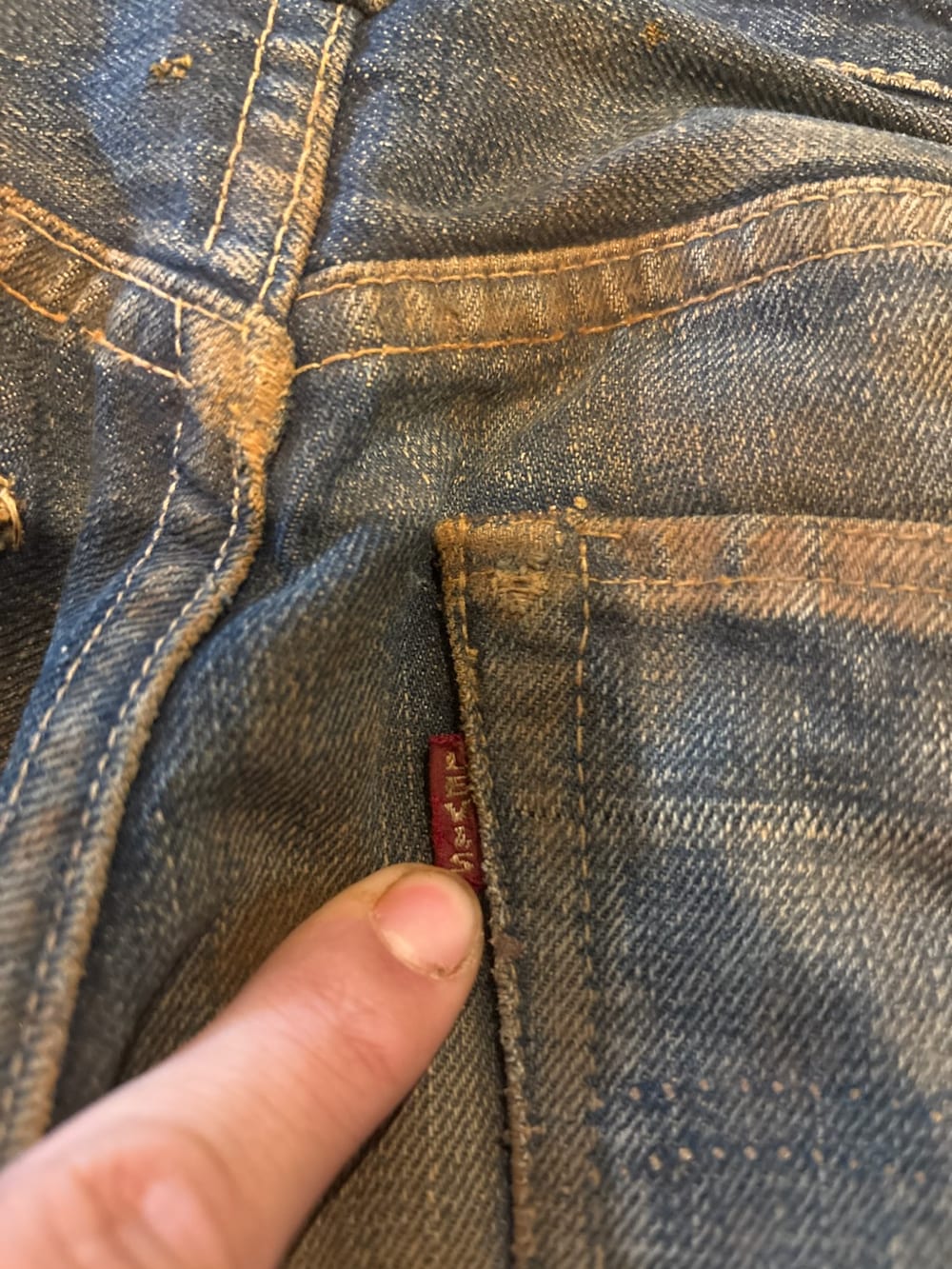
One-sided or two-sided: which big E tab is older?
Not every big E is the same age, and the tab itself tells you which half of the era you are in. From 1936 into the early 1950s the lettering was on one side of the tab only; turn it over and the back is plain red. Around 1953 Levi’s began making tabs with LEVI’S visible on both sides, and the registered trademark mark appears in the same period. So the order runs: no tab before 1936, a one-sided big E from 1936 to the early 1950s, a two-sided big E from about 1953 to 1971, and a small e after that. The Levi’s archive and the collector guides agree on the sequence within a year or two: treat the boundary years as approximate and the order as reliable.
For value, the one-sided tab is the one to hope for. It places a pair or a jacket in the 1930s to early 1950s, the era of buckle-backs, hidden rivets, and one-pocket jackets, and it is the tab collectors look for first in a photo. Fold it back with a thumbnail and look at the reverse in daylight. A frayed one-sided tab is still worth more than a crisp two-sided one.
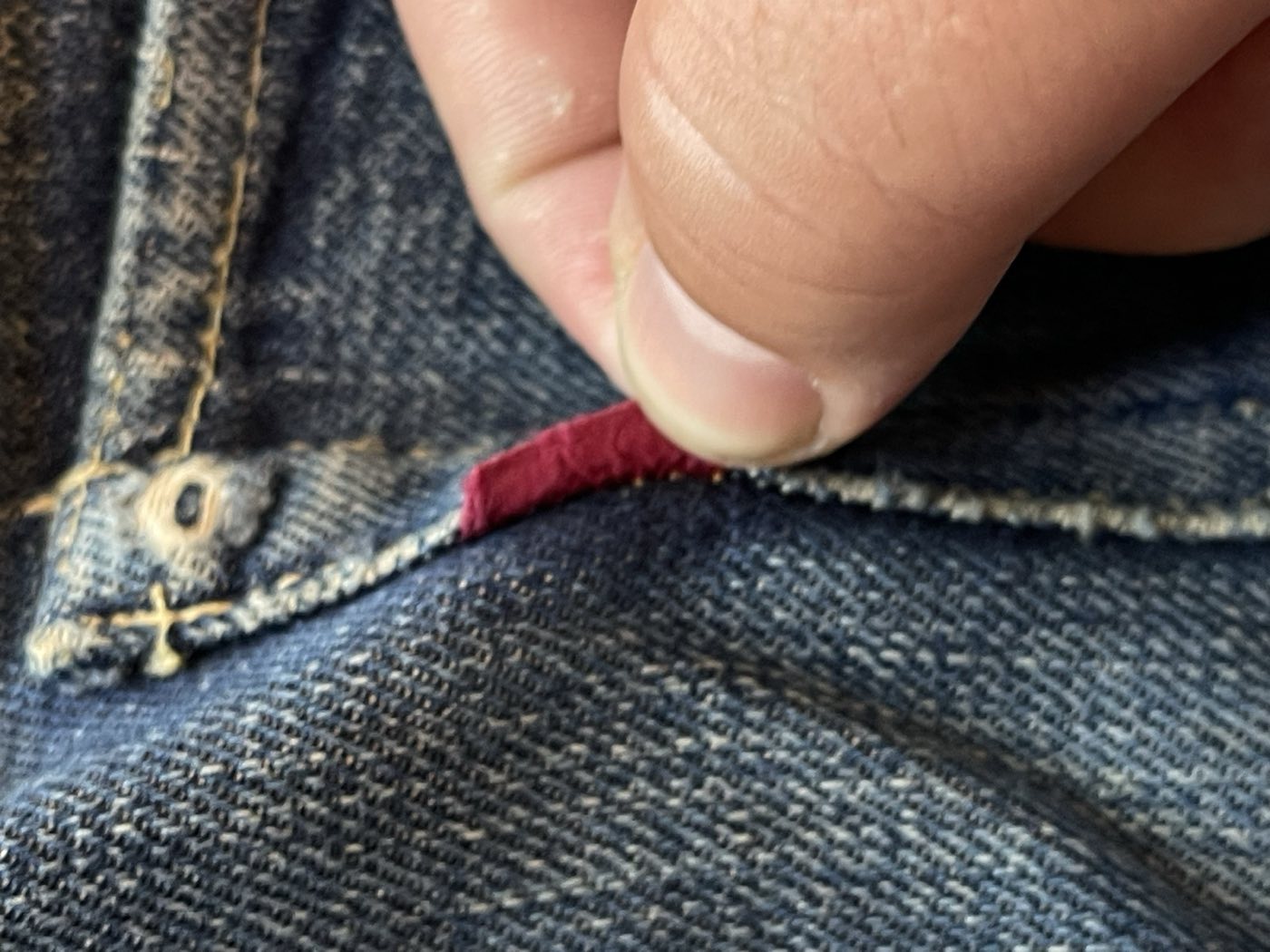
Where is the tab on jeans, jackets, and shirts?
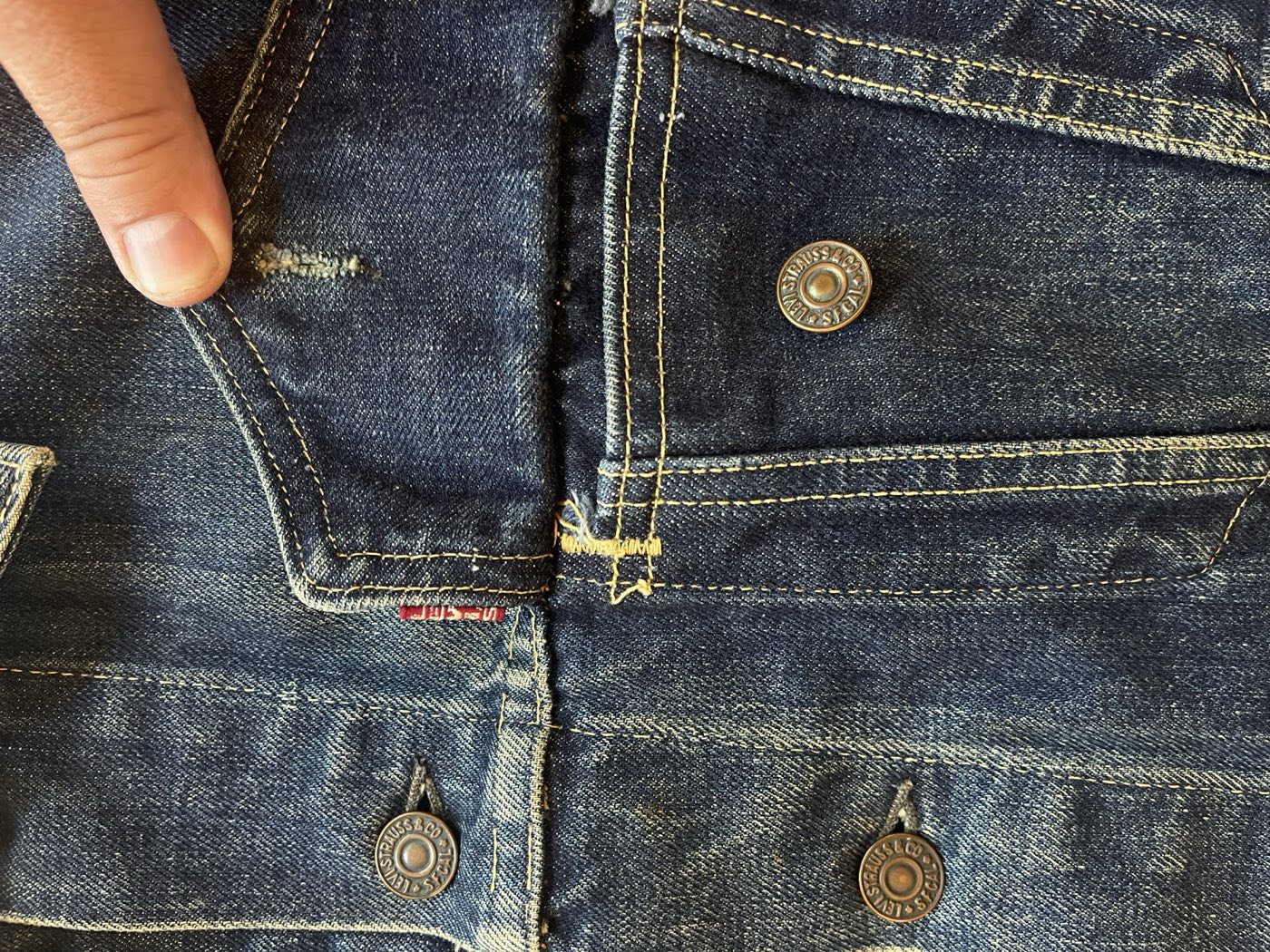
On jeans the tab sits in the seam of the right back pocket, on the side nearest the center of the pants, where it has been since 1936. On denim jackets it sits on the left chest pocket, in the seam at the pocket edge, on Type 1, Type 2, and Type 3 jackets alike: the wearer’s left, your right when the jacket is laid out facing you. Levi’s shirts carry a tab on the chest pocket too, and the rule is the same on every garment: capitals before 1971, lowercase after. The big E shirt market is much smaller than jeans and jackets, but a 1960s western shirt with a capital E is still worth photographing before it goes in a donation bag.
Is a big E on an orange tab the same thing?
No, and this is the most common misunderstanding we see in photos. Levi’s introduced the orange tab in 1969 for its fashion fits, the bell-bottoms, boot cuts, and slimmer jeans aimed at younger buyers, and by Levi Strauss and Co’s own account made orange tab garments until 1999 before reviving the line in 2017. Because the orange tab arrived two years before the lettering change, orange tabs made from 1969 to 1971 read LEVI’S in capitals. They are genuine big E tabs from the 1960s. What they are not is a 501, and by every collector guide we have read they sell into a generally smaller market than the red tab 501s and jackets of the same years. The right cut in the right size is often worth a few hundred dollars; it is not the $500-and-up bracket the red tab carries. Name the tab color first when you text a photo.
Can a new pair of Levi’s have a big E?
Yes, in three ways. First, Levi’s Vintage Clothing, the company’s own reproduction line, remakes the old 501s and jackets with big E tabs, leather patches, hidden rivets, and cinch backs, because accuracy is the point. Second, since 2018 Levi’s has put a capital E tab on some premium modern products. Third, about one tab in ten on a modern garment is left blank with only the registered mark, which Levi’s says protects the trademark; a blank tab confuses people the other way, because it looks as though something has worn off.
The tells are the same in every case. A real big E was made before 1971 and has no care tag; a reproduction or a premium modern pair has one, often barcoded, with a country of origin outside the United States. Turn over the top button: original pre-1971 buttons carry no number or one or two digits, while reproductions and later pairs carry three, and 555, the Valencia Street plant that made the early reproductions, is the stamp collectors know. The reproduction guide walks the two garments side by side. A capital E with a care tag is not a vintage big E, and the two markets do not overlap.
- Care tag present: reproduction, premium, or post-1971. A genuine big E has none.
- Three-digit number on the back of the top button: later production or a reproduction. Originals carry none, one, or two digits.
- Blank red tab with only the registered mark: a modern pair, not a worn-off vintage one. Levi’s makes them on purpose.
- Orange tab in capitals: genuine 1969 to 1971, a fashion fit, a different market from the red tab 501.
- Capital E, no care tag, hidden rivets, single-digit button: the real thing, worth a proper read.
How much are big E Levi’s worth?
The honest answer is a wide bracket, because the capital E only opens the door. Inside it, the era, the garment, the size, and the condition do the pricing, and two pairs with identical tabs can differ by a factor of ten. The figures below are the ranges we quote as of August 2026, typical collector-market ranges rather than promises, with the top of each band belonging to large sizes in strong, unwashed condition. The 501 value guide and the jacket value guide carry the by-era tables; this one is organized by what the tab says.
| Tab | Era | What it tells you | Typical range, as of August 2026 |
|---|---|---|---|
| No red tab, buckle on the back | Before 1936 | Pre-tab Levi’s, the rarest bracket | Read individually; the top of the market |
| One-sided big E, red tab | 1936 to the early 1950s | Earliest tab era; buckle-backs before 1942, hidden rivets to 1966 | 501s from $500 to $10,000 and beyond, the older the higher; Type 1 jackets $2,000 to $8,000 worn |
| Two-sided big E, red tab | About 1953 to 1971 | Late big E era; hidden rivets through 1966 sit at the higher end | 501s can bring $500 or more; Type 2 jackets $800 to $1,500; Type 3 truckers $150 to $2,000 and beyond |
| Big E, orange tab | 1969 to 1971 | Fashion fits, genuine 1960s, a smaller market | Often a few hundred dollars for the right cut; not the 501 bracket |
| Small e, red tab, redline selvedge | 1971 to the mid-1980s | Post-big E, still shuttle-loom denim | $200 to $1,000 |
| Small e, red tab, care tag, Made in USA | 1980s to 1990s | Good wearable vintage, not a collector object | $40 to $150 |
| Big E with a care tag | 2018 onward, or a reproduction | Premium modern Levi’s or Levi’s Vintage Clothing | Priced as used modern clothing, not as vintage |
What are big E jeans worth?
A pre-1971 big E 501 can bring $500 or more, and the bracket runs to $10,000 and beyond as the pair gets older, larger, and more original. The signals that move a pair up the band sit beside the tab: hidden rivets under the back pockets, used through 1966, put a pair at the higher end; a one-sided tab pushes it earlier; and a back cinch and buckle, which means before 1942, puts the pair at the top of the market, where it should be read in person rather than priced from a chart. Honest wear is priced in on early pairs because scarcity does most of the work. What costs money is intervention: a wash, a hem, a patch sewn on by a well-meaning relative.
What is a big E jacket worth?
Jackets sort by type before they sort by tab. A big E Type 3 trucker, the pointed-flap jacket made from 1962 to 1971, typically brings $150 to $2,000 and beyond, with size and condition deciding where it lands. A Type 2, the two-pocket jacket with side waist tabs from 1953 to 1962, typically brings $800 to $1,500. A Type 1, the one-pocket, cinch-back jacket made through 1952, brings $2,000 to $8,000 worn, and exceptional early examples run far above that: we paid $12,000 in cash, the same day, for a 1940s Type 1 from a former dealer who knew exactly what he had. The jacket types guide shows how to tell the three apart in ten seconds.
What should I not do with a big E pair before selling?
- Do not wash it. Original, unwashed condition is what collectors pay for, and one wash flattens the fades and the value with them.
- Do not trade it in. Checked against Levi’s published trade-in values in August 2026, jeans made more than twenty years ago earn $30 at Levi’s SecondHand, paid as a gift card rather than cash, whatever the pair is, and the trade cannot be undone.
- Do not sell it inside a bundle. A big E pair priced by the pound in a box of old clothes is how real pairs leave houses for nothing.
- Do not repair it. A period repair is part of the pair; an iron-on patch is damage on top of damage.
- Do not guess the year from the tab alone. A two-sided big E covers eighteen years and a wide price band. The dating guide stacks the other signals.
How do I get a big E pair read and sold?
Photograph the tab, the back of the top button, the patch, the inside of the back pockets, and the whole garment front and back, in daylight. The identification guide walks the five checks in order, and the Levi’s identifier turns those photos into an answer. Then call or text California Vintage Buyers at (949) 449-1255 rather than a generalist pricing the risk of what they cannot read. We buy vintage Levi’s from every state by video call: we agree a price on the call, pay by PayPal before you ship, and cover the shipping. In Southern California we also do free house calls and pay cash the same visit. Sometimes the honest answer is that your pair is a $60 pair. When it is a $6,000 pair, you will know exactly why.
Common questions
- Is a big E on an orange tab worth as much as a big E on a red tab?
- No. Levi’s introduced the orange tab in 1969 for its fashion fits, the bell-bottoms, boot cuts, and slimmer jeans, and kept it until 1999. Orange tabs made from 1969 to 1971 read LEVI’S in capitals, so they are genuine big E tabs from the 1960s, but they are not 501s and they sell into a smaller market. The right cut in the right size often brings a few hundred dollars; the red tab 501 bracket, $500 and up as of August 2026, belongs to the red tab.
- What does a blank red tab with only the registered mark mean?
- It means a modern pair, not a vintage one with the letters worn off. Levi Strauss and Co says about one tab in ten on its current garments is made blank on purpose, carrying only the registered trademark symbol, to protect the tab as a trademark. Its Vintage Clothing reproductions are the exception and always carry the name. A blank tab plus a care tag is an ordinary modern pair of Levi’s and is priced as used clothing.
- My tab says LEVI’S in capitals but the jeans have a care tag. Are they big E?
- Not in the collector sense. A genuine big E was made before 1971, the year the lettering changed and the year care tags became standard, so a capital E with a care tag is either a Levi’s Vintage Clothing reproduction or one of the premium modern products Levi’s has marked with a capital E since 2018. Check the back of the top button as well: originals carry none, one, or two digits, and reproductions and later pairs carry three. Both are good jeans. Neither is a vintage big E.
- Where is the big E tab on a Levi’s jacket?
- On the left chest pocket, in the seam at the edge of the pocket, which puts it on the wearer’s left and on your right when the jacket is laid out facing you. It sits there on Type 1, Type 2, and Type 3 jackets alike. On jeans the tab is in the seam of the right back pocket. On shirts it is on the chest pocket. The capital letter rule is the same on every garment: LEVI’S in capitals before 1971, Levi’s with a lowercase e after.
- Does a one-sided big E tab make Levi’s worth more?
- Usually, because it makes them older. From 1936 into the early 1950s the lettering was on one side of the tab only, with the back plain red; from about 1953 Levi’s produced tabs lettered on both sides. A one-sided tab therefore places a pair or jacket in the same era as buckle-backs, hidden rivets, and one-pocket jackets, the highest bracket of the big E market as of August 2026. Fold the tab back gently and photograph the reverse; a frayed one-sided tab still outranks a crisp two-sided one.
- Are big E jackets worth more than big E jeans?
- It depends on the garment more than the tab. As of August 2026, a big E Type 3 trucker typically brings $150 to $2,000 and beyond, a Type 2 $800 to $1,500, and a worn Type 1 $2,000 to $8,000, while a big E 501 can bring $500 or more and runs to $10,000 and beyond for the oldest pairs. A 1940s one-pocket jacket outranks most jeans; a 1960s trucker usually does not outrank a 1950s pair of 501s. Photograph both and have them read together.
Have something like this?
One phone call, from any state. A free video appraisal, the price agreed on the call, and payment through PayPal before you ship, with shipping on us. In Southern California we come to you and pay cash the same day.
Keep reading
- Where to Sell Vintage Levi’s From Anywhere in the US (2026)→
- How to Photograph Vintage Levi’s for an Accurate Offer→
- Sell vintage Levi’s to people who know what they’re holding.→
- Levi’s Tab Colors: What Orange, Silver, White, Black, and Blank Tabs Mean→
- Made in USA Levi’s: What 1980s and 1990s American-Made Levi’s Are Worth→
- Are Old Levi’s 501s Worth Anything? Real 2026 Prices→
- What Is a Vintage Levi’s Jacket Worth in 2026?→
- Is My Levi’s Jacket or 501 an Original or a Levi’s Vintage Clothing Reproduction?→
- Sell vintage clothing in Orange County.→