Sell to Us · Vintage Levi’s · Texas
Sell old Levi’s from anywhere in Texas, paid before you ship.
Free video appraisal · paid before you ship · no obligation
From El Paso to Beaumont and from the Panhandle to the Valley, California Vintage Buyers buys old Levi’s jeans and jackets from Texas by photos and video call. Text photos to (949) 449-1255 for a free appraisal; we agree the price on the call, pay through PayPal before you ship, and pay the shipping. For a big collection we come to you. We paid $12,000 cash for a 1940s Type 1 jacket.
Texas did not just wear Levi’s. It made them. In the 1990s El Paso was reported to be the company’s largest production center, with more than 6,000 of its 18,000 American manufacturing workers, and Levi’s ran plants in San Antonio, McAllen, Harlingen, Brownsville, San Benito, Wichita Falls and Amarillo, where the local plant supplied the jeans for the 47-foot Tex Randall cowboy in Canyon in the late 1950s. When Levi’s stopped sewing in America, Texas was where it stopped: its last two US plants, both in San Antonio, closed at the end of 2003.
Texas wore them hard, too. Spindletop came in near Beaumont in January 1901. The East Texas field opened with the Daisy Bradford No. 3 in October 1930 and grew to some 30,000 wells across five counties. Camp Hood opened in 1942 and at times had as many as 100,000 soldiers training at once, and about 90,000 candidates for flying training passed through the San Antonio preflight school before it closed in 1944. Oil field, ranch and service closets from those decades are the kind that hold the denim collectors pay serious money for.
What Texas closets tend to hold
Type 1 jackets and the Lot 213
One chest pocket, pleats down the front, a buckle strap across the lower back. The Type 1 is the most wanted Levi’s jacket, and the 1920s Lot 213 was its cheaper cousin. We paid $12,000 for a 1940s Type 1, and an original 213 is a rarity we want to see.
Text us a photo Send us a photoType 2 and big E Type 3 jackets
Two pleated pockets and side adjuster tabs on the 1950s Type 2; pointed flaps and V seams on the Type 3, with a capital E on the red tab through 1971. Blanket-lined winter versions too.
Text us a photo Send us a photoBig E 501s and earlier
A capital E on the red tab means 1971 or earlier, and pre-1970 big E pairs can bring $500 or more, well into four figures for the right one.
Text us a photo Send us a photoBuckle-back work jeans
The back cinch came off Levi’s jeans around 1942 under wartime rules, so a buckle on the back of a pair means pre-war. Worn, patched and oil-stained is fine.
Text us a photo Send us a photoWWII and service denim
Wartime Levi’s with plain donut buttons, and the service clothing that came home from Camp Hood, the San Antonio fields and every Texas base. We buy the uniforms and patches as well.
Text us a photo Send us a photoOld western and work shirts
Levi’s denim western shirts from the 1940s to 1960s, plus old Lee and Wrangler denim and heavy workwear of any label. Brands aside, if the tag looks old, it is worth a photo.
Text us a photo Send us a photoHumid Houston closet or dry Panhandle barn, send photos first
Texas is two climates for old cotton. Humid Gulf Coast and East Texas storage can mildew it; dry West Texas air is gentler on denim, though attics and barns still swing hot and dry. Either way, do not wash it, do not repair it, and do not cut anything off, because original condition is what collectors pay for. Lay the piece out, photograph the front, the back, the red tab, the patch, every inside label and the back of one button, and text them to (949) 449-1255. A real buyer answers the same day. If it is a piece we buy, we look together on a ten minute video call, agree the price while you hold it, and send payment through PayPal before anything is packed. Shipping is on us from any post office in the state, and for a big collection we travel.
What the label says about your Texas Levi’s
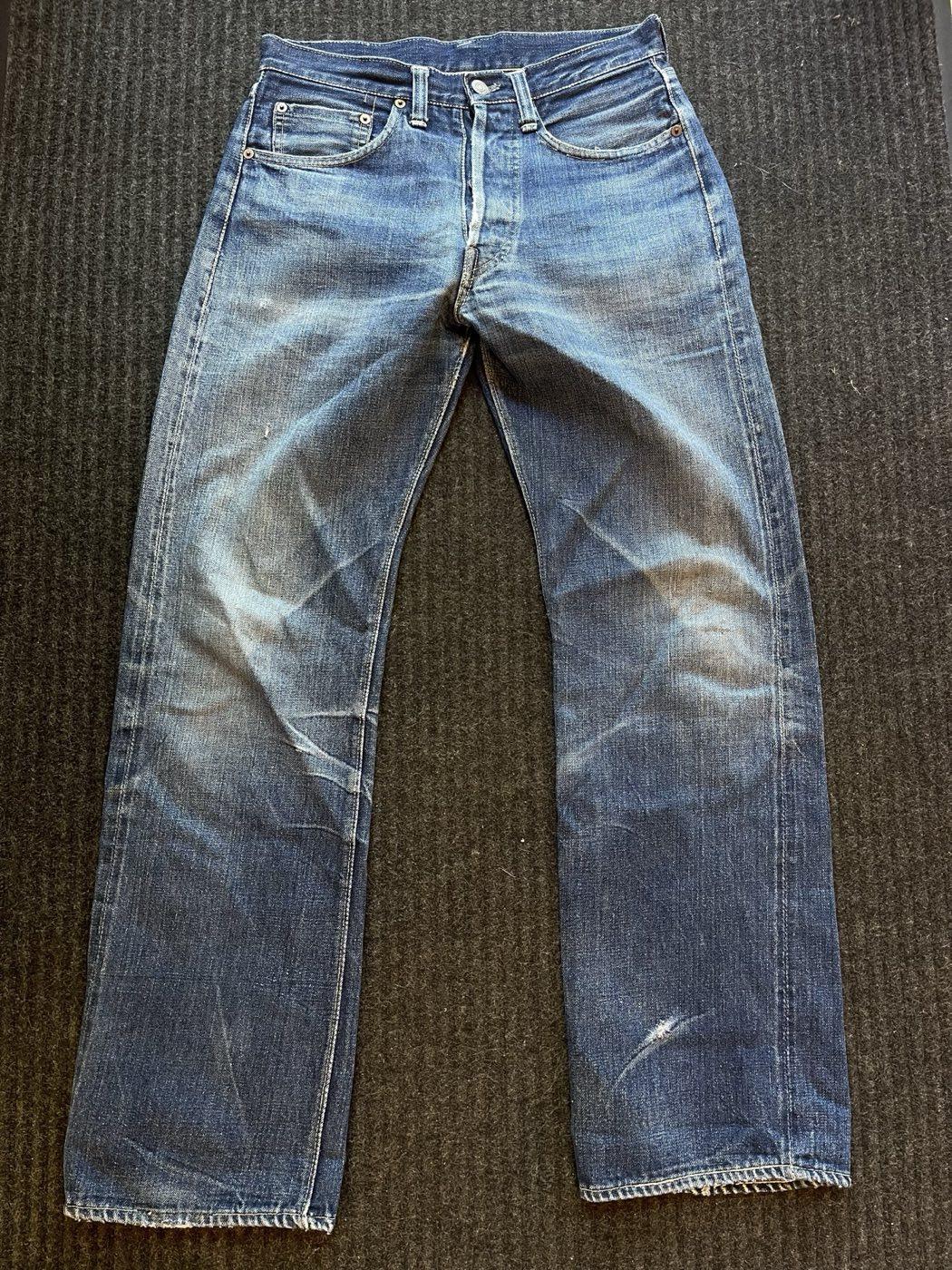
Many Texas families have Levi’s that may well have been sewn in Texas. The age, not the plant, decides the price, and the tag and tab tell you the age.
| What you see | What it means | What they bring |
|---|---|---|
| Capital E on the red tab, no care label | 1971 or earlier | Pre-1970 big E 501s $500 to $10,000 and beyond; a documented 1960s pair brought $2,040 |
| A buckle strap on the back of jeans | Pre-war, before about 1942 | Strong demand even worn; read one at a time |
| One chest pocket and pleats on a jacket | A Type 1, 1905 to 1953, or the 1920s Lot 213 | Type 1s typically $2,000 to $8,000 worn (July 2026); originals of the 213 are priced one at a time |
| Lowercase e and a red line inside the outseam | 1970s to the mid 1980s redline | $200 to $1,000 |
| Made in USA care tag, lowercase e | 1980s to 2003, the last American years | $40 to $150 worn; $299 to $899 never worn with the paper tags (September 2026) |
| No Made in USA line | 2004 or newer | Little collector value |
Ranges from CVB research verified July to October 2026 (eBay sales and listings, Levi Strauss and Co, Heddels, CVB purchases). Texas plant history: Christian Science Monitor (1999), CBS News (2002), NPR (2004), Levi Strauss and Co.
A Recent Find
A 1940s Levi’s Type 1 jacket, sold to us by a former dealer who knew exactly what he had. We paid $12,000 in cash, the same day.
From the Shop
Are My Old Levi's Worth Anything? Read the Patch, Care Tag, Selvedge and Big E
Read the transcript
Hi guys, Sam here with California Vintage Buyers, and I want to help clear the air and give you a little bit of information on how do you know if your old Levi's you're looking at are worth the time to try to sell them or bound for Salvation Army and just get them out of here. There's not really value there. This is not an exhaustive list of things to look for, but it's just some key distinguishing factors, right? So I have a few pairs of pants in front of me and different eras. So we're going to go over with the newer ones, right? Here we have a pair of the year 2000 pants. How do I know that these are from the year 2000? Well, because if you see that dark 501XX right there, that style of lettering is from the 90s to the early 2000s. It's different than this stuff. Do you see the difference of that one right there? You can see the difference. We'll get to these in a minute. But if you see that block lettering on your pants, you're looking at 90s up to say 2004 or something like that. Another tell. Let's just say you don't have this patch here. You wore the belt a lot. He wore the belt. She wore the belt a lot. The patch is gone. How old are my pants? With these ones, you can also pop this guy out right here. And you have, see that number right there? 1000. It's actually not the number 1000. It's 10, 00, October the year 2000. So whatever number you're looking at right there on the tag, if it has this tag on the inside leg, look at that number and you're going to see probably 0497 or what have you. It's going to be month and year. Good to know. So if that's gone, check if it has one of those. If it doesn't have one of these, then you're looking at somewhere in the 80s, right? Or potentially older. So I have a pair of 80s here. Anything made in USA is going to say on this tag, made in USA, right? So see that right there? Made in USA. Made in USA. What does these not have? These don't have made in USA. See how that part's missing? Made in Guatemala in the 2000s. They outsourced all the manufacturing. Bummer. So still good pants. We'll still buy these if the wash is cool. But the collector factor is not there. So again, if you got a pile of 100 of these guys, we'll still buy them. Give us a call. Are you kidding me? But when it comes to like Levi's, it's the details that matter. So moving forward. Oh, another thing is the distinguishing factor. See how it's red, the 501. And this one's black. You see in red, you're seeing 80s. Right? So you're looking at made in USA. Got the little red 501. That was an 80s thing. Right? So that's a couple things. Then you go over to these guys. Now, this is also 80s, but these are early 80s. What's the distinguishing factor on these guys? Flip up the pant leg. Do you see that? That's called selvedge denim. They call them redlines. These are called redlines. Right? Anything 501, 1982, 83-ish, right around there, and previous is going to have this kind of thing. This makes the value go up a little bit higher. Right? Why do they call these redlines you're asking? Great question. Well, when they were brand new, like these puppies from the 70s, which are a fantastic sample, they had a red line. Then, selvedge denim. So what does selvedge denim mean? It means the pant leg was made out of one sheet of denim, and they slapped them together. That's the end of a sheet of denim. They put them together, and they sewed the pant leg. And so this is made out of one sheet, a little more collectible. These are redlines. These are redlines. If you see that, you're looking at redlines. Even if you don't see any red, you got a pair of redlines. Right? We'll buy all these guys. Now, if you see one of these things that has a capital E right there, it's even better. Right? If you're looking at dealing with a barn, a ranch, Uncle Bob's house, and you're clearing it out, and you found him in the attic or in the bottom of his closet or something, we're great buyers for all this stuff. And we've paid up to thousands before for certain types of Levi's. There's a collectible value. It all depends on what the details are. You know? It's like if you call the car dealership, and you're like, hey, what do y'all pay for cars? They're going to say, okay, well, yes, we buy cars. What's the make? Model? Mileage? How's the condition? All the things. Give us a call. Number is 949-449-1255. We'd love to help you discern what you got, make your sweet offer, and buy all that stuff and more.
How it works
Text us photos.
Send shots of the piece, the tags, and the buttons to (949) 449-1255. A real buyer answers the same day.
Video call, price agreed.
Ten minutes on FaceTime or whatever you already use. We agree the number while the piece is in your hands.
Paid before you ship.
The PayPal payment lands before you pack a box. Then we handle the shipping label, and shipping is on us.
Common questions
Where can I sell vintage Levi’s in Texas?
For ordinary modern pairs, a local resale or vintage shop is fine. For old Levi’s, meaning big E pairs, buckle-backs, and Type 1, 2 and 3 jackets, the buyers are a national collector market, and California Vintage Buyers buys from anywhere in Texas: text photos to (949) 449-1255, agree the price on a free video call, and get paid through PayPal before you ship, with shipping on us. For a big collection we come to you.
Who buys old Levi’s jackets in Texas?
We do, from every corner of the state: the one-pocket Type 1, the Lot 213, the two-pocket Type 2, big E Type 3 truckers and blanket-lined jackets. Text photos of the front, back, patch, red tab, inside labels and a button back to (949) 449-1255 and a real buyer answers the same day. We paid $12,000 cash for a 1940s Type 1.
My Levi’s say Made in USA. Were they made in Texas, and are they worth anything?
Possibly, since Levi’s sewed jeans in El Paso, San Antonio, the Valley and elsewhere in Texas until its last American plants closed at the end of 2003, but the label does not name the city and we will not guess one. What sets the price is age. A worn 1980s or 1990s Made in USA pair usually brings $40 to $150, and never-worn pairs with paper tags more. The serious money is in pairs from 1971 and earlier, with a capital E on the red tab and no care label.
My father worked the oil field (or the ranch). Are his old work jeans worth anything?
They may be, and stains, patches and hard wear do not rule them out. Look for a capital E on the red tab, a buckle strap on the back, or a jacket with one chest pocket and pleats. Do not wash them or throw out a pair because it looks worn through; some of the most valuable denim ever sold looks like it should have been thrown away twice. Text photos to (949) 449-1255 before anything goes to a donation bag.
Do you come to Texas?
For a big collection, or pieces that deserve a look in person, yes, we travel. For a box, a few pairs or a single jacket, the video call is faster and safer for you: we agree the price while you hold the piece, pay before you ship, and send the shipping label.
What about my grandfather’s uniform or service jacket from a Texas base?
We buy those too. Service clothing, insignia and patches from World War II and later come home in Texas closets from Camp Hood, the San Antonio fields and every other base, and they deserve a careful look before they are donated. Text photos of the whole piece, any tags, and the patches to (949) 449-1255.
How do I get paid, and is it safe to ship?
We agree the price on the video call, then the money lands in your PayPal before you pack anything. We send the shipping label, so shipping costs you nothing, and you never send a piece to us on trust.
Know what it’s worth before you sell.
Our field guides explain how the market actually prices these things. No fishing, no hype: real ranges and the details that move them.
One call. We’ll take it
from there.
(949) 449-12555.0 on Google · Free video appraisal · Paid before you ship, shipping on us
Mon-Sat 6 am-8 pm · Sun 8 am-5 pm
A real person answers seven days a week, weekends included. Photos sent today are usually answered the same day.
Or send your photos online Photos on your phone? Text them to (949) 449-1255
Also from California Vintage Buyers
- Sell your old Levi’s jacket from any state, paid before you ship.→
- Sell vintage Levi’s to people who know what they’re holding.→
- Sell your Levi’s 501XX jeans from any state, paid before you ship.→
- Sell your big E Levi’s from any state, paid before you ship.→
- Clearing out the family farm or ranch? Call us before the old work clothes go.→
- Sell western wear to buyers who live and breathe it.→
- Grandpa’s uniform deserves a real answer, not a donation bin.→
- Sell vintage Carhartt to people who know what a union label means.→