Field Guide
Made in USA Levi’s: What 1980s and 1990s American-Made Levi’s Are Worth
The pair most people find is not a big E. It is a small e 501 with a Made in USA label from the 1980s or 1990s, and it has a real market of its own, smaller than the collector tier and larger than most people expect.
Think you have one? A real person reads your photos, usually the same day.
By Sam Wingenbach and Jake Cover, the buyers who make our house calls · Updated October 13, 2026
The short answer: yes, Made in USA Levi’s are worth money, mostly tens of dollars and sometimes hundreds. Worn 1980s and 1990s Made in USA 501s sold for about $40 to $150 on eBay between June and early September 2026, with the best worn pair at $176. Pairs that were never worn and still carry the original paper tags sold for about $299 to $899 in the same window. A red line in the cuff seam, which Levi’s used to the mid-1980s, moves a pair into the $200 to $1,000 range. Levi’s closed its last American plants at the end of 2003, so a vintage Made in USA label means before 2004. Free reads at (949) 449-1255.
Collectors talk mostly about the big E years before 1971, and that guide covers them. But the jeans that actually turn up in closets, garages, and estate cleanouts are usually later: small e 501s, 505s, 550s, orange tab boot cuts, and Silver Tab baggies sewn in Levi’s American plants in the 1980s and 1990s. These are not trophies, and they are not ordinary used jeans either. They are the entry level of the vintage market, and vintage buyers want them for the fit and the way they fade. Here is what they bring, how to tell a real late American pair from a modern one, and the mistakes that cost sellers money.
What are Made in USA Levi’s worth?
| What you have | How to recognize it | Typical range, with the date it was read |
|---|---|---|
| Worn small e 501, 1980s to 1990s | Red tab with a small e, Made in USA on the care label, no red line in the cuff seam | $40 to $150, best worn pair $176, eBay sales June to early September 2026 |
| Deadstock 501, 1980s to 1990s | Never worn, original paper flasher tags still attached | $299 to $899, eBay sales June to early September 2026, most on accepted offers |
| Redline selvedge 501, 1970s to mid-1980s | A red and white line along the finished edge inside the outseam, visible when the cuff is turned | Most pairs $200 to $1,000, eBay sales June to early September 2026 |
| Orange tab, 1970s to 1990s | Orange tab on a boot cut, flare, or slim fit | 1970s 646 bell-bottoms about $70 to $105 in marketplace listings read October 2026 |
| Silver Tab, 1988 to the early 2000s | Silver tab on a baggy or loose fit | Worn 1990s pairs about $25 to $105 in marketplace listings read October 2026 |
| Trucker jacket, 1980s to 1990s | Small e jacket, often style 70506, Made in USA on the label | Sells as good used vintage; no dated figure on record, so we read each one |
| Any of the above, traded in at Levi’s | Levi’s SecondHand program | $30 in store credit for jeans more than twenty years old, checked August 2026 |
A note on those figures. The 501 and redline ranges come from eBay sold results we read sale by sale in September 2026; accepted offers can close below the listed price, so read the top of each range as a ceiling. The orange and Silver Tab ranges are marketplace listings read in October 2026, a mix of asking and sold prices. We do not quote a jacket figure because we have not been able to read enough dated sales to stand behind one.
When did Levi’s stop making jeans in the USA?
At the end of 2003. Levi Strauss and Co announced in September 2003 that it would close its last two American plants, in San Antonio, Texas, by the end of the year. Sewing stopped around Thanksgiving 2003, the finishing work stopped the following month, and the closing was formally reported in January 2004, ending about 150 years of Levi’s made in the United States. Imported production had been growing through the 1980s and 1990s, so the share of Made in USA pairs shrinks the later you go. A vintage Made in USA label therefore puts a pair before 2004.
There are two exceptions worth knowing, because both say Made in USA and neither is vintage. The first is Levi’s Vintage Clothing, the reproduction line, whose early runs from about 1998 were sewn at the Valencia Street plant in San Francisco and carry the 555 button stamp. The second is the modern premium Made in USA line of the 2010s, sewn from White Oak selvedge denim. Both are covered in the reproduction guide, and both carry modern care labels that give them away.
How do I tell what year my Made in USA Levi’s are?
Read the small printed care label inside the waistband or side seam. Levi’s added care labels in 1971, and through the 1970s and 1980s the label ends in a short code: one digit for the month, one digit for the year, and a factory number. That year digit is only the last digit, so a 7 can mean 1977 or 1987, and construction settles the decade: a red line in the cuff seam points to the 1970s or early 1980s, no red line points to the later 1980s or 1990s. From 1993 the label prints the month and year in full, so a 1990s pair often dates itself. The date codes guide walks through it with examples.
- The care label says Made in USA and has no barcode. That fits the American decades; a modern barcoded label is a later pair.
- The number on the back of the top button should match the factory number on the care label. A mismatch can mean a replaced button or a fake. Collectors read these codes, but published lists of which number is which plant conflict, so treat them as a cross-check, not a lookup.
- A 555 button stamp means the Valencia Street plant in San Francisco, which ran from 1906 to 2002. On a genuine 1980s or 1990s 501 it is a small collector bonus; on its own it does not prove age, because the early reproductions were sewn there too.
- The tab. A small e red tab is the core line after 1971; an orange tab marks a fashion fit; a Silver Tab dates from 1988 on. The tab colors guide explains each one.
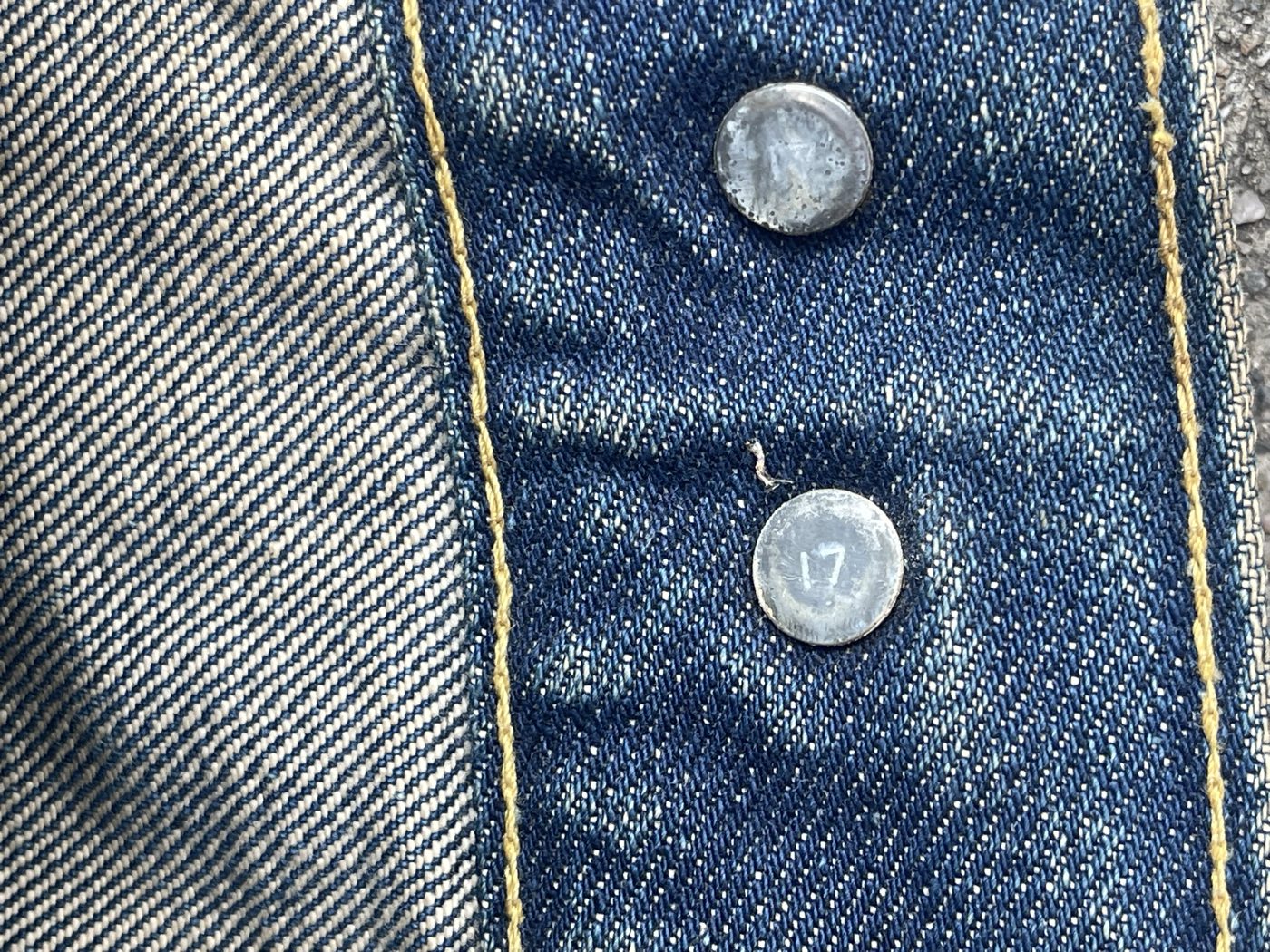
- The cuff seam. Turn up a leg. A red and white line along the edge is redline selvedge, which Levi’s used on 501s until about the mid-1980s, and it is the single detail most worth checking.
Are 1990s Levi’s worth anything?
Yes, if they are Made in USA and in a size and condition people want. A worn 1990s 501 typically sells in the $40 to $150 range on the June to September 2026 numbers, with larger sizes, original hems, and honest even fading at the top. Silver Tab baggies from the 1990s sit a little lower, about $25 to $105 in October 2026 listings, and they ride the current baggy trend. A 1990s pair that was never worn, with its paper tags still on, is a different object: those sold for $299 to $899 in the summer of 2026. What makes a 1990s pair hard to sell is damage that is not honest wear, such as stains, cut hems, or a missing care label.
Are Made in USA Levi’s worth more than imported ones?
Made in USA is the label vintage buyers search for, because it marks the American decades before 2004, and it is how the late-era sold results above are listed and found. An imported pair from the same years can still sell, but it is judged as a used pair of jeans first, on style, size, and condition. And the label cuts both ways: an early Levi’s Vintage Clothing reproduction can say Made in USA too, and used reproductions generally trade below their new price. Read the label as a strong signal, not a guarantee.
Should I wash or repair them before selling?
No. Fade patterns, original hems, and the wear on the knees and seat are what vintage buyers are paying for, and a hot wash, a tailor’s hem, or a patch job can take them away for good. Shake out dust, empty the pockets, let them dry if they are damp, and photograph them as they are. Holes and frayed cuffs are normal on worn pairs and are already in the price.
The mistakes that cost money
- Donating or dumping a stack of Made in USA 501s. A bag of them from a closet can add up to real money, and thrift buyers know it.
- Pricing every pair like a big E. A worn 1990s 501 is a good pair of vintage jeans, not a collector object, and holding out for a four-figure number usually means not selling at all.
- The opposite mistake: missing the red line. A small e pair with redline selvedge in the cuff is worth several times a plain 1990s pair, and it takes ten seconds to check.
- Cutting out the care label or removing the flasher tags. The label is the dating evidence, and the tags are most of a deadstock pair’s value.
- Trading vintage in for a gift card. Checked in August 2026, Levi’s SecondHand pays $30 in store credit for jeans more than twenty years old, whatever the pair is.
- Assuming Made in USA means old. Early reproductions and the 2010s premium line say it too; check for a modern barcoded label before you price a pair as vintage.
- Shipping to a mail-in buyer before you have a price in writing. Agree the number first, whoever you sell to.
Where can I sell Made in USA Levi’s?
You have real options. Selling a pair yourself on eBay, Poshmark, Depop, or Grailed usually brings the most per pair if you photograph it well and answer questions, after fees and shipping; the route comparison sets out each platform’s cut. Vintage shops and denim dealers pay less per pair but take a stack at once. Levi’s own trade-in is quick but pays in store credit. California Vintage Buyers buys Made in USA Levi’s from every state: we look at the pairs together on a free video call, agree the price on the call, and pay through PayPal before you ship, with shipping on us. In Southern California we come to you and pay cash the same visit. We will tell you plainly which pairs are worth selling on your own and which ones we want. Start with the photo guide or the Levi’s identifier, then call or text (949) 449-1255.
Common questions
- Are Made in USA Levi’s worth money?
- Yes, usually tens of dollars and sometimes hundreds. Worn 1980s and 1990s Made in USA 501s sold for about $40 to $150 on eBay between June and early September 2026, and never-worn pairs with their original paper tags sold for about $299 to $899. A red line in the cuff seam, used until about the mid-1980s, moves a pair into the $200 to $1,000 range.
- When did Levi’s stop making jeans in the USA?
- At the end of 2003. Levi Strauss and Co closed its last two American plants, in San Antonio, Texas, with sewing ending around Thanksgiving 2003 and the closing formally reported in January 2004. A vintage Made in USA label therefore means a pair made before 2004. Levi’s later made some premium styles in the US again, and those carry modern barcoded care labels.
- How can I tell what year my Made in USA Levi’s are?
- Read the small care label inside the pair. From 1971 through the 1980s it ends in a short code with the month, the last digit of the year, and a factory number, so a 7 can mean 1977 or 1987; a red line in the cuff seam points to the earlier decade. From 1993 the label prints the month and year in full, so most 1990s pairs date themselves.
- What are 1990s Levi’s 501s worth?
- A worn 1990s Made in USA 501 typically sold for $40 to $150 on eBay between June and early September 2026, with larger sizes, original hems, and even fading at the top. A never-worn 1990s pair with its paper tags still attached sold for $299 to $899 in the same window.
Have something like this?
One phone call and we come to you, anywhere in Southern California. Free visit, honest evaluation, cash the same day.
Keep reading
- Are Old Levi’s 501s Worth Anything? Real 2026 Prices→
- Levi’s Date Codes: How to Read the Care Tag, Button Stamps, and Lot Numbers→
- Levi’s Tab Colors: What Orange, Silver, White, Black, and Blank Tabs Mean→
- Is My Levi’s Jacket or 501 an Original or a Levi’s Vintage Clothing Reproduction?→
- Where to Sell Vintage Levi’s From Anywhere in the US (2026)→
- Sell vintage Levi’s to people who know what they’re holding.→