Our Services · Free Turquoise Read
A free turquoise jewelry appraisal, from someone who handles it every week.
Free visit · cash offers · no obligation
California Vintage Buyers gives free turquoise and Native American jewelry appraisals: a working read of what the stone is, who likely made the piece, what era it belongs to, and what the market actually pays, in person across Southern California or by photo and video call from anywhere in California. Usually the same day, no fee, no obligation. Call or text (949) 449-1255.
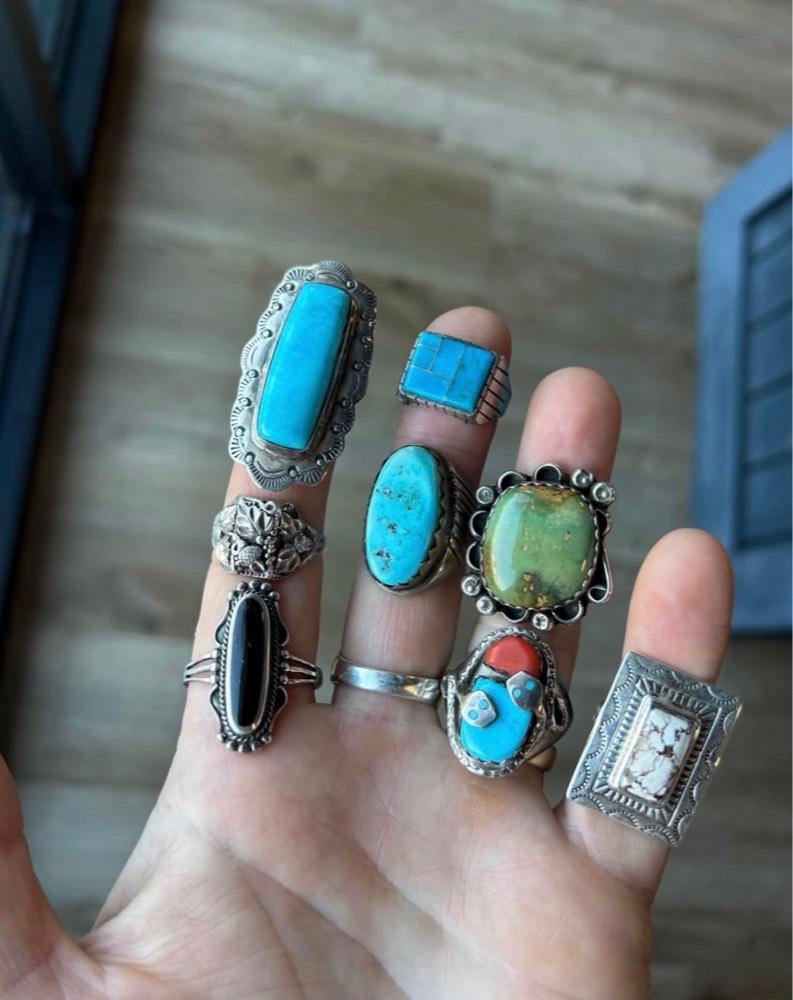
Most people searching for a turquoise appraisal are holding a piece they cannot read: a squash blossom from a parent’s dresser, a cuff bought on a 1970s road trip, a box of rings with marks too faint to make out. The questions are always the same. Is the stone real, is it natural or treated, is the piece Native made, who made it, and what is it worth. Those are exactly the questions a dealer answers before deciding anything, and we answer them for free.
The read is done by Sam Wingenbach, who grew up in Alaska and specializes in Native American and turquoise jewelry, alongside Jake Cover, the other half of the California Vintage Buyers team. We look at the stone, the silverwork, the hallmark and the construction together, because on finished jewelry those decide the value far more than the mine name ever does. You get the answer said plainly, including when the honest answer is that a piece is a tourist souvenir.
One distinction up front. This is a dealer’s working read, not a certified appraisal. If you need formal paperwork for insurance, probate or a legal matter, that is a licensed appraiser’s job and we will say so. For the far more common question, what is this and what would it bring, the free read is the answer most families actually need.
What the free read covers
Is it turquoise at all
Dyed howlite, magnesite, block and plastic all pass for turquoise at a glance. Weight, feel, and how the matrix sits in the stone separate them, and that check comes first.
Text us a photo Send us a photoNatural or stabilized
Trade sources put natural, untreated stone at under three percent of the market, and high grade natural can run around ten times the price per carat of stabilized. We say which yours reads as, and how sure the read is.
Text us a photo Send us a photoNavajo, Zuni, Hopi or Kewa
Heavy stampwork and single stones read Navajo; precise stone-forward cluster and needlepoint work reads Zuni; two-layer overlay reads Hopi; heishi and mosaic read Kewa. Tribe is read from the work, never assumed from the look.
Text us a photo Send us a photoThe hallmark, if any
Inside a cuff near the terminal, inside a ring shank, on the back of a bolo. Hallmarks were rare before about 1945, so an unsigned older piece is normal and a mark on a claimed 1920s piece is a question.
Text us a photo Send us a photoEra and provenance
Old pawn, Fred Harvey tourist era, mid-century, or contemporary, read from construction and wear. A pawn ticket dates the loan, not the piece, and we read it that way.
Text us a photo Send us a photoThe mine, honestly
No visual test proves which mine a stone came from, and GIA issues no mine-of-origin reports for turquoise. We will say consistent with a mine when the stone looks it, and we will never say it is.
Text us a photo Send us a photoIn person across Southern California, by video anywhere in California
Across Orange County, Los Angeles, San Diego, the Inland Empire and Ventura the read usually happens at your kitchen table on a free house call, or at our warehouse at 23011 Moulton Pkwy, Suite G-11, Laguna Hills, CA 92653, by appointment. From anywhere else in California, text photos of the front, the back and every mark to (949) 449-1255, or ask for a video call and we will look together. The appraisal stays free either way. If you decide to sell the jewelry, we know the reputable specialist buyers and will point you to the right one. The rugs, baskets, pottery and Southwestern paintings that so often sit in the same house are what we buy outright, and that offer comes the same visit.
What each answer in the read changes
The read is a sequence of questions, and each one moves the piece into a different conversation. All figures are dated and attributed.
| The question | What settles it | What it changes |
|---|---|---|
| Is it turquoise or an imitation? | Weight, feel, matrix, and a look at any drilled or chipped edge | Block, dyed howlite and plastic end the value conversation; real stone begins it |
| Natural or stabilized? | Depth of color, matrix behavior, wear pattern; trade sources put natural under three percent of the market | High grade natural can run around ten times stabilized per carat, a trade rule of thumb rather than a price for your piece |
| Who made it? | Hallmark, construction, stampwork, technique | The Hindman pair: unsigned Navajo cuff with a Bisbee stone $219 (2022), Loloma ring with a Bisbee stone $9,450 (2023), same house, about forty times apart |
| Which mine? | Paperwork only; no visual test proves origin | Consistent with is the honest ceiling; on finished jewelry the mine is close to a footnote |
| Which era? | Hallmark presence (rare before about 1945), silver type, construction, honest wear | Old pawn and early work read differently from 1970s boom pieces and from contemporary work |
| Certified or working read? | What you need the answer for | Insurance and probate want a licensed appraiser; deciding what to do with a drawer wants the free read |
Auction results per Hindman as recorded in growth/VINTAGE-NICHE-MAP.md section 3n; treatment shares per trade sources, section 3b.
Why It Matters
The difference between ordinary and valuable is in the details: a stitch, a hallmark, a date code. Knowing them is our entire job.
How it works
Call or text photos.
A real conversation about what you have, no pressure to sell.
We come to you.
We look at everything, at your pace. We know what we're seeing.
Cash offer, same visit.
A fair price on the spot, or a full estate sale run for you.
Common questions
How much does a turquoise jewelry appraisal cost?
Ours costs nothing. A certified written appraisal from a licensed appraiser, the kind an insurer or a probate court asks for, is typically billed by the hour or by the piece and produces formal paperwork. A dealer’s working read, which is what we give, answers the questions most people actually have: what the piece is, who likely made it, whether the stone is natural, and what it would bring. If your situation needs the certified route we will tell you so, and you owe us nothing for the conversation.
Why is my insurance appraisal so much higher than what anyone will pay?
Because it measures a different thing. An insurance appraisal states retail replacement cost, what it would take to have a comparable piece made or bought new from a gallery, and it is written high on purpose so a loss is fully covered. A market read states what a piece brings when it is sold, at auction or to a dealer, which is always lower. Both numbers are honest; they answer different questions. Bring the old appraisal anyway, because it often records the maker and the mine a family has since forgotten.
What should I photograph for a turquoise appraisal by text?
Five photos in daylight, no flash. The front of the piece laid flat. The back, where the hallmark and the construction live, with a close shot of any stamp even if it looks too faint to read. The stone up close, so the matrix and any surface pits show. The clasp, terminal or bolo tips. And one shot of the whole collection together if there is more than one piece, for scale. Do not clean or polish anything first; the patina and the wear are part of what we read.
Can you tell which mine my turquoise came from?
Not from looking, and neither can anyone else. Peer-reviewed provenance work has found even trace-element chemistry only partly successful, GIA does not issue mine-of-origin reports for turquoise, and the trade itself concedes that Kingman stone is routinely relabelled as rarer mines. What we can say is that a stone is consistent with a named mine, and what actually settles origin is paperwork: a dated receipt, an old pawn ticket, or a documented collection history. On finished jewelry the maker matters far more than the mine in any case.
Does the maker or the stone decide the value?
The maker, by a wide margin, on any finished piece. The clearest published example is a pair of results at one auction house: an unsigned Navajo cuff set with a Bisbee stone realized $219 in 2022, and a Charles Loloma ring set with a Bisbee stone realized $9,450 in 2023, about forty times apart with the same mine in both. Silverwork quality, period, condition and provenance follow the signature. The stone’s grade matters, but it moves a price within a bracket rather than choosing the bracket.
Is it worth appraising a whole collection at once?
Yes, and it is the better way to do it. A collection read together keeps sets intact, lets the signed pieces set the tone for the unsigned ones from the same hand, and turns a drawer of mixed rings into a short list of what matters. Do not sort out the pieces that look cheap before the read; the ones with the faint marks and the dark patina are often the ones we stop on. A house call handles a whole collection in one sitting, and a video call can do the same for a family out of state.
My turquoise piece was bought in the 1970s. Is that old enough to matter?
Often, yes. The 1970s were the biggest boom in Native American silver and turquoise jewelry, so a great deal of honest work from named makers dates from then, and stones from mines that have since stopped producing were still being set. Sleeping Beauty ended turquoise recovery in August 2012, for example, so every Sleeping Beauty stone is old stock now. A 1970s piece is read the same way as any other: maker, silverwork, stone, condition and paperwork, with the mine as a footnote.
Do you appraise turquoise jewelry that is not Native American?
Yes. Plenty of turquoise jewelry was made for the tourist trade, by overseas factories, or by non-Native studio jewelers, and the honest read says which is which. Under the Indian Arts and Crafts Act of 1990 it is illegal to sell non-Native work as Native made, so knowing what a piece is protects you as a seller as well as a buyer. A well-made non-Native piece with a good natural stone still has a market; a block turquoise souvenir usually does not, and we will say so plainly.
Know what it’s worth before you sell.
Our field guides explain how the market actually prices these things. No fishing, no hype: real ranges and the details that move them.
One call. We’ll take it
from there.
(949) 449-12555.0 on Google · Free visit, no obligation · Cash the same visit
Mon-Sat 6 am-8 pm · Sun 8 am-5 pm
A real person answers seven days a week, weekends included. Photos sent today are usually answered the same day.
Or send your photos online Photos on your phone? Text them to (949) 449-1255
Also from California Vintage Buyers
- How to tell Lone Mountain from Lander Blue, and either from a tourist piece.→
- How to tell what your Native American jewelry actually is.→
- A squash blossom necklace is worth far more than the silver in it.→
- A good concho belt is silver worth reading, not silver worth melting.→
- Old pawn is the good stuff, and the melt counter cannot see why.→
- A free, honest read on your vintage clothing. Usually the same day.→