Field Guide
Vintage Levi’s 505 Value: Big E, Redline, and Orange Tab 505s
The 505 is the zip-fly Levi’s, born in 1967. Most vintage pairs are worth tens of dollars, a 1970s redline pair a few hundred, and a big E 505 from the first four years about $500 and up. Here is how to tell which one you have.
Think you have one? A real person reads your photos, usually the same day.
By Sam Wingenbach and Jake Cover, the buyers who make our house calls · Updated October 27, 2026
Read the transcript
This Short has no spoken words, only music and on-screen text. What it shows: Turn up the cuff of old Levi's: that clean finished edge is selvedge, and on Levi's it carried a thin red line, which wear can fade to white without making it any less a redline. Levi's made 501s this way until about 1983 to 1984, and in eBay sales from June to early September 2026 most redline pairs sold for $200 to $1,000. Text a photo of the cuff to (949) 449-1255 for a free answer the same day. House calls across Southern California, buying nationwide.
The short answer: a vintage Levi’s 505 is worth anywhere from about $25 to $600, and the tab and the cuff seam tell you where. In listings read in October 2026, worn 1970s and 1980s Made in USA 505s without a red line ran about $25 to $150, 1970s redline selvedge 505s sold through dealers for about $200 to $350, and big E 505s from 1967 to 1971 sold or were priced at about $500 to $600. Those are marketplace and dealer prices, asking and sold mixed, not auction results. A 505 generally sells below a 501 of the same years. Free reads at (949) 449-1255.
The 505 is the Levi’s jean with a zipper instead of a button fly. Most vintage collecting talk is about the 501, so a 505 owner often hears either that their pair is worthless or that it is worth what a 501 is, and neither is right. The 505 has its own market: smaller than the 501’s, real at every age, and steepest in the first four years, when the tab still read LEVI’S in capitals. This guide covers what each era brings, how to date your pair, how to tell it from Levi’s modern reproduction, and the mistakes that cost sellers money.
What is a vintage Levi’s 505 worth?
| What you have | How to recognize it | Typical price, with the date it was read |
|---|---|---|
| Big E 505, 1967 to about 1971 | Red tab reading LEVI’S in capitals, zip fly, no care label, usually redline selvedge in the cuff seam | About $500 to $600 marked sold or priced by dealers, October 2026; asks run to $2,000 and higher |
| Redline 505, 1970s to early 1980s | Small e tab, care label, red and white line along the edge inside the outseam | About $200 to $350 at dealers, sold out, October 2026 |
| Worn 505, 1970s to 1980s, no red line | Red or orange tab, Made in USA on the care label, plain cuff seam | About $25 to $150 in marketplace listings, October 2026 |
| Orange tab 505 | Orange tab, often style 20505 on the care label | Inside the $25 to $150 band; one eBay pair sold for $34, read October 2026 |
| 1967 505 reproduction, new | Big E tab, selvedge, a Talon zipper, and a modern barcoded care label | $260 list at Levi’s, read October 2026; not vintage |
| Any of the above, traded in at Levi’s | Levi’s SecondHand program | $30 in store credit for jeans more than twenty years old, checked August 2026 |
A note on those figures. We could not read 505 sales one by one the way we read 501 sales in September 2026, so every 505 figure here comes from marketplace and dealer listings read in October 2026: some marked sold, some still asking. That is why the table gives ranges and labels asks as asks. A $2,000 or $3,500 asking price on a big E 505 is a hope, not a result. For comparison, wearable 1960s big E 501s sold for about $540 to $1,600 on eBay between June and September 2026, so a 505 of the same years generally sits below the 501.
When did Levi’s introduce the 505?
In 1967. Levi Strauss and Co dates the 505 to that year and ties it to the music scene of the 1970s, writing that it is the jean on the cover of the Rolling Stones’ Sticky Fingers in 1971 and the one all four Ramones wear on their 1976 debut album. It was a zip-fly cut with a lower rise than the 501, made from preshrunk denim so it fit off the shelf instead of shrinking to size. Levi’s calls it its first zip fly, but collectors point to a zip-fly 501 sold in the 1950s, so the fair description is that the 505 was Levi’s zip-fly answer to the 501, not the first zipper Levi’s ever sewed. The 505 also took over from the 551ZXX of 1961 to 1967; the zip-fly guide covers that pair and the 1950s 501ZXX.
What is the difference between a Levi’s 505 and a 501?
The fly and the fabric. The 501 has a button fly and, on vintage pairs, was traditionally sold to shrink to fit. The 505 has a zipper, a lower rise, a little more room in the thigh, and preshrunk denim, so it was bought in the size it would stay. Both carry the same red tab, arcuate stitching on the back pockets, and the same dating details. For value, the 501 is the collector’s jean and usually brings more at the same age and condition; the 505 is the wearer’s jean and is bought for fit and fade.
How do I tell what year my 505 is?
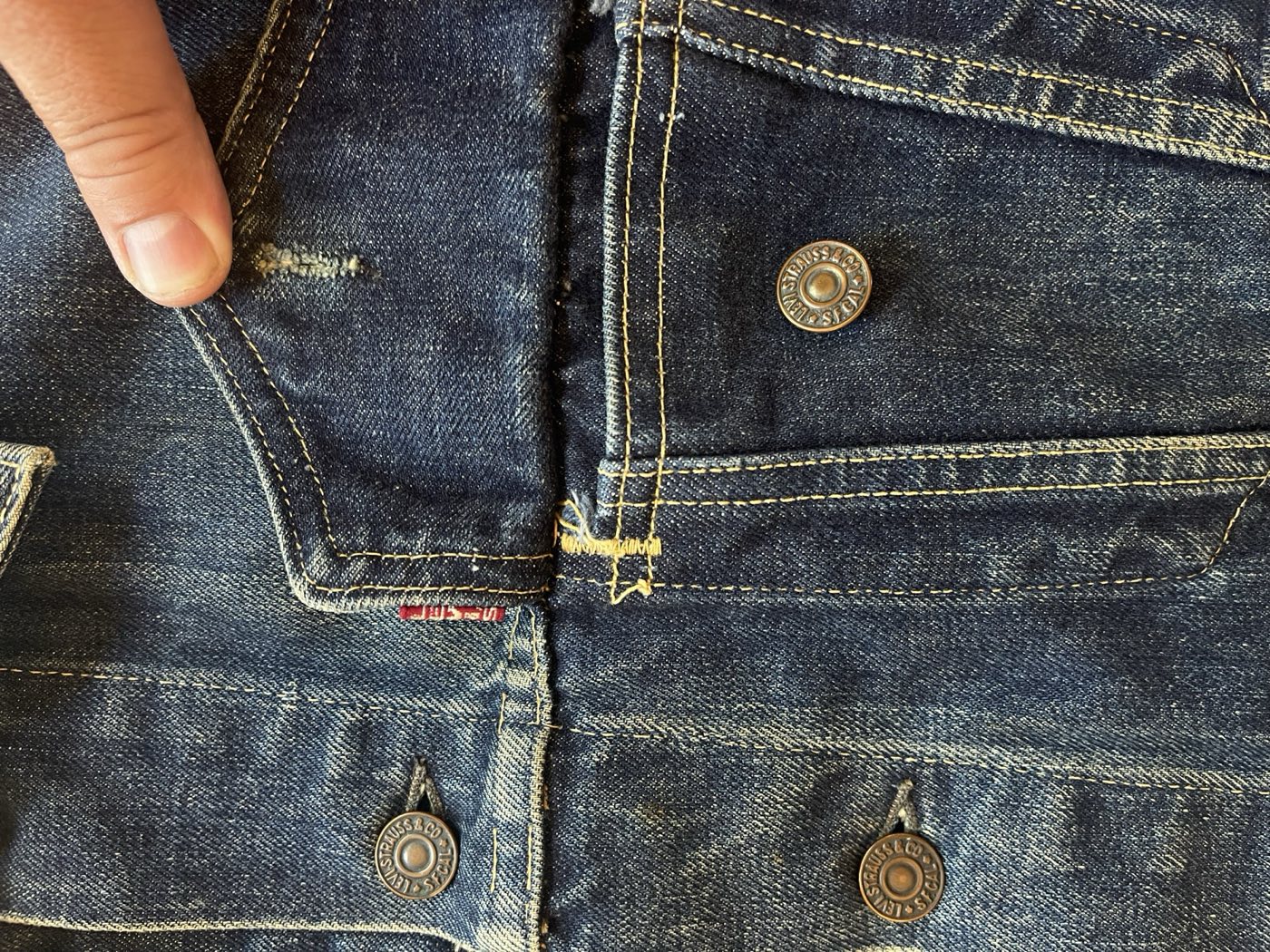
- The tab first. A red tab reading LEVI’S in capitals is a big E, made before 1971, so a big E 505 dates to the first four years, 1967 to about 1971. A small e tab means 1971 or later. An orange tab marks Levi’s fashion line, which also included 505s. The tab colors guide explains each one.
- The care label. Levi’s added care labels in 1971, so a genuine big E 505 almost never has one. Through the 1970s and 1980s the label ends in a short code with the month, the last digit of the year, and a factory number; from 1993 it prints the month and year in full. The date codes guide walks through it.
- The cuff seam. Turn up a leg. A red and white line along the finished edge is redline selvedge, which Levi’s used into the early to mid-1980s. A plain overlocked seam points later.
- The style number. Vintage 505s carry 505 followed by a four-digit fabric or finish code, and 505-0217 is the one seen most on 1970s pairs. Later care labels show a five-digit form such as 20505. Sources disagree on exactly what each finish code means, so read it as a style check, not a date.
- The top button. On pairs made before 1971 the back of the button carries no number or one or two digits. Three digits point to a later pair or a reproduction.
Does a Talon zipper mean my 505 is old?
Not on its own. Talon 42 zippers turn up on many 1960s and 1970s 505s, and collectors note them, but Levi’s builds its modern 1967 505 reproduction with a Talon zipper too. Read the zipper together with the tab, the care label, the cuff seam, and the button. If all of them agree, the zipper supports the date. If the zipper is the only old-looking detail, it proves nothing.
How do I tell a real big E 505 from the 1967 505 reproduction?
Levi’s Vintage Clothing sells a 1967 505 with a capital E tab, selvedge denim, and a Talon zipper, at $260 list when we read it in October 2026, and used ones turn up described as vintage. The reproduction gives itself away inside: it carries a modern sewn care and fiber label, often with a barcode and a country of origin, and usually a Levi’s Vintage Clothing label in the waistband. A genuine 1967 to 1971 pair has no care label at all. The reproduction guide covers the other tells.
Are orange tab 505s worth anything?
Yes, modestly. Levi’s introduced the orange tab in 1969 for its fashion fits and made it until 1999, and many 1970s and 1980s 505s wear one. In October 2026 listings, worn Made in USA orange tab 505s sat in the same band as plain red tab pairs of those years, about $25 to $150, with one eBay pair selling for $34. An orange tab made from 1969 to 1971 reads LEVI’S in capitals, and those early pairs are worth checking carefully.
Should I wash or repair a 505 before selling?
No. Fading, original hems, and honest wear at the knees and seat are what vintage buyers pay for, and a hot wash or a tailor’s hem can take them away for good. Shake out dust, empty the pockets, let the pair dry if it is damp, and photograph it as it is. Rips and frayed cuffs are already in the price.
The mistakes that cost money
- Assuming a zipper means modern. The 505 has been a zip-fly jean since 1967, and a big E 505 is one of the more valuable pairs that turns up in a closet.
- The opposite mistake: pricing a 505 like a 501. At the same age and condition the 505 generally sells for less, and holding out for a 501 number usually means not selling.
- Skipping the cuff seam. A small e 505 with a red line inside the cuff is worth several times a plain pair, and it takes ten seconds to check.
- Trusting a Talon zipper or a capital E alone. Levi’s own 1967 505 reproduction has both; the care label settles it.
- Cutting out the care label or hemming the legs. The label is the dating evidence, and original hems are part of the value.
- Quoting an asking price as a value. A listing at $2,000 tells you what one seller hopes, not what the pair brings.
- Trading vintage in for a gift card. Checked in August 2026, Levi’s SecondHand pays $30 in store credit for jeans more than twenty years old, whatever the pair is.
Where can I sell vintage Levi’s 505s?
You have real options. Listing a pair yourself on eBay, Poshmark, Depop, or Grailed usually brings the most per pair if you photograph it well and answer questions, after fees and shipping; the route comparison sets out each platform’s cut. Vintage shops and denim dealers pay less per pair but take a stack at once. Levi’s trade-in is quick but pays in store credit. California Vintage Buyers buys vintage Levi’s, 505s included, from every state: we look at the pairs together on a free video call, agree the price on the call, and pay through PayPal before you ship, with shipping on us. In Southern California we come to you and pay cash the same visit. We will tell you plainly which pairs are worth listing yourself and which ones we want. Start with the photo guide or the Levi’s identifier, then call or text (949) 449-1255.
Common questions
- What is a vintage Levi’s 505 worth?
- From about $25 to $600, depending on era. In marketplace and dealer listings read in October 2026, worn 1970s and 1980s Made in USA 505s without a red line ran about $25 to $150, 1970s redline selvedge 505s about $200 to $350, and big E 505s from 1967 to 1971 about $500 to $600. Those are listing prices, asking and sold mixed, and a 505 generally sells below a 501 of the same years.
- When did Levi’s make the first 505?
- Levi Strauss and Co dates the 505 to 1967. It was a zip-fly jean with a lower rise than the 501, made from preshrunk denim. A 505 with a red tab reading LEVI’S in capitals, the big E, was made in the first few years, from 1967 to about 1971.
- What is the difference between Levi’s 505 and 501?
- The 501 has a button fly and was traditionally sold to shrink to fit; the 505 has a zipper, a lower rise, a little more room in the thigh, and preshrunk denim. Both carry the same tabs and dating details. Among vintage pairs the 501 is the collector’s jean and usually brings more at the same age and condition.
- How can I tell if my Levi’s 505 is a reproduction?
- Look inside. Levi’s modern 1967 505 reproduction has a capital E tab, selvedge, and a Talon zipper, but it carries a modern sewn care label, often with a barcode, and usually a Levi’s Vintage Clothing label. A genuine big E 505 from 1967 to 1971 has no care label at all, because Levi’s added them in 1971.
Have something like this?
One phone call and we come to you, anywhere in Southern California. Free visit, honest evaluation, cash the same day.
Keep reading
- Are Old Levi’s 501s Worth Anything? Real 2026 Prices→
- Big E Levi’s: What the Capital E Means and What They Are Worth→
- Levi’s Tab Colors: What Orange, Silver, White, Black, and Blank Tabs Mean→
- Made in USA Levi’s: What 1980s and 1990s American-Made Levi’s Are Worth→
- Is My Levi’s Jacket or 501 an Original or a Levi’s Vintage Clothing Reproduction?→
- Where to Sell Old and Vintage Levi’s Jeans From Any State (2026)→
- Sell vintage Levi’s to people who know what they’re holding.→